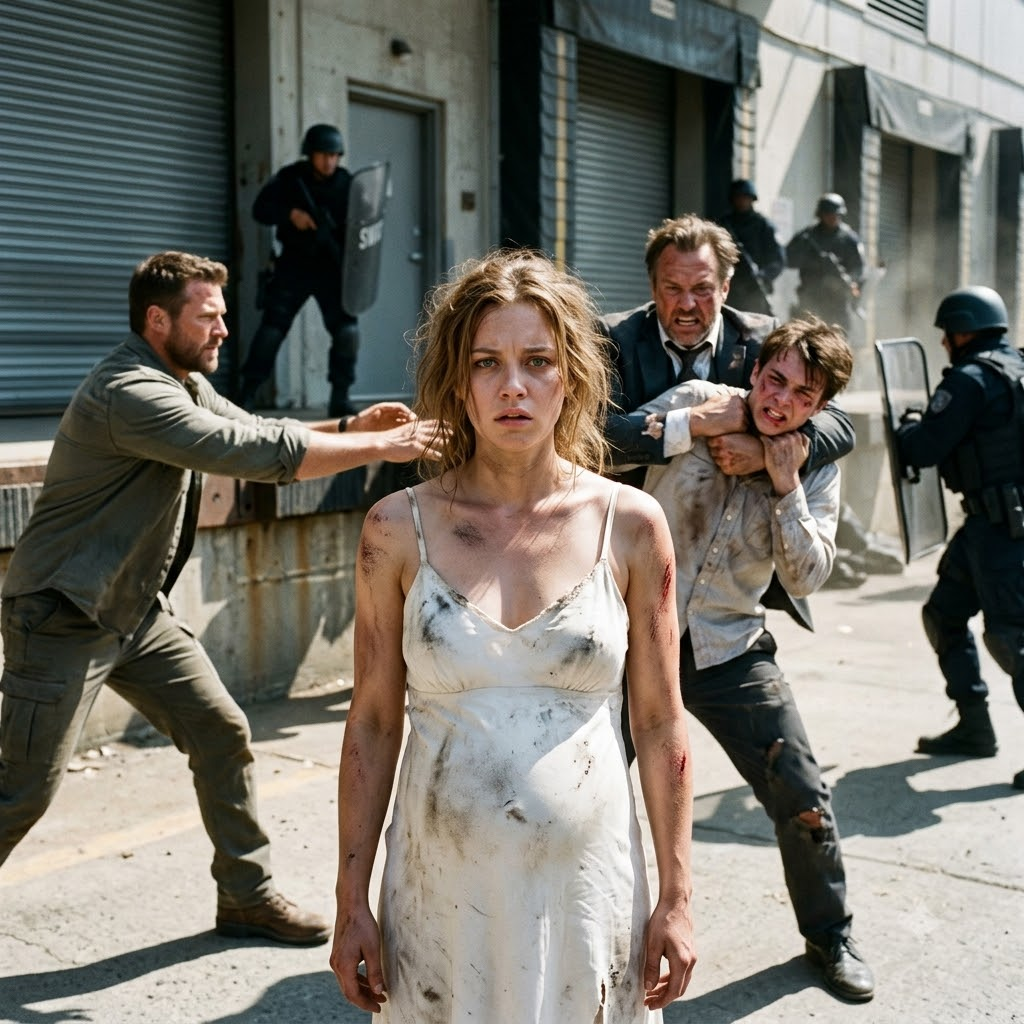
The metallic click inside Rebecca Vale's handbag was the sound of a lock opening.
Not a gun.
Not a weapon.
A small steel medical case.
Rebecca stood on the loading dock of Warehouse Seventeen, trembling as she lifted it from her bag.
Two investigators immediately stepped closer.
"Ma'am, put that on the ground."
Rebecca obeyed.
Her eyes never left mine.
"Lauren, I should have told you everything seventeen months ago."
I stared at her.
"You should have told me before my father died."
Tears ran down her cheeks.
"Yes."
Eleanor Hail stood beside me, her hand still resting lightly on my wrist.
For thirty-one years, I had lived without knowing she was my biological mother.
For seventeen months, I had mourned a father whose death had been arranged by people he trusted.
For eleven months, I had loved a man who intended to steal my inheritance and claim a child who wasn't his.
And now the woman who had helped destroy my family was standing before me with a second syringe.
I looked at the steel case.
"Open it."
An investigator examined it first.
Then, with Rebecca's permission, he released the latch.
Inside were two sealed evidence sleeves.
One contained an empty syringe.
The other held a small medication vial, a handwritten label, and a folded hospital record.
Rebecca covered her mouth.
"The syringe in the video was the one Cross ordered me to use."
My stomach tightened.
"And the second?"
She looked at me.
"The second contained the medication your father was actually supposed to receive."
I stared at her.
"Then why didn't you give it to him?"
Rebecca began crying harder.
"Because by the time I understood what Cross had done, Arthur was already dying."
The loading dock seemed to tilt beneath my feet.
I gripped the edge of the ambulance.
"Tell me everything."
Rebecca nodded.
And for the first time, she did.
"Arthur knew his treatment records had been altered," Rebecca said. "He had asked Jace to remove the original authorization because he believed Cross was planning to administer an experimental compound."
I looked at Jace.
He sat beside the ambulance, pale and exhausted.
His eyes met mine.
Rebecca continued.
"Cross told me Arthur needed an emergency injection. He showed me a medical order. He said the supervising physician had approved it."
"You believed him?"
"I knew he was involved in the research. I knew he had lied before. But I didn't understand what he was asking me to do."
I stared at her.
"You had accepted money from Maddox Global."
Her face crumpled.
"Yes."
"Three million dollars."
"Yes."
"And you signed the payment authorization connected to my father's final treatment."
She lowered her head.
"Yes."
My voice shook.
"Then don't tell me you were innocent."
Rebecca looked up.
"I'm not."
The answer surprised me.
She didn't defend herself.
Didn't blame Colton.
Didn't tell me she had only been trying to protect me.
She simply stood there, accepting what she had done.
"I helped hide records," she said. "I signed documents I knew were misleading. I accepted money to keep quiet about the research. And when Cross gave me that syringe, I was too frightened to challenge him."
I swallowed.
"What happened after you administered it?"
"Arthur became distressed almost immediately. His breathing changed. Cross told me it was his heart condition."
She wiped her eyes.
"I went to the medication cabinet and found the original treatment vial. The labels didn't match."
My heart pounded.
"So you knew."
"Then, yes."
"And you called for help?"
"I did. I called the supervising physician and demanded a response team. But Cross intercepted the call. By the time another doctor arrived, Arthur was unconscious."
I looked toward the evidence case.
"Why keep the second syringe?"
"Because I knew someone would eventually ask what he was supposed to receive. I kept the original medication and its packaging, along with the unused syringe prepared for it."
She looked directly at me.
"I should have gone to the police that night."
"Yes," I whispered.
"I was afraid Colton would kill me."
I thought of Adrian's staged death.
Simon's injuries.
Jace bleeding on the floor.
Cross firing from the warehouse platform.
I believed she had been afraid.
But fear did not erase what she had done.
I stepped back.
"Give the investigators everything."
Rebecca nodded.
"I already agreed to."
Then she held out the envelope bearing my father's handwriting.
"Arthur wanted you to have this."
I didn't open the envelope immediately.
An investigator photographed it and documented its condition before allowing me to read a copy.
Inside was a letter.
Three pages.
Written in my father's unmistakable handwriting.
My fingers trembled as I held them.
My dearest Lauren,
If you are reading this, then the people I trusted have finally forced you to confront the mistakes I spent too long trying to correct.
Tears blurred the words.
I wiped my eyes and continued.
You were born Evelyn Hail. Your mother was Eleanor. The circumstances of your birth placed you in danger because men involved in the research program believed your biological inheritance could help them claim ownership of discoveries that never belonged to them.
I allowed your identity to be changed after Eleanor disappeared. I told myself it was necessary to keep you alive. I also told myself that I would explain everything when you were old enough.
I waited too long.
I stopped reading.
Eleanor began crying beside me.
I looked at her.
"He knew you were alive?"
She nodded slowly.
"Eventually. But Richard Maddox controlled the information that reached us. Arthur believed I was under surveillance and that contacting me would expose you."
I looked back at the letter.
The research began with mineral-processing technology. It should have remained a study of how to extract rare-earth elements more safely and efficiently. Instead, Cross and his financial partners expanded it into unauthorized human biological research.
They claimed certain inherited characteristics could predict tolerance to industrial exposure. Their evidence was incomplete, their methods were unethical, and their conclusions were exaggerated.
I helped finance the original work. I cannot pretend otherwise.
When I discovered what was happening, I should have stopped it immediately. Instead, I spent years trying to repair the damage quietly.
My chest tightened.
Dad hadn't been an innocent bystander.
He had helped create the circumstances that destroyed so many lives.
But he had eventually tried to expose them.
I continued reading.
The mine itself is valuable. Its minerals are real. Its workers deserve honest leadership. But the research data does not give anyone ownership of a human being.
Not you.
Not your mother.
Not your children.
No matter what documents they produce, your body and your future are not corporate assets.
I pressed the letter against my chest.
For the first time since discovering the blood-red folder, I felt I could breathe.
Then I read the final paragraph.
I have changed the trust to protect you from anyone who attempts to gain control through marriage, guardianship, or parentage. I have also created a fund for those harmed by the research.
You may choose to keep the mine, sell it, or walk away from it entirely.
The fortune is yours to decide about.
But your freedom was always yours.
Love, Dad.
I closed my eyes.
And cried.
The next several hours belonged to investigators, doctors, and attorneys.
Rebecca gave a recorded statement.
The original medication, the syringe, and the hospital records were secured for forensic examination.
Cross survived his injuries and was placed under guard.
Colton remained in custody.
Derek was detained during the warehouse operation.
Marcus Vane, already cooperating with investigators, provided additional records concerning the security breaches and the planned attack on Jace.
Simon Reed was taken to the hospital.
His injuries were painful, but not life-threatening.
Adrian was treated for bruises, dehydration, and a concussion.
And Jace—
Jace nearly collapsed trying to stand.
I caught his arm.
"That's it."
He looked at me.
"What?"
"You're going back to the hospital."
"Lauren—"
"No."
He sighed.
"I was hoping you'd forgotten."
"You have a gunshot wound."
"A healing gunshot wound."
"Jace."
He studied my face.
Then raised both hands slightly.
"All right."
I looked at the paramedic.
"Please take him before he changes his mind."
The paramedic smiled.
"Gladly."
As they helped Jace onto the stretcher, he caught my hand.
"Lauren."
I looked at him.
"I'm sorry I didn't tell you everything sooner."
I swallowed.
"I know."
He waited.
I took a breath.
"I don't know what happens between us."
His expression softened.
"Neither do I."
"But I want you to recover."
A faint smile touched his lips.
"That's a reasonable beginning."
I squeezed his hand.
Then let him go.
Three days later, I visited Adrian Mercer.
He was sitting beside a hospital window, wearing a blue sweater and holding a cup of coffee.
For a moment, he looked exactly as he had before the plane crash.
Then he turned.
And I saw the changes.
The scar near his temple.
The exhaustion around his eyes.
The way he watched the door before looking back at me.
Two years of hiding had left marks no doctor could remove.
"Sunshine," he said softly.
I smiled through sudden tears.
"Hello, Adrian."
He stood.
We looked at each other.
Then he opened his arms.
I stepped into them.
For a long time, neither of us spoke.
I had imagined this moment during the worst months of my grief.
I had imagined him walking through a door.
Telling me the crash had been a mistake.
Telling me we could return to the life we'd planned.
But the woman holding him now wasn't the woman who had lost him.
And he wasn't the same man.
Eventually, I stepped back.
"We need to talk."
He nodded.
"I know."
We sat beside the window.
I told him everything I remembered about Connecticut.
The clinic.
The medication.
The missing hours.
Colton's reaction when I discovered the pregnancy.
Adrian listened without interrupting.
When I finished, his eyes were wet.
"I never authorized them to use my stored material for that purpose."
"I know."
"I didn't even know they still had it."
I looked down.
"The records suggest they used an embryo created years earlier."
He nodded.
"The investigators told me."
I placed a hand over my stomach.
"An independent laboratory is reviewing the original samples and arranging further testing through my medical team."
Adrian looked at me.
"And if the results confirm I'm the father?"
I met his eyes.
"Then I want our child to know you."
He swallowed.
"Lauren, I don't expect us to pretend the last two years didn't happen."
"Good."
He smiled sadly.
"Because they did."
I nodded.
"We can't go backward."
"No."
"But we can decide what happens next."
He looked at my stomach.
"Can I ask something?"
"Of course."
"Are you happy about the baby?"
My eyes filled.
"Yes."
He exhaled.
"Then that's where I'd like to begin."
Six weeks later, the independent testing confirmed Adrian's biological paternity.
The results were reviewed by specialists who had no connection to Cross, Colton, or the original research program.
They also confirmed that the Connecticut clinic's records contained serious consent irregularities.
The investigation into the unauthorized procedure continued separately from the paternity determination.
I met with Dr. Bennett to discuss what the findings meant for my pregnancy.
She sat across from me in her office.
"Your baby is developing normally," she said.
I smiled.
"That's all I wanted to hear."
She returned the smile.
"And I want you to understand something else. The circumstances surrounding the pregnancy do not determine what kind of mother you will be."
I looked down at the ultrasound photograph.
A tiny face.
A curved hand.
A heartbeat that had become the most beautiful sound in the world.
"I know."
And I did.
I loved my baby before I knew the truth.
I loved my baby after learning it.
Nothing Colton had done could change that.
The legal proceedings took longer.
There were hearings.
Expert reports.
Witness interviews.
Financial audits.
And thousands of pages of documents.
Margaret Ellison led the effort to defend my interests in the estate.
The court rejected Colton's attempt to use the disputed identity records as a basis for taking control of Hail Mineral Holdings.
The forged psychiatric assessments were discredited.
My legal identity and my father's intent were established through authenticated records, including his final trust amendment.
The emergency restrictions on the trust were lifted after the court was satisfied that appropriate safeguards were in place.
Jace's role as emergency successor trustee ended when the independent trustees confirmed I could exercise my rights without the restrictions Colton had sought.
That mattered to me.
I didn't want Jace controlling my inheritance.
I didn't want Adrian controlling it.
I didn't want Eleanor controlling it.
I wanted a team of accountable professionals helping me make decisions that were mine.
Margaret helped me appoint them.
Colton's criminal case was separate.
The recordings, payment records, witness statements, and communications recovered from Cross's drive established the conspiracy behind my father's unauthorized treatment.
Rebecca's testimony was supported by the original medication records and the preserved hospital footage.
Cross had directed the administration of the experimental compound.
Colton had authorized payments and participated in communications showing that he knew Arthur was being pressured through his medical care.
A forensic review found that the compound had materially contributed to my father's death.
The investigation also uncovered the scheme involving the Connecticut clinic, the falsified psychiatric reports, and the planned transfer of the mine.
Colton's attorneys challenged nearly everything.
They questioned the recordings.
The witnesses.
The laboratory findings.
The trust.
My credibility.
But this time, I wasn't standing alone.
Simon testified.
Adrian testified.
Jace testified.
Michael Rowan explained the research archive and the altered records.
Eleanor authenticated the documents she had signed and described how Richard Maddox had separated her from her children.
And Rebecca testified about the hospital room.
She did not escape accountability.
Her cooperation helped establish the truth, but she still faced charges for her role in the financial concealment and medical-record conspiracy.
When she apologized to me in court, I listened.
Then I told her:
"I believe you're sorry. But my father is still dead."
She lowered her head.
I didn't forgive her that day.
I wasn't required to.
The trial lasted months.
By the time the verdict was read, I was holding my daughter in my arms.
Colton was convicted of multiple offenses arising from the conspiracy, coercion, financial fraud, and my father's death.
Cross was convicted in a separate proceeding for his role in the unauthorized medical treatment and related crimes.
Derek faced consequences for his participation in the kidnappings and threats.
Marcus received a reduced sentence after his cooperation was considered, but he was not excused for helping Colton breach Jace's security.
Rebecca accepted responsibility through a negotiated resolution that included testimony, restitution, and a custodial sentence.
The civil proceedings recovered assets diverted from the research program and returned funds to the trust and the people harmed by the scheme.
I sat in the courtroom while Colton listened to the verdict.
He looked older.
His hair was no longer perfectly arranged.
His face had lost the smooth confidence I remembered.
When the judge finished, Colton turned toward me.
For one moment, our eyes met.
I expected anger.
A threat.
One last attempt to make me afraid.
Instead, he looked at the baby sleeping against my chest.
Then he looked away.
He had wanted to claim her.
Use her.
Turn her into a legal key to my father's fortune.
Now she was safe in my arms.
And he had no claim over her.
My daughter's name was Grace Evelyn Hail-Mercer.
Grace, because she had survived a beginning she never should have been forced to endure.
Evelyn, because the name that had once been taken from me deserved to become part of our family's future.
And Hail-Mercer, because Adrian and I wanted her to know both sides of her story.
She was born on a rainy Tuesday morning.
Dr. Bennett stood beside the delivery team.
Adrian held my hand.
Eleanor waited outside with Margaret.
When Grace finally cried, I began crying too.
The nurse placed her against my chest.
She was warm.
Tiny.
Perfect.
Her fingers curled around mine.
I looked down at her.
"Hello, sweetheart."
The words came naturally.
The same words my father had used in his final recording.
Adrian leaned closer.
His eyes were wet.
"She's beautiful."
I smiled.
"She is."
He kissed my forehead.
And for the first time in a very long time, the future didn't feel like something someone else had written for me.
A year after Grace's birth, I returned to Montana.
The Hail mine stretched across the valley beneath a wide blue sky.
I stood on the observation platform wearing jeans, boots, and a simple white shirt.
Grace sat on Adrian's hip.
Eleanor stood beside us.
Jace had come for the opening of the new research and safety center.
He had recovered from the shooting, although he still moved carefully when he was tired.
Our friendship had survived the difficult conversations that followed the warehouse.
I had told him I couldn't build a future on gratitude or rescue.
He had agreed.
Over time, we learned to trust each other without promises we weren't ready to make.
He became someone I could call for advice.
Someone who respected my decisions.
Someone who understood that helping me didn't make him entitled to my life.
And that was enough.
The mine itself had changed.
I hadn't sold it.
Not because I needed the money.
But because thousands of people depended on its future.
We established independent environmental oversight, strengthened worker protections, and separated the legitimate mineral-processing research from the unethical biological program.
The remaining human research records were transferred to authorized investigators and independent reviewers under appropriate privacy safeguards.
No one would be permitted to use them as commercial property.
The compensation fund my father had started was expanded.
Former research participants and their families received access to independent medical evaluations, counseling, and financial support.
Michael Rowan helped investigators reconstruct the original program and later contributed to a public report explaining how the failures had occurred.
Simon Reed returned to work after recovering from his injuries, eventually becoming a specialist in medical-record integrity.
I offered him a position overseeing the mine's new document-protection program.
He accepted.
Then asked for one condition.
"No billionaire gets to override the records."
I laughed.
"Agreed."
That afternoon, we opened the Arthur Hail Center for Research Ethics and Worker Safety.
I stood before the employees, families, and community leaders gathered outside.
A microphone waited in front of me.
For a moment, I thought about my father.
His mistakes.
His secrecy.
His final efforts to make things right.
I had spent so long trying to decide whether he was a good man or a bad one.
Eventually, I understood that the answer wasn't simple.
He had made terrible choices.
He had also loved me.
Both things were true.
I stepped toward the microphone.
"My father built this company," I began. "He also allowed research to continue long after he should have stopped it."
The crowd was quiet.
"I won't ask anyone to forget that."
I looked toward the workers.
"But I believe we can honor the people harmed by the past through what we choose to do now."
I took a breath.
"This center exists to make sure that no discovery, no profit, and no executive decision is ever treated as more important than a human life."
Applause rose across the platform.
I looked at Grace.
She was clapping because everyone else was.
Adrian laughed.
And I laughed with him.
That evening, Eleanor and I walked through my father's old house.
The furniture had been restored.
The curtains were open.
Sunlight filled the rooms.
For years, I had thought of this place as a monument to everything I had lost.
Now it felt different.
A home.
Eleanor stopped beside a photograph of my father.
"He loved you very much."
I looked at the picture.
"I know."
She wiped her eyes.
"I wish I could have been there when you were little."
I turned toward her.
"So do I."
She looked at me.
"I'm sorry I wasn't."
I took her hand.
"We can't get those years back."
She nodded.
"But Grace has you now."
Eleanor began crying.
I hugged her.
For the first time, it didn't feel like embracing a stranger.
It felt like embracing my mother.
We stood together until Grace called from the next room.
"Grandma!"
Eleanor laughed through her tears.
"Coming, sweetheart."
And she went.
Later that night, Adrian found me on the back porch.
The Montana sky was full of stars.
Grace was asleep upstairs.
The house was quiet.
He handed me a cup of tea.
"Thinking?"
"Always."
He sat beside me.
For a while, we watched the mountains.
Then he said, "I found something in an old box."
I looked at him.
He reached into his pocket.
My heart tightened when I saw the silver watch.
The one I had given him before the crash.
He had repaired the scratched face.
The inscription on the back was still there.
For all the time we haven't had yet.
I smiled sadly.
"I remember buying that."
"You told me I was always late."
"You were."
"I still am."
I laughed.
He turned the watch in his hands.
"I used to think we could recover the years we lost."
I looked at him.
"And now?"
He met my eyes.
"I don't think we can."
I nodded.
"Neither do I."
He reached for my hand.
"But I think we can build something new."
I looked toward the upstairs window.
Grace's room was softly lit.
I thought about the first time I had loved Adrian.
The years I had mourned him.
The day I discovered he was alive.
And everything we had learned about each other since.
We hadn't rushed back into our old relationship.
We had gone to counseling.
Learned how to talk about the things that frightened us.
Argued.
Apologized.
Shared the ordinary exhaustion of caring for a newborn.
Slowly, we had fallen in love again.
Not with the memories.
With the people we had become.
I squeezed his hand.
"I'd like that."
He smiled.
"Good."
Then he kissed me.
Softly.
Without fear.
Without promises about fortunes or forever.
Just love.
And a future we were free to choose.
The following morning, I visited my father's grave.
I brought white roses.
Grace was with Adrian at the house.
I wanted a few minutes alone.
I knelt beside the headstone.
"Hi, Dad."
The wind moved through the grass.
I placed the flowers down.
"I finally understand why you kept telling me never to sell my freedom."
My voice trembled.
"I wish you'd told me everything while you were alive."
I looked at his name.
"But I know you were trying to fix what happened."
I wiped my eyes.
"The mine is safe. The workers are safe. The people who were hurt are finally being heard."
I smiled through tears.
"And you have a granddaughter."
I paused.
"Her name is Grace."
The wind moved gently through the trees.
"She's stubborn. You would have loved that."
I laughed softly.
Then I took the final letter from my pocket.
I had carried a copy for months.
The edges were worn.
The words familiar.
The fortune is yours to decide about.
But your freedom was always yours.
I folded the paper.
And placed it against my heart.
"Goodbye, Dad."
When I returned home, Grace was sitting on the living room rug.
Adrian was building a tower of wooden blocks.
Eleanor was laughing because Grace kept knocking it down.
Jace stood near the fireplace, talking with Simon about the new safety center.
Margaret was at the dining table, pretending not to answer work emails.
The house was filled with voices.
Warmth.
Ordinary life.
I stood in the doorway for a moment.
Then Grace saw me.
"Mama!"
She raised both arms.
I crossed the room and lifted her.
She pressed her small face against my neck.
I closed my eyes.
Once, I had run barefoot from a wedding, terrified that the man I loved would take everything from me.
I had believed the four-billion-dollar mine was the reason everyone wanted to control my life.
But the mine had never been the greatest thing my father left me.
He had left me the chance to choose.
To love without surrendering myself.
To tell the truth, even when it hurt.
To raise my daughter in a world where she would never have to earn the right to belong to herself.
Adrian walked toward us.
He slipped an arm around my waist.
"Everything okay?"
I looked at him.
Then at Grace.
Then at the people filling our home.
"Everything's okay."
He smiled.
Grace reached for his face.
"Dada!"
He laughed and kissed her tiny hand.
Outside, the mountains stood beneath the morning sun.
The mine was still there.
The fortune was still there.
But neither controlled my future.
I held my daughter close.
And for the first time in my life, I knew that nobody could steal the thing that mattered most.
My life was finally my own.






Comments 0