"Claire, don't scream. I came to finish what Melissa started."
I knew that voice.
For one terrible second, my mind refused to accept it.
Then the figure stepped into the faint light coming through our kitchen window.
"Mrs. Parker?"
Our neighbor stood just inside the back door.
Her gray hair was disheveled. Her coat hung open, and she was holding a thick envelope against her chest.
The woman who had brought us soup.
The woman who had sat beside my injured daughter.
The woman who had photographed Laura while she slept.
I backed away.
"Get out of my house."
Mrs. Parker shook her head.
"Please, Claire. You have to listen."
Behind me, Daniel shouted, "Laura, stay with Grandma!"
My mother-in-law had been in the living room when the lights went out. I heard her guiding Laura toward the front hallway.
My phone was still connected to Detective Mitchell.
"Claire?" the detective said sharply. "Who is there?"
I raised it.
"Mrs. Parker. She's inside my house."
Mrs. Parker flinched.
"No. Please don't call the police."
"They're already coming."
Her face crumpled.
Then she said something I would never forget.
"Melissa told me if I didn't finish this, she'd make sure I took the blame for everything."
I stared at her.
"Finish what?"
Mrs. Parker looked toward the envelope.
"Getting rid of the evidence."
My stomach turned.
The darkness.
The unlocked back door.
The threats.
The photographs.
Everything had led to this moment.
And the woman standing in my kitchen was still more frightened of Melissa than of what she had done to my family.
"Put the envelope on the floor," Detective Mitchell instructed through the phone.
Mrs. Parker heard her.
She looked at me.
"Claire, I didn't come to hurt Laura."
I swallowed.
"Then why did you say you came to finish what Melissa started?"
Mrs. Parker began crying.
"Because that's what she called it."
I stared at her.
"She said we had to finish cleaning up the mess."
My anger rose so suddenly that my hands stopped shaking.
"My daughter's injury is not a mess to clean up."
"I know."
"No, you don't."
Mrs. Parker lowered her head.
"You came into my home. You took photographs of my child. You gave her medical information to someone who was trying to destroy her credibility."
Tears ran down her cheeks.
"I know."
"And tonight you came through my back door."
She looked toward the hallway.
"I thought the house would be empty."
"Why?"
"Melissa said you were going to your parents' house."
I stared at her.
"She knew we were home."
Mrs. Parker nodded slowly.
"Then she lied to me again."
Daniel appeared at the kitchen entrance.
He held a flashlight.
"Claire, step away from her."
I moved toward him.
Mrs. Parker didn't follow.
Instead, she placed the envelope on the floor.
Then she raised her empty hands.
"I'll tell them everything."
Outside, sirens approached.
For the first time in weeks, the sound didn't frighten me.
It brought relief.
The officers entered through the front door after Daniel let them in.
Mrs. Parker cooperated.
They secured the house, checked the rear entrance, and documented the envelope and the scene.
The power outage turned out to be a tripped breaker in the garage electrical panel. Investigators later determined that Mrs. Parker had switched it off after entering through the unlocked patio door, hoping to retrieve a small storage device Melissa believed we kept in the kitchen.
She hadn't understood that we'd already given the original files to Detective Mitchell.
Melissa hadn't understood it either.
Or perhaps she had simply refused to believe that anyone could act without asking her permission.
The officers escorted Mrs. Parker outside.
I watched from the hallway.
She looked back once.
"Claire, I'm sorry."
I didn't answer.
There were too many apologies in this story.
Some were sincere.
Some were frightened.
Some came only after the truth became impossible to hide.
I had learned that I didn't have to decide what an apology was worth the moment someone offered it.
Detective Mitchell arrived shortly afterward.
She found Daniel and me sitting with Laura and his mother in the living room.
Laura's face was pale.
"Mom," she whispered, "is it over?"
I sat beside her.
"Mrs. Parker is with the police. We're safe right now."
My daughter looked toward the kitchen.
"Why did she come here?"
I took a breath.
"She was trying to take evidence."
Laura's eyes filled.
"About my hand?"
"Yes."
She stared at me.
Then whispered, "Why can't they just leave me alone?"
I wrapped my arms around her.
I had no answer that would make what happened acceptable.
So I told her the truth.
"They should have left you alone. And we're going to make sure they can't keep doing this."
The investigation did not end that night.
I wish it had.
I wish the moment Mrs. Parker was taken away had been the moment everything became simple.
But real consequences took time.
There were interviews.
Digital examinations.
Records requests.
Meetings with attorneys.
And more days when I looked at my phone with dread.
What changed was that we were no longer facing Melissa's threats alone.
Mrs. Parker provided investigators with her messages, the hospital recording files, and the instructions Melissa had sent her.
The private investigator who had delivered the threatening photograph was identified and questioned.
He admitted that Melissa had hired him to watch our house and collect photographs, but claimed she had misrepresented the purpose. Investigators examined his messages and the threatening delivery separately. He could no longer hide behind the excuse that he was simply doing a job.
The anonymous emails were traced through account records and devices to an email account Melissa had controlled, with several messages prepared using information Rachel had supplied before she began cooperating.
That explained why the sender knew about Evan's video.
Melissa had learned Evan was recording before Christmas because Rachel had told her.
It also explained why the threats had become more specific whenever another piece of evidence emerged.
Melissa wasn't predicting what we would discover.
She was reacting to what she already knew.
The altered notebook image had been created using photographs Rachel took of Laura's private writing. The added sentence was Melissa's.
Daniel's signature on the false complaint had been copied from an old family document.
Mine had been copied from paperwork Mrs. Parker photographed in our kitchen.
The hospital's original records remained intact, and the false correction request was preserved as evidence of an attempted deception.
Every document Melissa had tried to use against us had become another reason investigators questioned her account.
The most difficult revelation concerned the months before Christmas.
My mother finally told Detective Mitchell everything she knew.
Last summer, she had seen Rachel corner Laura outside the boxing academy.
Laura had been crying.
Rachel had been holding her gym bag.
My mother intervened, and Rachel claimed they were only arguing.
When Laura refused to explain, Mom accepted Rachel's version.
Later, she urged Laura to keep boxing because she thought the sport might help her become more confident.
That was why she appeared in the photograph Evan had shown us.
She hadn't planned the Christmas attack.
But she had seen enough to know Laura was frightened of Rachel.
And she had chosen silence.
My mother told me this herself.
We were sitting at her kitchen table.
The same table where she'd spent years asking me to keep the peace.
"I thought I was preventing another family argument," she said.
I looked at her.
"You were leaving Laura alone with it."
Tears filled her eyes.
"I know."
I waited.
She didn't offer an excuse.
"I was wrong, Claire."
I swallowed.
"For a long time, I thought you loved Rachel more."
Mom began crying.
"I loved the idea that everything in our family was fine."
I stared at her.
She wiped her cheeks.
"And I let that matter more than what was happening to your daughter."
It was the most honest thing she'd ever said to me.
I couldn't give her back the years we'd lost.
But I could recognize that she was finally taking responsibility for them.
The evidence concerning Christmas became clearer as well.
Rachel had planned to hurt Laura.
Melissa had known about the threats.
She had encouraged Rachel's resentment, helped arrange the circumstances that placed Laura near the tree, and prepared the accident story afterward.
Evan had been manipulated into recording part of the gathering without knowing the full plan. His messages, the original video, and his cooperation helped establish what he'd been told and what he'd actually done.
The black stilettos were recovered.
The recordings from my parents' house were preserved.
The statements from Coach Marcus, Evan, Rachel, and other witnesses were compared against the physical evidence.
Melissa's attempt to remove the original security drive had not erased the copies my father had already made.
And the hospital recording, once examined in full, confirmed that Daniel had been trying to ensure Laura's injury was documented accurately.
He hadn't altered anything.
He had been protecting our daughter.
The person Melissa tried hardest to discredit was the person who had been telling the truth all along.
Several months later, the legal process reached a point where we finally had some answers.
Rachel's case was handled through the juvenile system.
Because she had admitted deliberately injuring Laura, cooperated with investigators, and provided substantial evidence, the court considered both the seriousness of the harm and her age.
She was required to participate in structured counseling, comply with supervision and other court-ordered conditions, and make restitution as directed.
There were restrictions on contacting Laura.
Rachel was not permitted to use an apology as an excuse to approach my daughter.
Her future would not be destroyed by one courtroom appearance.
But neither would she be allowed to pretend that what she had done was a harmless mistake.
Melissa faced separate criminal proceedings involving the planning and concealment of the assault, forged documents, intimidation, and other conduct supported by the evidence.
She eventually entered a plea agreement that included a custodial sentence, probationary supervision after release, restitution obligations, and restrictions on contacting or harassing our family.
Mrs. Parker also faced consequences for her actions. Her cooperation was considered, but it did not erase the unauthorized access to our home or her role in the attempts to obtain and misuse Laura's information.
The private investigator's conduct was addressed through the appropriate legal process.
I didn't celebrate anyone being punished.
There was nothing joyful about watching my sister stand in a courtroom and finally hear the consequences of her choices.
But when the judge spoke about the seriousness of targeting an injured child and interfering with efforts to establish the truth, I felt something settle inside me.
For once, the conversation wasn't about Melissa's reputation.
It was about what she had done.
Rachel wrote Laura another letter after her case was resolved.
This time, the letter was shorter.
She didn't ask for forgiveness.
She didn't ask for a visit.
She wrote that she was attending counseling, that she was learning to recognize jealousy before turning it into cruelty, and that she understood Laura might never want a relationship with her.
At the bottom, she wrote:
I hope you get to do everything you still dream about, whether that includes boxing or something else. I'm sorry I tried to take that choice away from you.
Laura read the letter at our kitchen table.
Then she folded it.
"Mom?"
"Yes?"
"I don't want to write back."
I nodded.
"You don't have to."
She looked relieved.
Then she said, "I hope she gets better."
I smiled gently.
"That's kind of you."
Laura looked down at her hand.
"But I still don't want to see her."
"That's okay."
My daughter nodded.
Then she placed the letter in a drawer and went upstairs to finish her homework.
It wasn't a dramatic reconciliation.
It was something better for Laura.
A decision she made for herself.
Her recovery continued slowly.
There were days when the pain was manageable.
And days when it wasn't.
There were exercises she hated.
Appointments she dreaded.
Small improvements that felt enormous.
And setbacks that left her crying in frustration.
Dr. Whitaker never promised that her hand would return to exactly the way it had been before Christmas.
He explained what the healing process showed, what remained uncertain, and which activities were safe to resume.
Laura learned to measure progress differently.
At first, she celebrated being able to hold a pencil comfortably for longer.
Then fastening a zipper.
Then turning a door handle without sharp pain.
Eventually, she could manage more of her daily activities with less assistance.
Some stiffness remained.
Her grip wasn't what it used to be.
And returning to competitive boxing required far more than simply wanting it badly enough.
But Laura didn't stop loving the gym.
Coach Marcus welcomed her every week.
She helped younger students with footwork, balance, and defensive positioning.
She watched training sessions and learned how to explain techniques.
One afternoon, I arrived early and found her standing beside a little girl who couldn't have been more than nine.
The girl was frustrated.
"I keep messing up," she complained.
Laura smiled.
"That's what practice is for."
The little girl looked at her.
"But you're good at this."
Laura laughed.
"I wasn't always."
Then she demonstrated the movement slowly, keeping her injured hand protected.
The girl tried again.
This time, she got it.
Her face lit up.
Laura clapped.
I stood in the doorway, watching my daughter encourage someone else to keep trying.
And I realized she had found another way to be strong.
The following spring, Bennett Boxing Academy held its annual youth awards evening.
Marcus invited our entire family.
Laura assumed she was going to help hand out certificates.
She wore a navy dress and comfortable shoes.
Her hair was tied back.
Her injured hand was no longer constantly supported, though she still followed restrictions and sometimes wore a brace for particular activities.
Daniel and I sat in the front row.
My parents sat beside us.
The gym was full of families.
Children laughed.
Parents took photographs.
Coaches moved between tables.
Everything felt ordinary.
Beautifully ordinary.
Then Marcus stepped onto the small stage.
"Before we finish tonight," he said, "there's one more award."
Laura looked at me.
I shrugged.
Marcus smiled.
"This year, we wanted to recognize someone who reminded us that being part of a team isn't only about competing."
My heart tightened.
He continued.
"It's about patience. Leadership. Encouragement. And showing up for other people, even when life becomes difficult."
Laura slowly turned toward him.
Marcus held up a small plaque.
"The Bennett Boxing Academy Youth Leadership Award goes to Laura Bennett."
For a moment, my daughter didn't move.
Then the gym erupted in applause.
Laura stared at Marcus.
"Me?"
He laughed.
"Yes, you."
Daniel stood first.
Then my father.
Then my mother.
I was crying before Laura even reached the stage.
Marcus handed her the plaque.
She held it carefully.
Then looked toward us.
Her smile was enormous.
Not because someone had finally declared her better than Rachel.
Not because she'd proven anything to Melissa.
But because she was being recognized for the person she had become.
After the ceremony, Laura came running toward us.
Not quite as quickly as she used to.
But with the same excitement I'd seen when she won her first boxing medal.
"Mom!"
I opened my arms.
She hugged me.
"Did you know?"
I laughed through tears.
"No!"
She turned toward Daniel.
"Dad?"
He raised his hands.
"I had no idea."
Laura laughed.
Then my father stepped forward.
"I'm proud of you, sweetheart."
She smiled.
"Thanks, Grandpa."
My mother reached for her hand, then paused.
"May I?"
Laura nodded.
Mom held it gently.
"I'm proud of you too."
My daughter smiled.
And this time, there was no hesitation.
No fear that Grandma was only saying it because Rachel wasn't there.
Just a grandmother celebrating her granddaughter.
Later, as we walked toward the parking lot, Laura looked at the plaque.
"Mom?"
"Yes?"
"I still want to compete someday."
I smiled.
"I know."
"But if I can't..."
She paused.
I waited.
Then she looked up.
"I think I'll be okay."
My throat tightened.
I put an arm around her shoulders.
"I think you will too."
By the time another Christmas approached, our family had changed.
My parents no longer hosted gatherings simply because tradition demanded them.
They asked who felt comfortable attending.
They respected boundaries.
They stopped treating silence as proof that everyone was happy.
Rachel remained in counseling and continued complying with her court-ordered requirements. She lived with appropriate family support and had begun rebuilding her life through school, therapy, and accountability.
My parents maintained a relationship with her.
Laura knew that.
And she was okay with it.
She didn't have to participate.
Melissa remained responsible for the consequences of her choices.
She sent one letter through the approved legal channel.
I read it privately.
For the first time, she acknowledged that protecting Rachel from every consequence had helped turn her daughter into someone capable of hurting another person.
She admitted that she'd been more afraid of losing her image as a successful mother than of facing the truth.
I didn't know whether that understanding would last.
I hoped it would.
But my life no longer depended on Melissa changing.
I placed the letter in a folder and returned to the kitchen, where Laura was helping Daniel make cookies.
That was where I wanted to be.
On Christmas Eve, we gathered at our house.
Just the people Laura wanted there.
Daniel.
My parents.
His mother.
Coach Marcus stopped by briefly with a card from the gym.
There were no arguments about who had been excluded.
No demands for reconciliation.
No speeches about family loyalty.
We ate dinner.
We laughed.
We exchanged gifts.
And for the first time in years, Laura wasn't watching the room to see whether someone was about to embarrass her.
After dinner, she brought me a small package.
"Mom, this is for you."
I smiled.
"You already gave me a present."
"I know. This one's different."
I opened it.
Inside was a framed photograph.
Laura stood in the gym, holding her leadership plaque.
Her smile was bright.
On the back, she'd written a message.
Thank you for believing me when I was scared.
My eyes filled immediately.
"Laura..."
She hugged me.
"I know you always believed me, Mom."
I held her tightly.
Then she whispered, "But thank you for making everybody else listen."
I closed my eyes.
For months, I had wondered whether I'd done enough.
Whether I should have noticed Rachel's cruelty sooner.
Whether I could have prevented Christmas.
Some of those questions would stay with me.
But I knew one thing.
When Laura needed me, I had chosen her safety over everyone else's comfort.
And I would make that choice again.
Later that night, after the guests had gone home, Laura sat beside the Christmas tree.
The lights reflected in the ornaments.
A small pile of presents remained beneath the branches.
I stood in the doorway.
For a moment, I remembered another Christmas.
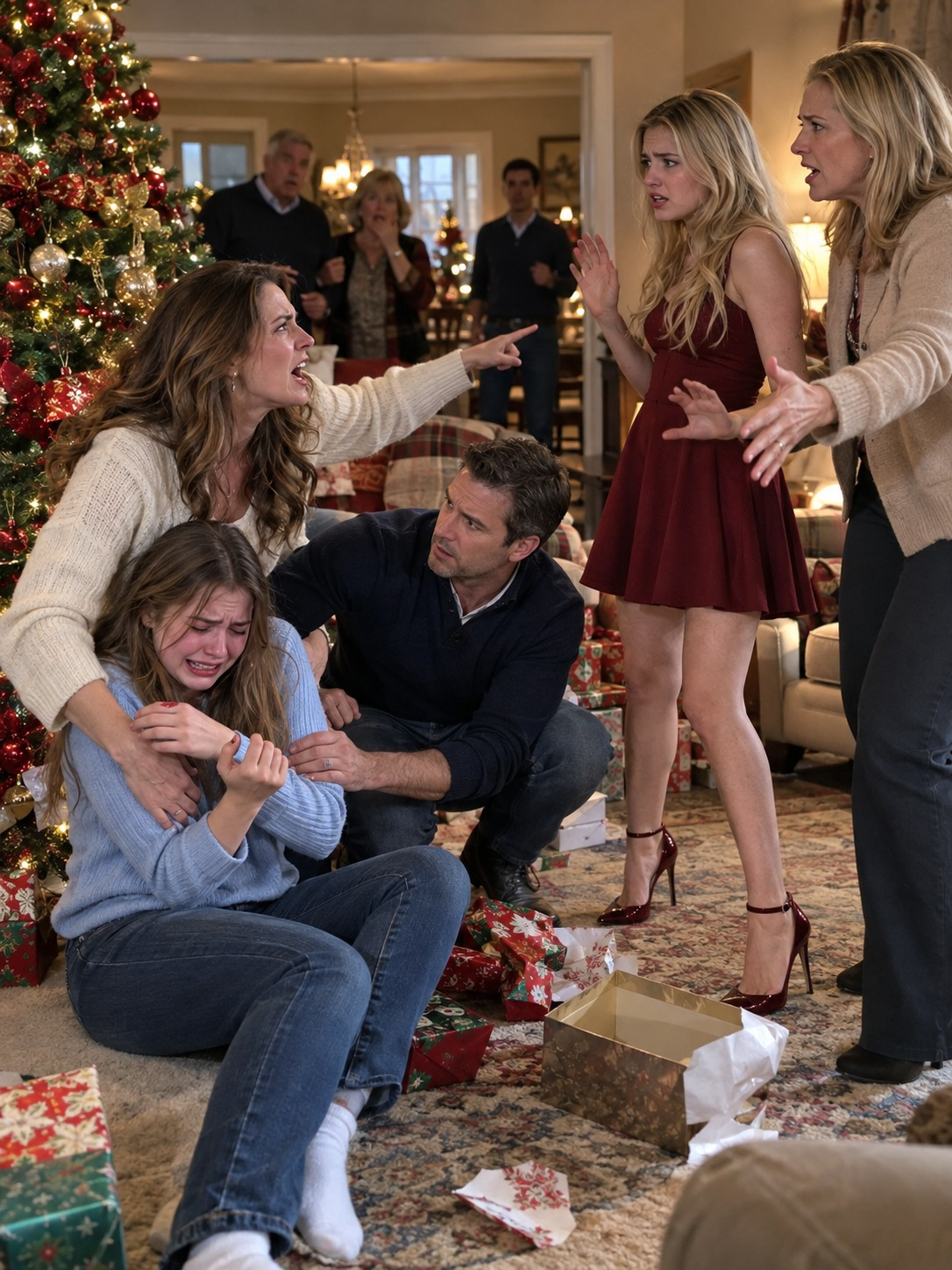
The scream.
The black heel.
The blood on the wrapping paper.
The fear in my daughter's eyes.
Then Laura looked up.
"Mom?"
I blinked.
"Yes, sweetheart?"
"Come sit with me."
I crossed the room.
She moved closer as I sat beside her.
For a while, we watched the lights.
Then she said, "I used to think being strong meant never getting hurt."
I looked at her.
"What do you think now?"
She considered the question.
"Maybe it means you can get hurt and still have a future."
My eyes filled.
I smiled.
"I think that's exactly what it means."
She rested her head on my shoulder.
"Coach Marcus says I might be able to try some more training activities next year if Dr. Whitaker clears me."
"That's exciting."
She nodded.
"But if I can't compete, I want to keep coaching."
I smiled.
"You'd be wonderful at it."
Laura laughed softly.
"You have to say that. You're my mom."
"No," I said. "I get to say it because I've seen you teach."
She looked at me.
Then she smiled.
And I saw the same girl who had once stood in a boxing ring, terrified before her first match, then raised her gloves and tried anyway.
She was still there.
She had always been there.
A few weeks later, Marcus invited Laura to help lead a beginner's class on her own, with him supervising.
Daniel and I watched from the benches.
Laura stood at the front of the gym.
A dozen children faced her.
She demonstrated footwork, explained how to keep their balance, and reminded them that nobody had to be perfect.
Then a little boy raised his hand.
"Coach Laura?"
She smiled.
"Yes?"
"Are you going to fight in the ring again?"
The gym became quiet.
I held my breath.
Laura glanced at Marcus.
Then looked back at the boy.
"Maybe," she said. "My hand is still healing, so I have to be careful."
The boy nodded seriously.
Then asked, "What if you can't?"
Laura smiled.
"Then I'll still be here."
The boy grinned.
"Good. You're my favorite coach."
Everyone laughed.
Laura laughed too.
And when she looked toward me, her face was shining.
I lifted my hand.
She lifted hers.
Not in pain.
Not in fear.
Just a small wave across a crowded gym.
That afternoon, Dr. Whitaker's latest assessment was still sitting in my bag.
It described meaningful improvement, ongoing limitations, and the need for continued rehabilitation before any decision about contact boxing.
It wasn't the ending Laura once imagined.
But it was a future.
A real one.
With choices.
With people who believed in her.
With room to heal.
And nobody else had the right to take it away.
When class ended, Laura came over and slipped her uninjured hand into mine.
"Ready to go home, Mom?"
I looked at my daughter.
At the young woman who had endured more than any child should have to endure.
At the girl who had found her voice.
At the future she was building, one careful step at a time.
I smiled.
"Yes, sweetheart."
Daniel joined us.
Together, we walked out of the gym into the bright afternoon sunlight.
And for the first time since that terrible Christmas, I wasn't looking over my shoulder.
I was looking ahead.






Comments 0