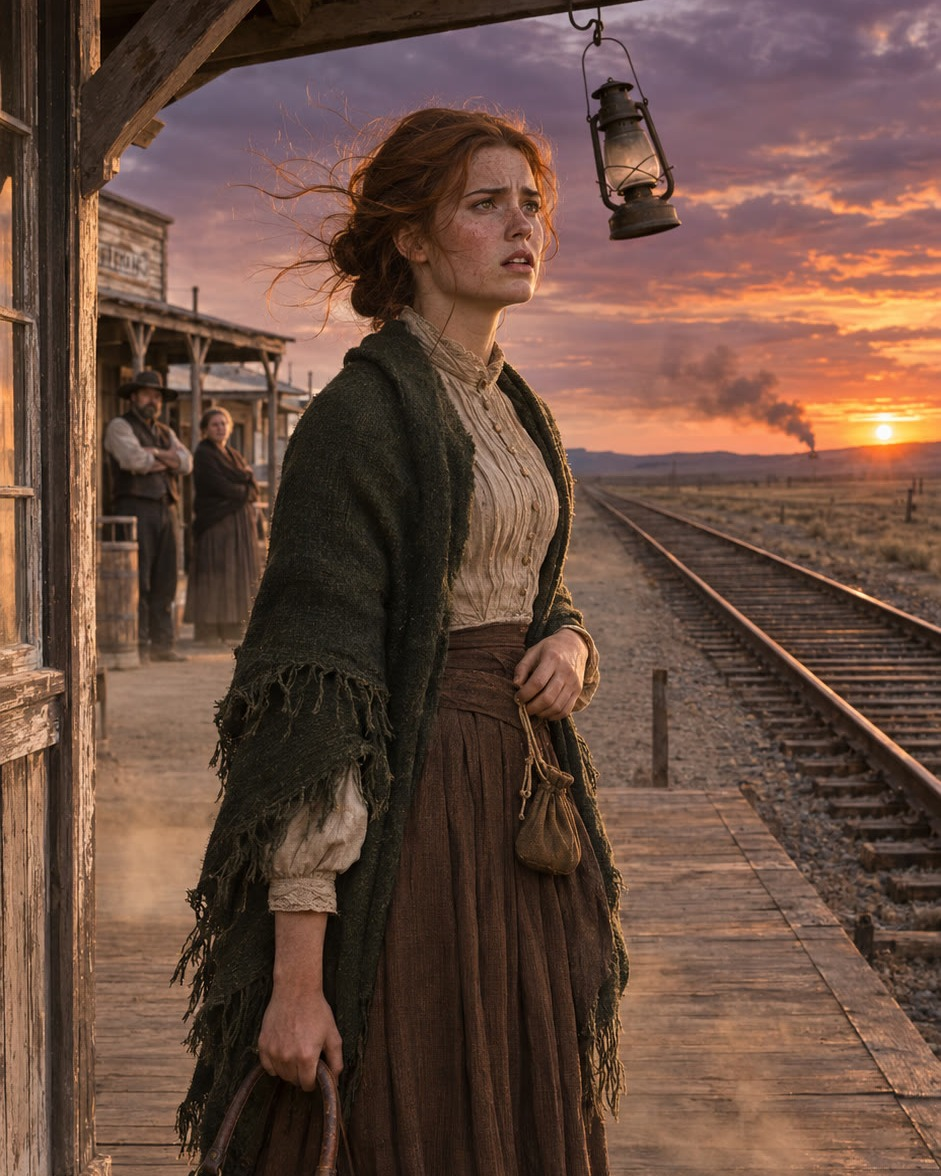
Maeve Kelleher grabbed the stationmaster's arm before he could carry her carpet bag away.
"Please! I was promised someone would meet me!"
When rancher Callahan finally arrived, he noticed the small envelope tucked beneath the bag's leather handle.
Inside was a letter bearing his name.
But the letter contained something he had never expected to see.
Maeve had traveled farther than anyone in her family had ever imagined.
She had crossed the Atlantic Ocean, spent days aboard crowded trains, and watched the landscape change from green hills to endless stretches of dry country.
Every mile had carried her closer to a new beginning.
At least, that was what she had believed.
Now she stood alone on a wooden railway platform in Hartwell, a small frontier town somewhere in the American West.
The last train had already departed.
The evening sky was turning orange, and the stationmaster had begun closing the waiting room.
Maeve held the handle of her worn carpet bag with both hands.
Inside it were two dresses, a spare pair of stockings, a small prayer book, a photograph of her mother, and the few personal things she had managed to bring from Ireland.
Fourteen dollars and sixty cents remained in her purse.
It was not enough to make another journey.
It was certainly not enough to return home.
"Miss, you cannot stay here all night," the stationmaster told her.
Maeve looked toward the road.
"I understand, sir. But the man who offered me employment was supposed to meet me."
The stationmaster sighed.
"Then perhaps he has changed his mind."
Those words hurt more than Maeve expected.
She had spent months saving money for the passage to America. Her mother had sold two silver spoons that had belonged to her grandmother. Maeve herself had worked long hours in a boardinghouse kitchen before finally purchasing her ticket.
She had not come to America looking for riches.
She wanted honest work.
A small room.
Enough food to eat.
And perhaps, someday, a little land of her own.
Was that truly too much to ask?
"Do you know his name?" the stationmaster asked.
"Callahan. He owns a ranch outside Hartwell."
The older man frowned.
"Callahan?"
"Yes, sir."
"Big fellow? Works horses and cattle?"
Maeve nodded.
The stationmaster scratched his beard.
"I know him. Quiet sort. Doesn't come into town unless he needs something."
"Perhaps he has forgotten."
The stationmaster looked at her.
"Perhaps."
Maeve turned away before he could see her disappointment.
She had learned something during the voyage across the ocean.
People were often kinder when they believed you were not watching them.
But they could also be cruel when they thought you had nowhere else to go.
She would not beg.
She would not cry.
And she certainly would not tell a stranger how frightened she was.
The sound of wheels interrupted her thoughts.
A buggy appeared on the eastern road.
The horse pulling it was a strong bay mare, though she seemed uncomfortable putting weight on one hoof.
The driver slowed when he noticed the woman standing beside the station building.
He was tall, broad-shouldered, and dressed in practical frontier clothing.
A faded olive-brown shirt covered his arms. Dark suspenders crossed his chest, and his trousers were tucked into worn leather boots.
His sandy-blond hair was slightly longer than most town gentlemen preferred.
A short beard framed his weathered face.
He looked about thirty-eight.
More importantly, he looked like a man who had spent most of his life working outdoors.
He brought the buggy to a stop.
"Maeve Kelleher?"
She turned.
"Yes."
"Callahan."
He removed his hat.
For a moment, neither spoke.
Then he glanced at the carpet bag beside her.
"I'm sorry I'm late."
Maeve released a breath she had been holding for nearly an hour.
"I was beginning to think I had been forgotten."
"I wouldn't have blamed you for thinking so."
His voice was low and steady.
He climbed down from the buggy and approached the mare.
"She threw a shoe several miles outside town. I had to find someone who could tend to her before I brought her this far."
Maeve looked at the animal's front hoof.
"Is she badly hurt?"
"Nothing serious, I hope. But she won't be pulling a buggy comfortably until she's seen to."
He spoke about the horse with the same concern another man might have shown a family member.
Maeve found herself studying him.
There was something unusual about his manner.
He did not look at her as though she were an inconvenience.
He did not complain about the journey she had made him take.
He simply seemed embarrassed that she had been left waiting.
"Have you been standing here long?" he asked.
"Not too long."
It was a lie.
Callahan seemed to recognize it.
He picked up her bag.
"Come along. Darkness will be here soon."
Maeve climbed into the buggy.
As they traveled along the rutted road, the town slowly disappeared behind them.
They passed a blacksmith's shop, a small general store, and a church with a white wooden steeple.
Beyond the last houses, the prairie stretched toward distant hills.
Maeve watched the landscape carefully.
It was unlike anything she had ever known.
There were no stone fences dividing fields.
No familiar cottages.
No narrow green lanes leading toward the sea.
Only dry grass, distant mountains, and an enormous sky.
"Have you traveled far?" Callahan asked.
"From County Clare."
"Ireland?"
"Yes."
He nodded.
"Long way from home."
"Very long."
He seemed to consider that answer.
"Do you have family waiting for you here?"
Maeve shook her head.
"No."
He did not ask another question.
She appreciated that.
As the buggy continued along the road, their arms occasionally came close when the wheels struck uneven ground.
Each time, Callahan shifted slightly to give her more room.
It was a small gesture.
Yet Maeve noticed.
She had encountered enough men during her journey to recognize the difference between politeness and an attempt to take advantage of someone.
Callahan appeared determined to maintain a respectful distance.
That made her feel safer.
After several minutes, he pointed toward a modest wooden house in the distance.
"That's where I live."
Maeve followed his gaze.
The house stood near a small barn.
Its paint had faded, and the front steps showed signs of years of use.
There was a narrow chimney, a simple porch, and a few wooden fences surrounding the property.
It was not the grand ranch she had imagined.
But it was shelter.
And shelter was more than she had possessed an hour earlier.
When they arrived, Callahan helped her down.
He carried her carpet bag inside.
The house contained two modest rooms.
The kitchen had a cast-iron stove, a wooden table, and two chairs.
A small oil lamp rested beside a stack of plates.
The bedroom contained a narrow wardrobe, a washbasin, and a larger bed covered with a clean quilt.
Maeve looked around.
Everything was simple.
Everything was clean.
And everything seemed arranged for one person.
Callahan placed her bag beside the bedroom doorway.
"You can sleep here."
Maeve turned toward him.
"Where will you sleep?"
He pointed toward the barn.
"I'll manage out there."
"But this is your house."
"Yes."
"And you're giving me your bedroom?"
He nodded.
"It's the proper thing to do."
Maeve looked at the bed again.
She had expected a small cot, perhaps a blanket beside the stove.
She had not expected him to surrender his own bedroom to a woman he had never met.
"Mr. Callahan, I don't wish to cause you trouble."
"You aren't."
He said it simply.
There was no impatience in his voice.
He showed her where she could find water, explained how to use the stove, and placed a small bundle of firewood beside the kitchen wall.
Then he stopped at the doorway.
"There's bread in the cupboard. I'll bring something from town tomorrow morning."
"Thank you."
He nodded.
"Get some rest, Miss Kelleher."
After he left, Maeve remained standing in the middle of the bedroom.
She listened to his footsteps crossing the porch.
Then she heard the barn door open.
A few moments later, everything became quiet.
She sat on the edge of the bed.
For the first time since leaving Ireland, she allowed herself to feel the full weight of what she had done.
She was alone in a strange country.
Her family was an ocean away.
Her future depended on a job she had not yet begun.
But a stranger had given her a bed without asking anything in return.
That night, Maeve slept beneath a clean quilt.
And for the first time in many days, she did not wake every hour wondering where she would go next.
Morning arrived with the sound of rain.
Maeve woke to soft tapping against the window.
For several seconds, she did not recognize the room.
Then she remembered.
Hartwell.
Callahan.
The ranch house.
She sat up and reached for her dress.
After washing her face, she carefully braided her hair and secured it at the back of her head.
She did not want to appear unprepared on her first morning.
When she entered the kitchen, the smell of coffee greeted her.
Callahan stood beside the stove.
He had already changed into a dry work shirt.
"Good morning," he said.
"Good morning."
He poured coffee into a cup.
"There's breakfast if you're hungry."
Maeve looked at the table.
A plate of bread sat beside a small dish of butter.
There were two cups.
She noticed that.
"Did you make this?"
"Coffee, mostly. The bread came from town."
She smiled faintly.
"Then I'll have to make something better tomorrow."
Callahan looked at her.
"You're not required to do anything until we discuss the work."
Maeve pulled out a chair.
"I came here to work."
"I know."
"Then perhaps we should discuss it."
He sat opposite her.
Their conversation lasted nearly half an hour.
Callahan explained that he needed someone to prepare meals, keep the kitchen clean, help with the chickens, and occasionally assist with simple household chores.
He did not expect her to manage the entire ranch.
There were fences to repair, cattle to tend, and horses to care for, but he handled those responsibilities himself.
Maeve listened carefully.
The arrangement sounded fair.
"What about wages?" she asked.
Callahan named an amount.
It was modest, but enough to allow her to save money.
She accepted.
They agreed that she would begin that morning.
The rain eased shortly after breakfast.
Maeve washed the dishes, swept the kitchen, and inspected the pantry.
There was flour, dried beans, potatoes, a little salt pork, and several jars of preserved vegetables.
Not much.
But enough to prepare a decent meal.
She rolled up her sleeves and began working.
Callahan left to inspect the mare.
When he returned several hours later, the kitchen smelled of freshly baked biscuits.
He stopped in the doorway.
Maeve was standing beside the stove, carefully turning a pan.
She looked up.
"Something wrong?"
He shook his head.
"No."
He glanced at the clean table.
Then at the neatly arranged shelves.
"You've been busy."
"There's plenty to do."
Callahan nodded.
He seemed uncertain what else to say.
Maeve placed a biscuit on a small plate.
"Would you like one?"
He looked at it as though she had offered him something much more valuable.
"Thank you."
He took it.
Their fingers did not touch.
But Maeve noticed that he remained in the kitchen a little longer than necessary.
It was a small thing.
Yet it was the first indication that her presence might mean something to him.
By the end of the first week, Maeve had learned the rhythms of the house.
Callahan rose before sunrise.
He drank coffee in silence, checked the animals, and left for the fields.
He returned near evening, sometimes carrying a sack of supplies or a repaired piece of equipment.
He never entered the bedroom without knocking.
He never complained when Maeve asked questions.
And he never treated her as though she owed him something beyond the work they had agreed upon.
Maeve found that increasingly unusual.
Most people who offered help expected gratitude to become a kind of debt.
Callahan seemed different.
He rarely spoke about himself.
When Maeve asked how long he had owned the ranch, he answered simply, "Long enough."
When she asked whether he had family nearby, he said, "Not anymore."
And when she asked whether he had always lived alone, he looked toward the window.
"Most of my adult life."
That was all.
She did not press him.
There were things in her own past she did not wish to discuss with strangers.
Perhaps he felt the same.
One afternoon, while cleaning the kitchen shelves, Maeve noticed something.
There was only one cup beside the stove.
One plate was used more often than the others.
One chair had a worn place on its wooden seat.
The second chair looked almost new.
It was a small observation.
But it told her something about the man who lived there.
Callahan had not merely been living alone for a few weeks.
He had grown accustomed to it.
His house was organized around the habits of someone who expected no company.
Even the dining table seemed too large for one person.
That evening, Maeve prepared a proper supper.
She roasted potatoes, cooked the remaining salt pork, and made fresh biscuits.
Then she placed two plates on the table.
She had no particular reason.
She simply thought it would be pleasant.
Outside, the rain began again.
A few minutes later, she heard footsteps on the porch.
The door opened.
Callahan stepped inside.
His shirt was damp, and mud covered the bottom of his boots.
He stopped when he saw the table.
For several seconds, he did not move.
Maeve turned from the stove.
"You're just in time."
Callahan looked at the two plates.
Then at her.
"You set two places."
Maeve wiped her hands on her apron.
"I thought we might eat together."
He seemed unable to find an immediate answer.
Finally, he removed his hat.
"That sounds nice."
He washed his hands at the basin.
Then he pulled out the chair opposite hers.
It was the first time in years, perhaps longer, that the rancher had sat down to a meal prepared with the expectation that someone would share it with him.
They ate slowly.
Their conversation remained simple.
Maeve told him about the journey across the ocean.
Callahan told her about the mare's recovery.
They spoke about the weather, the condition of the road, and the price of flour in town.
Nothing extraordinary happened.
Yet the house felt different.
The quiet no longer seemed empty.
When supper ended, Callahan gathered the plates.
Maeve reached for them.
"I can wash those."
"I know."
He paused.
"Thank you for dinner."
She looked at him.
"You're welcome."
He carried the dishes to the basin.
Maeve watched him for a moment.
She could not explain why the sight affected her.
Perhaps because she had expected America to be a place where everyone looked after themselves.
But here was a man who had given away his bedroom, shared his food, and never once made her feel that she was an unwanted burden.
She wondered what had made him so careful.
And what had made him so lonely.
Later, Callahan took a folded wool blanket from the wardrobe.
He turned toward the narrow cot beside the wall.
Maeve looked from the cot to the bedroom doorway.
"Mr. Callahan?"
He stopped.
"Yes?"
She hesitated.
Then she looked directly at him.
"The bed is big enough."
The blanket remained in his hands.
He did not move.
Outside, rain tapped steadily against the window.
Maeve continued, her voice quiet.
"There's no sense in either of us being uncomfortable."
Callahan slowly lowered the blanket.
His expression changed.
Not with anger.
Not with embarrassment.
Something else.
Something Maeve had never seen in his face before.
He looked toward the dark window.
Then back at her.
"There is something you need to know about me," he said.
Maeve felt her heart quicken.
He had spoken those words with such seriousness that she immediately understood this was not about the sleeping arrangements.
Callahan took a breath.
"Something I should have told you before you ever came to Hartwell."
Then he reached toward the bottom drawer of the old wooden dresser.
And Maeve noticed that his hand was trembling.
Continue with a fully planned 15-chapter arc Expand Chapter 1 to 2,000 words






Comments 0