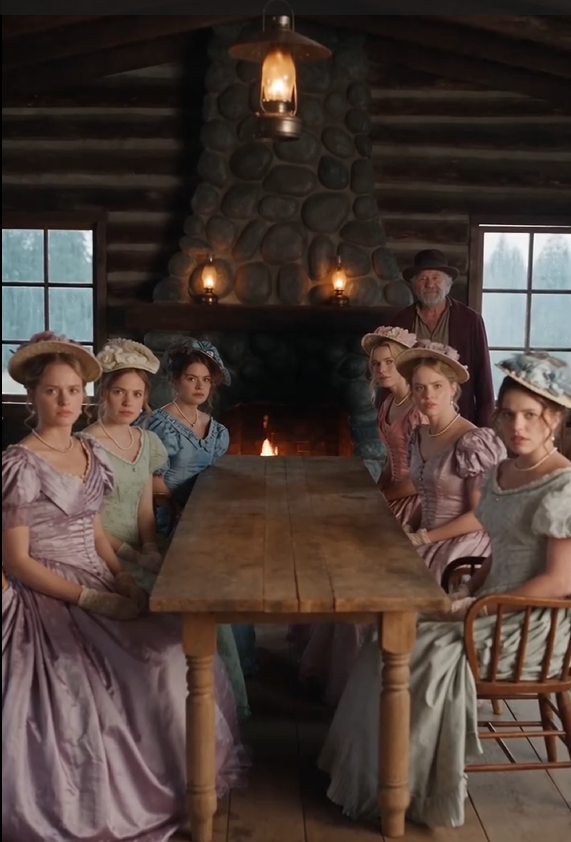
"Don't touch that pendant!" Samuel Whitaker shouted.
Adrian Caldwell stood beside the kitchen table, holding a small wooden pendant wrapped in worn leather.
Three letters were carved into its back.
C. E. W.
Clara Whitmore looked at those letters.
And suddenly, this was no longer a gathering to find a wife.
It was something far more dangerous.
Ten minutes earlier, Clara had been wondering whether anyone would notice if she slipped out through the kitchen door.
She had spent the entire afternoon preparing Samuel Whitaker's ranch house for an occasion that had nothing to do with her.
The finest china had been brought down from the upper cabinets. Fresh flowers stood in a crystal vase at the center of the long oak dining table. Silver utensils had been polished until Clara could see her own tired reflection in their curved surfaces.
And seated around that table were four women who looked as though they had stepped out of a fashionable magazine from Portland.
Eleanor Bellamy wore a deep-purple dress with delicate lace at the wrists. Her father owned three successful businesses and half the commercial buildings on Main Street.
Margaret Hayes had arrived wearing a teal silk gown and a pearl necklace that her mother had made certain everyone noticed.
Vivian Prescott, whose family owned the valley's largest grain mill, wore pale gold.
And Rebecca Sterling, the youngest daughter of the county judge, had chosen lavender.
Each woman had been invited for the same reason.
Adrian Caldwell was finally considering marriage.
At forty-two, Adrian was one of the most respected ranch owners in the Oregon valley. His land stretched across thousands of acres of pasture, forest, and rolling hills. His cattle brought handsome prices. His employees were paid fairly. His word carried more weight than most written contracts.
He was also unmarried.
That fact had become a source of almost unbearable concern to the town's older residents.
Samuel Whitaker had decided to do something about it.
And Clara had been asked to help with the refreshments.
Not to attend.
Certainly not to participate.
Just to help.
"Clara, dear," Samuel had told her that morning, "you understand that this is an important occasion. I need everything to be perfect."
She had nodded.
"Of course, Mr. Whitaker."
"And perhaps wear something suitable. There will be distinguished company."
Clara had looked down at her faded cotton dress.
It was dusty rose, though years of washing had softened the color.
"I'll wear my best."
Samuel had hesitated.
Then he had smiled.
"That will do."
Clara knew what he meant.
Her best would never resemble the best of the women sitting in his dining room.
She was twenty-eight years old, with chestnut-brown hair that she wore in a simple braided bun. She had no inheritance, no wealthy relatives, and no family name that opened doors.
For as long as she could remember, she had lived in the Whitaker household.
Samuel had taken her in when she was thirteen, after the death of the elderly woman who had raised her.
He had given her food, a roof, and work.
For those things, she was grateful.
But gratitude was a strange kind of debt.
It could make a person feel guilty for wanting anything more.
"Clara!"
Margaret Hayes's sharp voice pulled her back to the present.
"Would you bring more tea?"
"Certainly."
Clara carried the teapot into the dining room.
Margaret barely glanced at her.
"Do you think Mr. Caldwell will arrive soon?"
"I believe so."
"Well, I hope he appreciates punctuality. I've been waiting nearly an hour."
Eleanor Bellamy gave a delicate laugh.
"A man with that much property can afford to be late."
"Especially when four women are waiting to marry him," Vivian added.
The women laughed.
Clara lowered her eyes and poured the tea.
She had no desire to join their conversation.
Marriage had never seemed like a realistic possibility for someone in her position.
Not because she believed herself unworthy of love.
But because she had learned that wanting something did not make it possible.
And she had become very good at not wanting things.
At least, that was what she told herself.
The sound of horses outside interrupted the conversation.
Every woman straightened.
Rebecca quickly checked her hair in the reflection of a silver serving tray.
Eleanor adjusted her necklace.
Margaret smoothed the front of her dress.
Samuel hurried toward the entrance.
"He's here."
Clara took the empty teapot and returned to the kitchen table.
She could hear the front door opening.
Heavy footsteps crossed the wooden floor.
Then a deep male voice spoke.
"Samuel. It's good to see you."
"Adrian, my boy! Welcome, welcome!"
There was warmth in Samuel's greeting, but Clara detected something else.
Nervousness.
That surprised her.
Samuel Whitaker was rarely nervous around anyone.
He had served on the town council for years. He owned several profitable businesses. People sought his advice on matters ranging from cattle prices to family disputes.
Yet his voice had tightened when he greeted Adrian.
Clara glanced toward the dining room.
The man standing beside Samuel was taller than she expected.
His dark auburn hair was brushed neatly back, with the first traces of gray at his temples. A short beard framed a strong, serious face.
He wore a forest-green wool coat over a brown waistcoat and a cream-colored shirt.
Nothing about him seemed designed to impress.
And somehow, that made him more impressive.
He removed his gloves.
Samuel gestured toward the table.
"Adrian, allow me to introduce some of the valley's finest young ladies."
Clara returned her attention to the napkins.
It was none of her business.
She folded one.
Then another.
Then another.
From the dining room came polite introductions.
"Miss Bellamy."
"A pleasure, Mr. Caldwell."
"Miss Hayes."
"I'm delighted to meet you."
"Miss Prescott."
"How do you do?"
"Miss Sterling."
"Very well, thank you."
Clara listened without meaning to.
Adrian's voice was calm and courteous.
But something about his responses seemed unusual.
He did not linger.
He did not flatter.
He did not ask the questions a man might ask when seriously considering marriage.
Instead, he seemed distracted.
Searching.
Then the footsteps moved away from the dining table.
Toward the kitchen.
Clara continued folding napkins.
Until a pair of worn brown leather boots stopped directly in front of her.
"Excuse me."
She looked up.
Adrian Caldwell was standing less than three feet away.
For a moment, she simply stared.
His hazel eyes met hers.
"Yes, sir?"
"What's your name?"
She blinked.
"Clara, sir."
"Clara what?"
"Whitmore."
Something changed in his expression.
It was small.
Almost invisible.
But Clara noticed.
"Whitmore," he repeated.
"Yes."
"How long have you lived here?"
Clara glanced toward Samuel.
The older man was watching them.
"Fifteen years, sir."
Adrian's gaze sharpened.
"Fifteen?"
"Approximately."
"And before that?"
She hesitated.
"I lived with a woman named Mrs. Agnes Miller."
"Was she your grandmother?"
"No, sir. She raised me, but we weren't related."
Adrian became very still.
Behind him, the dining room had fallen silent.
Clara felt heat rise into her cheeks.
She had never liked being the center of attention.
"Mr. Caldwell," she said softly, "I'm afraid I don't understand."
He looked at the folded napkins.
Then back at her.
"Did you know I was coming today?"
"Everyone knew."
"Did you know why?"
"Yes."
"And you didn't come to meet me?"
She gave a small, embarrassed shake of her head.
"No, sir."
"Why not?"
The question was so unexpected that she almost laughed.
Almost.
"Because I wasn't invited to meet you."
Adrian studied her face.
"Who told you that?"
"No one needed to."
For the first time, something resembling sadness crossed his expression.
Clara wished she had said something else.
She had not intended to embarrass him.
"I'm sorry," she added quickly. "I didn't mean to sound disrespectful."
"You weren't disrespectful."
His voice softened.
"You were honest."
From the dining room, Margaret Hayes cleared her throat.
"Mr. Caldwell, perhaps you'd like to sit down?"
Adrian did not turn.
He continued looking at Clara.
"May I ask you something?"
"Of course."
"Do you always apologize when you've done nothing wrong?"
Clara stared at him.
No one had ever asked her that.
She searched for an answer.
But none came.
Adrian waited.
He did not rush her.
He did not smile to make the moment less uncomfortable.
He simply gave her the dignity of time.
And somehow, that made her feel more exposed than any insult could have.
Finally, she whispered, "I suppose I've gotten used to it."
Something hardened in his eyes.
Not toward her.
Toward the idea that someone had taught her to live that way.
Samuel approached.
"Adrian, surely you didn't come all this way to discuss napkins."
His laughter sounded forced.
Adrian turned slightly.
"No, Samuel."
"Then come. The ladies are waiting."
"I know."
He looked back at Clara.
"But I believe I've found the person I wanted to speak with."
The room became so quiet that Clara could hear the ticking clock above the fireplace.
Margaret's mouth opened.
Eleanor stared.
Rebecca looked from Adrian to Clara as though she had misunderstood something.
Samuel's smile disappeared.
"Adrian," he said carefully, "Clara is a good girl, but she's only helping with the household arrangements."
"Only?"
The single word carried no anger.
Yet Samuel stopped speaking.
Adrian's gaze remained steady.
"She's standing right here, Samuel."
Samuel cleared his throat.
"Of course. I meant no offense."
Clara wanted the floor to open beneath her.
She could feel every woman's eyes on her.
She was suddenly painfully aware of her simple dress, her worn boots, and the faint flour mark near her sleeve.
"Mr. Caldwell," she whispered, "please don't trouble yourself over me."
He turned toward her.
"Clara, I haven't troubled myself at all."
Then he said something that made her heart stumble.
"I came here because I hoped you would be here."
Samuel's face went pale.
Clara had been overlooked for most of her life.
She knew how to move through a crowded room without interrupting conversations.
She knew how to make herself useful without becoming noticeable.
She knew that wealthy people often remembered the quality of a meal but forgot the person who prepared it.
What she did not know was how to respond when the most respected ranch owner in the valley looked at her as though she mattered more than everyone else in the room.
"Me?" she whispered.
"Yes."
"But you don't know me."
Adrian took a slow breath.
"Not as well as I would like."
Samuel stepped forward.
"Adrian, perhaps we should speak privately."
"In a moment."
"I really must insist."
Adrian looked at him.
The warmth left his expression.
"Why?"
Samuel's eyes flickered toward Clara.
"Because there are matters you don't understand."
"Then perhaps it's time I understood them."
The older man's jaw tightened.
Clara looked between them.
Something was wrong.
This was no longer an awkward social gathering.
There was history here.
History she knew nothing about.
"Mr. Whitaker?" she asked.
Samuel turned toward her.
His expression softened immediately.
"Clara, dear, why don't you finish preparing the kitchen?"
"But—"
"Please."
The word was gentle.
The command beneath it was not.
Clara lowered her gaze.
"Yes, sir."
She reached for the napkins.
Then Adrian spoke.
"Don't."
Her hand stopped.
He looked toward Samuel.
"She deserves to hear what I have to say."
Samuel's voice dropped.
"Adrian, you're making a mistake."
"Am I?"
"You don't know what you're stirring up."
Adrian reached inside his coat.
"I know exactly what I've been looking for."
He withdrew a small leather-wrapped package.
Clara's attention shifted toward it.
The leather was dark with age.
A narrow cord held it closed.
Adrian carefully loosened the knot.
The women leaned forward.
Samuel took one step backward.
Inside the leather lay a small wooden pendant.
It was shaped like a teardrop.
The edges had been smoothed by years of handling.
A tiny carved oak tree decorated the front.
Clara stopped breathing.
She knew that tree.
She did not know how.
But she knew it.
A sudden image flashed through her mind.
A woman's hand.
A blue ribbon.
Sunlight passing through the branches of an enormous oak.
Then darkness.
Clara gripped the edge of the table.
Adrian noticed.
"Clara?"
She shook her head.
"Where did you get that?"
Her voice sounded distant.
Almost unfamiliar.
Adrian held the pendant carefully.
"I've spent years searching for the person connected to this."
Clara stared at the little wooden object.
A strange pressure formed behind her eyes.
She had seen it before.
She was certain.
But the memory would not come.
"May I?" she whispered.
Adrian stepped closer.
He placed the pendant in her open palm.
The wood felt warm from his hand.
Clara turned it over.
Three letters were carved into the back.
C. E. W.
Her fingers began to tremble.
"Those letters," she whispered.
Adrian watched her.
"What about them?"
"I don't know."
She swallowed.
"I feel like I should."
Samuel suddenly moved forward.
"That's enough."
Everyone turned.
The older man's face had changed completely.
His cheeks were pale.
His eyes were fixed on the pendant.
"Adrian, put that thing away."
Adrian did not move.
"Why?"
"Because it has nothing to do with Clara."
"Then why are you frightened of it?"
Samuel's expression hardened.
"I'm not frightened."
"Your hands are shaking."
Samuel looked down.
They were.
He clasped them behind his back.
Clara felt the first real chill of fear.
Not because Adrian had brought the pendant.
But because Samuel recognized it.
And he clearly did not want her to know why.
"Mr. Whitaker," she said quietly, "have you seen this before?"
Samuel looked at her.
For one moment, his expression seemed almost pleading.
"Clara, some things are better left alone."
Her heart began beating faster.
"That isn't an answer."
He drew himself upright.
"You must remember who raised you."
The words struck harder than she expected.
Clara lowered her eyes.
"I remember."
"And who provided for you when you had nowhere else to go?"
"Mr. Whitaker—"
"I did."
Adrian stepped between them.
"That's enough, Samuel."
The older man stared at him.
"You have no right to interfere in my household."
Adrian's voice remained calm.
"Then don't use your generosity as a weapon."
Silence.
Clara looked up.
No one had ever spoken to Samuel Whitaker that way.
Not in his own home.
Not in front of guests.
Samuel's face reddened.
"You've forgotten yourself, Adrian."
"No."
Adrian turned toward Clara.
"I think I've finally remembered why I came."
He looked at the pendant.
"Clara, would you mind telling me the earliest thing you remember about your childhood?"
She hesitated.
"Why?"
"Because I believe someone has kept part of your life from you."
Samuel made a sharp sound.
"Adrian!"
But Clara barely heard him.
She was staring at the carved oak tree.
Her earliest memories were scattered.
A small cottage.
A woman singing.
The smell of fresh bread.
A man's laughter.
And something else.
Something she had never been able to explain.
A voice calling her by a different name.
Not Clara Whitmore.
Something longer.
Something beginning with Clara.
She closed her eyes.
For an instant, she heard the voice again.
A woman's voice.
Soft.
Urgent.
Clara Evelyn...
Her eyes opened.
"Clara Evelyn," she whispered.
Adrian went completely still.
Samuel gripped the back of a chair.
Clara looked from one man to the other.
"Why did I just say that?"
Adrian's face had lost its color.
"Because that was your name."
Her throat tightened.
"What?"
He looked down at the pendant.
Then back at her.
"Clara Evelyn Whitmore."
The room seemed to tilt.
Clara reached for the table to steady herself.
"How do you know my middle name?"
Samuel suddenly shouted.
"Don't touch that pendant!"
The women gasped.
Clara flinched.
Adrian turned sharply.
"Samuel, sit down."
But Samuel did not sit.
He stared at Clara with an expression she had never seen before.
Not anger.
Not disappointment.
Fear.
Genuine fear.
"Give it to me," he said.
Clara instinctively closed her fingers around the pendant.
"Why?"
"Because it doesn't belong to you."
Adrian's voice became dangerously quiet.
"That's not true."
Samuel turned toward him.
"You don't know the whole story."
"Then tell it."
"I can't."
"Or you won't?"
Samuel looked toward the dining room door.
For the first time, Clara noticed that he seemed to be listening for something.
Or someone.
Adrian followed his gaze.
Then he reached for the pendant.
"Clara, there's something else you need to see."
She slowly opened her hand.
Adrian took the wooden object and turned it sideways.
His thumb pressed against a nearly invisible seam.
A tiny compartment opened.
Clara gasped.
Inside was a narrow strip of yellowed paper.
Folded so tightly that it seemed impossible anything could fit inside.
Adrian carefully removed it.
Samuel stumbled forward.
"Don't open that!"
Adrian ignored him.
He unfolded the paper.
There were only a few words.
Written in faded brown ink.
Clara leaned closer.
Her eyes moved across the first line.
Then the second.
And her blood seemed to turn cold.
The message was addressed to her.
In handwriting she somehow recognized.
Adrian began reading aloud.
"To my daughter, Clara Evelyn—"
Samuel lunged toward him.
"STOP!"
Adrian stepped back.
The paper remained in his hand.
Clara stood frozen.
Her mother.
The woman she had been told died before she was old enough to remember.
Had written her a message.
And Samuel Whitaker had known.
For fifteen years, he had known.
"Where is my mother?" Clara whispered.
Samuel's expression collapsed.
He looked suddenly old.
Much older than his sixty-eight years.
"Clara..."
"Where is she?"
No one moved.
Then came three heavy knocks from the front door.
Samuel turned white.
Adrian looked toward the entrance.
The knocking came again.
Louder.
More urgent.
Clara's fingers tightened around the pendant.
Samuel whispered, "No. It can't be."
The door handle slowly turned.
Someone outside spoke Clara's forgotten middle name.
And Samuel whispered the one sentence that made Adrian reach for the door—
"That woman was supposed to be dead."






Comments 0