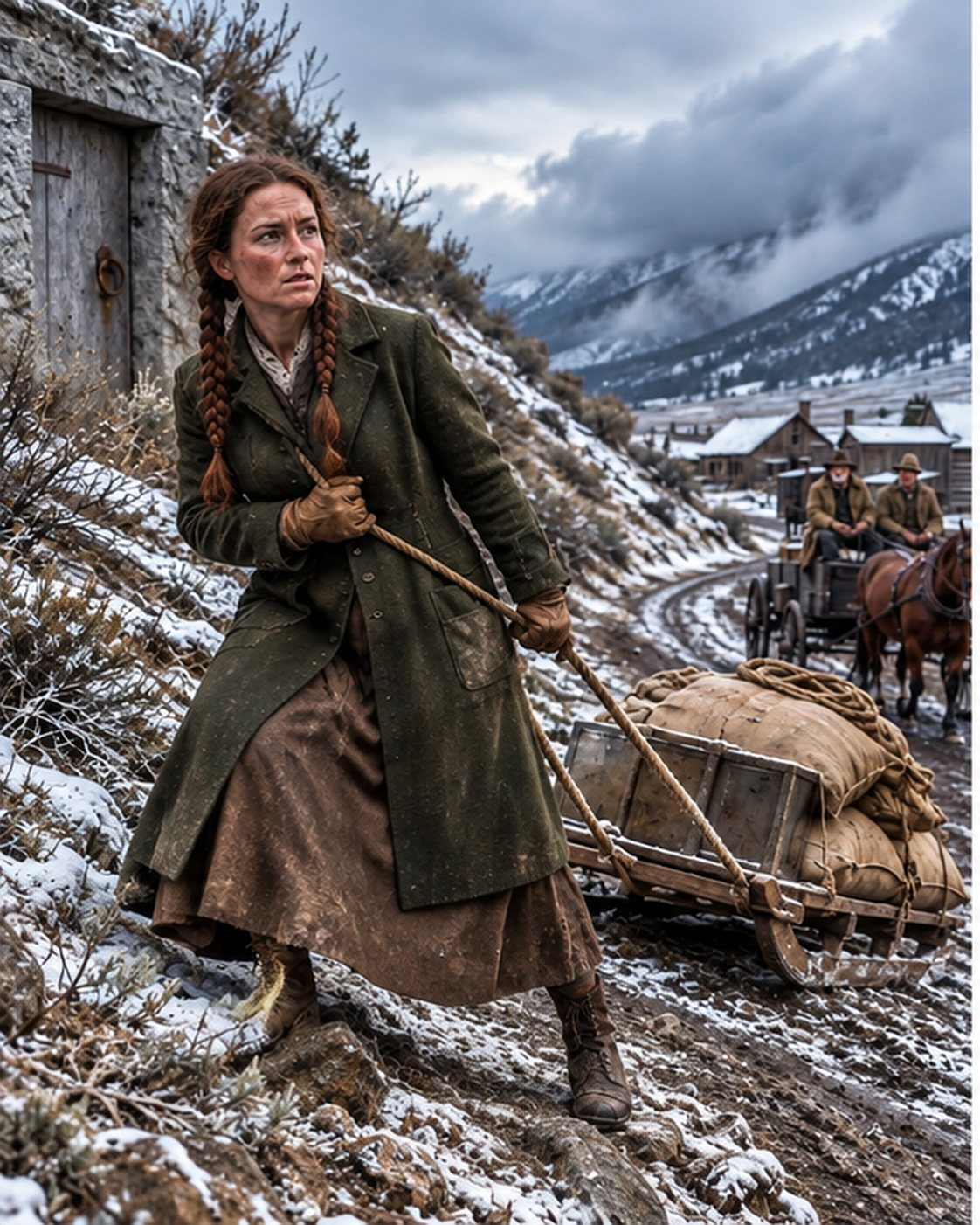
An eighteen-year-old girl dragged a wooden sled up a frozen mountain road while the entire town laughed behind her.
"You're hauling groceries for the bears!"
When Cinder Gap's blacksmith saw the old iron stove pipe tied to her sled, he stopped laughing.
Because he recognized the mark stamped into the metal.
It belonged to the abandoned railroad survey station.
And nobody had seen anyone go near that place in forty years.
Nora Vail kept walking.
Her boots slipped against the icy ground. The wooden runners of the sled scraped over rocks, leaving two crooked tracks in the thin layer of snow.
She tightened the rope around her shoulder and pulled again.
Behind her, somebody whistled.
"Hey, Nora! You planning to open a grocery store up there?"
Laughter rolled through the small gathering outside the general store.
Nora didn't turn around.
She had learned that answering people who enjoyed humiliating her only gave them another reason to continue.
The sled carried two sacks of flour, dried beans, preserved meat, a small iron cooking pot, several blankets, a box of matches, and the pieces of a stove pipe she had purchased with almost every dollar she owned.
There were also three wooden crates containing coal.
They were heavy enough to make her shoulders ache.
But she couldn't leave anything behind.
Not this time.
"Your father would be ashamed of you!"
That voice made her stop.
She recognized it immediately.
Elias Mercer, the blacksmith, stood beside the general store with his arms folded across his chest.
He was a broad man with a thick gray beard and a reputation for speaking his mind whether anybody wanted to hear it or not.
Nora turned.
"My father taught me to prepare for winter," she replied.
Mercer laughed.
"Your father taught you to waste your money on a hole in a mountain?"
A few men chuckled.
Nora looked at the iron pipe on her sled.
Then she looked back at him.
"No. He taught me not to depend on people who laugh when someone needs help."
The laughter stopped for a moment.
Mercer's expression hardened.
But Nora had already turned away.
She pulled the sled forward.
And she never looked back.
Eleven months earlier, Nora's father had been buried beneath a small wooden cross on the hill outside Cinder Gap.
His name was Thomas Vail.
He had worked as a carpenter, occasional railroad repairman, and part-time survey assistant when the mining companies still employed men in the surrounding mountains.
He had never been wealthy.
Their cabin had been small, their clothes had been patched repeatedly, and their meals had depended on how much work he could find.
But he had always provided for Nora.
Every winter, he stored extra flour.
Every autumn, he repaired the chimney.
Whenever the first snow appeared on the distant peaks, he checked the roof twice.
He had taught her how to recognize dangerous ice, how to preserve meat, how to keep a fire burning overnight, and how to find water when the streams froze.
He had also taught her something else.
"People often mistake confidence for intelligence, Nora. Never assume the loudest person in the room knows what he's talking about."
She remembered those words whenever somebody laughed at her.
After her father's death, she had tried to remain in their cabin.
But the property had been tied to debts he had accumulated during his final illness.
The bank eventually took it.
Nora had nowhere to go.
Her older half brother, Wade Vail, offered her a place at his cattle farm.
For a while, she believed things might work out.
Wade was thirty-one and had inherited a larger portion of their father's property through an earlier family arrangement.
He had a wife, two children, a barn full of cattle, and a comfortable farmhouse.
His wife, Clara, had never been particularly cruel to Nora.
But she had never been especially welcoming either.
Wade initially told Nora she could stay as long as necessary.
Then the cattle began eating through the farm's winter feed faster than expected.
Hay prices increased.
The harvest was poor.
And Wade began looking at Nora's place at the dinner table as though it were another expense he could no longer afford.
One evening, while Nora washed the dishes, he approached her.
"I need to talk to you."
She dried her hands.
"What is it?"
Wade glanced toward the kitchen door.
"Things are getting difficult around here."
Nora waited.
"The cattle need more feed. Clara's been trying to stretch the household money. The children are growing."
"I understand."
"I can give you another two weeks."
The words landed harder than she expected.
"Two weeks?"
"After that, you'll have to find somewhere else."
Nora looked at him.
She had helped repair the fence, cleaned the barn, prepared meals, and cared for his children whenever Clara needed to rest.
She had never asked him for anything beyond a bed and food.
"Where am I supposed to go?"
Wade shrugged.
"You're eighteen. You'll figure something out."
She looked toward the dining room.
His children were sitting at the table, coloring on scraps of paper.
Clara was cutting bread.
Nobody looked up.
Nora nodded.
"All right."
Wade seemed relieved.
He had expected an argument.
He had expected tears.
Instead, Nora returned to the dishes.
That night, she made her decision.
She would leave before the two weeks were over.
She would not wait until someone had to tell her she was no longer wanted.
The memory faded as Nora reached the last bend in the mountain road.
The town had disappeared behind a ridge.
Only the tops of a few wooden buildings remained visible.
She stopped to catch her breath.
Her shoulders burned.
The cold air hurt her lungs.
She pulled her father's patched brown coat tighter around herself.
It was too large, and one sleeve had been repaired so many times that the original fabric was almost impossible to recognize.
But she refused to sell it.
It was the last thing she owned that still smelled faintly of him.
She reached into the inside pocket.
Her fingers touched a small brass compass.
Thomas had given it to her when she was eleven.
Its glass was scratched, and the needle occasionally trembled before settling.
On the back were three engraved letters.
T.V.
Nora rubbed them with her thumb.
"Almost there, Papa."
Then she started pulling again.
The mountain chamber had been her father's secret.
He had shown it to her once when she was a child.
They had been hiking along an old survey trail when Thomas suddenly stepped behind a wall of exposed rock.
Nora had followed him through a narrow opening.
Beyond it was a chamber carved into the mountain.
It had once served as a temporary shelter for railroad surveyors who mapped possible routes through the valley.
The railway project had been abandoned before construction reached the area.
The workers left their equipment.
The company eventually closed the access route.
And time buried the entrance beneath fallen stone, brush, and snow.
Thomas had explained that the chamber was structurally sound.
The stone walls were thick.
A ventilation shaft connected to an old chimney passage.
A natural spring ran through a narrow channel behind the rear wall.
It was not a comfortable home.
But it could become a safe shelter.
At the time, Nora had been more interested in the strange markings carved into the stone.
She remembered asking her father why anyone would build a room inside a mountain.
He had smiled.
"Sometimes the safest place is the one nobody thinks to look for."
He had never taken her back.
Now, eleven months after his death, she was going to find it herself.
The entrance was almost impossible to recognize.
A thick tangle of dead brush covered the lower opening.
Several stones had fallen across the narrow path.
Snow had collected between the rocks.
Nora set down the rope and began clearing the entrance with a small shovel.
It took nearly an hour.
Her gloves became wet.
Her fingers went numb.
At one point, a loose stone rolled down the slope and struck the side of her boot.
She stopped, listened, and waited for the remaining rocks to settle.
Then she continued.
Eventually, a narrow opening appeared.
She pushed aside the final branch.
Darkness waited beyond it.
Nora lit a lantern.
The first beam revealed a stone floor covered with dust and old leaves.
She stepped inside.
The chamber smelled of damp earth, cold stone, and forgotten wood.
A rusted iron hook hung from one wall.
Several broken boards lay near the back.
An old wooden workbench stood beneath a small ventilation opening.
Nora lifted the lantern higher.
The room was larger than she remembered.
There was enough space for a stove, shelves, a sleeping area, and several crates of supplies.
She placed her hand against the nearest stone wall.
It felt cold.
But it was solid.
She smiled faintly.
Not because she was happy.
Because, for the first time in months, she could see a future that didn't depend on somebody else's generosity.
She had found somewhere to stay.
The next three days were the hardest.
Nora worked until her arms trembled.
First, she cleared the old debris.
Then she examined the chimney.
The passage was partly blocked with soot and bird nests.
She climbed carefully onto the workbench and removed the obstruction piece by piece.
A small amount of loose stone fell from the opening.
She stepped down immediately.
The structure held.
She spent the afternoon cleaning the floor and inspecting the timber supports.
Some of the wood had rotted.
Other beams remained surprisingly strong.
She used the usable pieces to reinforce the sleeping platform.
Then she sealed gaps around the entrance with smaller stones, packed earth, and strips of old cloth.
She left enough ventilation to keep the air moving.
Her father had taught her never to block a chimney or ventilation opening simply because the cold was unpleasant.
A fire could warm a room.
It could also kill everyone inside it.
On the fourth morning, she installed the stove.
It was an old iron model with a cracked handle and a dent along one side.
The blacksmith had sold it cheaply because he considered it useless.
Nora had repaired the handle with wire and replaced the damaged section of pipe.
She connected the chimney pieces.
Then she placed a small amount of kindling inside.
Her first match went out.
The second burned briefly.
The third caught.
A thin ribbon of smoke rose through the chimney.
Nora stood beside the stove and watched it carefully.
For several minutes, she did nothing but check the draft.
Then she placed another piece of wood inside.
The fire strengthened.
Warmth slowly spread across the stone floor.
She sat down on an overturned crate.
Her hands shook from exhaustion.
She looked around the chamber.
The shelves were still mostly empty.
The floor needed another layer of insulation.
The entrance needed additional reinforcement.
And she had only enough food for several weeks.
But it was a beginning.
A real beginning.
By the sixth day, Nora had carried most of her supplies uphill.
The flour went onto the highest shelf.
The beans were divided into smaller containers to protect them from moisture.
She hung the preserved meat away from the stove.
Coal was stacked near the entrance, where it would remain dry.
Her blankets were folded on the sleeping platform.
She also filled several metal containers with water from the natural spring.
Her father had once shown her the narrow channel behind the chamber.
The water emerged through a crack in the stone and disappeared beneath the floor.
It was clear and cold.
She boiled what she needed before drinking it.
Nothing was wasted.
Every object had a purpose.
Every meal was measured.
Every piece of coal mattered.
At night, she slept with her father's old coat folded beneath her head.
Sometimes she dreamed about the farmhouse.
She saw Wade sitting at the dinner table.
She heard Clara calling the children.
She remembered the evening she had packed her belongings.
Nobody had asked her to stay.
Nobody had followed her to the door.
But Nora refused to spend another night wishing they had.
She had survived without them.
She would continue.
On the seventh morning, Nora walked down toward Cinder Gap to purchase lamp oil.
The sky looked unusually clear.
But something about the mountains bothered her.
The clouds had gathered behind the northern ridge.
They were thick, low, and gray.
She stopped outside the general store.
Elias Mercer was repairing a horseshoe.
He looked up when she entered.
"Back already?"
Nora placed two coins on the counter.
"I need lamp oil."
Mercer filled a small container.
Then he looked at her through narrowed eyes.
"Your little mountain project still standing?"
"Yes."
He laughed under his breath.
"Enjoy it while you can."
Nora took the oil.
"Thank you."
She was turning toward the door when she noticed a wooden bucket beside the blacksmith's workshop.
A thin layer of ice had formed across its surface.
That was strange.
The bucket was close to a burning stove.
Nora stepped closer.
She touched the edge.
The water underneath was freezing.
Her stomach tightened.
She looked toward the mountains.
The clouds had grown darker.
She remembered something her father had once told her about the winter of 1872.
When water froze unexpectedly near a warm building, it meant the air temperature could be dropping faster than people realized.
Combined with the cloud formation, it was a warning.
A serious one.
She hurried back to the store.
"Mr. Mercer?"
The blacksmith looked annoyed.
"What now?"
"Have you seen the northern clouds?"
"Clouds are clouds."
"I think a major storm is coming."
He laughed.
"According to you, the whole mountain is about to fall on us."
"I'm serious. The cattle should be moved lower. Families should prepare extra firewood and food."
Mercer shook his head.
"You're eighteen. Don't start telling men who have survived forty winters how to prepare for one."
Nora looked around.
Several ranchers had gathered near the store.
She spoke loudly enough for them to hear.
"The air is freezing unusually fast. The clouds are moving over the northern ridge. You need to prepare."
One of the ranchers laughed.
Another shook his head.
Then a familiar voice came from behind them.
"Nora?"
She turned.
Wade stood near the store entrance.
He had ridden into town with two workers.
He looked at the small oil container in her hand.
Then at her patched coat.
"What are you doing down here?"
"Buying supplies."
Wade glanced toward the mountain road.
"Still living in that old railroad hole?"
"It's a shelter."
He sighed.
"You know you can still come back to the farm if you stop making things difficult."
Nora stared at him.
"You gave me two weeks."
"And I gave you two weeks."
"I left before the deadline."
Wade shook his head.
"You always did take things personally."
Nora said nothing.
He looked toward the darkening sky.
Then he laughed.
"Don't tell me you're worried about a little snow."
She wanted to warn him again.
She wanted to explain that the clouds were moving in a way she had never seen before.
But she recognized the expression on his face.
He wasn't listening.
Nobody was.
She picked up the oil container and walked away.
Behind her, the men resumed their conversation.
Somebody made another joke about the girl who had gone to live with the bears.
Nora kept walking.
That evening, she returned to the chamber and checked every reinforcement.
She inspected the entrance.
She tested the stove.
She checked the chimney draft.
She moved the flour away from the coldest wall.
Then she counted her supplies.
There was enough food for one person to survive the winter if she rationed carefully.
Perhaps a little more.
She sat beside the stove and opened her father's old notebook.
Most pages contained measurements, sketches, and notes about the mountain.
Some were written in his handwriting.
Others appeared to have been copied from old railroad documents.
She turned several pages.
Then she noticed a drawing she had never paid attention to before.
It showed the chamber's rear wall.
Three thick timber supports were marked with small numbers.
Beside the third support, her father had written a sentence.
Never remove this brace.
Nora frowned.
She looked toward the back of the chamber.
The timber was old.
But it appeared solid.
She approached it with the lantern.
A small iron plate had been fixed to its lower section.
She wiped away the dust.
There were several faint scratches on the metal.
And beneath them, almost hidden by rust, were three letters.
T.V.
Her father's initials.
Nora ran her fingers over the plate.
Why had he marked this particular support?
She searched the notebook again.
The drawing showed no explanation.
Only a small arrow pointing toward the stone behind the timber.
Then she noticed another sentence written near the bottom of the page.
If the mountain speaks, listen before you answer.
Nora read it twice.
A cold feeling moved through her chest.
She looked toward the dark rear wall.
Nothing moved.
The stove crackled.
Outside, the wind began to rise.
She closed the notebook.
Tomorrow, she would inspect the brace more carefully.
But tonight, she needed sleep.
She returned to her blankets and placed the lantern beside the bed.
Just before closing her eyes, she heard something outside.
A faint scraping sound.
Like metal dragging across stone.
She sat up.
The noise stopped.
Nora listened.
Nothing.
She took the lantern and approached the entrance.
The wooden door remained locked.
She checked the narrow viewing gap.
The slope outside was empty.
Only snow-covered brush moved in the wind.
She waited another minute.
Then she noticed something lying beside the entrance.
A small bundle.
It hadn't been there when she came inside.
Nora opened the door just enough to reach it.
She pulled the object inside.
It was wrapped in a piece of clean cloth.
She unfolded it.
Inside were two freshly cleaned hares.
No note.
No name.
No explanation.
Nora stared at the meat.
Someone had left it outside her shelter.
Someone knew where she lived.
And whoever that person was, they had managed to approach without her hearing them.
She looked toward the mountain slope.
The darkness offered no answers.
Then she noticed something else.
A fresh bootprint in the snow.
It stopped directly in front of her door.
But there was no second footprint leading away.
Someone had been standing outside her shelter.
And they had disappeared without leaving a trail.






Comments 0