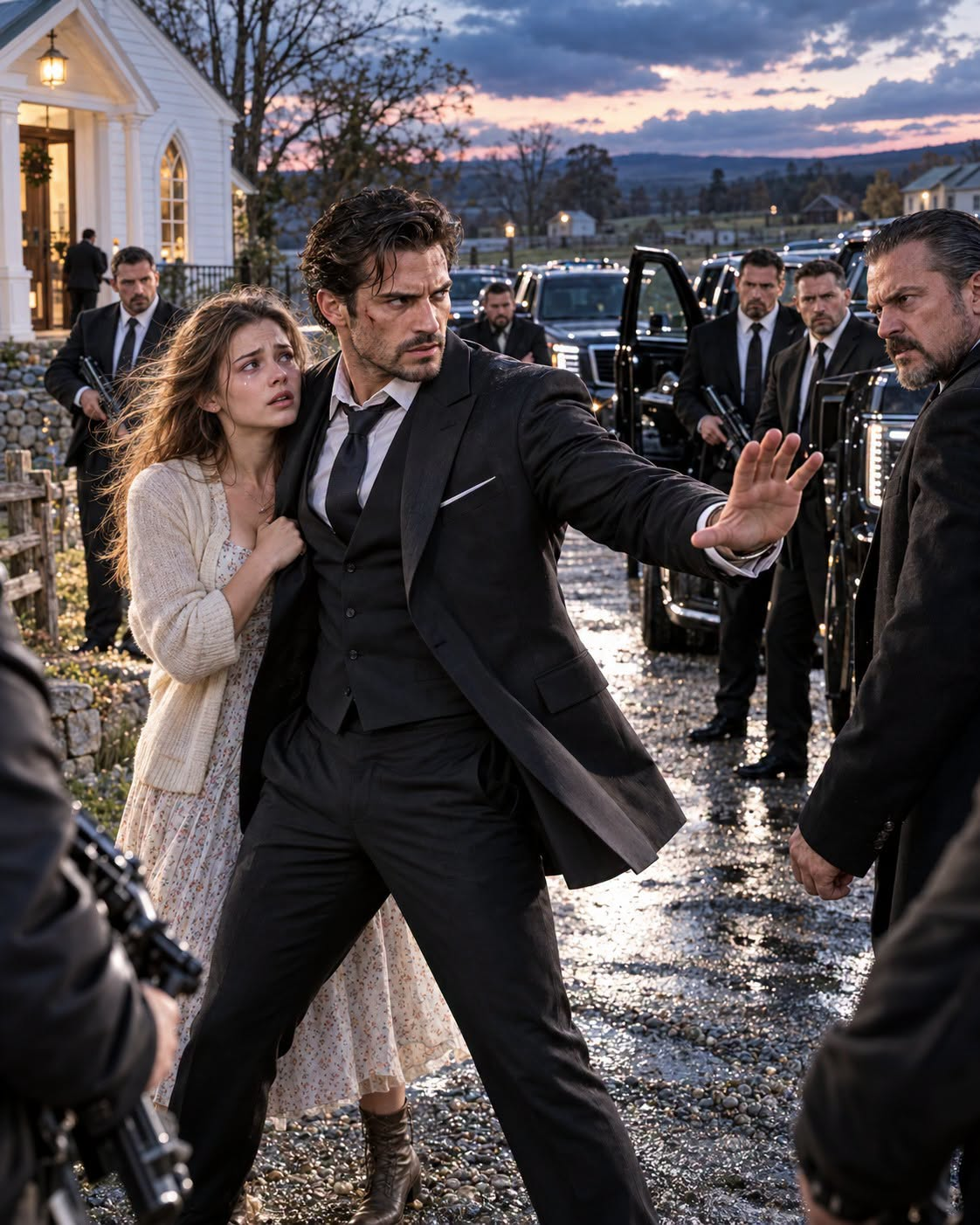
"Please! Somebody help me! He's dying!"
Nora Quinn dropped to her knees beside a bleeding stranger and pressed both hands against his stomach.
Hundreds of miles away, men who feared mafia king Adrian Marchetti were searching for a missing black leather briefcase.
Inside it was a photograph marked with three words.
QUINN. DELANEY STREET.
The dying man had been looking for Nora before she ever found him.
The first thing Nora noticed was the blood.
Not the expensive suit. Not the handsome face. Not even the gun lying in the puddle beside his hand.
The blood.
It was spreading across the wet pavement, mixing with rainwater and disappearing into the cracks between the bricks.
She had seen blood before. She had cut her fingers on bakery knives, scraped her knees as a child, and once watched her father split his forehead while repairing the kitchen roof.
But this was different.
This was the kind of blood that meant someone might not see tomorrow.
"Hey." She touched the stranger's shoulder. "Can you hear me?"
His eyes moved toward her.
Gray.
That was what she would remember later. Not the wound or the gun, but those strangely clear gray eyes.
He looked at her as though he were trying to memorize her face.
"Don't..." he whispered.
"Don't what?"
His fingers twitched.
"Stay..."
Nora leaned closer.
"Stay? You want me to stay?"
His lips moved again.
"Don't... stay."
She understood then.
He was warning her to leave.
Nora looked over her shoulder.
The alley was empty.
Two abandoned warehouses stood on either side, their windows dark and broken. Beyond them, a single streetlamp flickered above the deserted road.
It was almost eleven.
She had worked fourteen hours at Bellamy's Bakery, and her stepmother would already be furious.
She should have gone home.
Instead, she pulled off her burgundy cardigan and pressed it against the stranger's wound.
He made a sharp sound through his teeth.
"I'm sorry," she whispered. "I know it hurts."
His hand closed around her wrist.
Even injured, his grip was surprisingly strong.
"Go."
"No."
His eyes narrowed.
"Girl..."
"My name is Nora."
He stared at her.
"Nora," he repeated.
Something changed in his expression.
For a moment, he seemed more startled by her name than by the fact that he was bleeding to death.
"What's yours?" she asked.
He didn't answer.
"Okay. Fine. You can be mysterious later. Right now, you're going to stay alive."
She pulled out her phone.
Her fingers were slippery with blood.
The emergency dispatcher answered on the third ring.
"911. What's your emergency?"
"There's a man who's been shot. He's bleeding badly. We're behind the old cannery on Harbor Road. Please hurry."
"Is the shooter still present?"
"I don't know."
"Are you somewhere safe?"
Nora looked down at the stranger.
His breathing had become shallow.
"No," she said quietly. "But I can't leave him."
The dispatcher began giving instructions.
Nora followed them as carefully as she could, keeping pressure on the wound while watching the stranger's face.
"Stay awake," she told him. "Please."
His eyelids fluttered.
"Talk to me," she begged. "Tell me anything."
He managed a faint, humorless smile.
"You're... stubborn."
"That's what everyone says."
"Should've... run."
"Probably."
She swallowed.
"But my father always said that being afraid doesn't mean you stop doing the right thing."
The man's eyes opened a little wider.
"Your... father?"
"He's gone."
Something tightened around his mouth.
"I'm sorry."
The words were barely audible.
Nora almost laughed.
Here was a man dying in a filthy alley, apologizing for the death of someone he had never met.
"Save your strength," she whispered.
For several minutes, she talked about everything she could think of.
The bakery.
The lemon tarts she made every Friday.
The customers who complained about the price of coffee.
The stray orange cat that slept behind the flour sacks.
She talked because silence frightened her.
And because every time she stopped, his eyes began to close.
Finally, distant sirens broke through the rain.
"They're coming," Nora said.
The stranger's fingers tightened around her wrist.
"Listen..."
She bent closer.
His voice was almost gone.
"Don't trust..."
A violent cough interrupted him.
Blood appeared at the corner of his mouth.
"Don't talk," she pleaded.
But he was still trying.
"Mar..."
His eyes rolled back.
"Sir?"
Nothing.
"Sir!"
The ambulance turned into the alley.
Nora screamed for the paramedics.
At St. Catherine's Medical Center, a nurse tried three times to persuade Nora to go home.
Three times, Nora refused.
She sat beneath fluorescent lights with dried blood on her fingers and her ruined cardigan stuffed into a plastic hospital bag.
The clock above the reception desk read 12:47 a.m.
Her phone showed seventeen missed calls from Marlene.
Eight messages from Tessa.
The last one said:
Mom says if you're not home in twenty minutes, she's throwing your things into the street.
Nora stared at the message.
Then she turned off her phone.
She had spent twelve years being afraid of going home late.
Tonight, she was more afraid of leaving before she knew whether the stranger would live.
At 1:16 a.m., a surgeon emerged from the operating department.
He looked exhausted.
"Are you the young woman who called the ambulance?"
Nora stood immediately.
"Yes. Is he okay?"
The surgeon hesitated.
"He's lost a tremendous amount of blood."
Her stomach tightened.
"But he's alive?"
"For now."
The surgeon glanced toward the nurses' station.
"We've identified an unusual compatibility problem. His blood is O-negative, but he also has a rare antibody profile that makes finding suitable donor blood difficult. Our blood bank is contacting regional suppliers."
Nora looked at him.
"What happens if you can't find it?"
"We're doing everything we can."
That was not an answer.
She knew it.
He knew it.
Nora looked down at the small scar on her wrist.
When she was eleven, her father had taken her to a specialist after a routine blood test revealed something unusual.
She remembered the doctor explaining that she had a rare blood phenotype.
Her father had kept a card with her medical information in his wallet.
After his funeral, Nora had transferred it to her own.
She reached into her bag.
"Wait."
The surgeon stopped.
Nora handed him the laminated card.
"I don't know if this helps."
He studied it.
His expression changed.
"Where did you get this?"
"My father. A doctor gave it to us years ago."
He read the information again.
Then he looked directly at her.
"Would you be willing to have your blood tested for compatibility?"
"Yes."
"Miss Quinn, we need to confirm whether you're an appropriate donor. Even if you are, we can only collect a safe amount. We may still need additional blood from other sources."
"Then test me."
He studied her for another moment.
"Are you certain?"
Nora thought about the stranger's gray eyes.
The way he had tried to warn her away.
The strange gentleness of his apology.
"Yes," she said.
"I'm certain."
The compatibility testing took longer than Nora expected.
A nurse brought her water and crackers.
Another asked whether she had eaten.
Nora admitted she had survived most of the day on coffee and half a cinnamon roll.
The nurse gave her a disapproving look and brought her a sandwich.
At 2:03 a.m., the surgeon returned.
"The preliminary tests are encouraging. Your blood appears compatible, and the transfusion service has approved a directed donation."
Nora felt her shoulders loosen.
"Then let's do it."
The collection room was quiet.
She lay back in a reclining chair while a nurse prepared her arm.
"First time donating?" the nurse asked.
Nora nodded.
"You're doing something generous."
Nora watched the needle disappear beneath her skin.
"I just don't want him to die."
The nurse smiled gently.
"That's a good reason."
Nora looked away as the collection began.
She had never liked needles.
Her father used to hold her hand during vaccinations and tell ridiculous stories until she laughed.
For the first time that night, she missed him so fiercely that tears burned behind her eyes.
She blinked them away.
"Your father would be proud of you," the nurse said.
Nora turned her head.
"How did you know I was thinking about him?"
"You've been holding that watch since you came in."
Nora looked down.
In her free hand was an old silver wristwatch with a scratched crystal and a worn leather strap.
It no longer kept time.
But she carried it everywhere.
"It was his," she whispered.
The nurse nodded.
"Then I imagine he'd be very proud."
Nora smiled faintly.
She wished she could believe that.
By the time the donation was complete and she had rested, the hospital had received additional compatible blood from a regional supplier.
The surgeon told Nora that the stranger had survived the most dangerous part of the operation.
He remained in critical condition.
But he had a chance.
A real chance.
Nora closed her eyes.
"Thank God."
She sat in the waiting room for another twenty minutes.
Then she rose.
Her legs felt tired.
Her head was heavy.
But she had a shift at seven, and she still had to get home.
She approached the reception desk.
"Could you tell him something when he wakes up?"
The nurse looked up.
"Of course."
"Tell him Nora from the bakery said he still owes me his name."
The nurse smiled.
"I'll make sure he gets the message."
Nora turned to leave.
She didn't notice the two men entering through the hospital's private entrance.
Both wore expensive dark suits.
Neither looked like someone visiting a sick relative.
One had a scar above his eyebrow.
The other carried a black leather briefcase.
They approached the surgeon who had treated the stranger.
"Where is he?" the taller man demanded.
The surgeon frowned.
"I'm sorry, who are you?"
"Family."
"Can I have a name?"
The man leaned closer.
"Marchetti."
The surgeon went pale.
Nora reached Delaney Street shortly before three in the morning.
The house stood at the end of a narrow gravel driveway, its white paint peeling beneath the porch light.
Her father had built the front steps himself.
He had planted the rosebush beside the fence.
He had painted her bedroom yellow because she once told him yellow was the color of happiness.
After he died, Marlene had painted the room gray.
Nora still remembered coming home from school and finding her childhood drawings in a garbage bag.
Marlene had called it growing up.
Nora called it the day the house stopped feeling like home.
She paused at the gate.
The kitchen light was on.
Of course it was.
She could already hear Marlene's television through the window.
Nora took a deep breath.
Then she went inside.
Marlene sat at the kitchen table in a stained robe.
A half-empty bottle of cheap wine stood beside her.
Tessa lay on the couch, scrolling through her phone.
Neither looked surprised to see Nora.
"Well," Marlene said. "The little princess finally decided to come home."
"I'm sorry I'm late."
"You're always sorry."
"There was an emergency."
Marlene raised an eyebrow.
"An emergency?"
"I found someone hurt on my way home."
Tessa snorted.
"Sure you did."
"He'd been shot. I called an ambulance."
Marlene's expression sharpened.
"Shot?"
Nora nodded.
"And I went to the hospital with him."
"Why?"
"Because he was alone."
Marlene stared at her.
Then she laughed.
It was an ugly sound.
"You really are your father's daughter. Always desperate to rescue some worthless stranger."
"He wasn't worthless."
"Did he pay you?"
Nora blinked.
"What?"
"Did. He. Pay. You?"
"No."
Marlene set down her wineglass.
"You spent half the night with a strange man and didn't get a single dollar?"
"He was dying."
"That's not what I asked."
Nora looked toward the stairs.
"I'm exhausted. Can we please talk tomorrow?"
Marlene stood.
"Show me your bag."
Nora hesitated.
"Why?"
"Because I said so."
Nora handed it over.
Marlene emptied everything onto the table.
A crumpled bakery receipt.
A hair tie.
Three old coins.
A ten-dollar bill.
And the silver wristwatch.
Marlene took the money first.
Then she picked up the watch.
Nora immediately reached for it.
"Please. Not that."
Marlene held it above her head.
"Still carrying this piece of junk?"
"It was Dad's."
"Your father was a fool."
Nora went still.
Marlene smiled.
"He spent his whole life fixing things that were already broken. Cars. Houses. People."
"Give it back."
"Excuse me?"
Nora swallowed.
"Please give me the watch."
Marlene turned it over.
The scratched metal caught the kitchen light.
For one brief moment, her expression changed.
She stared at the back of the watch.
Nora noticed.
"What?"
"Nothing."
Marlene's fingers tightened around it.
"Where did you get this?"
Nora frowned.
"You know where. Dad gave it to me."
"When?"
"Before he died."
Marlene's face lost some of its color.
"What exactly did he say?"
Nora stared at her.
"He told me to keep it safe."
"Anything else?"
"No."
"Think carefully."
Nora took a step backward.
"Why are you asking?"
Marlene suddenly threw the watch into the kitchen trash.
"There. Now stop being ridiculous."
Nora dropped to her knees.
She pulled the watch from beneath a pile of vegetable scraps and wiped it with her sleeve.
Behind her, Tessa laughed.
"Look at her. Like a dog digging for bones."
Nora said nothing.
She held the watch against her chest.
Marlene leaned over her.
"Tomorrow, you're going to earn every dollar you owe me."
"I already give you almost everything I make."
"Almost isn't enough."
"I need money for food. For bus fare."
Marlene smiled.
"That won't be your problem much longer."
Nora looked up.
Something in her stepmother's voice made her skin prickle.
"What does that mean?"
"Go to bed."
"Marlene—"
"Now."
Nora stood slowly.
She gathered her belongings and walked toward the stairs.
Behind her, Marlene picked up her phone.
Nora heard the first words before she reached the landing.
"Yes. It's me."
A pause.
"She's home."
Another pause.
Then Marlene said something that made Nora stop breathing.
"Tell your buyer the girl is ready."
Across town, inside a private hospital room, the wounded stranger opened his eyes.
A heart monitor beeped beside his bed.
The surgeon had warned his visitors that he needed rest.
Neither visitor seemed particularly interested in medical advice.
The man with the scar stood near the window.
The other placed the black briefcase on a chair.
"Boss," the scarred man said.
The patient turned his head.
"How long?"
"Nearly five hours since surgery."
The wounded man closed his eyes briefly.
"The girl."
Both visitors exchanged glances.
"What girl?"
"The one who found me."
"She's gone, sir."
His eyes opened.
"Find her."
"We've already spoken to the staff. Her name is Nora Quinn."
The wounded man's expression hardened.
"Quinn?"
"Yes."
He stared at the ceiling.
For several seconds, he said nothing.
Then he whispered, "Delaney Street."
The scarred man went still.
"How did you know that?"
The wounded man ignored the question.
"Did she leave anything?"
"Only a message."
"What message?"
"She said you owe her your name."
For the first time that night, something resembling a smile touched the wounded man's mouth.
It disappeared almost immediately.
"Get me the briefcase."
The man obeyed.
Inside were documents, a photograph, and an old envelope bearing a faded seal.
The wounded man pulled out the photograph.
It showed a younger man standing beside a little girl.
The man's face had been scratched out.
But the girl's face was clear.
Copper-red hair.
Gray-green eyes.
A shy smile.
The wounded man stared at it.
Then he turned the photograph over.
Three words were written on the back.
QUINN. DELANEY STREET.
His breathing changed.
"Boss?" the scarred man asked.
The wounded man looked up.
"Who knows she's there?"
"Sir?"
"Who knows about Nora Quinn?"
The man hesitated.
"We intercepted a message from one of the Marchetti brokers an hour ago."
"Read it."
The scarred man took out his phone.
His eyes moved across the screen.
Then he stopped.
"Read it," the wounded man repeated.
The man swallowed.
"Female. Twenty-four. Copper-red hair. Delaney Street. Transfer approved. Collection scheduled for tomorrow night."
The wounded man's face became completely still.
"Who authorized it?"
The scarred man looked at the name attached to the message.
His expression drained.
"Boss..."
"Who?"
The man answered in a whisper.
"Your uncle."
For several seconds, the only sound in the room was the steady beep of the heart monitor.
Then the wounded man pushed himself upright.
Pain tore across his injured side.
The monitor began beeping faster.
"Sir, you can't get out of bed."
"Bring me my clothes."
"The surgeon said—"
"I didn't ask what the surgeon said."
His voice remained quiet.
That made it worse.
The scarred man immediately stepped toward the door.
The wounded stranger looked down at the photograph once more.
"Nora Quinn," he whispered.
Then he reached for his phone.
Back on Delaney Street, Nora sat on the edge of her narrow bed.
She had locked her bedroom door.
She knew the lock wouldn't stop Marlene if she truly wanted to get inside.
But it made Nora feel a little safer.
She held her father's watch beneath the bedside lamp.
The scratched crystal was cloudy.
The hands had stopped at 8:17.
She had never understood why her father refused to repair it.
He could fix almost anything.
But whenever she asked about the watch, he would simply smile.
"Some things are supposed to remember a moment, sweetheart. Not measure one."
Nora turned it over.
Something caught her eye.
A tiny line near the edge of the metal backing.
She frowned.
She had never noticed it before.
She ran her fingernail along the seam.
There was a faint click.
The back shifted.
Nora froze.
Slowly, she pressed again.
A small concealed compartment opened beneath the watch casing.
Inside was a folded piece of paper.
Her hands began to tremble.
She unfolded it carefully.
The handwriting was unmistakable.
Her father's.
Only one sentence had been written.
If they ever come for you, Nora, remember that the man who calls himself your enemy may be the only one who can save you.
Beneath the sentence was a name.
ADRIAN MARCHETTI.
Nora stared at it.
She had heard that surname only hours earlier.
Marlene had mentioned it once before, during a drunken conversation with Tessa.
The Marchettis.
The family that supposedly controlled the ports, the warehouses, and half the criminal businesses along the coast.
Nora read the note again.
Then again.
Her father had been a mechanic.
A gentle man who collected broken radios and made pancakes shaped like hearts.
What could he possibly have known about the Marchettis?
A floorboard creaked outside her bedroom.
Nora quickly folded the note.
She slid it beneath her pillow.
Someone stopped outside her door.
She held her breath.
A man's voice spoke from the hallway.
Not Marlene.
Not Tessa.
A stranger.
"She's in there?"
Marlene answered softly.
"Yes. Just like I promised."
Nora's heart began hammering.
The bedroom doorknob moved.
Once.
Twice.
Then the stranger said, "Good. Tell the others to come upstairs."
A key scraped against the lock.
Nora backed away from the door.
The lock turned.
The door began to open.






Comments 0