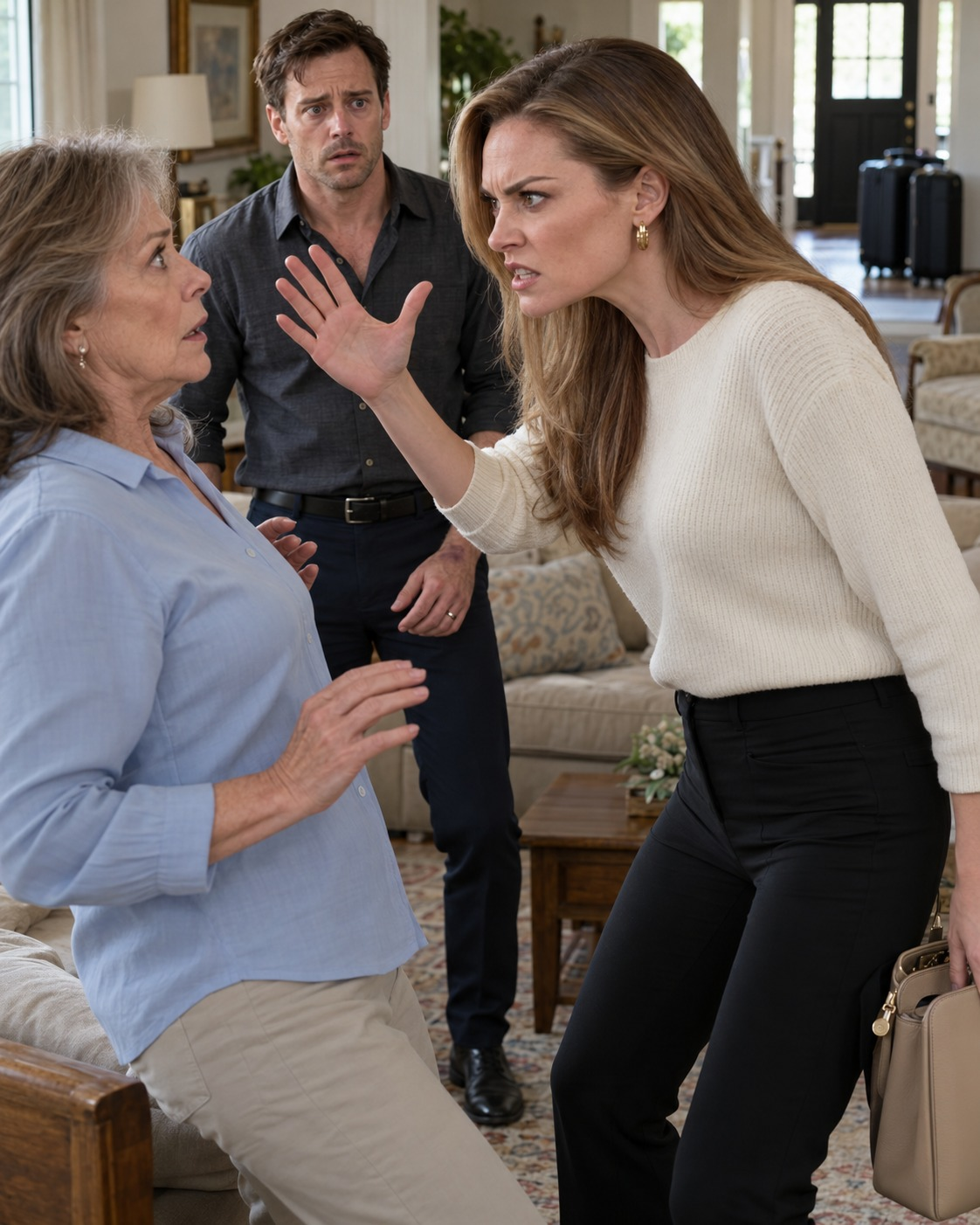
My daughter-in-law's hand was already inches from my face when my son whispered:
"Please, Lennox. Not again."
I froze.
Terrence had just stepped backward, and his sleeve had caught on the wooden chair beside him.
When I saw the dark marks around his wrist, I understood that the argument in my living room was about something much bigger than money.
And the phone in his trembling hand was about to change everything.
Twenty minutes earlier, I had been worried about something entirely different.
I had been worried about my furniture.
That might sound ridiculous, considering what happened afterward, but I had spent thirty years keeping that little house together. Every chair, every curtain, every photograph on the wall had a story. Nothing was particularly expensive. Most of it had been purchased slowly, after years of working, saving, and telling myself that someday I would finally have a comfortable place to call my own.
I was sixty-four years old.
My husband had been gone for six years, and since his passing, I had learned to manage everything myself. I paid my bills on time, kept my garden trimmed, and never spent money simply because I wanted something.
I wasn't wealthy.
I was secure.
There was a difference, and I had worked too hard to forget it.
That afternoon, I was arranging a few photographs on the coffee table when the doorbell rang.
I wasn't expecting anyone.
When I opened the door, Terrence stood on the porch with two enormous suitcases.
His wife, Lennox, stood behind him holding an expensive handbag.
A garment bag hung over her shoulder.
For a moment, I thought they were stopping by before going on vacation.
Then I noticed Terrence wasn't smiling.
"Mom," he said.
He leaned forward and gave me a stiff hug.
"Can we come in?"
"Of course. What's wrong?"
"Nothing. We just need to talk."
Lennox walked past me without waiting for an invitation.
She glanced around the living room, then placed her handbag on my sofa.
"Your place looks exactly the same," she remarked.
I wasn't sure whether that was supposed to be a compliment.
"Thank you," I replied.
Terrence was already dragging the suitcases toward the hallway.
I watched him for several seconds.
"Why do you have all that luggage?"
He didn't answer immediately.
"We need somewhere to stay."
I looked at Lennox.
Then at my son.
"For how long?"
"Maybe a few months."
I felt something tighten in my chest.
"A few months?"
Terrence nodded.
"We're going through a difficult period."
I slowly closed the front door.
"What's happened?"
Lennox sighed as if I had asked her to explain something painfully obvious.
"We sold the house."
I stared at her.
"What house?"
"Our house," Terrence said. "The colonial."
The beautiful colonial home in the expensive neighborhood.
The house I had helped them purchase.
Three years earlier, Terrence had come to me with photographs of the property. He had been excited in a way I hadn't seen since he was a teenager.
He showed me the wide staircase, the renovated kitchen, the backyard, and the little office he planned to use when working from home.
He had told me it was the beginning of a better life.
I believed him.
I had taken forty thousand dollars from my retirement savings to help with the purchase.
It wasn't a casual gift.
That money represented decades of work.
It represented the vacations I never took, the clothes I never bought, and the little luxuries I had postponed because I wanted to make sure I could take care of myself when I grew older.
But Terrence was my only son.
I wanted him to have something good.
I wanted him to build a stable future.
Now he stood in my living room with two suitcases, telling me the house was gone.
"Why did you sell it?" I asked.
Terrence rubbed the back of his neck.
"We had some financial problems."
"How much did you sell it for?"
Lennox answered immediately.
"Six hundred and twenty thousand dollars."
I blinked.
For a moment, I thought I had misunderstood.
"Six hundred and twenty thousand?"
"Yes," she said.
I looked at Terrence.
"That's a substantial amount of money."
"I know."
"Then why are you here with nowhere to live?"
Neither answered.
I sat down slowly.
The room suddenly felt smaller.
"Where did the money go?"
Lennox folded her arms.
"That's a complicated question."
"No, it isn't. You sold a house for six hundred and twenty thousand dollars. I want to know where the money went."
Terrence lowered his eyes.
"We had debts."
"How much?"
He hesitated.
"Almost eighty thousand in credit-card debt."
I looked at him.
"Credit cards?"
Lennox rolled her eyes.
"It wasn't just credit cards. There were expenses."
"What kind of expenses?"
She began listing them.
Vacations.
Designer clothing.
Jewelry.
Restaurants.
Expensive gifts.
Newer vehicles.
There were always expenses, apparently.
Every time one bill was paid, another appeared.
Every time they received money, they found another way to spend it.
I tried to understand the numbers.
Eighty thousand dollars in credit-card debt.
That was already more than most people could comfortably manage.
But Terrence wasn't finished.
"There was also the boutique."
I turned toward him.
"What boutique?"
"Lennox invested in a business with a friend."
Lennox interrupted.
"It was a fashion boutique. It had potential."
"How much did you invest?"
She hesitated for the first time.
"Three hundred thousand."
I stared at her.
"Three hundred thousand dollars?"
"It was an investment."
"How much did it earn?"
She looked away.
"Almost nothing."
I felt a strange emptiness in my stomach.
Three hundred thousand dollars.
The money from the sale of their house had apparently disappeared into debt, shopping, luxury vacations, vehicles, and a business that barely produced any profit.
I looked at my son.
"How much do you have left?"
Terrence didn't answer.
Lennox crossed her arms more tightly.
"Nothing. It's all gone."
The words seemed to hang in the air.
Nothing.
I looked around my living room.
The sofa beneath her handbag had been purchased after I worked an extra year before retirement.
The wooden coffee table had belonged to my husband.
The curtains had been sewn by my sister.
The photographs on the wall showed birthdays, graduations, and holidays.
This was not a luxurious house.
It was simply my house.
And suddenly I understood what they wanted.
They wanted to move in.
Not for a weekend.
Not for a few days while they found an apartment.
They wanted my home to become the next place where they could avoid the consequences of their decisions.
I stood up.
"You're adults. You need to find a rental property you can afford."
Lennox gave a short laugh.
"With what money?"
"Sell the jewelry."
She looked offended.
"Excuse me?"
"Sell the expensive things. Downgrade the cars. Sell the designer clothes if you need to. Find a smaller apartment. Start again."
"You cannot be serious."
"I am."
Terrence stepped closer.
"Mom, we're not asking for much. Just a few months."
I looked at him.
"You told me that when you needed the forty thousand dollars."
His expression changed.
I hadn't intended to hurt him.
But I needed him to understand that my help had never been unlimited.
"I gave you money because I believed you were building a future. I didn't give it to you so that one day you could spend everything and expect me to absorb the consequences."
Lennox picked up her handbag.
"Wow."
She shook her head.
"Your own son is struggling, and this is how you treat him?"
I felt my voice becoming firmer.
"I am not making anyone homeless. I am refusing to let two adults turn my home into their financial rescue plan."
Terrence looked down.
"Mom, please."
I wanted to say yes.
That was the difficult part.
A mother doesn't stop loving her child simply because he makes terrible decisions.
I wanted to make everything easier for him.
I wanted to put my arms around him and tell him we would figure it out.
But I also knew what would happen if I surrendered.
They would move in.
A few months would become six.
Six would become twelve.
And eventually I would be afraid to ask when they planned to leave.
I had seen enough families fall into that arrangement.
I wasn't going to spend the remaining years of my life feeling like a guest in my own home.
"No," I said again.
Lennox's expression changed.
It was subtle at first.
Her lips tightened.
Her eyes narrowed.
The polite face she had worn when she entered my house disappeared.
"How can you do this to your own son?"
"How can you expect me to pay for mistakes I didn't make?"
"He's your child!"
"And he's a grown man."
She stepped closer.
"He's going to have nowhere to go."
"He has options."
"What options?"
"Find somewhere affordable. Sell what you don't need. Get another job if necessary. Work through the debt."
Lennox shook her head.
"You really think it's that simple?"
"No. I think it's difficult. But difficult doesn't mean impossible."
Terrence remained silent.
That silence bothered me more than Lennox's anger.
He was standing beside the chair, his shoulders tense, his eyes moving between us.
He looked like a person waiting for something unpleasant to happen.
I had noticed that expression before.
At family gatherings, whenever Lennox became irritated, Terrence would become unusually quiet.
I had always assumed he was trying to avoid arguments.
I had never considered that he might actually be afraid.
Lennox took another step toward me.
"You have a house with more rooms than you need. You're sitting here comfortably while your own son has nowhere to sleep."
"I worked for this house."
"And we're family."
"Family doesn't mean you can demand everything from someone."
Her face hardened.
Then she raised her voice.
"You have no idea what we've been through!"
I looked at her.
"Then explain it."
She didn't.
Instead, she moved closer.
I could see the muscles in her jaw tightening.
Terrence suddenly spoke.
"Lennox."
It was barely more than a whisper.
She ignored him.
"Do you know what people will say when they find out you refused to help us?"
"I don't care."
"You should."
"Why?"
"Because you're abandoning your own son."
I took a breath.
"I am not abandoning him. I am refusing to surrender my security."
Something changed in her eyes.
It happened so quickly that I almost missed it.
Her right shoulder moved.
Her hand came up.
For one terrible second, I thought she was going to strike me.
I stepped backward.
Then Terrence spoke.
"Put your hand down, Lennox. Please."
But his voice was not angry.
It was frightened.
Deeply frightened.
And that was when the entire argument changed.
Lennox turned toward him.
"What?"
Terrence swallowed.
His face had lost its color.
"Please. Not again."
I looked at my son.
"What do you mean, not again?"
He didn't answer.
Instead, he stepped backward.
His sleeve caught on the wooden chair.
The fabric pulled upward.
And I saw them.
Dark marks around his wrist.
Several of them.
They looked like the impressions of fingers pressed hard against his skin.
My heart seemed to stop.
I had seen bruises before.
I had seen them on children who fell off bicycles and on elderly neighbors who stumbled on their front steps.
But these marks were different.
They were clustered around his wrist.
Their shape was unmistakable.
"Terrence?"
He immediately pulled his sleeve down.
"Mom, it's nothing."
I looked at Lennox.
She was staring at him.
Not with concern.
Not with embarrassment.
With anger.
The kind of anger that seemed to say he had made a terrible mistake by allowing me to see something.
"Terrence," I repeated, more quietly. "What happened to your wrist?"
"Nothing."
"Let me see."
He shook his head.
"Please don't."
That answer frightened me more than the bruises.
I took a step toward him.
Lennox grabbed her handbag.
"We're leaving."
But Terrence didn't move.
She turned toward him.
"I said we're leaving."
He looked at the floor.
His fingers trembled.
I had never seen my son look so small.
"Lennox," I said carefully, "I think we need to talk."
She gave me a cold stare.
"There is nothing to talk about."
Then she looked at Terrence.
"Come on."
He remained where he was.
And for the first time since she had entered my home, Lennox seemed uncertain about what he would do.
Terrence slowly reached into his pocket.
He pulled out his phone.
His hands were shaking so badly that he nearly dropped it.
Lennox saw the screen.
Her expression changed.
The anger vanished.
Her lips parted slightly.
She stared at the device as if she had just seen something she had spent months trying to keep hidden.
Terrence looked at me.
His eyes were wet, but he wasn't crying.
"Mom," he whispered.
I moved closer.
"What is it?"
He swallowed.
Then he turned the phone slightly toward me.
Lennox took one sudden step forward.
"Terrence, don't."
My son tightened his grip on the phone.
And I realized that whatever was inside it was the real reason he had come to my house.
Not the money.
Not the suitcases.
Not the lost house.
The phone.
Terrence unlocked the screen.
Then he opened a folder with a name I had never seen before.
He had saved everything.
And Lennox knew exactly what was inside.






Comments 0