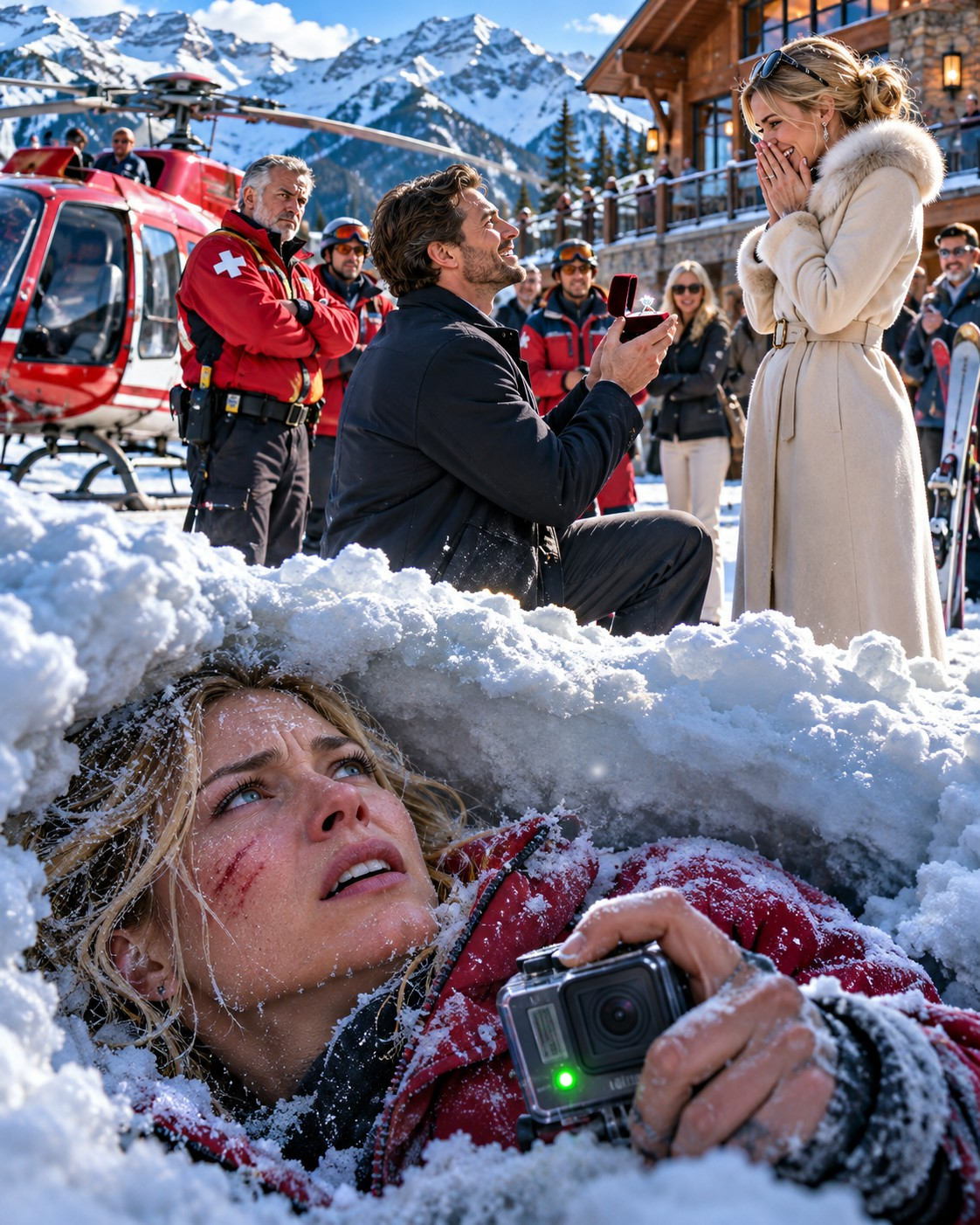
I clawed at the snow pressing against my mouth and whispered, "Please. Don't leave me."
Hundreds of yards below, my husband, Rowan Hale, stood beside the rescue coordinator with my phone's emergency information displayed on a screen.
One detail on that screen was wrong.
My avalanche beacon showed no signal.
Rowan knew exactly why.
And I was still alive.
My name is Elise Hale. I was forty-six years old, and until that afternoon, I believed the worst thing that could happen on a mountain was an avalanche.
I was wrong.
The worst thing was realizing that someone you trusted had planned for the mountain to finish what he couldn't do himself.
I couldn't see the sky.
I couldn't move my legs.
My left arm was trapped beneath my chest, and my right hand was pressed against a wall of snow so tightly packed that it felt like concrete.
There was a small hollow beside my face.
Not much bigger than a cereal bowl.
It was the only reason I could breathe.
Every time I inhaled, the space seemed to shrink.
Every time I exhaled, warm moisture collected against the frozen surface inches from my lips.
I knew what that meant.
The air wouldn't last forever.
I had spent more than twenty years skiing difficult terrain. I knew the risks. I knew the warning signs. I knew the statistics nobody liked discussing over dinner.
But knowledge didn't make the weight of six feet of snow any lighter.
And experience didn't stop fear from crawling into my throat.
I tried moving my left shoulder.
Pain shot through my arm.
I stopped immediately.
Something was wrong with my wrist, possibly broken, and the ski attached to my right boot had twisted my knee into a position no joint was meant to hold.
I couldn't tell whether the pain was getting worse or whether the cold was simply making it harder to feel.
Then I heard it.
A helicopter.
At first, it was only a faint vibration traveling through the snow.
Then the sound grew louder.
A deep mechanical thudding.
I closed my eyes.
Someone was coming.
Someone had called for help.
For one extraordinary second, I forgot the pain.
I forgot the cold.
I forgot that I was buried beneath a mountain.
I imagined rescuers digging through the snow, calling my name, reaching down with gloved hands.
I imagined sunlight.
I imagined breathing air that didn't taste like wet ice.
I tried to scream.
"Here!"
The sound barely escaped my mouth.
I tried again.
"Please!"
Nothing.
The snow swallowed every word.
The helicopter continued approaching.
I could feel the vibration through my ribs.
Then it stopped getting louder.
For several seconds, it hovered somewhere beyond my reach.
I waited.
And waited.
Then the sound changed.
The rotor noise began to fade.
At first, I told myself the pilot was repositioning.
Maybe they were searching another section of the slope.
Maybe they needed to land.
Maybe they were circling.
But the sound kept getting weaker.
Until there was nothing.
Only the wind.
I stared into the darkness.
They had left.
I didn't understand.
Rowan knew where I was.
He had been standing less than fifty yards away when the slope broke.
He had watched me disappear.
Surely he had told the rescue team.
Surely he was demanding that they keep searching.
My husband might have been impatient, controlling, and increasingly distant over the last year, but he wasn't a monster.
That was what I told myself.
Because the alternative was too terrible to consider.
Three hours earlier, Rowan had kissed my forehead outside our suite at the Silver Pine Lodge.
"Beautiful day for a little adventure," he'd said.
I remembered the way he'd smiled.
Not a broad smile.
Just the small, familiar expression that had once made me feel safe.
We had been married for eleven years.
Eleven years of birthdays, holidays, shared bank accounts, arguments about kitchen renovations, and quiet Sunday mornings.
Eleven years of believing I knew the man sleeping beside me.
Rowan was forty-nine, the founder of Hale Strategic Holdings, a company that managed commercial property investments across Colorado and neighboring states.
He was the sort of man who could walk into a room full of strangers and leave with three business cards, two dinner invitations, and someone offering him money.
People trusted him.
I had trusted him more than anyone.
When my mother died, Rowan handled the funeral arrangements.
When my father suffered a stroke, Rowan drove through a snowstorm to reach the hospital.
When I sold my small outdoor equipment business, Rowan told me I had earned the right to enjoy life.
He made me feel protected.
That was the dangerous part.
He had spent years teaching me that protection and control were the same thing.
I hadn't noticed the difference until much later.
That morning, we were supposed to enjoy a private ski excursion before returning to Denver.
Rowan had insisted on making the trip.
"We need time together," he'd said.
I had agreed.
Our marriage had been strained for months.
He worked late.
He traveled constantly.
His phone was always turned facedown.
And whenever I asked about the distance growing between us, he accused me of imagining problems.
I wanted to believe we could repair whatever had changed.
So I packed my ski gear.
I wore my emerald-green insulated jacket, charcoal thermal pants, and black gloves.
My short chestnut hair barely fit beneath my helmet.
Rowan wore a dark forest-green ski jacket and black snow pants.
He looked handsome, relaxed, and unusually affectionate.
He even carried my skis to the equipment area.
That should have made me happy.
Instead, I remembered feeling slightly unsettled.
Rowan had never been particularly interested in skiing.
He enjoyed luxury resorts, expensive restaurants, and photographs taken beside fireplaces.
He didn't enjoy cold fingers or steep mountain traverses.
Yet he had spent weeks planning this trip.
He had studied trail maps.
He had asked questions about avalanche conditions.
He had insisted we take an upper route that I hadn't used in years.
I thought he was trying to share something I loved.
Now, buried beneath the snow, I wondered whether he'd been studying something else.
The morning began with a routine equipment check.
I had already tested my avalanche transceiver.
The battery indicator was strong.
The device was transmitting.
I checked it twice.
Then Rowan approached.
"Let me see your beacon."
I laughed.
"Since when did you become the equipment expert?"
"Since my wife started treating every mountain like her personal playground."
He held out his hand.
I gave him the device.
He examined it with exaggerated seriousness.
"Rowan, I know what I'm doing."
"I know you do."
His gloved thumb moved across the controls.
"Just humor me."
I looked away for a moment because someone behind us dropped a pair of skis.
When I turned back, Rowan was fastening the device securely beneath my jacket.
"All good," he said.
"Happy?"
"Very."
He kissed my cheek.
I remembered that kiss now.
And for the first time, it made me feel sick.
I turned my head as far as the snow would allow.
Somewhere beneath my jacket, the transceiver should have been transmitting a steady emergency signal.
If rescuers were nearby, they should have been able to detect it.
But I hadn't heard anyone digging.
I hadn't heard anyone calling my name.
And the helicopter had left.
My stomach tightened.
Could the beacon have been damaged in the avalanche?
Of course.
That was possible.
Electronics could fail.
Batteries could become dislodged.
A violent tumble could destroy equipment.
I knew that.
But another memory pushed its way forward.
The closed traverse.
We had been approaching a narrow section of the upper basin when Rowan pointed toward a slope beyond the marked route.
"Let's cut across there."
I stopped.
A closure rope stretched between two poles.
A warning sign was partially buried in fresh snow.
"Absolutely not."
Rowan looked back.
"Why?"
"Because it's closed."
"It's a shortcut."
"It's avalanche terrain."
He glanced toward the slope.
Then back at me.
"Elise, you've skied worse."
"That doesn't make it safe."
He sighed.
Not angrily.
Almost affectionately.
"You worry too much."
I remembered looking toward the ridge.
The snow above us had formed a thick overhanging cornice.
The recent storm had loaded the upper slopes.
The wind had been moving snow across the ridge all morning.
Everything about the terrain made me uncomfortable.
"We should turn around," I said.
Rowan was already moving.
"Come on, sweetheart."
He looked over his shoulder.
"Trust me."
Those were the last words he spoke before the mountain broke.
I remembered a cracking sound.
Sharp.
Sudden.
Like a massive sheet of glass splitting.
Then the ground moved.
I had barely enough time to turn my head.
The cornice collapsed above the traverse.
Snow surged downward.
I tried to push sideways.
My skis crossed.
The world disappeared.
I tumbled through a white explosion of snow and ice.
My helmet struck something hard.
One ski released.
The other stayed attached.
I felt myself being dragged downward.
I tried to keep my arms in front of my face.
Then the avalanche slowed.
The snow began to settle.
I managed one desperate movement, bringing my shoulder toward my mouth.
Then everything stopped.
And I was buried.
I had no idea how much time passed before I regained full awareness.
Maybe seconds.
Maybe minutes.
The first thing I noticed was the pressure.
The second was the darkness.
The third was that I couldn't move.
Now, with the helicopter gone, I forced myself to stop remembering.
Memories wouldn't save me.
Air might.
I focused on breathing slowly.
In.
Out.
I counted.
One.
Two.
Three.
My heart was racing.
I tried to slow it.
Panic increased oxygen consumption.
I knew that.
I had taught mountain safety workshops years earlier.
I had told students that the first battle after an avalanche burial was often against their own fear.
I had never imagined repeating those lessons to myself beneath six feet of snow.
I moved my right fingers.
They responded.
Barely.
My glove was pressed against the snow beside my chest.
I tried bending my wrist.
A few inches of movement.
That was something.
I began feeling along the inside of my jacket.
I wasn't sure what I was looking for.
A whistle?
My phone?
A tool?
Then my fingers touched hard plastic.
My action camera.
I had almost forgotten it.
That morning, I had removed the camera from its helmet mount because the bracket kept icing over.
Instead, I'd clipped it beneath my collar.
Rowan had noticed.
"Still recording your adventures?"
"Of course."
He laughed.
"Another thrilling video of snow."
"Maybe something interesting will happen."
He had shaken his head.
"You're impossible."
Now the memory made my chest ache.
I carefully pulled the camera toward the small space beside my face.
The device was cold.
Its casing was scratched.
But when I tilted it, I saw something that made me forget the pain for one second.
A tiny green light.
Blinking.
The camera was still recording.
I stared at it.
Once.
Twice.
Three times.
It had been running since we left the lodge.
I had activated continuous recording before our equipment check.
That meant it might have captured Rowan handling my beacon.
It might have captured our argument about the closed traverse.
It might have recorded his final words before the avalanche.
And if the microphone had continued working after I was buried, it might have captured something else.
I didn't know what.
I didn't even know whether the footage would survive.
But for the first time since the helicopter left, I had something more than hope.
I had evidence.
Or the possibility of it.
I pressed the camera's side button carefully to mark the recording.
The green light blinked again.
I held the device against my chest.
"Keep going," I whispered.
I wasn't sure whether I was speaking to the camera or myself.
My right hand was beginning to go numb.
I needed to do something.
I couldn't simply wait.
I started scraping at the snow above my wrist.
Small movements.
Careful movements.
I pushed loose grains toward the empty space near my elbow.
The snow was packed so tightly that my glove barely made an impression.
I tried again.
And again.
Minutes passed.
My breathing became louder.
I stopped to conserve air.
Then I heard something.
At first, I thought it was the wind.
A faint vibration.
Then another.
Voices.
I froze.
Someone was above me.
I couldn't make out words.
But I heard movement.
A scraping sound.
Then a dull impact.
My heart began hammering.
Rescuers.
They hadn't abandoned me after all.
Maybe the helicopter had only repositioned.
Maybe a ground team had continued searching.
I tried shouting.
"Here!"
The sound was pathetic.
I tried hitting the snow with my free hand.
Nothing.
The voices moved.
Closer.
I held my breath.
Then a narrow metal object punched through the snow beside my face.
It stopped inches from my nose.
An avalanche probe.
I knew exactly what it was.
A rescuer was standing directly above me.
Someone had inserted a metal probe into the snow, searching for a buried body.
I stared at the tip.
It was so close I could see scratches along the metal.
I tried reaching for it.
My fingers strained.
My shoulder screamed with pain.
I couldn't touch it.
I tried making a sound.
Any sound.
"Please."
The probe remained motionless.
For one second, I believed whoever held it had felt something.
Maybe the tip had touched my jacket.
Maybe they knew.
Maybe they were about to dig.
Then the metal moved.
Upward.
Slowly.
I watched it disappear.
No.
I tried to scream.
The probe slid completely out of sight.
Above me, footsteps crunched across the snow.
They were moving away.
I couldn't understand how someone could come so close and miss me.
I couldn't understand why they weren't searching harder.
I couldn't understand why Rowan wasn't there demanding that they keep trying.
Then I heard a voice through the snow.
Faint.
Distorted.
But familiar.
A man's voice.
Not Rowan's.
Someone else.
"Coordinator wants us back at the pad."
Another voice answered.
"What about the missing woman?"
There was a pause.
Then the first man spoke again.
"Her husband says she made it out."
My blood turned cold.
I stared at the place where the probe had disappeared.
Her husband says she made it out.
Rowan.
I wanted to believe I'd misheard.
Sound traveled strangely through snow.
Words could become distorted.
Voices could overlap.
But the next sentence was unmistakable.
"He showed them a message from her account."
I stopped breathing.
A message?
I hadn't sent any message.
My phone was somewhere inside my jacket, inaccessible beneath the snow.
I hadn't touched it since before the avalanche.
And Rowan knew that.
The footsteps began fading.
I tried moving again.
Pain tore through my wrist.
I didn't care.
I pushed against the snow with everything I had.
Nothing moved.
Then another sound reached me.
A distant cheer.
Several voices.
A woman gasped.
Someone laughed.
It was impossible to tell exactly where the sounds came from, but they seemed to drift from the direction of the lodge.
I couldn't imagine what anyone could possibly be celebrating.
Not while a woman was missing.
Not while rescuers were leaving the mountain.
Not while I was still buried alive.
I pressed the camera against my chest.
The green light continued blinking.
I stared at it until my eyes began to burn.
And then I remembered something Rowan had said three nights earlier.
We had been eating dinner in our Denver home.
He had received a message and turned his phone away.
I had asked whether everything was all right.
He smiled.
"Just business."
Then he added something strange.
"Sometimes the easiest way to solve a problem is to let people believe it's already been solved."
At the time, I thought he was talking about a difficult client.
Now I wasn't sure.
I closed my eyes.
For the first time, I allowed myself to think the unthinkable.
What if Rowan hadn't made a mistake?
What if the beacon hadn't failed?
What if the closed traverse hadn't been an impulsive shortcut?
What if the message wasn't a misunderstanding?
What if my husband had brought me here because he never intended for me to leave?
A small tremor passed through my body.
I forced myself to breathe.
Slowly.
Carefully.
Then, through the snow above me, I heard another faint metallic sound.
A probe striking something hard.
Closer than before.
I opened my eyes.
The sound came again.
And then a voice shouted from directly overhead.
"Wait! There's something down here!"






Comments 0