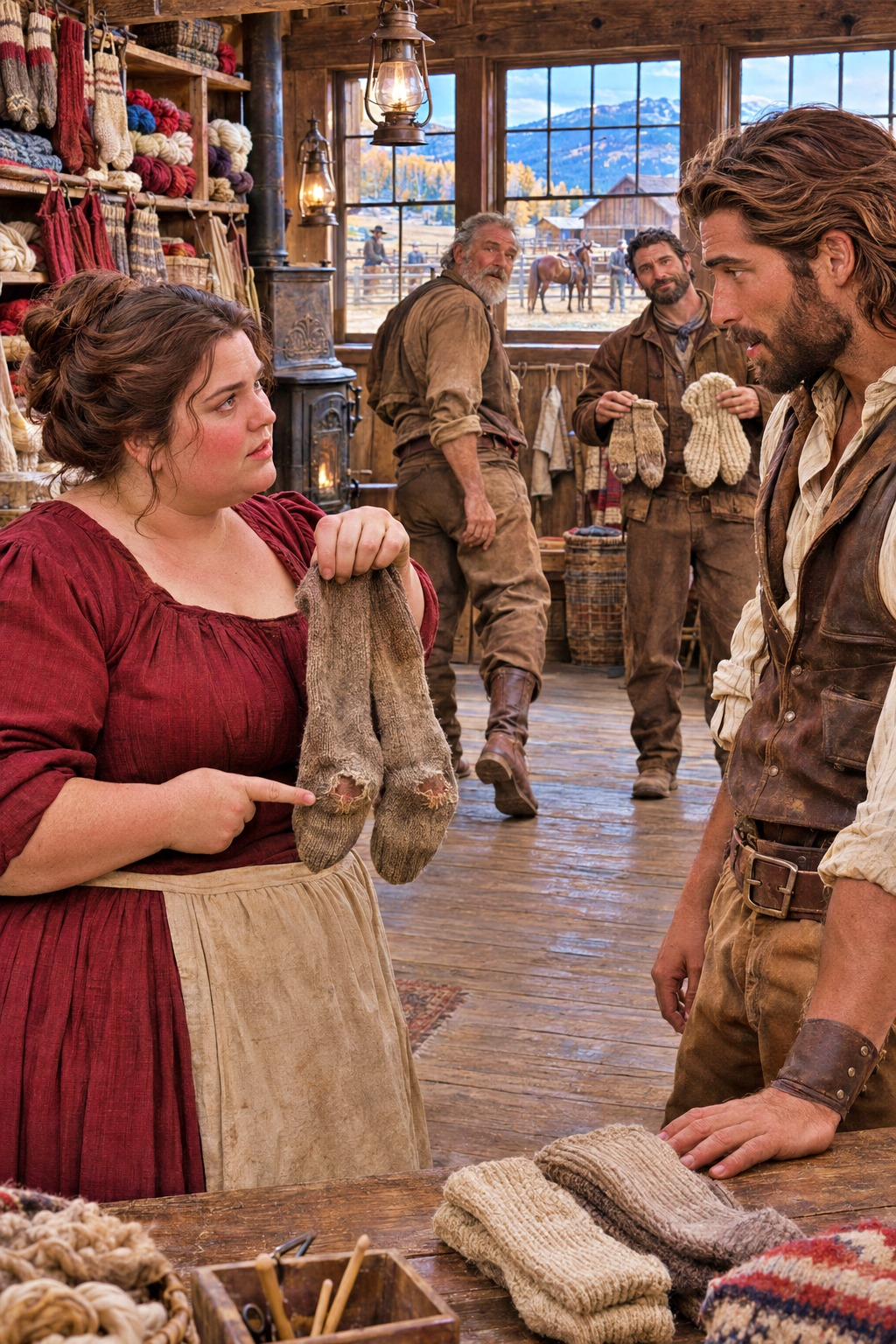
"Don't throw those away!" Mara called, catching the ranch hand's attention as he reached for the waste basket.
Thomas Vale stopped with one hand extended.
Caleb Mercer turned toward the sound.
On the wooden counter lay a pair of wool socks with one heel almost completely worn through.
But there was something written on the inside of the leather tag attached to the basket.
Three small letters.
T.V.
Caleb suddenly realized Mara had been keeping track of every damaged item.
And she wasn't finished.
"Thomas, would you mind coming over here?"
Mara Bell held up the socks.
The older ranch hand approached the counter, his silver mustache twitching as he studied the familiar brown wool.
"Those again?" he asked.
Mara nodded.
"These are the newest ones?"
"Yes, ma'am."
"And the other pair?"
Thomas pointed toward the basket.
"Last week's."
Mara reached down and retrieved them.
She placed both pairs side by side.
There was no mistaking the pattern.
The right heel on each pair had been worn almost completely through. The left heel remained thick enough to last another season.
Mara turned the socks around.
She studied the stitches, the fibers, and the uneven damage.
Caleb stood opposite her with his arms folded.
He was a man accustomed to solving problems quickly.
When the ranch needed something, he bought it.
When a roof leaked, he hired a carpenter.
When a horse needed new shoes, he sent for the blacksmith.
When a ranch hand complained about cold feet, Caleb ordered better socks.
He had never considered that the same problem might return because the original solution had been wrong.
"Thomas has been working here for seventeen years," Caleb said. "He's harder on equipment than most men. That's all."
Thomas looked down.
"I do my best, Mr. Mercer."
"I know you do."
Caleb glanced at the socks.
"I've already replaced them twice. The wool is good quality. If he needs another pair, I'll buy ten."
Mara did not argue.
She simply placed the newest pair beside the older one.
"That might help," she said.
Then she looked at Thomas.
"But I'd like to understand something first."
Thomas shifted his weight.
"What is it?"
"Does your right foot ever hurt?"
The older man's expression changed.
It was barely noticeable.
A slight tightening around his eyes.
"No, ma'am."
Mara waited.
Thomas looked toward Caleb, then back at her.
"Not enough to matter."
That answer interested her more than a complaint would have.
Caleb noticed it too.
"What does that mean?" he asked.
Mara folded the socks neatly.
"It means I would like to see how he walks."
Thomas looked uncertain.
"Walk?"
"Just across the room. Nothing difficult."
Caleb gave a small nod.
Thomas stepped away from the counter.
He walked toward the cast-iron stove, turned, and returned.
His movements appeared ordinary.
He had a slight stiffness in his shoulders, but most older ranch hands did.
Mara watched his boots.
Not his face.
Not his hands.
His boots.
"Would you do that again?" she asked.
Thomas repeated the movement.
This time, Mara crouched slightly to observe the way his feet met the floor.
The right boot landed at a different angle.
It was subtle.
Almost impossible to notice unless someone was looking for it.
Caleb leaned forward.
"Something wrong?"
Mara did not answer immediately.
She looked at Thomas.
"Which foot do you put forward first when you mount your horse?"
"The left."
"And when you dismount?"
"Usually the left, too."
"Do you favor one stirrup?"
Thomas hesitated.
"Depends on the horse."
Mara looked at Caleb.
"Do you have different lengths of stirrup leather for different riders?"
Caleb frowned.
"Of course. Every rider gets equipment fitted to him."
"Every rider?"
"That's what I said."
Mara nodded slowly.
She had learned something during her short time at Mercer Ridge.
Caleb was not an uncaring man.
He was generous, hardworking, and proud of the fact that his ranch hands had everything they needed.
But he often confused providing something with understanding whether it worked.
Mara had seen it in the gloves.
She had seen it in the coats.
And now she was beginning to see it in the boots.
"May I look at them?" she asked Thomas.
He glanced down.
"They're nothing special."
"They don't need to be."
Thomas sat on a wooden chair near the stove and removed his right boot.
Mara took it carefully.
The leather was worn along the outside edge.
The heel had a distinct pattern of damage.
She examined the sole.
Then she looked at the left boot.
The difference was unmistakable.
The left sole had worn evenly.
The right sole showed repeated pressure along one side.
"Have you had these boots long?" she asked.
"Since last spring."
"Did they fit properly when you got them?"
Thomas considered the question.
"Well, they were a little loose."
Caleb immediately looked up.
"Why didn't you tell me?"
Thomas rubbed the back of his neck.
"They were good boots, sir. Better than the ones I had before."
"That doesn't answer my question."
"I didn't want to make trouble."
The words settled over the workroom.
Mara looked down at the boot again.
She knew that answer.
She had heard it in different forms from people who had spent their lives adapting to whatever circumstances were given to them.
A woman in a small bedroom who said the room was perfectly fine even when the window would not close.
A housekeeper who worked by a dim window because she did not want to inconvenience anyone.
A ranch hand who wore uncomfortable boots because he believed asking for another pair would make him appear ungrateful.
Mara understood something Caleb was only beginning to recognize.
People did not always tell you what they needed.
Sometimes they had learned not to.
"May I ask you something else?" she said.
Thomas nodded.
"Do you wear thicker socks in winter?"
"Yes."
"And thinner ones when you're working inside the barn?"
"Whenever I remember to change them."
Mara looked at the inside of the boot.
Then she looked at the damaged heel of the sock.
"Would you put the boot back on?"
Thomas did so.
He stood.
Mara watched him take several steps.
His right foot slid slightly inside the boot before making contact with the floor.
She looked toward the counter.
"Caleb, could you bring me the measuring tape?"
Caleb did not move immediately.
He was watching her.
Then he turned toward the workbench and retrieved the tape.
"Here."
Mara thanked him.
She measured Thomas's feet.
The right foot was slightly longer and broader than the left.
Not dramatically.
But enough to matter.
She measured again to make sure.
Then she compared the measurements with the boot.
Thomas looked embarrassed.
"Is something wrong with my foot?"
"No," Mara said gently.
"Not that I can tell."
She turned toward Caleb.
"These boots were probably ordered according to the size he usually wears. But his feet aren't exactly the same."
Caleb examined the numbers.
"That much difference?"
"Enough that one boot may allow his heel to move while the other holds it in place."
Thomas looked down.
"I always thought they were supposed to feel like that."
Mara shook her head.
"Not if they're hurting you."
Caleb took the boot from her.
He examined the interior.
For the first time, he saw the problem as something other than an item that had simply worn out.
He looked at Thomas.
"How long has this been happening?"
Thomas shrugged.
"Since I started wearing them."
"All summer?"
"Mostly."
Caleb's jaw tightened.
"Why didn't you say something?"
Thomas looked uncomfortable.
"You'd already bought them, sir."
There was no accusation in his voice.
That somehow made it worse.
Caleb put the boot down.
For several seconds, he said nothing.
Mara returned to the socks.
She had not solved everything.
She still needed to understand how the boots affected Thomas while riding, whether his old discomfort had changed the way he walked, and whether his stirrups needed adjusting.
But she had found the beginning of an answer.
And that was enough to change the conversation.
"Thomas," she said, "I'd like to check your riding equipment tomorrow. If that's all right."
"Of course."
"Not because you've done anything wrong."
"I understand."
She smiled faintly with her eyes, though her mouth remained serious.
"I just don't want you wearing out another pair of socks for the same reason."
Thomas gave a quiet laugh.
Caleb did not.
He was still looking at the boot.
Later that afternoon, Mara returned to her worktable.
The wool shop had grown quieter.
Warren Cole had taken the mittens back to the barn.
Thomas had returned to his duties.
Caleb remained near the counter, studying a stack of supply invoices.
Mara sorted the damaged clothing into separate baskets.
One basket contained items damaged by friction.
Another contained clothing that had never been used.
A third held pieces that needed alterations rather than repairs.
Caleb glanced over.
"Why do you keep separating them that way?"
"Because they're different problems."
"They're all winter supplies."
"Yes."
"So why not put everything that needs attention together?"
Mara looked up.
"Because a hole in a glove and an unused pair of mittens don't tell us the same thing."
Caleb leaned against the counter.
"Explain."
Mara lifted a thick wool mitten.
"This one belongs to Warren. It's in excellent condition."
"Then it's doing its job."
"Not necessarily."
Caleb raised an eyebrow.
"He wears it when he rides," she continued. "But when he works with buckles, he takes it off because it's too thick."
"So?"
"So his hands are cold when he needs his fingers most."
Caleb looked at the mitten.
Mara placed it beside a thinner pair.
"I repaired these instead. I strengthened the places where the leather straps rub against the wool. He can work in them without removing them."
Caleb remembered seeing Warren wearing them that morning.
He had assumed the man simply preferred them.
"You noticed all that?"
"I watched him work."
"How long?"
"Several mornings."
Caleb shook his head slightly.
He had owned Mercer Ridge for years.
He knew the names of his workers, their families, their responsibilities, and how much each man earned.
He knew which horses needed special feed and which barns needed new roofs.
Yet Mara had learned something important about a pair of mittens simply by watching a man fasten a saddle.
"You're observant," he said.
"I try to be."
"Why?"
Mara looked at him.
It was an unexpected question.
She considered it for a moment.
"Because people don't always notice what is making their lives difficult."
Caleb glanced toward the narrow window.
Outside, the first thin layer of snow had begun collecting along the fence rails.
He remembered his childhood.
He remembered winters when his father patched the same boots so many times that the leather barely resembled its original shape.
He remembered blankets being shared between brothers.
He remembered promising himself that no one working for him would ever have to live that way.
And he had kept that promise.
Or so he had believed.
"I built this ranch so nobody would have to worry about things like that," he said.
Mara folded a wool scarf.
"I know."
"Then what am I missing?"
She did not answer immediately.
Instead, she placed the scarf into a basket and straightened the stack of repaired clothing.
"Sometimes," she said, "people have what they need on paper."
Caleb looked at her.
"But that doesn't mean it works for them."
He remained silent.
Mara continued sorting.
She did not seem aware that she had just challenged the principle on which he had built much of his adult life.
Or perhaps she was aware.
Perhaps she simply had no interest in making a speech about it.
That was something else Caleb found unusual.
Most people who disagreed with him wanted him to know they were doing so.
Mara simply showed him what she had noticed.
That evening, Caleb passed the small room assigned to her.
The door stood slightly open.
Mara was sitting beside her narrow window, mending a wool cuff.
A single oil lamp illuminated her hands.
Her chair was positioned too far from the glass.
She leaned forward to see the stitches.
Caleb stopped.
He remembered moving the chair closer to the window earlier in the week.
Someone had moved it back.
He watched her shift her position rather than interrupt her work.
Then he noticed something else.
The room had a narrow bed, a small washstand, one chair, and a single peg for hanging clothes.
It was clean.
Everything was in order.
But it contained almost nothing that suggested someone expected to remain there.
No photographs.
No decorative objects.
No personal books.
Just the trunk she had brought with her.
Caleb had asked whether the room would do.
Mara had said yes.
He had accepted that answer.
Now, standing in the hallway, he wondered how many times she had said the same thing in places where she had never truly belonged.
He knocked lightly.
Mara looked up.
"Mr. Mercer?"
"Just Caleb is fine."
She set down her needle.
"Was there something you needed?"
"I wanted to ask about Thomas's boots."
"I'll check the stirrups tomorrow."
"Good."
He hesitated.
Then he glanced at the chair.
"Is that comfortable?"
Mara looked down.
"Yes."
"You're leaning toward the window."
She followed his gaze.
"Oh. The light is better there."
Caleb looked at the chair.
Then at the narrow space beside the washstand.
He realized he had never actually asked whether the room was comfortable.
Only whether it would do.
"I'll have someone move the chair," he said.
"There's no need."
"It takes two minutes."
Mara gave him a polite nod.
"Thank you."
Caleb started to leave.
Then she spoke again.
"Caleb?"
He turned.
"Yes?"
"Do you know whether Thomas's saddle was adjusted when he received those boots?"
Caleb frowned.
"Why?"
"Because if his foot has been sliding inside the boot, I would like to see how he sits in the saddle too."
Caleb studied her.
"You think the problem might be bigger?"
"I think we should find out before buying anything else."
He nodded slowly.
"Tomorrow morning, then."
Mara picked up her needle again.
"Tomorrow morning."
Caleb walked away.
But he did not go directly to his office.
Instead, he turned toward the old barn.
He wanted to look at Thomas's saddle himself.
And when he reached the tack room, he discovered that someone had already removed it from its usual place.
There was a folded piece of paper underneath it.
Caleb picked it up.
His name was written across the front.
He unfolded it.
There were only two sentences.
Mr. Mercer, I thought you should know about the right stirrup.
And beneath that, in a different hand, was a name Caleb had not expected to see.
Edward Mercer.






Comments 0