The signature belonged to Daniel Brooks.
My attorney.
The man who had stood beside me since Christmas night.
The man who had helped me challenge the forged power of attorney, preserve my father's records, and stop the sale of my house.
His name appeared beneath the words:
Personal Guarantor.
I stared at the document.
Then at him.
"Daniel?"
He didn't move.
His face had gone pale.
For one terrible second, I thought I understood everything.
The suspicious transfers.
The missing documents.
The people who had pretended to help while hiding their involvement.
Margaret.
Melissa.
My mother.
And now Daniel.
I pushed my chair back.
"Tell me you didn't do this."
He looked at me.
"Claire, I didn't."
I pointed at the paper.
"That's your signature."
"No. It isn't."
I stared at him.
He took a slow breath.
"I recognize what they used."
My stomach tightened.
"What?"
"That signature image came from an engagement agreement I signed for your father five years ago."
The room went silent.
I looked down again.
The signature was familiar.
The capital D.
The long stroke beneath his surname.
Daniel continued.
"Robert consulted me about the financial dispute before his final hospitalization. I wasn't his primary estate attorney, but I reviewed some of the documents."
I felt cold.
"You never told me."
"Because I didn't realize this transaction was connected to that old consultation until we found the earlier records."
I stared at him.
"Daniel, you should have told me as soon as you recognized the connection."
He nodded.
"You're right."
I waited.
He looked directly at me.
"And I should have disclosed it when we began investigating the old transactions. I was focused on the current forgery and failed to recognize the significance of my earlier involvement."
My hands trembled.
"Why would Andrew use your signature?"
Daniel looked at the document.
"Because a lawyer's name on a guarantee might make the paperwork appear more credible to someone who didn't verify it."
I swallowed.
"Did you guarantee Vanessa's debt?"
"No."
"Did you authorize anyone to use your signature?"
"No."
"Can you prove it?"
He nodded.
"I can provide the original engagement agreement and the corresponding records. But Claire, I don't expect you to accept my explanation simply because I say it's true."
I stared at him.
For the first time since Christmas, I felt something other than fear or anger.
Disappointment.
Daniel had helped me.
But he'd also withheld information that mattered.
He seemed to understand.
He pushed the document toward me.
"You should have independent counsel review this. I'll preserve everything, disclose my earlier involvement, and cooperate fully."
I looked down.
Then back at him.
"That's what I want."
He nodded.
"Good."
I stood.
"I need to know that the people helping me aren't deciding which parts of the truth I can handle."
Daniel lowered his eyes.
"You're right."
I picked up Dad's notebook.
And for the first time, I understood that protecting myself didn't require deciding immediately whether someone was trustworthy.
It required making sure trust was never the only thing standing between me and the truth.
Within forty-eight hours, a second attorney had joined the case.
Her name was Rachel Morgan.
She was practical, experienced in real estate litigation, and completely unimpressed by Judith Whitmore's reputation.
Our first meeting lasted almost three hours.
Rachel reviewed the disputed loan documents, the title records, the original power of attorney, and Daniel's old engagement agreement.
Then she looked at me.
"Claire, the most important thing is that your recorded ownership remains intact."
I nodded.
"But the loan?"
"We've contacted the lender and provided notice that you dispute the signatures and any claimed authorization involving your property."
I leaned forward.
"Did they release the money?"
Rachel opened a folder.
"Yes."
My stomach dropped.
"All two hundred and eighty thousand?"
"According to the records provided, the funds were disbursed to an account associated with Northbridge Consulting Group."
Vanessa's company.
I closed my eyes.
"So she got the money."
"Her company received it. We're still examining the complete movement of the funds."
"And my house?"
Rachel looked directly at me.
"The lender has acknowledged the dispute and agreed not to pursue enforcement against the property while the matter is investigated. We've also confirmed that no mortgage or deed of trust arising from this loan has been recorded against your house."
I felt my shoulders loosen.
Not completely.
But enough to breathe.
Rachel continued.
"That doesn't mean every issue is resolved. We still need formal releases and confirmation that no one can rely on the disputed documents later."
I nodded.
"Then that's what we do."
She smiled faintly.
"Exactly."
The evidence developed faster than I'd expected.
Andrew's electronic files contained the original insurance form Vanessa had requested from me.
They also contained the image of my signature, imported into the forged power of attorney.
The file history matched Patricia Whitmore's records from Hartwell Document Services.
Dr. Rebecca Sloan completed her examination and concluded that the signature image on the disputed authorization was reproduced from the insurance document rather than independently written on the power of attorney.
Evelyn Price's travel records and preserved emails supported her account that she had never notarized it.
The seal had been copied from the sample acknowledgment Andrew requested.
And the alleged loan guarantee bearing Daniel's name contained another imported signature image.
Rachel arranged for an independent examiner to compare it with Daniel's original engagement agreement.
The result was the same.
A reproduced image.
Not an independently executed guarantee.
When I read the report, I sat silently for a long time.
Then I called Daniel.
He answered.
"Claire?"
"The examiner confirmed the signature was copied."
He exhaled.
"I know. Rachel sent me the report."
I looked out the window.
"I believe you didn't sign the guarantee."
"Thank you."
I paused.
"But I still wish you'd told me about Dad."
"I know."
"That matters."
"It does."
For a moment, neither of us spoke.
Then Daniel said:
"I've provided Rachel with everything from Robert's consultation. There are no more documents I'm withholding."
I nodded.
"Good."
I wasn't ready to return to the easy trust I'd felt before.
But I was willing to recognize the difference between a serious omission and the deliberate fraud we'd uncovered.
That distinction mattered too.
Vanessa's confession came next.
She made it through her own attorney.
No excuses.
No stories about misunderstandings.
She admitted she'd sent Andrew my signed insurance form.
She admitted she knew he intended to use the signature image on documents connected to the house.
She admitted she'd approved the authorization package and helped arrange Christmas dinner so I wouldn't discover the proposed sale before closing.
And she admitted that Northbridge Consulting Group had received the loan proceeds.
When Rachel read the statement to me, I felt a strange emptiness.
I'd spent so many years arguing with Vanessa about what she'd done.
Watching her deny things.
Minimize them.
Turn them into jokes.
For the first time, she'd put the truth in writing.
But the statement contained something else.
Vanessa had believed Judith would use the house sale to repay the loan.
When the first closing failed, Andrew prepared the backup transfer documents.
And when those failed too, Judith told Vanessa that the entire debt was now her responsibility.
I read that paragraph twice.
Then looked at Rachel.
"Judith was planning to leave her with the debt?"
"That's what Vanessa alleges."
I shook my head.
Vanessa had helped Judith try to take my house.
And Judith had been prepared to sacrifice Vanessa the moment the plan stopped working.
It was cruel.
But it wasn't surprising.
Judith had never treated anyone in our family as a person.
Only as something she could use.
The investigation into Dad's missing money took longer.
Caroline West worked with independent investigators and attorneys to reconstruct the transfers.
The original agreement Evelyn preserved proved important.
It showed Dad had never agreed to use the house as collateral for Vanessa's obligations.
It also contradicted Judith's later claim that she possessed an enforceable option to purchase the property.
The handwritten amendment bearing Richard Hale's signature was examined separately.
Investigators found that the document's property reference information had been inserted after the date it supposedly carried.
Richard had died four years earlier, and there was no reliable evidence that he'd approved the later version.
His signature appeared to have been copied from an older business record.
The original agreement did not contain that amendment.
And Dad's handwritten warning was consistent with the authentic document.
He'd refused to surrender the house.
Every time.
The money trail was more complicated.
Dad's business had transferred hundreds of thousands of dollars through investment and consulting arrangements.
Some payments had been authorized.
Others had not.
Margaret Ellis had administered the trust account, but the records showed she had not personally received the missing investment proceeds.
She had approved transactions she should have questioned and failed to report suspicious instructions promptly.
She admitted that.
She also supplied the original account correspondence, including messages showing Andrew had submitted instructions using Dad's credentials.
Her cooperation helped investigators identify accounts connected to Judith's development businesses.
Eventually, they traced a substantial portion of the disputed money to investments Judith still controlled.
The records also explained the mysterious two-hundred-and-thirty-thousand-dollar transfer.
It had been used to purchase an interest in a Whitmore family development project.
The investment hadn't disappeared.
It had been hidden behind several entities.
When Caroline told me, I closed my eyes.
Dad hadn't been imagining things.
He hadn't been confused by illness.
He'd been right.
And for five years, the people who'd dismissed his concerns had been counting on the fact that he was no longer alive to challenge them.
The criminal investigation proceeded separately from our civil case.
Andrew cooperated through counsel and admitted his role in preparing and submitting fraudulent documents.
Vanessa also cooperated and accepted responsibility for knowingly participating in the scheme.
Judith initially denied directing the forged transactions.
But the emails, document histories, financial records, and witness statements contradicted key parts of her account.
Her lawyers eventually stopped sending threats.
The first time an entire week passed without a message from Judith Whitmore, I almost didn't notice.
Then I realized something remarkable.
I'd slept through the night.
No phone vibrating beside my pillow.
No urgent message from Daniel.
No photograph of a document I didn't recognize.
No demand that I surrender something I owned.
Just sleep.
It felt like a luxury.
My mother asked to see me in January.
Not at the house.
At a small café near the town center.
I agreed.
When I arrived, she was already sitting beside the window.
She wore the camel-colored coat I'd bought her.
The one Judith had used to frighten me.
Her hair was neatly brushed.
Her injured hand had healed.
But she looked older.
Not physically, exactly.
More like she'd finally stopped pretending everything was fine.
"Claire," she said.
"Mom."
I sat across from her.
She'd ordered tea.
I ordered coffee.
For several minutes, neither of us spoke.
Then she reached into her handbag.
And placed an envelope on the table.
I stared at it.
"What is that?"
"A letter."
My chest tightened.
"From whom?"
"Me."
I looked up.
Mom's eyes filled with tears.
"I wrote down everything I should have said to you on Christmas."
I didn't touch the envelope.
She continued.
"I've spent years telling myself I was protecting this family."
I remained silent.
"I protected Vanessa from consequences. I protected myself from embarrassment. I protected Judith's secrets because I was afraid she'd expose mine."
Her voice broke.
"But I didn't protect you."
I looked down.
Mom wiped her eyes.
"You bought that house because you loved me. And I treated it as though you owed it to me."
I swallowed.
"Yes."
She nodded.
"I know."
Then she said something I hadn't expected.
"I want to move out."
I looked up.
"What?"
"Not because you're forcing me. Because I think it's time."
I stared at her.
"Mom, you don't have to decide that today."
"I know."
She took a breath.
"I've found a small apartment near the library. It's not fancy. But I can afford it."
I felt something shift inside me.
For years, Mom had acted as though she couldn't survive without my financial support.
Now she was talking about a place of her own.
A budget.
A plan.
A life she would be responsible for managing.
"I've started meeting with a financial counselor," she continued. "And I've given my attorney all the documents I still had."
I nodded.
"That's good."
She looked at me.
"I know saying I'm sorry doesn't fix what I did."
"No."
"And I know you may never trust me the same way."
I looked at her for a long moment.
"Probably not."
She began crying.
But she didn't argue.
Didn't accuse me of being cruel.
Didn't remind me that she was my mother.
She simply nodded.
"I understand."
I picked up the envelope.
Then said quietly:
"Mom, I don't know what our relationship will look like."
She wiped her eyes.
"Neither do I."
"But if we're going to have one, it has to be honest."
She nodded.
"Yes."
"And you can't ask me to rescue Vanessa every time she makes a mistake."
"I won't."
I looked at her.
"You have to mean that."
She met my eyes.
"I do."
For the first time, I believed she might.
Not because she'd promised.
Because she'd begun doing something different.
Vanessa's apology came in March.
By then, she and Andrew had separated.
Their marriage hadn't survived the investigation.
She was working with her attorney to address the loan proceeds and her company's financial obligations.
She'd also taken a job.
A regular job.
With a paycheck that didn't depend on promises of enormous investment returns.
We met in a public park.
The snow had begun melting.
Children were riding bicycles along the path.
Vanessa sat beside me on a bench.
She looked nervous.
"I don't know how to say this," she began.
I looked at her.
"Then just say it."
She took a breath.
"I was jealous of you."
I stared ahead.
"Of me?"
She nodded.
"You always knew what you were doing. You had a career. You made your own money. Dad trusted you."
I swallowed.
"Vanessa, Dad loved both of us."
"I know that now."
She looked down.
"But I wanted everything to come easily. And when it didn't, I blamed you."
I remained silent.
She continued.
"Judith told me you were selfish. That you cared more about owning the house than helping Mom."
I looked at her.
"And you believed her."
"I wanted to."
That answer hurt.
But it was honest.
Vanessa wiped her eyes.
"Because if you were selfish, then I didn't have to admit what I was doing."
I turned toward her.
"You tried to take my home."
She nodded.
"I know."
"You laughed when Mom shut me out on Christmas."
Her face crumpled.
"I know."
I took a breath.
"I don't think you understand what that moment did to me."
She began crying.
"I think about it every day."
I looked away.
For a while, we sat in silence.
Then Vanessa said:
"I don't expect us to go back to how things were."
I nodded.
"Good. Because we can't."
She wiped her eyes.
"But I'd like to try to become someone you don't have to be afraid of."
I looked at her.
It was the first apology she'd ever given me that didn't end with a request.
No money.
No favor.
No demand.
Just accountability.
I wasn't ready to forgive her.
But I could recognize that she was finally beginning to understand the damage she'd caused.
"Then keep telling the truth," I said.
She nodded.
"I will."
By summer, the property dispute was formally resolved.
The lender released any asserted interest arising from the disputed loan documents.
The attempted sale to Judith's company was abandoned.
The backup transfer package was withdrawn.
And the recorded title remained in my name.
Rachel handed me the final confirmation during a meeting at her office.
I read it carefully.
Then read it again.
No pending transfer.
No recorded security interest from the fraudulent loan.
No outstanding claim by Bennett Family Holdings to ownership of the house.
I looked up.
"It's over?"
Rachel smiled.
"The property dispute is resolved."
I closed my eyes.
For months, I'd been afraid to believe those words.
Now they were supported by documents.
Verified.
Recorded.
Final.
The financial cases continued through their own proceedings, but the major claims were eventually settled.
Judith's companies agreed to return substantial funds traced to the disputed transactions, with additional amounts addressed through asset sales and negotiated repayment obligations.
Dad's estate received the portion legally established as belonging to it.
The remainder of the claims were resolved through documented settlements.
Andrew and Vanessa faced legal consequences for their participation.
Judith did too.
The exact outcomes weren't the dramatic punishments I'd imagined during sleepless nights.
There was no single courtroom speech.
No sudden confession that made everyone gasp.
Just evidence.
Statements.
Agreements.
Judgments.
And accountability that took time.
It wasn't glamorous.
But it was real.
And the house was safe.
Mom moved into her apartment in September.
I helped her carry the last box.
It was a small place with pale yellow walls and a balcony overlooking a courtyard.
She'd bought a secondhand dining table.
Two comfortable chairs.
A bookshelf.
And a little artificial Christmas tree she'd found on sale.
I placed the final box beside the sofa.
"That's everything."
Mom looked around.
Then smiled.
"It's enough."
I watched her.
For years, she'd lived in a large house and acted as though she had nothing.
Now she stood in a modest apartment and seemed genuinely content.
She turned toward me.
"Claire, thank you for helping."
I nodded.
"You're welcome."
Then she hesitated.
"Would you like to stay for dinner?"
I looked at her.
It was such a simple question.
No guilt.
No pressure.
No assumption that I owed her my time.
Just an invitation.
I smiled faintly.
"Not tonight. I have plans."
She nodded.
"All right."
No argument.
No disappointment disguised as an accusation.
Just acceptance.
As I reached the door, she said:
"Claire?"
I turned.
"Yes?"
Her eyes filled with tears.
"I'm proud of you."
I stood very still.
For years, I'd wanted those words.
I'd imagined hearing them after a promotion.
After buying my first apartment.
After helping her keep the house.
Now they came when I no longer needed them to prove anything.
I smiled.
"Thank you, Mom."
Then I left.
I spent the autumn restoring Dad's study.
Not because it had been damaged beyond repair.
But because I wanted the room to feel like his again.
I put his books back on the shelves.
Repaired the little wooden fishing boat.
Framed the photograph of us standing beside the maple tree.
And placed his original notebook in a secure archive with the other family records.
I kept one copy of his final letter.
The one he'd written for me.
Sometimes I read it when the house felt too quiet.
Not because I was sad.
Because I wanted to remember the man who'd taught me how to recognize the difference between responsibility and sacrifice.
He'd spent his life trying to protect the people he loved.
But he hadn't wanted me to spend mine doing the same at the cost of everything else.
The following Christmas, I flew home from Seattle again.
But this time, I wasn't arriving as a guest.
I was coming home to my own house.
I'd arranged for a local caretaker to look after the property while I worked in Seattle, and I'd spent several months deciding what I wanted to do with it.
Sell it.
Rent it.
Move back permanently.
Every option had been possible.
For the first time, the decision belonged entirely to me.
I eventually chose to keep it.
Not because Dad would have wanted me to.
Not because Mom needed it.
Not because Vanessa had made mistakes.
Because I loved the place.
And because I wanted to create new memories inside it.
On Christmas Eve, I decorated the tree.
I hung Dad's wooden fishing-boat ornament near the center.
Placed the silver star on top.
And set a small table for dinner.
Not a huge gathering.
Not a performance.
Just a few people I wanted to share the evening with.
Rachel came with her husband.
Caroline stopped by with a bottle of sparkling cider.
Daniel arrived later, carrying a small wooden box.
We'd rebuilt a professional friendship after the investigation.
Not the unquestioning trust we'd once had.
Something more careful.
More honest.
He handed me the box.
"What's this?"
"Something I found while organizing Robert's old consultation files. It's yours."
I opened it.
Inside was a photograph.
Dad and me.
Standing beside the house.
I was twenty-four.
He was smiling.
His arm was around my shoulders.
On the back, in his handwriting, were the words:
For Claire. Wherever life takes you, always know you have a place to come home to.
My eyes filled with tears.
I looked at Daniel.
"Thank you."
He smiled.
"You're welcome."
I placed the photograph beside the tree.
Then I opened the front door.
Mom stood on the porch.
She wore her camel-colored coat.
Vanessa stood beside her.
Both looked nervous.
I had invited them.
Not because everything was forgotten.
Not because the past no longer mattered.
But because I'd decided I was ready for one evening together.
On my terms.
Mom smiled.
"Merry Christmas, Claire."
I looked at her.
Then at Vanessa.
"Merry Christmas."
Vanessa held out a small gift bag.
"I made something for you."
I took it.
Inside was a framed photograph of Dad.
The same picture we'd kept on the mantel when I was little.
Vanessa had restored the faded colors.
I stared at it.
Then looked at her.
"Thank you."
She smiled through tears.
"You're welcome."
I stepped aside.
"Come in."
Mom hesitated.
"Are you sure?"
I looked at her.
"Yes."
She nodded.
Then entered.
Vanessa followed.
And for the first time in years, nobody crossed that threshold believing they were entitled to something that belonged to me.
They came because I'd invited them.
Because they wanted to be there.
Because they understood that an invitation was a gift, not a debt.
Dinner was simple.
Roast chicken.
Potatoes.
Green beans.
Dad's favorite cranberry sauce.
We talked about ordinary things.
Work.
Weather.
Books.
The ridiculous amount of snow forecast for the weekend.
There were awkward moments.
Of course there were.
Some wounds don't disappear because people share a meal.
But nobody pretended the past hadn't happened.
And nobody asked me to pay for anyone else's mistakes.
After dinner, Mom helped clear the plates.
Vanessa washed the dishes.
I stood beside the kitchen window.
Watching snow settle over the backyard.
Then Mom approached.
"Claire?"
I turned.
"Yes?"
She looked around the kitchen.
"You've made the house beautiful."
I smiled.
"Thank you."
She hesitated.
Then said:
"Your father would have loved this."
My throat tightened.
"I hope so."
Mom looked toward the dining room.
Where Vanessa was laughing softly at something Caroline had said.
Then she looked back at me.
"I know I can never give you back that Christmas."
I remained silent.
She continued.
"But I'm grateful you gave us this one."
I felt tears sting my eyes.
I took a breath.
"Mom, I didn't invite you because I forgot what happened."
She nodded.
"I know."
"I invited you because you've been making different choices."
Her eyes filled with tears.
"I'm trying."
"I can see that."
She smiled.
And for once, neither of us needed to say anything more.
Later that night, after everyone had gone home, I stood alone in the dining room.
The Christmas lights glowed softly.
Snow covered the lawn.
Dad's photograph stood beside the tree.
I picked it up.
Looked at his smiling face.
And remembered something he'd told me when I was a little girl.
"A house isn't a home because of what's inside it, Claire. It's a home because nobody has to ask permission to belong."
For years, I'd believed that meant I had to keep the door open for everyone.
No matter what they did.
No matter how much they took.
No matter how badly they hurt me.
But I finally understood what Dad had meant.
Belonging wasn't the same as entitlement.
Love wasn't the same as surrender.
And protecting a home didn't mean allowing people to destroy it.
I looked toward the front door.
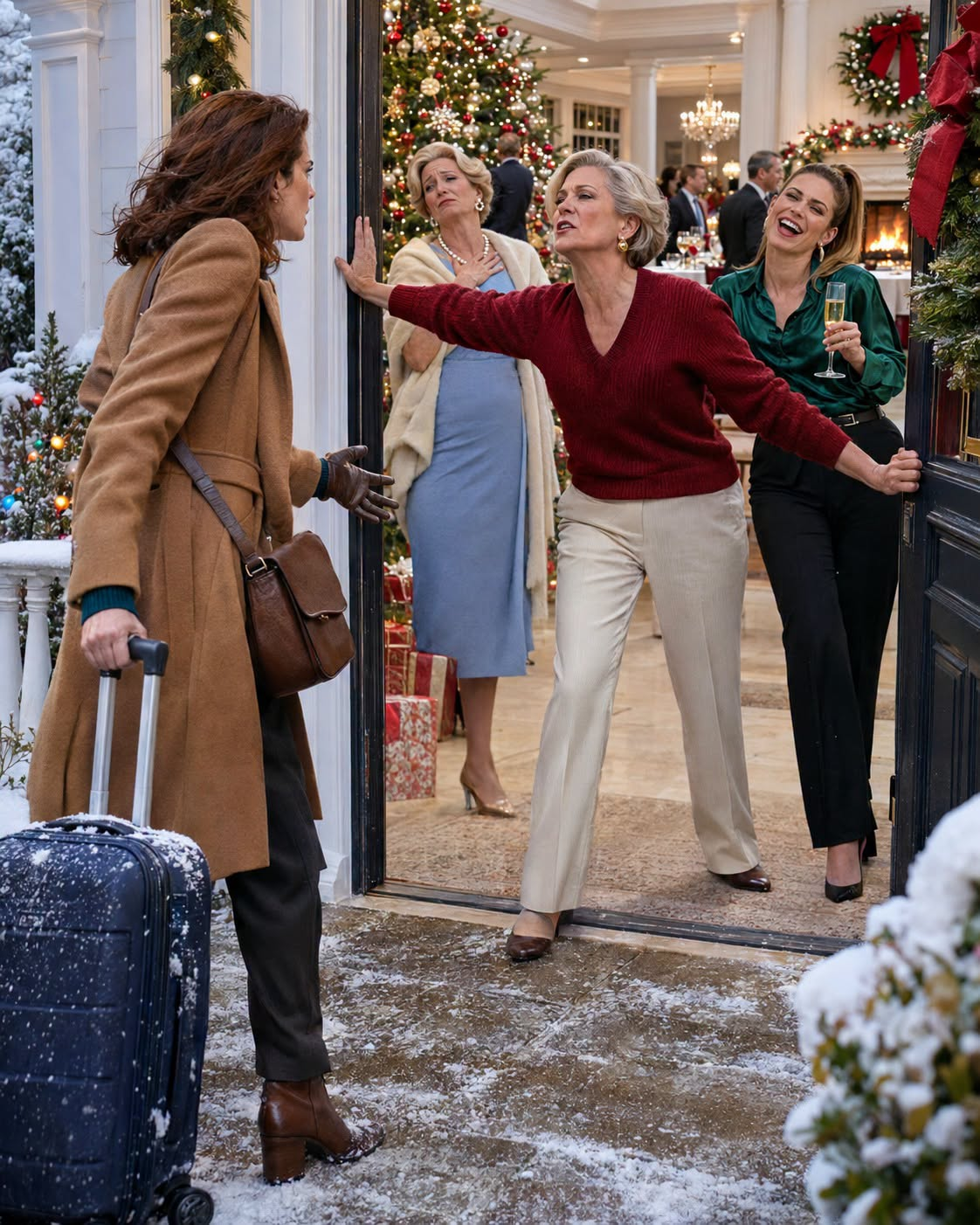
The same door Mom had closed in my face the previous Christmas.
The same door I'd stood outside with my suitcase.
The same door that had once made me feel like a stranger in my own family.
I walked toward it.
Opened it.
Cold winter air brushed my face.
The porch light illuminated the snow-covered steps.
I stood there for a moment.
Then smiled.
Because I no longer saw the place where I'd been rejected.
I saw the home I'd fought to protect.
The home Dad had loved.
The home I'd chosen to keep.
I closed the door gently.
Turned off the porch light.
And walked back into the warmth.
For the first time in a very long time, I wasn't waiting for someone to tell me I belonged.
I already knew.






Comments 0