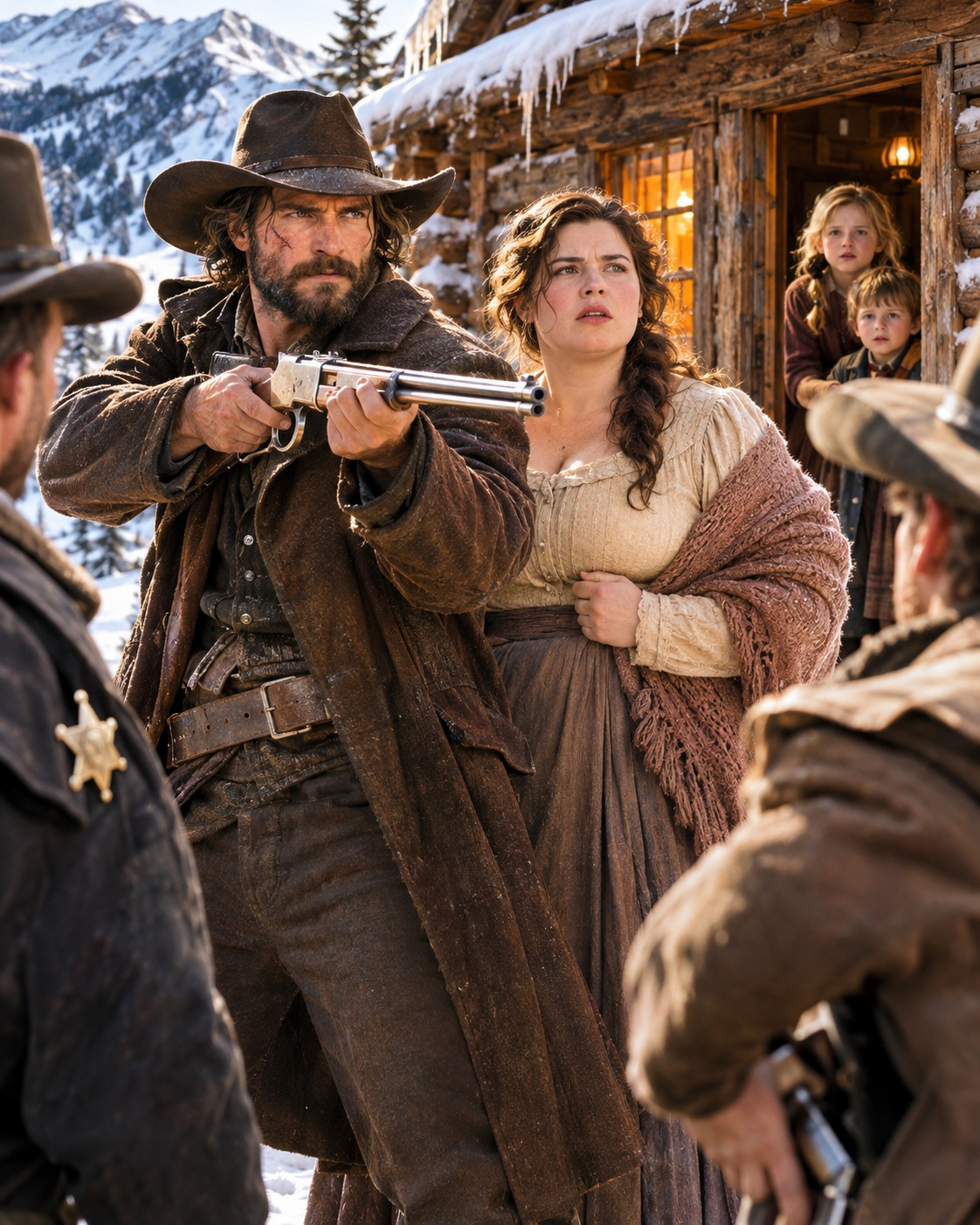
The child was crying behind the wall.
Cannon Jimenez stood motionless in the cellar beneath Dr. Henry Whitaker's clinic, listening to that small, desperate sound.
A thin hiss filled the room.
Gas was escaping from a pipe along the ceiling.
Above them, the iron door had been bolted shut.
And somewhere beyond it, the doctor who had helped murder Cannon's wife was preparing to leave them to die.
"Cannon!"
Aurelia Brooks seized his arm.
"The lantern!"
Cannon looked at the flame trembling inside its glass chimney.
One spark could turn the cellar into a furnace.
He immediately lowered the wick and extinguished it.
Darkness swallowed the room.
Margaret Whitaker began sobbing.
"Henry! Please!"
Her brother's voice came faintly through the door.
"You should have stayed away."
Footsteps retreated.
Aurelia pressed a hand over her mouth.
The bitter smell was growing stronger.
Cannon pulled a handkerchief over his nose.
"Nobody strike a match."
He turned toward the sound behind the wall.
"Who's there?"
The crying stopped.
Then a tiny voice answered.
"Please don't leave me."
Cannon felt his heart break.
"What's your name, sweetheart?"
A pause.
"Lucy."
"How old are you?"
"Five."
Aurelia moved toward the wall.
"Lucy, my name is Aurelia. We're going to get you out."
The little girl began crying again.
"Please hurry."
Cannon ran his hands across the boards.
There had to be a door.
A latch.
Something.
Then Margaret whispered, "The medicine cabinet."
Cannon turned.
"What?"
"The wall behind it opens."
He seized the cabinet and pulled.
It resisted.
He pulled harder.
The cabinet shifted, revealing a narrow iron handle.
Cannon grabbed it.
Locked.
He stepped back.
Then drove the butt of his Winchester against the wooden frame.
Once.
Twice.
The third blow shattered the fastening.
A narrow panel swung inward.
Behind it stood a little girl in a white nightdress.
Her cheeks were wet with tears.
Her bare feet were blue with cold.
Aurelia immediately knelt.
"Oh, sweetheart."
Lucy ran into her arms.
Cannon looked past them.
A narrow passage extended into darkness.
Fresh air brushed his face.
He nearly collapsed with relief.
"Where does this go?"
Lucy pointed.
"Outside."
Cannon turned toward Margaret.
"Did you know about this?"
She shook her head.
"Henry never told me."
Cannon looked at Aurelia.
"Take her."
Aurelia lifted Lucy.
The little girl wrapped both arms around her neck.
Cannon led them into the passage.
Margaret followed.
Behind them, the hiss continued.
They had escaped the locked room.
But the gas was still filling the cellar.
And Dr. Whitaker was still somewhere above them.
The passage was barely wide enough for Cannon's shoulders.
It ran beneath the clinic, then climbed toward a narrow wooden hatch.
Cannon pushed against it.
Nothing.
He tried again.
The hatch lifted an inch.
Cold daylight slipped through.
He pushed harder.
Snow fell across his face.
Then the hatch swung open.
They emerged behind a small carriage shed.
Aurelia stumbled into the fresh air.
She lowered Lucy onto a blanket near the wall.
The child coughed.
Cannon knelt beside her.
"Can you breathe?"
Lucy nodded weakly.
He looked toward Aurelia.
"Get her away from the building."
She nodded.
"What about you?"
Cannon looked toward the clinic.
"Whitaker's still inside."
Aurelia caught his sleeve.
"Cannon, don't."
He turned.
Her eyes were filled with fear.
"You have Sadie and Wyatt waiting for you."
The words stopped him.
He looked toward the clinic.
Then toward Lucy.
The little girl was staring at him with enormous frightened eyes.
He remembered his son asking whether the bad men were going away.
He remembered Sadie begging him to come home.
Cannon swallowed.
"You're right."
He took Aurelia's hand.
"We get everyone clear."
They hurried toward the alley.
Then a man stepped from behind the carriage shed.
Dr. Henry Whitaker.
His gray coat was buttoned neatly.
A leather medical bag hung from one hand.
In the other, he held a revolver.
"Stop."
Cannon froze.
Whitaker looked at Lucy.
His expression darkened.
"So that's where you went."
The child hid behind Aurelia.
Cannon slowly moved in front of them.
"Put the gun down, Doctor."
Whitaker shook his head.
"You have no idea what you've done."
Cannon stared.
"I know exactly what you've done."
The doctor glanced toward Margaret.
"You betrayed me."
She began crying.
"Henry, she's a child."
Whitaker's face hardened.
"She was supposed to be transferred this morning."
Aurelia held Lucy closer.
"To whom?"
Whitaker didn't answer.
Cannon stepped forward.
"How many children?"
The doctor's hand trembled.
"Stay back."
"How many?"
Whitaker swallowed.
"You're making a mistake."
Cannon's voice became dangerously quiet.
"Tell that to Mary."
The doctor went still.
For the first time, genuine fear crossed his face.
Cannon saw it.
And understood.
Whitaker knew exactly what had happened to his wife.
"Mary Jimenez," Cannon said slowly. "You remember her."
Whitaker looked toward the street.
"She was ill."
"You treated her."
"Yes."
"And Andrew Long paid you five hundred dollars three days before she died."
The doctor stared.
Cannon took another step.
"Was that the price of my wife's life?"
Whitaker raised the revolver.
"Don't come closer!"
Aurelia gasped.
Cannon stopped.
The doctor was breathing hard.
For several seconds, nobody moved.
Then Margaret whispered, "Henry, tell him."
Whitaker looked toward her.
"Be quiet."
She shook her head.
"No."
Her voice trembled.
"I helped you forge documents. I helped Andrew pretend Mary was alive. I did everything you asked because I thought you were protecting our family."
Whitaker stared.
Margaret continued.
"But I won't help you kill anyone else."
The doctor's face twisted.
"You don't understand."
"Then explain it."
Whitaker looked toward Cannon.
His hand began to shake.
"Andrew told me Mary had been passing information to Thomas Brooks."
Cannon felt his chest tighten.
"He was right."
"She had documents."
"Yes."
"Documents that could destroy everything."
Cannon's expression hardened.
"So you killed her."
Whitaker closed his eyes.
For a moment, he seemed to age twenty years.
Then he whispered, "I gave her medicine."
Cannon stopped breathing.
"What medicine?"
"A preparation meant to weaken her."
Aurelia covered her mouth.
Whitaker's voice broke.
"Andrew wanted her frightened. Too sick to travel. Too weak to testify."
Cannon felt the world narrowing around him.
"And when she got worse?"
Whitaker looked down.
"I tried to stop it."
Cannon stared.
"You watched her die."
The doctor nodded.
"I didn't intend—"
Cannon lunged forward.
Whitaker raised the gun.
A shot exploded.
The bullet struck the carriage shed.
Cannon slammed into him.
They fell into the snow.
The revolver skidded across the ground.
Whitaker struggled beneath him.
Cannon caught the doctor's collar.
"You let me thank you!"
His voice broke.
"I stood beside her bed and thanked you for trying to save her!"
Whitaker closed his eyes.
"I'm sorry."
Cannon raised his fist.
Then stopped.
He thought of Mary.
Of her laughter.
Of her hands guiding Sadie's first stitches.
Of the night Wyatt was born.
He thought of everything Whitaker had stolen.
And then he thought of what Mary would want her children to remember about their father.
Cannon slowly lowered his fist.
He stood.
Whitaker lay trembling in the snow.
Cannon picked up the revolver.
Then looked toward Aurelia.
"Find the constable."
Within half an hour, the clinic was surrounded.
The town constable arrived with three deputies.
The gas valve was shut off, the cellar ventilated, and the records secured.
Whitaker was arrested.
Margaret surrendered herself and agreed to testify.
Lucy was carried to a nearby boardinghouse, where the proprietor wrapped her in warm blankets and brought her soup.
When Aurelia finally sat beside the child, Lucy looked up.
"Are you going to leave me?"
Aurelia felt tears rise.
"No, sweetheart."
Lucy lowered her eyes.
"That's what the other lady said."
Aurelia took her hand.
"Who?"
"The lady who brought me here."
"Do you remember her name?"
Lucy shook her head.
"But she cried when she left."
Aurelia looked toward the constable.
"Can you find her family?"
He nodded.
"We'll start with the records."
Cannon stood near the doorway.
His face was pale.
His hands were still shaking.
Aurelia approached him.
"Cannon."
He looked at her.
For a moment, he couldn't speak.
Then he whispered, "Mary didn't die from a fever."
Aurelia's eyes filled.
"No."
"She was murdered."
Aurelia gently took his hand.
Cannon stared toward the street.
"I spent three years believing there was nothing I could have done."
She stepped closer.
"You didn't know."
His voice broke.
"I should have."
Aurelia shook her head.
"She trusted the doctor. So did you."
Cannon closed his eyes.
Then he pulled her into his arms.
For a long moment, he held her.
And finally, after three years of grief tangled with unanswered questions, he allowed himself to cry.
By late afternoon, Jonathan Vale and Elias Mercer returned from the old mill.
They weren't alone.
A wagon followed them.
Inside lay Samuel Whitcomb.
Alive.
The attorney's face was pale, and one arm rested in a sling.
But when Aurelia approached, he opened his eyes.
"Miss Brooks."
She covered her mouth.
"Mr. Whitcomb."
He smiled faintly.
"Your father would be proud of you."
Aurelia began crying.
Vale helped the older man sit upright.
Cannon approached.
"Can he travel?"
Whitcomb nodded.
"Slowly."
Mercer looked toward the clinic.
"Did you find the records?"
Cannon held up the leather ledger.
"Every name we could find."
Whitcomb closed his eyes.
"Thank God."
Aurelia stepped closer.
"Mr. Whitcomb, who tried to kill you?"
The attorney looked toward Vale.
Then answered.
"Silas Crowe."
Cannon's expression hardened.
"Andrew's gunman."
Whitcomb nodded.
"He came to my office in Denver after learning I had obtained Whitaker's original deposition."
Aurelia stared.
"The one about my father?"
"Yes."
Whitcomb swallowed.
"Your father discovered Andrew was transferring money through false railroad accounts. When Thomas refused to sign away his controlling interest, Andrew ordered Whitaker to poison him."
Aurelia closed her eyes.
The truth was worse than she had feared.
Whitcomb continued.
"Whitaker confessed in writing after Andrew threatened to make him the sole scapegoat."
Cannon looked toward the clinic.
"And then Andrew tried to silence Whitcomb."
The attorney nodded.
"Crowe attacked me before I could deliver the deposition to federal authorities."
Vale stepped forward.
"I found him afterward."
Whitcomb looked toward him.
"He saved my life."
Cannon studied Vale.
The man had confessed to helping transport children.
He had worn a dead marshal's badge.
He had lied to them.
But he had also risked his life to preserve the evidence.
Cannon looked toward Whitcomb.
"What about the real Benjamin Hale?"
The attorney's expression darkened.
"He was murdered at Fort Laramie while carrying evidence against Andrew."
Vale lowered his eyes.
Whitcomb continued.
"Vale was present. His testimony will be needed to establish who gave the order."
Cannon turned toward him.
"And Silas Crowe?"
Vale looked toward the street.
"He's the man who fired the fatal shot."
Whitcomb nodded.
"Andrew paid him to do it."
Aurelia felt a chill.
"Then the man who came to our cabin pretending to be Hale—"
"Was Crowe," Vale finished.
Cannon's expression hardened.
"Where is he now?"
Whitcomb looked toward the constable approaching from the clinic.
The officer removed his hat.
"We have news."
Silas Crowe had been captured.
He had tried to leave Silver Creek aboard a freight train bound east.
But the stationmaster, warned by the constable, delayed the departure until armed deputies arrived.
Crowe fought.
One deputy was wounded.
But the gunman was taken alive.
In his possession were papers bearing Andrew Long's seal, a stolen federal badge, and a list of witnesses marked for execution.
Among the names were Thomas Brooks, Mary Jimenez, Samuel Whitcomb, Nathaniel Price, and Jonathan Vale.
Cannon stared at the list.
Then he looked toward Whitcomb.
"That explains the surviving witness."
The attorney nodded.
"Andrew believed I was dead. When he learned otherwise, he ordered Crowe to finish the job."
Aurelia remembered the strange letter Nathaniel had stolen.
The warning that a surviving witness had returned to Colorado.
Now she understood.
Samuel Whitcomb had carried the missing testimony.
And Andrew had been willing to kill everyone who might expose him.
Cannon turned toward Vale.
"What happens to you?"
Vale looked down.
"I'll surrender."
Aurelia stared.
"You helped save us."
Vale nodded.
"That doesn't erase what I did."
Cannon studied him.
The answer surprised him.
Vale continued.
"I transported children for Andrew. I ignored things I should have questioned. I wore a badge that wasn't mine."
He looked toward Whitcomb.
"I'll tell the court everything."
The attorney nodded.
"Your cooperation will matter."
Vale swallowed.
"But I know it won't make me innocent."
Cannon slowly extended his hand.
Vale stared at it.
Then took it.
"Make sure those children get home," Cannon said.
Vale nodded.
"I will."
The final confrontation came the following morning.
Andrew Long was found in the railroad office at Silver Creek, preparing to board a private carriage for Denver.
He had money.
He had forged documents.
He had two armed guards.
But he no longer had the one thing he had always relied upon.
Control.
The town constable arrived with deputies.
Samuel Whitcomb accompanied them.
So did Cannon and Aurelia.
Andrew stood behind his desk when they entered.
He smiled at Aurelia.
"Darling."
She didn't move.
His smile faded slightly.
"I see you've brought company."
Whitcomb stepped forward.
"Andrew Long, you're under arrest."
Andrew laughed.
"On whose authority?"
The constable held up a warrant issued on the basis of Whitaker's confession, the original trust records, and the evidence recovered from the clinic.
Andrew's expression changed.
He looked toward Cannon.
"You think you've won?"
Cannon said nothing.
Andrew turned toward Aurelia.
"You still belong to me."
The words once would have made her shrink.
Now she looked him directly in the eyes.
"No."
Andrew stared.
She stepped forward.
"You took my father's money. You lied about his death. You threatened my sister. You tried to destroy a family that gave me shelter when I had nowhere else to go."
His jaw tightened.
Aurelia continued.
"But you never owned me."
Andrew's hand moved toward his desk drawer.
Cannon raised the Winchester.
"Don't."
Andrew froze.
The constable stepped forward.
"Hands on the desk."
For a moment, Andrew looked ready to fight.
Then he saw the armed deputies behind Cannon.
He slowly raised his hands.
The constable secured them.
Andrew looked toward Aurelia one last time.
"You'll regret this."
She shook her head.
"No, Andrew."
Her voice was steady.
"Regret is what I felt every day I stayed silent."
The constable led him away.
And Aurelia watched him go without lowering her eyes.
The months that followed were not easy.
Justice came slowly.
There were hearings in Denver.
Depositions.
Witnesses.
Long days spent examining ledgers and comparing signatures.
But the truth held.
Whitaker's confession established that Thomas Brooks had been poisoned and that Mary's fatal illness had been deliberately caused.
Nathaniel Price's accounts showed the payments.
Margaret Whitaker testified about the forged guardianship papers and the false claim that Mary had survived her death.
Deputy O'Reilly admitted helping Andrew kidnap Wyatt and attempting to seize Sadie.
Silas Crowe was convicted for the murder of Marshal Benjamin Hale and for his part in the attack on Samuel Whitcomb.
Andrew Long was convicted of conspiracy, fraud, kidnapping, and arranging the deaths of Thomas Brooks and Mary Jimenez. He received a life sentence.
Whitaker was sentenced for his part in both deaths and the unlawful confinement of children.
O'Reilly received a lengthy prison sentence.
Margaret was held accountable for her forgeries, but her cooperation and testimony were considered by the court.
Jonathan Vale testified to the railroad's trafficking operations and accepted punishment for his own involvement.
And the children whose names had been hidden in the clinic's ledger were finally given something more important than a number.
Their identities.
Some were reunited with parents who had been told they were dead.
Others found relatives who had spent years searching.
Lucy returned to her mother in Kansas, a seamstress who had been told her daughter had been adopted by a respectable family.
When the little girl left Silver Creek, she hugged Aurelia so tightly that neither wanted to let go.
"Will I see you again?" Lucy whispered.
Aurelia smiled through her tears.
"I hope so."
Lucy nodded.
Then she reached for her mother's hand.
And together, they went home.
The legal battle over Thomas Brooks's estate ended before spring.
The original trust documents proved that Aurelia and Clara were his daughters and rightful heirs.
Andrew's fraudulent transfers were overturned.
The railroad holdings were placed under independent management until the sisters' interests could be protected.
Clara's identity was confirmed through the original birth records, Evelyn Hart's surviving correspondence, and testimony from Samuel Whitcomb and Elias Mercer.
Aurelia became her younger sister's legal guardian.
The arrangement was made with Clara's consent, as much as a child could give it.
When the judge asked whether she wanted to live with Aurelia, Clara looked toward her sister.
Then smiled.
"Yes, sir."
Aurelia began crying.
Clara reached for her hand.
"Does that mean I can stay?"
Aurelia knelt beside her.
"For as long as you want."
Clara wrapped her arms around her neck.
"I want forever."
Aurelia held her tightly.
"Then forever it is."
Andrew's conviction did not immediately end Aurelia's marriage.
But the evidence of his cruelty, fraud, and coercion gave her a path to freedom.
Samuel Whitcomb helped her petition for a divorce.
The proceedings were painful.
Andrew tried to delay them.
He sent letters from prison.
He threatened to contest her inheritance.
But the courts had already established what his forged papers could not change.
Aurelia Brooks was a woman with rights of her own.
By late summer, the divorce was granted.
She stood outside the courthouse in Denver holding the final decree.
For a long time, she simply stared at the paper.
Samuel Whitcomb waited beside her.
"Miss Brooks?"
She looked up.
He smiled.
"You're free."
Aurelia closed her eyes.
She had imagined that moment so many times.
During the long nights in Andrew's house.
During the stagecoach journey through the mountains.
During the blizzard that had nearly killed her.
She had imagined freedom as a door opening.
A road stretching into the distance.
A place where nobody could tell her where to go or whom to love.
Now it was real.
And the first person she wanted to tell was Cannon.
Autumn arrived in the Rockies with golden aspens and clear blue skies.
The snow had melted from the lower trails.
The northern valley was green again.
Cannon's cabin had been repaired.
The porch was rebuilt.
The broken windows were replaced.
The woodshed stood stronger than before.
And beside the cabin, a new room had been added.
Cannon had built it himself.
It had two small beds.
A wide window overlooking the meadow.
And shelves for books.
Sadie called it Clara's room.
Clara called it the best place in the world.
Wyatt simply called it home.
Elizabeth and Nathaniel Price had moved to a small house near Silver Creek after Nathaniel's testimony and sentencing arrangements were settled. Elizabeth recovered from her wounds, and Nathaniel began the difficult work of making restitution to the families harmed by the railroad accounts he had once maintained.
Elias Mercer visited often.
He brought maps, stories, and occasionally terrible jokes that made Sadie laugh until she couldn't breathe.
Daniel Whitcomb recovered from his gunshot wound and returned to Denver to study law under his father.
And Samuel Whitcomb, who had nearly died protecting the truth, lived long enough to see the Brooks sisters reclaim their inheritance.
But the greatest change came quietly.
It came in ordinary moments.
Wyatt falling asleep in Aurelia's lap.
Sadie asking her to braid her hair.
Clara learning to read beside the fire.
Cannon returning from the woods to find the cabin filled with laughter.
He had once believed happiness was something he had buried with Mary.
Now he understood that love did not disappear when someone died.
Sometimes it remained hidden beneath grief.
Waiting.
One evening, Aurelia stood beside the kitchen table, folding a letter.
Cannon entered carrying a basket of firewood.
He stopped when he saw her expression.
"Good news?"
She looked up.
Her eyes were shining.
"Very good news."
He set down the basket.
"What happened?"
She held out the paper.
He took it.
Read.
Then looked at her.
"The divorce?"
She nodded.
"It's final."
Cannon stared.
For a moment, he couldn't speak.
Then he smiled.
A slow, astonished smile.
Aurelia laughed softly.
"You're supposed to say something."
He stepped closer.
"I'm trying."
She raised an eyebrow.
"You're usually not short of words."
Cannon chuckled.
"Only when they matter."
He took her hands.
"Aurelia Brooks."
She smiled.
"Yes?"
He looked into her eyes.
"How does it feel?"
She thought for a moment.
Then whispered, "Like I can finally breathe."
Cannon pulled her into his arms.
She rested her head against his chest.
For a long time, they stood together beside the fire.
Then Cannon spoke.
"There's somewhere I'd like to take you."
Aurelia looked up.
"Where?"
He smiled.
"Come with me."
They walked toward the old pine overlooking the northern valley.
The evening sun painted the mountains gold.
A cool breeze moved through the grass.
Mary's grave stood beneath the tree, marked by a simple stone.
Cannon stopped beside it.
Aurelia remained quiet.
He knelt.
Brushed away a fallen leaf.
Then rested his hand against the stone.
"Hello, Mary."
Aurelia felt tears rise.
Cannon looked toward the valley.
"I found out what happened."
His voice trembled.
"I know you were trying to protect us."
He swallowed.
"I wish you'd told me."
The wind moved gently through the branches.
Cannon closed his eyes.
For a moment, he remembered Mary's face.
Her laughter.
The way she had held their children.
The way she had looked at him on the day they married.
He had loved her deeply.
He always would.
But the grief that had once felt like a locked door had finally begun to open.
He looked toward Aurelia.
Then back at the stone.
"I think you'd like her."
Aurelia covered her mouth.
Cannon smiled faintly.
"Sadie does. Wyatt certainly does."
He glanced toward the cabin.
"And Clara thinks she's the smartest woman in Colorado."
Aurelia laughed through her tears.
Cannon looked back at Mary's grave.
"Thank you for helping us find our way."
Then he stood.
He took Aurelia's hand.
And together, they walked a few steps beyond the tree.
To the place where he had once asked Mary to marry him.
Aurelia looked toward the valley.
"It's beautiful."
Cannon nodded.
"It is."
She turned toward him.
He was strangely quiet.
"Cannon?"
He looked at her.
For a moment, he seemed nervous.
That surprised her.
She had seen him face gunmen without flinching.
She had watched him cross frozen mountains to save his son.
She had seen him stand against Andrew Long.
But now his hands were trembling.
Aurelia smiled.
"What's wrong?"
Cannon reached into his coat.
Then slowly lowered himself onto one knee.
Aurelia stopped breathing.
"Cannon..."
He looked up.
His eyes were filled with emotion.
"When you came to my door, I thought you were just another traveler caught in a storm."
Aurelia's lips trembled.
Cannon continued.
"I had two children who needed me, a house full of memories, and a heart I thought had nothing left to give."
He swallowed.
"Then you walked inside."
Aurelia began crying.
"You held Wyatt when he was sick. You made Sadie laugh. You helped me find the truth about Mary."
He smiled.
"And somewhere along the way, you became the person I wanted beside me every morning."
Aurelia pressed a hand against her heart.
Cannon opened a small wooden box.
Inside lay a simple gold ring.
It had belonged to his mother.
He had kept it for years.
Waiting for a reason to bring it into the light.
"Aurelia Brooks," he whispered, "will you marry me?"
She stared at him.
The mountains blurred through her tears.
She thought of Andrew's house.
Of the locked doors.
Of the fear.
Of the night she had arrived at Cannon's cabin with nothing but a small bag and the hope that someone might let her stay until morning.
She thought of Sadie.
Wyatt.
Clara.
And the man kneeling before her.
A man who had never asked her to surrender herself in exchange for love.
A man who had given her room to choose.
Aurelia smiled through her tears.
"Yes."
Cannon's face changed.
She laughed.
"Yes, Cannon Jimenez. A thousand times yes."
He rose and pulled her into his arms.
She kissed him.
The sun slipped behind the mountains.
And for the first time in years, Aurelia felt no fear of what tomorrow might bring.
They married the following spring.
The ceremony took place in the meadow beside Cannon's cabin.
Wildflowers covered the hillside.
The air smelled of pine and fresh grass.
Samuel Whitcomb attended with Daniel.
Elias Mercer stood beside Cannon.
Elizabeth Price helped Aurelia dress.
Nathaniel, permitted to attend under the terms of his restitution arrangements, sat quietly among the guests.
Margaret Whitaker, rebuilding her life after her sentence, sent a letter of apology and a small embroidered handkerchief.
And the children had the most important roles of all.
Sadie carried the flowers.
Clara carried the rings.
Wyatt insisted on walking beside Aurelia.
He wore a little blue jacket and boots polished so carefully that he kept looking down at them.
When the music began, he took Aurelia's hand.
"Ready, Mama?"
She smiled.
"Ready, sweetheart."
He looked toward Cannon waiting beneath the pine branches.
Then grinned.
"Papa looks scared."
Aurelia laughed.
"Just a little."
Wyatt nodded seriously.
"I'll help him."
He led her down the short path.
Cannon stood waiting.
His eyes filled when he saw her.
Aurelia wore a simple ivory dress.
Her hair was pinned with tiny white flowers.
She looked nothing like the frightened woman who had arrived in the snow.
She looked happy.
And Cannon knew he would spend the rest of his life trying to keep that smile on her face.
When Aurelia reached him, Wyatt placed her hand in Cannon's.
Then whispered loudly, "Now kiss her."
The guests laughed.
Cannon chuckled.
"Not quite yet, son."
Wyatt frowned.
"Why not?"
Sadie giggled.
"Because they have to say the words first."
Clara nodded.
"That's how weddings work."
Wyatt sighed.
"All right."
The minister smiled.
Then began.
Their vows were simple.
Cannon promised to love Aurelia without trying to control her.
To stand beside her in hardship.
To protect the family they had built.
And to remember that courage was not the absence of fear, but the choice to keep loving despite it.
Aurelia promised to share his joys and sorrows.
To honor the memory of Mary.
To love Sadie and Wyatt as her own.
And to build a home where Clara would never again wonder whether she belonged.
When the minister pronounced them husband and wife, Cannon drew Aurelia close.
He kissed her.
The children cheered.
Mercer wiped his eyes.
Samuel Whitcomb smiled.
And Wyatt shouted, "Now we're all a family!"
Cannon laughed.
He lifted the little boy into his arms.
Sadie ran forward.
Clara followed.
Aurelia gathered them close.
For a moment, the five of them stood together beneath the spring sunshine.
No fear.
No secrets.
No one waiting to take them away.
Only a family.
That evening, after the guests had gone and the children were asleep, Cannon and Aurelia sat together on the porch.
The mountains rose dark against a sky filled with stars.
A gentle breeze moved through the meadow.
Inside the cabin, the fire burned low.
Sadie slept with her doll beside her pillow.
Wyatt dreamed beneath his blue blanket.
Clara rested in the room Cannon had built for her, surrounded by books and drawings.
Aurelia leaned against her husband's shoulder.
Cannon wrapped an arm around her.
For a long time, neither spoke.
Then Aurelia smiled.
"Do you remember the first night?"
Cannon chuckled.
"Hard to forget."
"I was freezing."
"You were."
"I thought you might send me away."
He looked at her.
"I almost did."
She laughed.
"I know."
Cannon kissed her hair.
"Best decision I ever made was opening that door."
Aurelia looked toward the mountains.
"I thought I had lost everything."
He held her closer.
"You found your way."
She shook her head gently.
"We found each other."
Cannon smiled.
Then he looked toward the window.
Inside, the children's drawings hung beside the fireplace.
One showed the cabin beneath a bright yellow sun.
Five figures stood in front of it.
A tall man.
A woman in a blue dress.
Two little girls.
And a small boy holding everyone's hands.
Above them, in Sadie's careful handwriting, were the words:
Our Family.
Cannon looked at the drawing for a long moment.
Then he turned toward Aurelia.
"Happy?"
She smiled.
"More than I ever thought possible."
He kissed her forehead.
"Good."
Aurelia rested her head against his shoulder.
The night was quiet.
The house was warm.
And the children were safe.
Years later, when Sadie was grown and Wyatt had children of his own, they would still tell the story of the winter a stranger came to their father's door.
They would remember the snow.
The danger.
The long journey through the mountains.
But most of all, they would remember what happened afterward.
How a frightened woman found the courage to begin again.
How a grieving father learned that loving someone new did not mean forgetting someone lost.
How a lonely little girl named Clara discovered she had a sister.
And how three children, who had once been afraid of losing their home, grew up knowing that home was more than walls and a roof.
It was the people who stayed.
The people who listened.
The people who opened the door when someone needed shelter.
On that quiet spring evening, Cannon reached for Aurelia's hand.
Their wedding rings caught the light from the window.
He smiled.
"Welcome home, Mrs. Jimenez."
Aurelia turned toward him.
Then she kissed him softly.
"I'm already home."






Comments 0