The document was a signed statement from Captain Reed.
It described the circumstances surrounding the original deployment incident.
It also explained why he had supported the initial rehabilitation arrangement.
But there was something else.
A section near the bottom acknowledged that the proposed separation between Hayes and Atlas had been recommended without a complete assessment of their shared recovery needs.
Margaret read it twice.
"Why didn't you submit this earlier?"
Reed looked exhausted.
"Because I was afraid."
"Of what?"
"Of admitting that I had made a mistake."
Margaret placed the document on the table.
"Captain, everyone makes mistakes. The question is what they do after they discover them."
Reed nodded.
"I know."
"Then do something useful."
The captain looked toward Hayes's room.
"I will."
Over the next several hours, the situation changed.
Reed contacted the appropriate military representatives and requested an immediate review of the separation order.
The hospital provided documentation about Hayes's condition and the importance of maintaining his emotional stability during treatment.
Thomas, the EMT who had first examined the Marine, submitted his account of the rescue.
Daniel Foster provided the road-service report describing how Atlas had remained beside the crashed vehicle until help arrived.
And Margaret wrote a statement of her own.
She described the moment the German Shepherd appeared at her door.
She described how he had repeatedly looked back to make sure she was following.
She described the truck, the injured Marine, and the dog's desperate attempts to reach his owner.
She finished with one sentence.
That animal did not abandon his family when the world became dangerous. I see no reason anyone should force him to do so now.
The statement was submitted with the others.
That afternoon, a representative from the review board arrived.
Her name was Elaine Porter.
She was a middle-aged woman with short silver hair and a serious expression.
She introduced herself to Hayes.
"Corporal, I've reviewed the preliminary documents."
Hayes looked toward Atlas.
The dog was lying beside his bed.
"Does that mean they're taking him?"
Elaine glanced at the animal.
"No."
Hayes stared at her.
She continued.
"Your transfer order has been temporarily suspended pending a full review."
Margaret exhaled.
Hayes lowered his head.
For a moment, he couldn't speak.
Elaine turned toward Captain Reed.
"We'll also need your testimony regarding the original incident report."
Reed nodded.
"I understand."
The review took several weeks.
During that time, Hayes remained under medical supervision.
His head injury improved.
The bruising faded.
His strength gradually returned.
Atlas stayed with him under the hospital's approved accommodation arrangement.
Margaret visited whenever she could.
Sometimes she brought homemade soup.
Sometimes she brought clean blankets.
And sometimes she simply sat beside the bed and talked about ordinary things.
She told Hayes about William.
She told him how they had built the cabin together.
She told him about the old wooden sled and how her husband had insisted on making it stronger than necessary.
Hayes listened.
Eventually, he began talking too.
He told her about his childhood.
About joining the Marines.
About meeting Atlas.
And about the deployment that had changed everything.
He didn't tell the story all at once.
Some days, he couldn't.
Margaret never pushed him.
She had learned that grief did not follow a schedule.
Neither did healing.
One afternoon, Hayes looked toward the window.
"Do you ever get used to being alone?"
Margaret considered the question.
"No."
He looked at her.
She continued.
"You learn how to live with it. But that's not the same thing."
Hayes nodded.
"I don't think Atlas and I know how to live without each other."
"Then perhaps you shouldn't have to."
He looked down at the dog.
Atlas was sleeping with his head resting against Hayes's leg.
For the first time, Margaret noticed that the animal's breathing was peaceful.
No sudden movements.
No anxious searching.
No frightened barking.
He was simply sleeping.
The review board eventually reached its decision.
The original incident report required correction.
Hayes's personal statement was accepted for further investigation.
Captain Reed formally acknowledged his role in the reporting errors and agreed to cooperate with the review.
Most importantly, the separation recommendation was withdrawn.
Atlas would remain with Hayes throughout his recovery.
The news arrived on a Thursday morning.
Hayes read the letter twice.
Then he looked at Margaret.
"They're letting him stay."
She smiled.
"Of course they are."
He laughed softly.
It was a sound she hadn't heard from him before.
A real laugh.
Not forced.
Not nervous.
Just relief.
Several weeks later, Hayes was discharged from the hospital.
He had a long rehabilitation process ahead.
But he was alive.
And Atlas was going home with him.
There was one complication.
The military had arranged temporary accommodation for the pair, but the available housing was far from ideal.
Hayes looked at Margaret.
"I'll figure something out."
She studied him.
Then she remembered the cabin.
The empty guest room.
The wood-burning stove.
The small porch William had built.
"How would you feel about staying with me for a while?"
Hayes blinked.
"Ma'am?"
"Don't make me repeat myself. I'm seventy-five. I don't have the energy to offer hospitality twice."
He looked at Atlas.
The dog lifted his head.
Margaret smiled.
"There's room for both of you."
Hayes lowered his eyes.
"I don't know what to say."
"Then don't say anything. Just help me bring in the firewood."
He laughed again.
And this time, Margaret laughed with him.
They returned to Aspen Ridge when the roads reopened.
The cabin looked almost exactly as Margaret had left it.
William's wooden shelves remained in place.
The old brass lantern stood beside the door.
The hauling sled leaned against the porch.
Hayes helped repair a loose section of the railing.
Atlas explored the yard.
The first evening, Margaret prepared a simple dinner.
Three bowls were placed on the table.
One for her.
One for Hayes.
And one for Atlas.
The dog ate slowly.
Then he walked toward the fireplace and lay down.
Hayes sat beside him.
Margaret watched them from the kitchen.
For twelve years, she had believed that the cabin was a place where she had to learn to live without William.
Now, for the first time, it felt like a place where new memories could begin.
The following weeks were not perfect.
Hayes still had difficult nights.
Sometimes he woke suddenly, confused by the darkness.
Atlas sometimes lifted his head and whined.
But now, neither of them had to face those moments alone.
Margaret learned when to speak.
When to remain quiet.
And when to place a warm cup of coffee on the table without asking questions.
Hayes began attending rehabilitation appointments.
He worked with medical professionals.
He gradually regained confidence.
Atlas received his own veterinary assessments and continued his recovery.
Their bond remained strong.
But slowly, something changed.
They stopped living entirely in the past.
One spring morning, Margaret found Hayes standing on the porch.
Atlas was sitting beside him.
The snow had finally melted from the trees.
Sunlight touched the distant mountain peaks.
"Beautiful, isn't it?" she asked.
Hayes nodded.
"I haven't seen a morning like this in a long time."
Margaret stood beside him.
"William used to say that mountains teach you patience."
Hayes smiled.
"Was he right?"
"Usually. Don't tell him I said that."
They both laughed.
Then Hayes looked toward her.
"Margaret, there's something I've been wanting to ask."
She turned.
"What is it?"
"Would you mind if Atlas and I stayed a little longer?"
Margaret looked at the dog.
Atlas wagged his tail.
She pretended to consider the request.
"Well, I suppose I could tolerate one more dog."
Hayes smiled.
"One more?"
"You're forgetting the enormous Marine who keeps eating all my biscuits."
He laughed.
Then his expression softened.
"Thank you. For everything."
Margaret looked at him.
"You don't have to thank me for opening a door."
Hayes shook his head.
"You didn't just open a door."
He looked toward Atlas.
"You gave us somewhere to come home to."
Margaret felt her eyes grow warm.
She reached for his hand.
"Then let's make sure this home stays open."
That evening, she placed William's old brass lantern on the porch.
Its golden light spread across the wooden steps.
Atlas lay beside the door.
Hayes sat nearby, reading a book.
Margaret watched the two of them from the kitchen window.
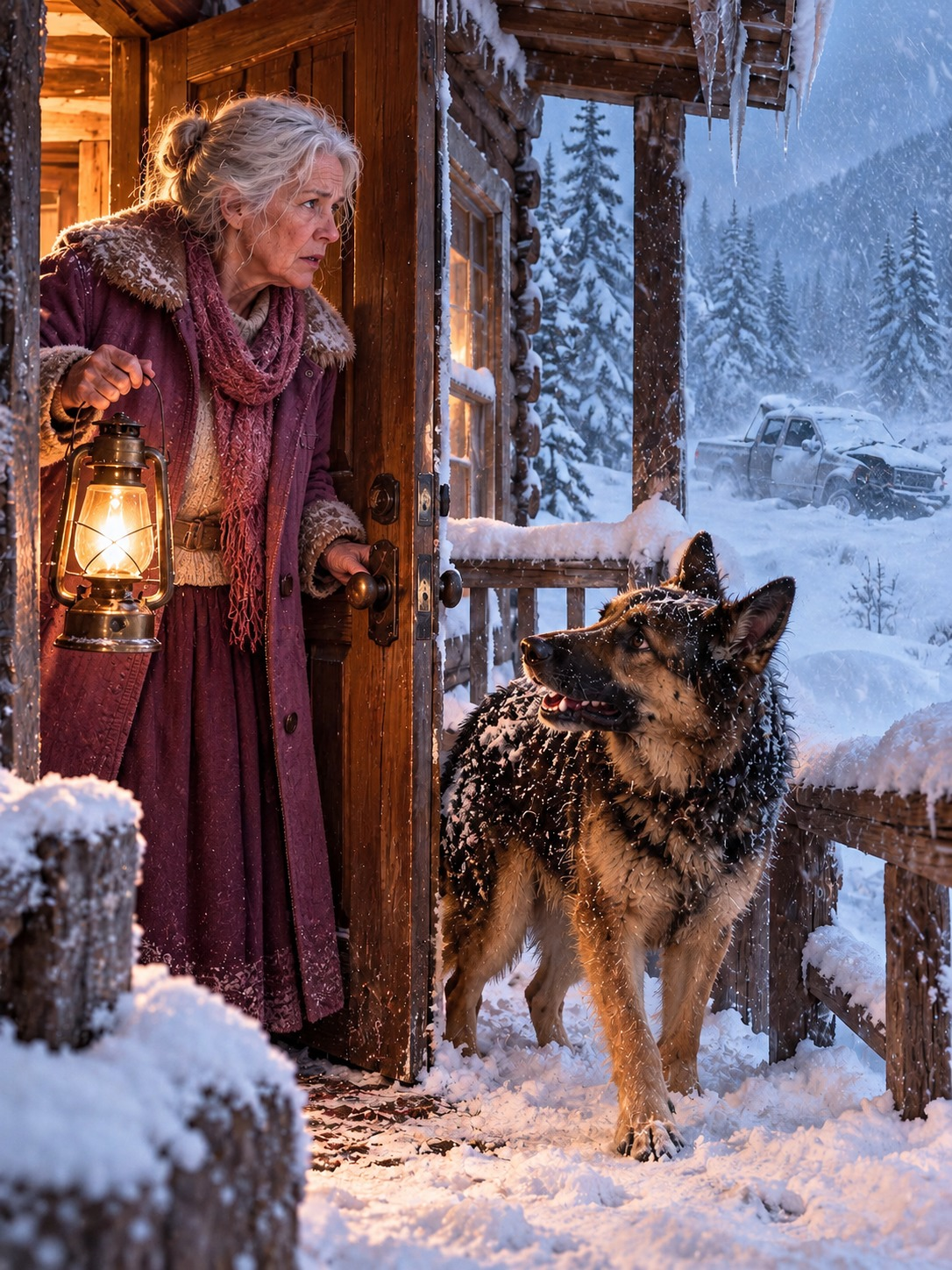
She remembered the terrible night when a frightened dog had appeared in the snow.
She remembered the wrecked truck.
The blood on the soldier's forehead.
The desperate whisper of a name.
Atlas.
She had thought she was rescuing a stranger.
But somewhere along the way, she had discovered something she hadn't expected.
A family could begin in the most unlikely circumstances.
Sometimes it began with a knock.
Sometimes with a bark.
And sometimes with an old woman deciding that she was not too old to walk into a storm for someone who needed her.
The blizzard had taken almost everything from the mountain that winter.
It had buried the roads, broken the power lines, and turned familiar places into dangerous wilderness.
But it had also brought three lonely souls together.
Margaret no longer ate dinner alone.
Hayes no longer woke without someone beside him.
And Atlas no longer had to search the darkness for the person he loved.
On the anniversary of the rescue, the three of them stood together on the porch.
Margaret held her brass lantern.
Hayes rested one hand against Atlas's neck.
The dog looked toward the mountains.
Then he turned back toward them.
His tail wagged.
Margaret smiled.
"Come on, sweetheart. It's getting cold."
Atlas walked inside.
Hayes followed.
Margaret closed the door behind them.
For the first time in twelve years, the cabin was no longer just a place where she remembered the life she had lost.
It was where she was living the life she still had.
And as the fireplace crackled and the snow began falling softly outside, Margaret understood that sometimes the greatest gift of a terrible winter was discovering that no one had to face the cold alone.






Comments 0