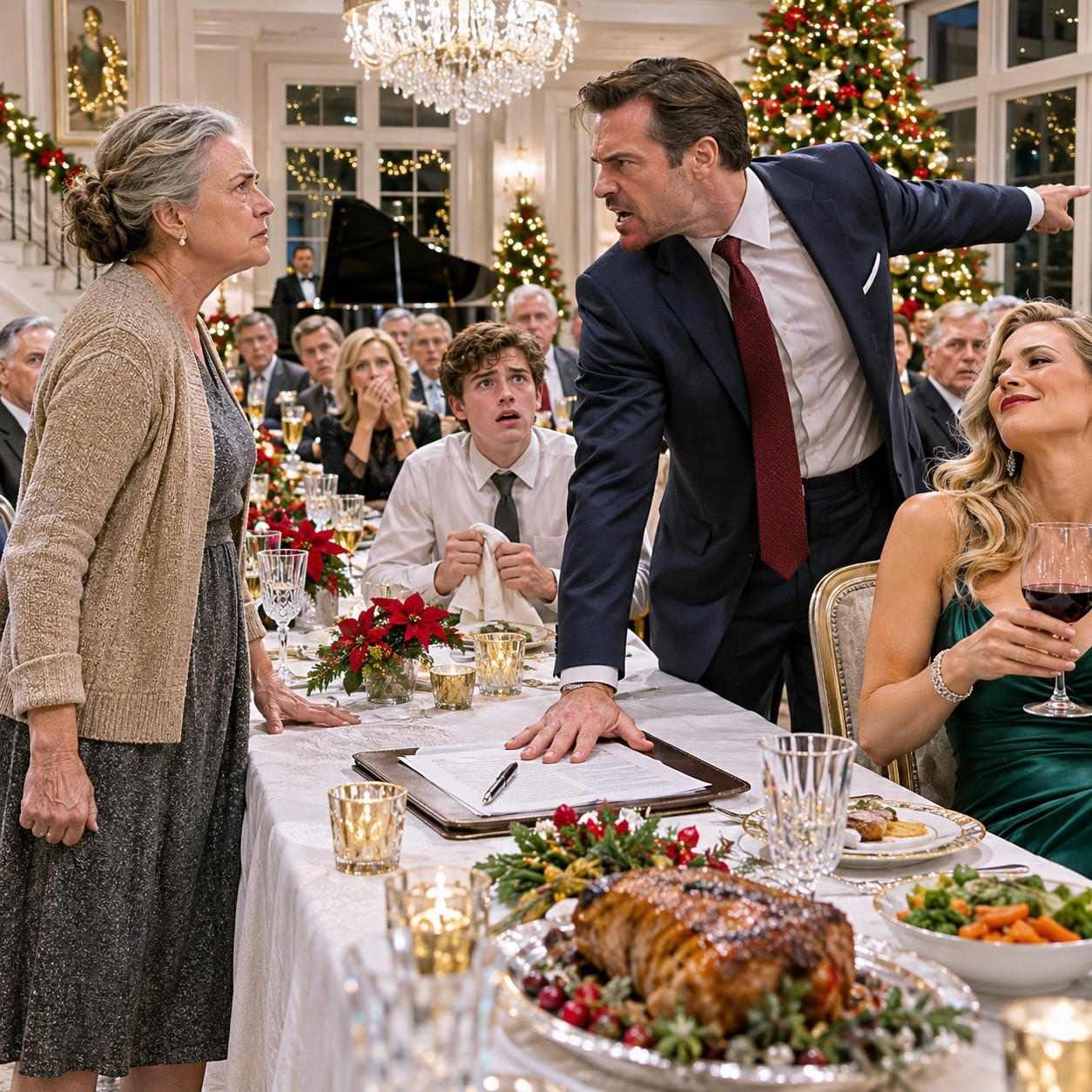
"Mom, I think it's time we talked."
My son's voice came through the conference room door.
For a moment, nobody moved.
Caroline Bennett stood beside the table, her phone still in her hand. Michael Sullivan was staring at the letter Terry had left for me. Max sat perfectly still, his fingers resting on the unopened envelope bearing his name.
And I was looking at the signature on the second page.
Todd Mitchell.
Today's date.
A signature that had no business appearing on a letter my husband had written ten years earlier.
"Mom?"
Todd knocked again.
I looked at Caroline.
"Did you invite him?"
"No."
Michael shook his head.
"Neither did I."
Caroline walked to the door but didn't open it.
"Mr. Mitchell, this is a private meeting with my client. You need to leave."
Todd's voice hardened.
"I know Michael Sullivan is in there."
Michael closed his eyes.
"I suppose he does."
"I have a right to be part of this conversation," Todd called.
Caroline answered immediately.
"No, you don't."
There was a pause.
Then Todd said something I had heard countless times since August.
"She's my mother."
I stared at the door.
For months, those three words had been his excuse.
He was my son, so he could ask about my investments.
He was my son, so he could enter my cottage without permission.
He was my son, so he could question my memory.
He was my son, so he could demand my signature.
And because I was his mother, he believed I would eventually surrender.
I stood.
"Caroline, may I speak?"
She looked at me.
"Of course. You don't have to open the door."
I walked toward it.
"Todd?"
"Mom. Thank God. Tell your lawyer to let me in."
"No."
Silence.
"What?"
"I said no."
His breathing was audible through the door.
"Mom, you're making a terrible mistake."
I looked at the polished wood between us.
"No, Todd. I made my mistake in August when I gave you four hundred thousand dollars without protecting myself."
"That's not fair."
"Neither was charging me three thousand dollars a month to live in the home you promised me."
He didn't answer.
I continued.
"Neither was using my bank account without permission. Or preparing documents in my name. Or frightening Max."
"Mom, you don't understand—"
"I understand enough."
He lowered his voice.
"Michael is trying to take something that belongs to me."
Behind me, Michael made a quiet sound.
I looked back.
His face was filled with disbelief.
"Todd," I said, "whatever you believe you're entitled to, you'll have to establish it properly. I'm not discussing it in a hallway."
There was a long silence.
Then my son spoke again.
His voice sounded smaller.
"Mom, please."
I closed my eyes.
For one terrible moment, I heard the little boy who used to call for me when he had a fever.
I remembered sitting beside his bed.
Holding his hand.
Promising I would never leave him alone.
But Max was sitting behind me, frightened of his own father.
And I had finally learned that protecting one person sometimes meant refusing another.
"Goodbye, Todd."
I stepped away from the door.
Caroline waited until his footsteps disappeared down the hallway.
Then she turned toward me.
"Are you all right?"
I nodded.
"I think so."
But my hands were trembling.
Michael pulled out a chair.
"Rita, sit down. There's something we need to explain."
I returned to the table.
The letter lay before me.
Terry's handwriting covered the first page.
The second page contained a typed paragraph, a red-ink notation, and Todd's fresh signature.
I looked at Michael.
"Tell me what this means."
He took a slow breath.
"The first page is Terry's letter. I recognize it. I was there when he sealed it."
I touched the paper gently.
"And the second?"
Michael shook his head.
"That wasn't part of the envelope I kept."
Caroline nodded.
"The envelope appears to have been opened and resealed before today's meeting. Michael brought it here from his office, and the original contents will need to be examined."
I stared at the page.
"How could Todd have gotten to it?"
Michael looked miserable.
"An employee retrieved the folder for me this morning. Todd had visited the office earlier, claiming he needed records concerning his father's interest. We now know he had no authority to handle them."
Caroline placed the second page in a protective sleeve.
"We can't yet say who inserted it or exactly when. But its date and appearance are reasons to preserve it separately."
I looked at Todd's signature.
He had tried to alter even this.
A letter from a dead husband to his wife.
Nothing had been sacred.
"What's the red sentence?" I asked.
Caroline read it aloud.
"'The beneficiary acknowledges that all remaining interests are assigned to Todd Mitchell.'"
I stared at her.
"That's not Terry's handwriting."
"No," she said. "And it contradicts the other records."
Michael leaned forward.
"Rita, Terry never instructed me to give his interest to Todd."
I looked at him.
"Then what did he arrange?"
Michael opened the original business agreement.
"Terry invested in my equipment company many years ago. He owned a minority interest. The agreement gave him certain rights, including the right to receive distributions."
I remembered Terry mentioning the investment.
It had seemed so small at the time.
A favor for an old friend.
A few thousand dollars we could afford to risk.
Michael continued.
"When Terry became ill, we reviewed the agreement. He wanted the interest to pass according to his estate arrangements."
"To me?"
"Yes."
I looked at Caroline.
She nodded.
"The genuine estate records support that position. The company had continued carrying Terry's interest on its records because the final transfer paperwork was never completed."
My stomach tightened.
"Why not?"
Michael looked ashamed.
"After Terry died, the company went through a difficult period. The interest had little apparent value. We should have resolved the paperwork sooner."
I thought about all the years that had passed.
"Did Todd know?"
Michael nodded.
"Terry had discussed the investment with him. He also signed an acknowledgment in the original agreement confirming that he understood he had no present ownership rights."
I looked at the document.
There was Todd's signature.
Older.
Genuine.
Beside it was the heading:
Acknowledgment of No Beneficial Interest.
I stared at it.
"So he knew."
"Yes," Michael said.
I looked at the conditional transfer agreement.
"What about this?"
Michael turned the page toward me.
"Terry wanted to make sure you would benefit from the interest if the business eventually succeeded. He also asked that, if the company ever repurchased the shares, the proceeds be paid to the lawful owner rather than someone claiming through an informal family arrangement."
I frowned.
"And the condition?"
Caroline answered.
"The condition was triggered when a competing claim was made. It requires the company to suspend any transfer to a disputed claimant until ownership is established."
I stared at her.
"So Todd's application doesn't give him the interest?"
"No. His filing doesn't establish ownership. It has instead triggered a review of the records."
Michael nodded.
"And the company is prepared to purchase the interest from the person legally entitled to it once the title is confirmed."
I looked down at the papers.
"How much is it worth?"
Michael gave me an estimate.
I stared at him.
It was enough to buy a comfortable home.
Enough to restore a measure of security.
Enough that I would not have to spend my remaining years depending on Todd's promises.
My eyes filled with tears.
"Terry," I whispered.
For years, I had believed my husband had left me everything he could.
Now I learned that something he planted long ago had continued growing after he was gone.
Not because he expected to become rich.
Because he believed in helping a friend build something worthwhile.
And because he had always thought about the future.
I reached for his letter.
This time, I read it all the way through.
My darling Rita,
If you're reading this, it means our son has finally done the one thing I prayed he never would.
I hope I was wrong about him. I hope he grew into the honest man we tried to raise.
But if he has asked you to sacrifice your security to save him from his own decisions, please remember something.
You have already given him a lifetime of love.
You do not owe him the rest of your life.
I stopped reading.
Tears fell onto my hands.
I remembered Terry sitting at our kitchen table, watching Todd drive away after another argument about money.
Our son had been in his twenties then.
He had borrowed from us and failed to repay it.
Terry had been worried.
I had told him Todd would mature.
Perhaps he would have.
Perhaps, for a while, he did.
But Terry had seen a weakness I refused to recognize.
I continued reading.
The investment with Michael may never amount to much. If it does, I want it to help you live freely.
Buy a small place with a good kitchen. Plant roses if you want them. Keep baking because you love it, not because you need the money.
And if Todd ever tries to make you feel guilty for protecting yourself, remember that I would be standing beside you.
I love you, Rita.
Always,
Terry.
I pressed the letter against my chest.
For a moment, I couldn't speak.
Then I looked at Michael.
"Thank you for keeping this."
His eyes were wet.
"I wish I'd brought it to you sooner."
I shook my head.
"You brought it when I needed it."
Max was crying quietly beside me.
I turned toward him.
"Sweetheart, your envelope."
He looked down.
Then carefully opened it.
Inside was a short letter in Terry's handwriting.
Max read silently.
His face changed.
Then he began crying harder.
I moved beside him.
"What does it say?"
He handed me the page.
Dear Max,
You're too little to read this now, but one day you won't be.
I hope you grow into a kind man. Not the richest man. Not the most important man. Just a kind one.
Money can buy a house, but it cannot make a home.
If your grandmother ever needs you, be gentle with her.
And remember that you never have to become someone else to make your father proud.
Love, Grandpa Terry.
I looked at Max.
He was wiping his cheeks.
"Grandpa knew me."
I smiled through my tears.
"He loved you from the moment he held you."
Max folded the letter carefully.
Then he whispered, "I'm going to keep this forever."
The weeks that followed were difficult.
But they were different from the months before Christmas.
For the first time, the people handling my affairs were working for me.
Caroline obtained the remaining estate records and arranged for the disputed documents to be examined.
Michael's company provided its original agreements, corporate records, and financial statements.
The false claim Todd had filed was challenged.
After reviewing the evidence, Todd withdrew his claim to Terry's business interest. The company and the estate professionals completed the necessary transfer and repurchase arrangements, with the proceeds paid to me after the applicable costs and taxes were addressed.
I remember the day Caroline called to confirm the funds had arrived.
I was standing in the cottage kitchen.
Max was doing homework at the table.
"Rita," Caroline said, "the payment has cleared."
I sat down.
For a moment, I couldn't speak.
Then I asked, "It's really mine?"
"Yes."
I closed my eyes.
Terry had given me another chance.
Not through a miracle.
Through an old investment, careful records, and a friend who had kept his promise.
I cried for a long time.
Then I called Michael.
"Thank you," I whispered.
He was quiet for a moment.
"Rita, Terry would be happy knowing you're secure."
I looked toward my husband's photograph.
"I think so too."
The investigation into Todd's conduct continued.
The man who had used Daniel Mercer's name was identified as Peter Vale, a document preparer who had falsely presented himself as having legal authority.
He had helped assemble several of the disputed papers.
The authorities established that the supposed second will was not genuine.
Margaret Ellis's signature had been reproduced from old documents.
The medical letter bearing Dr. Shaw's name was false.
The power of attorney had not been validly executed.
And the documents used to support the attempt to control my property contained statements that could not be reconciled with the evidence.
The real Daniel Mercer cooperated fully and helped establish that his identity and professional information had been used without permission.
The bank completed its review of the unauthorized transactions.
Some disputed amounts were restored to my account, and the remaining losses became part of the proceedings involving those responsible.
Heather admitted her role in the unauthorized purchases and in preparing information intended to portray me as incapable.
She also provided investigators with records of communications between Todd and Peter Vale.
I didn't celebrate when I learned that.
I simply felt relieved.
The truth no longer depended on whether Todd would admit it.
There were records.
Witnesses.
Messages.
And people willing to speak.
Eventually, Todd faced criminal charges relating to the fraudulent documents and attempted financial access.
He was represented by a lawyer.
He had the opportunity to respond.
The case did not end overnight.
But months later, after the evidence was reviewed and the proceedings advanced, Todd entered guilty pleas to several offenses.
The court imposed a sentence that included a period of custody, probationary conditions, and restitution obligations.
Peter Vale was also convicted for his involvement.
Heather resolved her own charges through a separate process that required accountability, repayment, and compliance with court-imposed conditions.
I attended the sentencing hearing.
I sat quietly in the back.
Todd looked older.
His expensive suit was gone.
His shoulders were bent.
For the first time in years, he wasn't trying to impress anyone.
When the judge gave me the opportunity to speak, I stood.
My hands trembled.
But my voice was steady.
"Todd," I said, "I loved you before you were born."
He looked up.
"I loved you when you were a little boy who was afraid of thunderstorms. I loved you when you made mistakes. I loved you when you became a father."
My throat tightened.
"But you used that love to make me afraid to say no."
Todd lowered his eyes.
"You took my trust and treated it as permission."
I paused.
"You frightened your son. You tried to take my independence. And you made me question whether the family I had spent my life building had ever been real."
The courtroom was silent.
I took a breath.
"I hope you change. I hope someday you understand what you've done."
Then I said the words I had needed to say for months.
"But I will never again give you control over my life."
Todd began crying.
I didn't know whether his tears were for me, for Max, or for everything he had lost.
Perhaps even he didn't know.
I sat down.
And I let the court do its work.
The mansion was eventually sold through the lender's enforcement process.
Todd's business had collapsed.
The property was worth less than the debts and obligations surrounding it.
There was no grand fortune waiting to be rescued.
No secret investor arriving at the last moment.
No way to preserve the image Todd had spent years constructing.
My original four-hundred-thousand-dollar contribution remained a painful lesson.
Caroline pursued my claims, and a negotiated resolution of the related civil disputes provided a partial recovery and a repayment obligation supported by the available assets and enforceable terms.
I did not recover every dollar.
But I recovered something more important.
The ability to stop fighting for a place in a house where I had never been truly welcome.
I moved out of the cottage before the sale was completed.
On my final morning, I stood in the little kitchen and looked around.
I remembered how excited I had been when Todd first showed me the plans.
The stone walls.
The garden.
The sunny windows.
The promise of spending my remaining years close to my family.
I had believed the cottage would be the happiest place I'd ever lived.
Instead, it had become the place where I learned how much a promise could cost.
Max came into the room carrying a box.
"Grandma, is this the last one?"
I looked at the old blue mixing bowl inside.
Terry's bowl.
The one Heather had tried to keep in storage.
I smiled.
"Almost."
He looked around.
"Are you sad?"
I thought about it.
"A little."
He nodded.
"Me too."
Then he grinned.
"But the new place has a bigger kitchen."
I laughed.
"That it does."
He picked up the box.
"Then let's go."
I took one last look through the window.
The mansion stood beyond the garden.
Beautiful.
Empty.
And no longer powerful enough to frighten me.
I closed the cottage door.
Then I walked away.
Our new home was a modest brick house in Hamilton.
It stood on a quiet street not far from the old bakery.
There were three bedrooms, a sunny kitchen, and a small garden with room for roses.
The living room had a fireplace.
The windows faced east.
And the front porch was wide enough for two rocking chairs.
I bought it using part of the money from Terry's business interest, keeping the remainder invested for my future.
The house was in my name.
Every document was reviewed by Caroline.
Every signature was mine.
Every arrangement was clear.
There were no verbal promises.
No hidden conditions.
No one telling me I should be grateful.
The first thing I did after moving in was hang Terry's photograph above the fireplace.
Then I placed his silver pen in a small wooden box on the mantel.
Max helped me unpack.
He carried furniture.
He assembled shelves.
He complained about the instructions.
And when he accidentally dropped a screwdriver behind the sofa, he laughed instead of looking frightened.
I hadn't realized how much I missed that sound.
A boy laughing without checking whether someone was angry.
Max's living arrangements took longer to resolve.
There were meetings.
Assessments.
Conversations with professionals who wanted to understand what he needed.
Heather began participating in counseling and worked to rebuild her relationship with him.
Todd's legal situation and the safety concerns were considered through the appropriate family process.
Max's wishes were heard.
Eventually, a formal arrangement allowed him to live primarily with me while maintaining carefully structured contact with Heather.
Any future contact with Todd would depend on the relevant safeguards and decisions.
It wasn't the simple family life I had once imagined.
But it was stable.
And Max was safe.
He returned to school.
He joined a photography club.
He made new friends.
He started talking about college.
One afternoon, I found him sitting at the kitchen table with a stack of brochures.
"Grandma?"
I looked up from my recipe book.
"Yes?"
"I think I want to study engineering."
I smiled.
"Really?"
He nodded.
"Maybe mechanical engineering."
"Your grandfather would have loved that."
Max grinned.
"He liked machines."
"He loved fixing things."
Max looked thoughtful.
"Maybe that's where I get it."
I reached across the table.
"Maybe."
Then he smiled.
"Or maybe I just like taking things apart."
I laughed.
"That sounds like Terry too."
Heather visited regularly after the arrangements were settled.
At first, the visits were awkward.
She looked uncomfortable sitting in my kitchen without the expensive clothes and perfect makeup she used to wear.
She apologized more than once.
I listened.
But I didn't rush to forgive.
Forgiveness, I had learned, was not something someone could demand because they were finally sorry.
It required time.
Honesty.
And changed behavior.
Heather worked.
She paid what she could toward her obligations.
She attended counseling.
And she stopped asking Max to pretend everything was fine.
One afternoon, while he was outside working on his bicycle, she stood beside my kitchen sink.
"Rita?"
I looked up.
"Yes?"
"I know I don't deserve your kindness."
I dried my hands.
"Heather, I'm not being kind because you've earned it."
She looked confused.
"I'm being civil because Max deserves adults who can behave decently around each other."
Her eyes filled.
"I understand."
I nodded.
"And because I don't want to spend the rest of my life angry."
She began crying.
I handed her a tissue.
That was all.
It was enough.
I received a letter from Todd the following spring.
It arrived in a plain envelope.
His handwriting looked smaller than I remembered.
I sat at the kitchen table and opened it.
He apologized.
Not perfectly.
There were still sentences that sounded like excuses.
He mentioned pressure.
Debt.
Fear.
The terrible decisions he'd made while trying to keep his business alive.
But he also wrote something I had never heard him say before.
Mom, you didn't make me do any of it.
I read that sentence three times.
Then I continued.
I chose to lie. I chose to use your money. I chose to hurt Max. I chose to treat your love like something I owned.
My eyes filled.
At the bottom, he wrote:
I don't expect you to forgive me. I just want you to know that I'm beginning to understand what I destroyed.
I folded the letter.
For a long time, I sat quietly.
Then I took out Terry's silver pen.
I wrote a reply.
I told Todd I hoped he continued accepting responsibility.
I told him Max needed time and safety, not promises.
I told him I would not send money or intervene to spare him the consequences of his actions.
And I told him that someday, if he demonstrated real change over time, we might find a way to speak again.
I didn't promise more.
I didn't need to.
When I sealed the envelope, I felt sad.
But not afraid.
That was new.
By December, our house had become a home.
There were photographs on the walls.
Books beside the fireplace.
Roses sleeping beneath the winter soil.
And a kitchen that smelled of cinnamon almost every weekend.
Max had grown taller.
He was doing well in school.
He had friends who came over to study and stayed for cookies.
Sometimes they called me Grandma Rita.
I pretended to complain.
But I always made extra.
One Saturday, Michael Sullivan came to visit.
He brought flowers and a small framed photograph of Terry.
We drank tea in the kitchen.
Michael looked around.
"Terry would have loved this place."
I smiled.
"I think so."
He nodded toward the oven.
"Especially the smell."
I laughed.
"That hasn't changed."
He grew quiet.
Then he said, "Rita, I want you to know something."
I looked at him.
"What?"
"When Terry asked me to keep those letters, he wasn't certain you'd ever need them."
I nodded.
"He hoped you wouldn't."
Michael smiled sadly.
"He said you were the strongest person he knew."
I looked down.
"I didn't feel strong."
"He knew that too."
I smiled through my tears.
Michael reached across the table.
"He said you were strong because you kept loving people even when life was hard."
I looked toward Terry's photograph.
For a moment, I could almost hear his voice.
You've got this, Rita.
I wiped my eyes.
Then I stood.
"Would you like another cinnamon roll?"
Michael laughed.
"I thought you'd never ask."
Christmas Eve arrived quietly.
There were no twenty-two guests.
No grand dining table.
No expensive decorations.
No leather folder.
No lease.
No demand for three thousand dollars.
Just a small house glowing with warm lights.
A roast in the oven.
Fresh bread cooling on the counter.
And Max hanging the last ornament on the tree.
He stepped back.
"What do you think?"
I studied it.
The tree was slightly crooked.
The lights were uneven.
And the angel on top leaned to one side.
I smiled.
"Perfect."
Max laughed.
"Grandma, it's not perfect."
I looked at him.
"It doesn't have to be."
He grinned.
Then he came into the kitchen.
"Can I help?"
I handed him Terry's blue mixing bowl.
"Make the icing."
He groaned.
"You always give me the sticky jobs."
"That's because you're good at them."
He laughed.
We worked side by side.
Outside, snow began falling.
Inside, the house was warm.
At six o'clock, Heather arrived for the agreed holiday visit.
She brought a small gift for Max and a pie she'd made herself.
It wasn't perfect.
The crust was uneven.
She looked embarrassed.
I smiled.
"It smells wonderful."
She laughed nervously.
"I hope it tastes all right."
Max took the pie.
"Mom, it looks great."
Her eyes filled.
For a moment, I watched them.
A mother and son learning how to speak to each other again.
It was not the family I had once imagined.
But it was something honest.
And honesty was a better beginning than perfection.
We ate together.
We talked about school.
About Michael's visit.
About the garden I planned to plant in spring.
Nobody raised their voice.
Nobody threatened anyone.
Nobody demanded that I prove I deserved to stay in my own home.
After dinner, Heather left with a quiet goodbye.
Max walked her to the door.
When he returned, he looked thoughtful.
"Grandma?"
"Yes?"
"Do you think things will ever be normal?"
I looked at him.
"What kind of normal?"
He considered that.
"Before everything happened."
I smiled gently.
"Maybe not exactly."
He nodded.
Then I added, "But we can make something good from here."
He looked around the room.
The tree.
The fireplace.
The photographs.
The little table where we'd eaten dinner.
Then he smiled.
"I think we already have."
Later that night, Max went upstairs.
I stayed in the living room.
The fire had burned low.
Snow covered the front garden.
The house was quiet.
I walked to the mantel and picked up Terry's silver pen.
I held it in my hand.
I remembered Christmas Eve the year before.
Todd standing beside me.
Heather watching.
Twenty-two people waiting.
The lease on the table.
The demand for three thousand dollars.
The threat of eviction.
And the moment I refused to sign.
I had been terrified.
I had believed I might lose everything.
My home.
My savings.
My family.
My independence.
But I hadn't lost everything.
I had lost the illusion that love could protect me from every betrayal.
I had lost a house built on promises that were never honored.
I had lost the version of my son I had spent years trying to preserve.
Those losses were real.
They still hurt.
But I had gained something too.
A home that belonged to me.
A grandson who felt safe.
Friends who had stood beside me.
And the certainty that my life was still my own.
I placed the pen back in its wooden box.
Then I picked up Terry's letter.
I had read it many times.
The paper was beginning to soften along the folds.
I sat in my rocking chair and read the final lines again.
Buy a small place with a good kitchen.
Plant roses if you want them.
Keep baking because you love it.
I looked around.
The kitchen was small.
The garden had roses waiting for spring.
And the counter was covered with flour from the bread Max and I had made that afternoon.
I smiled.
"Terry," I whispered, "I did it."
The fire crackled softly.
I closed my eyes.
For a moment, I remembered him standing behind the bakery counter.
His sleeves rolled up.
His smile warm.
His hands dusted with flour.
Then I heard footsteps on the stairs.
Max appeared in the doorway wearing pajamas and Terry's old cardigan.
"Grandma?"
I looked up.
"What's wrong, sweetheart?"
"Nothing."
He smiled.
"I just wanted to say goodnight."
I opened my arms.
He came over and hugged me.
"Merry Christmas, Grandma."
I held him tightly.
"Merry Christmas, Max."
He kissed my cheek.
Then he looked around the room.
"Grandpa would've loved this Christmas."
I smiled through my tears.
"Yes," I whispered. "He would."
Max went upstairs.
I turned off the Christmas tree lights.
Then I walked through the house, checking the windows and doors.
Not because I was frightened.
Because it was my home.
My responsibility.
My choice.
At the front door, I paused.
Beyond the glass, snowflakes drifted gently beneath the porch light.
I remembered the cottage in Oakville.
The mansion.
The promises.
The threats.
The silver pen hovering above the lease.
I remembered Todd telling me I had nowhere else to go.
He had been wrong.
I turned the lock.
Then I walked back into my warm kitchen, where the smell of cinnamon still lingered.
On the counter sat Terry's blue mixing bowl.
Beside it was a handwritten recipe card.
And through the doorway, I could see the little Christmas tree Max and I had decorated together.
I was sixty-nine years old.
I had survived the worst betrayal of my life.
I had protected my grandson.
I had defended my independence.
And I had learned that a home was never measured by the size of its rooms or the price of its walls.
It was measured by whether you could close your eyes at night and feel safe.
I switched off the kitchen light.
Then I smiled into the quiet darkness.
For the first time in a very long time, I knew exactly where I belonged.
I was home.






Comments 0