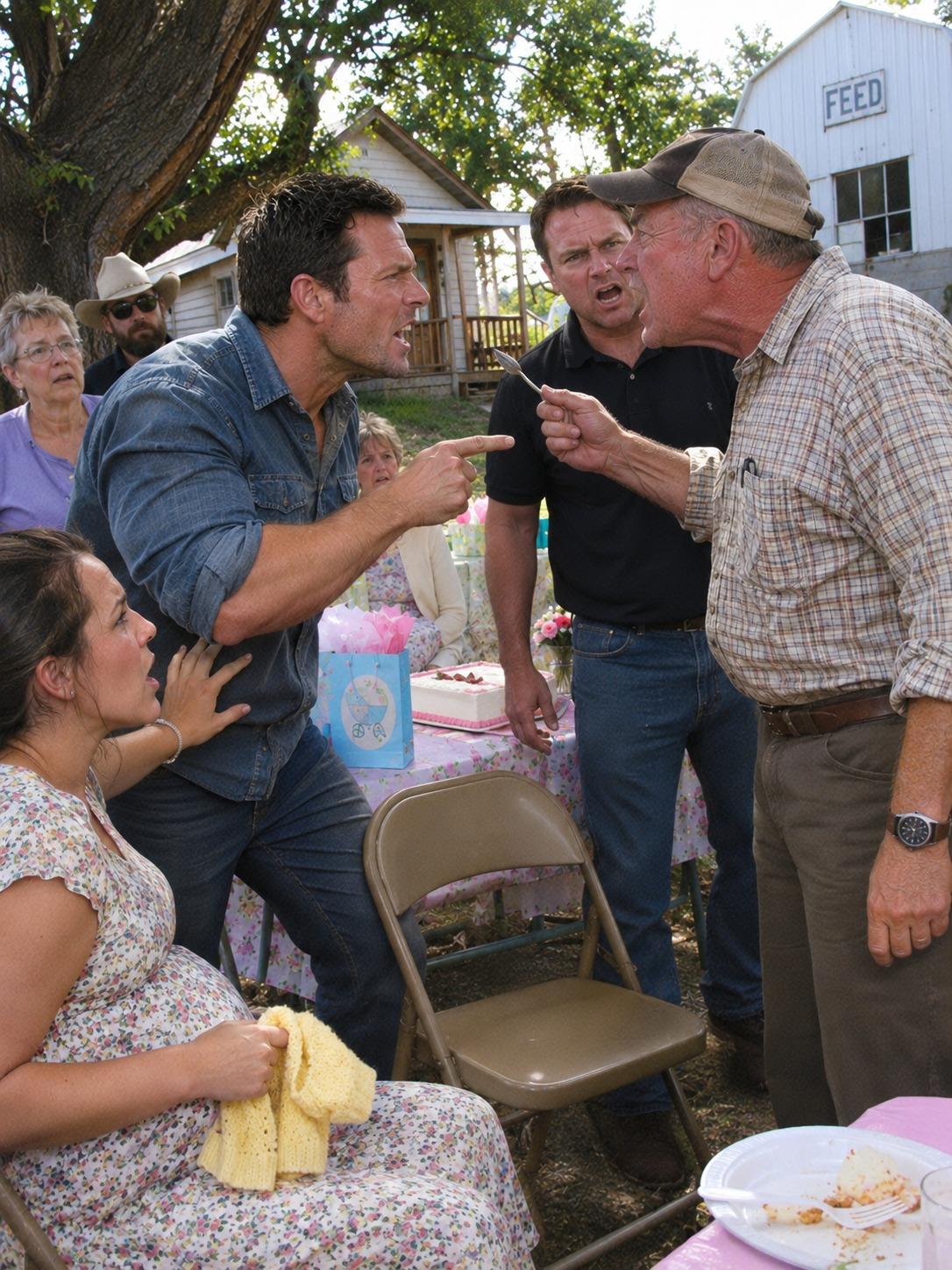
My father pointed his cake fork at my front porch and announced, "Your mother and I are moving into that house."
Then he pulled a folded yellow paper from his shirt pocket.
My name was written across the top.
Underneath it was a date from three weeks earlier.
I hadn't signed anything three weeks earlier.
That was the first moment I understood my father hadn't come to my wife's baby shower just to celebrate.
He had come expecting to collect something.
And the something was my home.
I stood beside a folding table covered with pink flowers, paper plates, and half-eaten cake, trying to decide whether I'd heard him correctly.
My wife, Liliana, was sitting six feet away with one hand resting on her pregnant belly.
She was eight months along.
Our daughter was due in five weeks.
Behind us stood the little white house I'd spent nearly two years building after work, on weekends, and during every spare hour I could find.
Twenty-four feet wide.
Thirty feet long.
One bedroom downstairs.
A sleeping loft upstairs.
A covered porch facing east so Liliana could drink her morning coffee without the Colorado wind blowing it into her lap.
It wasn't much by some people's standards.
But every board, nail, window, and crooked piece of trim had a story behind it.
And every dollar I'd put into it had come out of my own pocket.
My father was standing in front of that house with a fork in his hand, talking about it like he'd just spotted a used tractor he wanted to buy.
Except he wasn't offering to buy anything.
He was telling me he intended to move in.
"Dad," I said carefully, "what exactly are you talking about?"
He looked surprised that I'd interrupted him.
My father, Walter, had spent thirty-one years working irrigation canals around southeastern Colorado. He was the kind of man who could identify a neighbor's truck by the sound of its engine and tell you exactly how much water was running through a headgate without looking at a gauge.
He was also the kind of man who considered disagreement a personal insult.
"You heard me," he said.
He gestured toward the house again.
"Your mother and I aren't getting any younger. That place would be easier for us to maintain."
I looked at my mother.
She was sitting near Liliana, holding a tiny yellow sweater she'd knitted for our baby.
Her sewing needle was still tucked through one cuff.
She wouldn't meet my eyes.
That bothered me more than anything Dad had said.
"Where exactly do you expect Liliana and me to live?" I asked.
My younger brother, Kendrick, answered before Dad could.
"Above the store."
He said it casually.
Like he'd just suggested we switch parking spaces.
I turned toward him.
"Excuse me?"
"The upstairs room," Kendrick said. "You've already got plumbing up there. You could fix it up. Plenty of room for a little family."
I stared at him.
The room above my feed store was where I kept seed catalogs, spare cardboard boxes, and inventory that didn't fit downstairs.
It had a sink, a toilet, and seventeen steep wooden steps.
It didn't have a kitchen.
It didn't have a shower.
And it certainly wasn't where I intended to bring my newborn daughter.
Liliana's hand tightened over her belly.
"Kendrick," she said quietly, "that's a storage room."
He shrugged.
"People have raised babies in smaller places."
I felt something shift inside me.
Not anger yet.
Something colder.
Recognition.
Because suddenly I remembered the phone call I'd received that morning.
Dad had called while I was behind the counter at the feed store.
He'd asked how many stairs led to the upstairs room.
"Seventeen," I'd told him.
Then he'd asked what we used it for.
I'd assumed Mom wanted somewhere to store more furniture.
Now I understood why he'd been asking.
This wasn't a spontaneous suggestion.
They'd discussed it.
They'd made plans.
And nobody had bothered to include the two people who actually lived in the house.
I looked at Kendrick.
"How long have you been talking about this?"
He glanced toward Dad.
That glance answered my question.
"Don't make a scene," Dad said.
I almost laughed.
We were standing at my wife's baby shower.
There were pink decorations hanging from the cottonwood branches.
My father-in-law, Celestino, was holding a paper cup of lemonade.
Fidel and Ofelia Gallegos, the couple who'd sold me the feed store, were sitting beside a table covered with baby gifts.
My nephews, Lorenzo and Emiliano, had stopped chasing each other around the barn.
Everyone was watching.
And Dad was telling me not to make a scene.
"You brought this up in front of thirty people," I said. "What did you expect me to do?"
"Be reasonable."
"Reasonable?"
"Your mother and I need somewhere smaller. You've got a whole business here. You can make arrangements."
I looked over my shoulder at the house.
The porch rail still had a rough patch near the far corner.
I'd been meaning to sand it before the baby arrived.
Two tiny socks were hanging over it, drying in the afternoon breeze.
Liliana had washed them that morning.
I remembered holding those socks between my fingers and wondering how anybody's feet could be so small.
Then I looked back at Dad.
"No."
He blinked.
"What?"
"No, Dad. You're not moving into our house."
His expression hardened.
"Watch your tone."
"I'm not raising my voice."
"You're embarrassing your mother."
I looked at Mom again.
She was staring down at the yellow sweater.
"Mom," I asked, "did you know about this?"
Her fingers moved over the loose button she'd been repairing.
"Your father thought it might be a good arrangement."
"For who?"
She didn't answer.
That was when Kendrick stepped closer.
"You're making this bigger than it needs to be."
I turned toward him.
"Did you know about this before today?"
He shifted his weight.
"Everybody's just trying to figure out what works."
"Everybody except me and my wife."
"Come on, man."
"No. You come on."
My voice had gotten louder.
I could feel it.
But I wasn't going to apologize for it.
Kendrick looked toward the guests, then back at me.
"Dad and Mom have a lot going on right now."
"What does that have to do with my house?"
Dad stepped forward.
"Enough."
He had used that word on me since I was six.
Enough meant the conversation was finished.
Enough meant I was supposed to lower my eyes.
Enough meant he could say whatever he wanted, and I was expected to accept it.
For most of my childhood, it had worked.
It didn't work that afternoon.
"I'm thirty-eight years old," I said. "I own this property. I built that house. You don't get to say 'enough' and make my family disappear."
Dad's face turned red.
"Everything you've got started with this family."
I knew that argument.
I'd heard versions of it for twenty years.
When I was nineteen, Dad had taken twenty-seven hundred dollars from money he'd been holding for me.
He'd told me the well pump on the family farm needed replacing.
A few weeks later, Kendrick came home with a shaved-ice trailer.
The trailer had a penguin wearing sunglasses painted on the side.
The well pump hadn't been touched.
I knew because I'd checked it myself.
A mud dauber had built a nest across the pump cover.
The nest was still intact.
I opened my own bank account the following Monday.
I never accused Dad of stealing the money.
Not because I believed him.
Because I knew exactly what would happen if I did.
He'd say I was ungrateful.
Mom would cry.
Kendrick would tell me to get over it.
And somehow I'd end up apologizing.
That had been our family's way of handling money for as long as I could remember.
Dad made the decisions.
Kendrick received the benefits.
I was expected to understand.
But the house was different.
I'd built it with Liliana.
Not literally every board.
She'd been working full-time at the clinic when we started, and I'd done most of the framing.
But she'd helped me choose the windows.
She'd painted the kitchen cabinets.
She'd spent three weekends sanding the old oak boards we used for the bedroom floor.
When we discovered the bathroom wall was six inches out of square, she'd stood beside me with a level and laughed until we both had to sit down.
We'd eaten sandwiches on overturned buckets.
We'd slept on an air mattress before the bedroom had doors.
We'd made that place ours long before it was finished.
And now my father wanted to move us into a storage room.
I looked at Liliana.
Her eyes were shining, but she wasn't crying.
She'd always been steadier than me when things got ugly.
She reached for my hand.
"Daniel," she said softly.
I stepped closer.
"Are you okay?"
She nodded.
Then she looked straight at my father.
"Walter, that's our daughter's home."
Dad's expression changed.
He'd never liked being challenged by someone who wasn't his child.
Especially not in public.
"Nobody's trying to hurt the baby," he said.
"Then why are you asking us to move five weeks before she's born?"
"It's just a house."
Liliana went still.
I felt her hand tighten around mine.
Just a house.
Two years of work.
Every Sunday I could have spent fishing.
Every night I'd come home with sawdust in my hair.
Every dollar we'd saved instead of taking vacations.
The nursery we'd painted a pale yellow because Liliana didn't want to know whether we were having a boy or girl until the ultrasound technician accidentally called the baby "she."
Just a house.
I turned back toward Dad.
"That's enough."
He stared at me.
I could almost see him processing the fact that I'd used his own word against him.
Then he gave a short laugh.
"You'll come around."
"No, I won't."
"Don't be stubborn."
"My daughter is coming home to the house I built for her."
For a moment, nobody spoke.
Even the kids had gone quiet.
Then Dad looked toward a man standing beside Kendrick.
The man's name was Sutton.
He was from Denver.
Kendrick had introduced him earlier as a business partner.
Sutton was wearing expensive boots that didn't have a scratch on them.
He'd spent most of the afternoon asking questions about the feed store, the hay barn, and the upstairs room.
At the time, I'd assumed he was just curious.
Now I wasn't so sure.
Dad cleared his throat.
"Anyway, Sutton, why don't you tell everybody about the car wash?"
I stared at him.
He was changing the subject.
Just like that.
As if I hadn't said no.
As if my wife hadn't spoken.
As if the conversation was already settled.
Sutton hesitated.
Then he smiled awkwardly.
"Well, we're looking at a six-bay property in Pueblo West."
Kendrick straightened.
"It's a good opportunity."
Dad nodded enthusiastically.
"Drive-up coffee window, too. Could be a real moneymaker."
I looked from one face to another.
"Who's buying it?"
Dad answered.
"Your mother and I are borrowing against the home place."
The home place.
Forty acres south of Manzanola.
The white farmhouse where Kendrick and I grew up.
The property Dad had nearly lost to unpaid taxes two years earlier.
I knew because I'd loaned him nine thousand dollars to keep the county from taking action.
He'd promised to repay me by Christmas.
That Christmas had passed.
So had another.
He hadn't paid back a dollar.
Now he was talking about borrowing against the farm to finance Kendrick's newest business venture.
And apparently taking my house was part of the plan.
"How much are you borrowing?" I asked.
Dad waved his fork.
"That's business."
"Whose business?"
"Mine."
"Then why does your business involve my house?"
Kendrick stepped between us.
"Daniel, you're getting worked up over nothing."
I looked at him.
"Did you know Dad still owes me nine thousand dollars?"
His expression changed.
Only for a second.
But I saw it.
Dad's voice sharpened.
"That has nothing to do with this."
"It has everything to do with this."
Mom stood up.
"Please," she said. "Not today."
Her voice was shaking.
I hated seeing her upset.
I always had.
When I was little, she'd leave a plate of dinner for me on the stove if I got home late from helping Fidel at the store.
Even when Dad was angry.
Even when the rest of the family had eaten.
There was always a plate waiting.
That was part of what made this so difficult.
My parents weren't strangers.
They were people I'd loved my whole life.
People who'd taught me to ride a bicycle, helped me through the flu, and sat in the bleachers at my high school graduation.
But love didn't make what they were doing right.
I took a breath.
"Mom, I don't want to upset you."
"Then don't."
"I can't give you our house."
She looked toward Dad.
Not at me.
At Dad.
And I understood that she wasn't going to help.
Liliana rose halfway from her chair.
I immediately turned toward her.
"Stay seated, honey."
"I'm fine."
She wasn't.
Her face had gone pale.
Celestino moved toward us.
"Maybe everybody should take a minute," he said.
Dad bristled.
"This is a family matter."
Celestino looked at Liliana.
"She's my family."
That was all he said.
But it was enough to make Dad step back.
I helped Liliana settle into her chair.
She leaned close to me.
"Daniel," she whispered, "I don't want them in our house."
"They're not coming in."
"Promise?"
I looked at her.
Then at the little yellow socks hanging over the porch rail.
"I promise."
She nodded.
I could see she wanted to believe me.
So did I.
The party never really recovered.
People tried.
Ofelia started cutting more cake.
Fidel asked Celestino whether he'd fixed the hinge on his chicken coop.
Natalia gathered the boys and told them to help carry gifts.
But everybody kept looking toward Dad.
He stood beside Sutton, speaking quietly.
Kendrick joined them.
Three men.
Three lowered voices.
And every few seconds, one of them glanced toward my house.
I wanted to walk over and demand to know what they were discussing.
Instead, I stayed with Liliana.
I helped her open the last two presents.
One was a box of diapers from her sister.
The other was a small wooden picture frame from Fidel and Ofelia.
Inside was a photograph of the feed store from 1978.
Fidel stood in front of it, younger than I'd ever known him, holding a sack of chicken feed.
On the back, he'd written:
For the little girl who will grow up knowing what honest work looks like.
I had to look away for a moment.
Fidel noticed.
He came over and rested a hand on my shoulder.
"You okay, son?"
I nodded.
He didn't believe me.
But he didn't push.
That was one of the things I loved about him.
He knew when to ask questions.
And when to wait.
By five o'clock, most of the guests had gone.
Mom hugged Liliana carefully.
Dad shook my hand as if nothing had happened.
His grip was firm.
His smile wasn't.
"We'll talk later," he said.
"No, Dad. We already talked."
He held my hand a second longer.
Then he leaned closer.
"Don't make promises you can't keep."
I pulled my hand away.
"What does that mean?"
He put his cap on.
"Just think about your mother."
Then he walked toward his truck.
Kendrick followed.
Sutton stayed behind long enough to look at the house one more time.
He studied the porch.
The windows.
The gravel driveway.
Then he asked something that made my skin prickle.
"Daniel, is your street address still 418 County Road 22?"
I stared at him.
"Why?"
He gave a small smile.
"Just making conversation."
Then he walked away.
I watched his truck disappear behind the hay barn.
Only after it was gone did I remember the folded yellow paper Dad had pulled from his pocket.
The one with my name on it.
The one dated three weeks earlier.
He hadn't shown it to me.
And in all the arguing, I'd forgotten to ask what it was.
That evening, after we'd carried the presents inside, Liliana sat in the rocker Fidel had refinished for us.
I knelt beside her and rested my hand on her stomach.
Our daughter kicked.
Hard.
Liliana smiled for the first time in hours.
"She's got opinions," she said.
"Wonder where she gets that."
She laughed softly.
Then her smile faded.
"Do you think your dad really believes we're going to move?"
I thought about the fork.
The yellow paper.
The questions about the upstairs room.
Sutton asking for our address.
"Yes," I said.
She looked frightened.
I squeezed her hand.
"But believing something doesn't make it true."
I wanted that to be the end of it.
I wanted to finish painting the nursery, fix the porch rail, and spend the next five weeks worrying about ordinary things.
Car seats.
Hospital bags.
Whether I'd remember how to install the crib mattress.
Instead, I lay awake that night thinking about my father's last words.
Don't make promises you can't keep.
At six the next morning, I got dressed and walked toward the feed store.
The sun was barely above the fields.
I had a delivery coming at seven.
There were invoices to sort and a broken latch on the side door.
Normal problems.
Problems I understood.
Then I saw the truck.
A dark pickup I'd never seen before was parked beside our porch.
Its engine was running.
A man in a gray jacket stood at the bottom of the steps.
He was holding a brown document envelope.
When he saw me, he checked something on his phone.
Then he looked up.
"Daniel Mercer?"
"That's me."
He glanced toward the house.
"I'm here about the property."
I stopped walking.
"What property?"
He held out the envelope.
"Your father told us you'd been informed."
I didn't take it.
"Informed about what?"
The man opened the envelope and removed a document.
At the top was my address.
418 County Road 22.
Below it was a typed description of my house.
Twenty-four by thirty feet.
One bedroom.
Sleeping loft.
Covered east-facing porch.
My exact house.
The man turned to the final page.
"Before we proceed," he said, "I need you to confirm something."
He pointed to a signature.
My name was printed underneath it.
But I hadn't signed that paper.
I leaned closer.
The handwriting looked familiar.
Then I noticed the date.
Three weeks earlier.
The same date on the yellow paper Dad had shown at the baby shower.
The man turned the document toward me.
And beside my name, under the words Authorized Property Owner, was a second signature.
I knew that handwriting.
I had seen it on feed tickets, birthday cards, and a nine-thousand-dollar promise that had never been repaid.
But directly beneath it was another name.
One I had never expected to see connected to my house.
The man placed his finger under that name and said, "There's something else you need to know about who authorized this..."






Comments 0