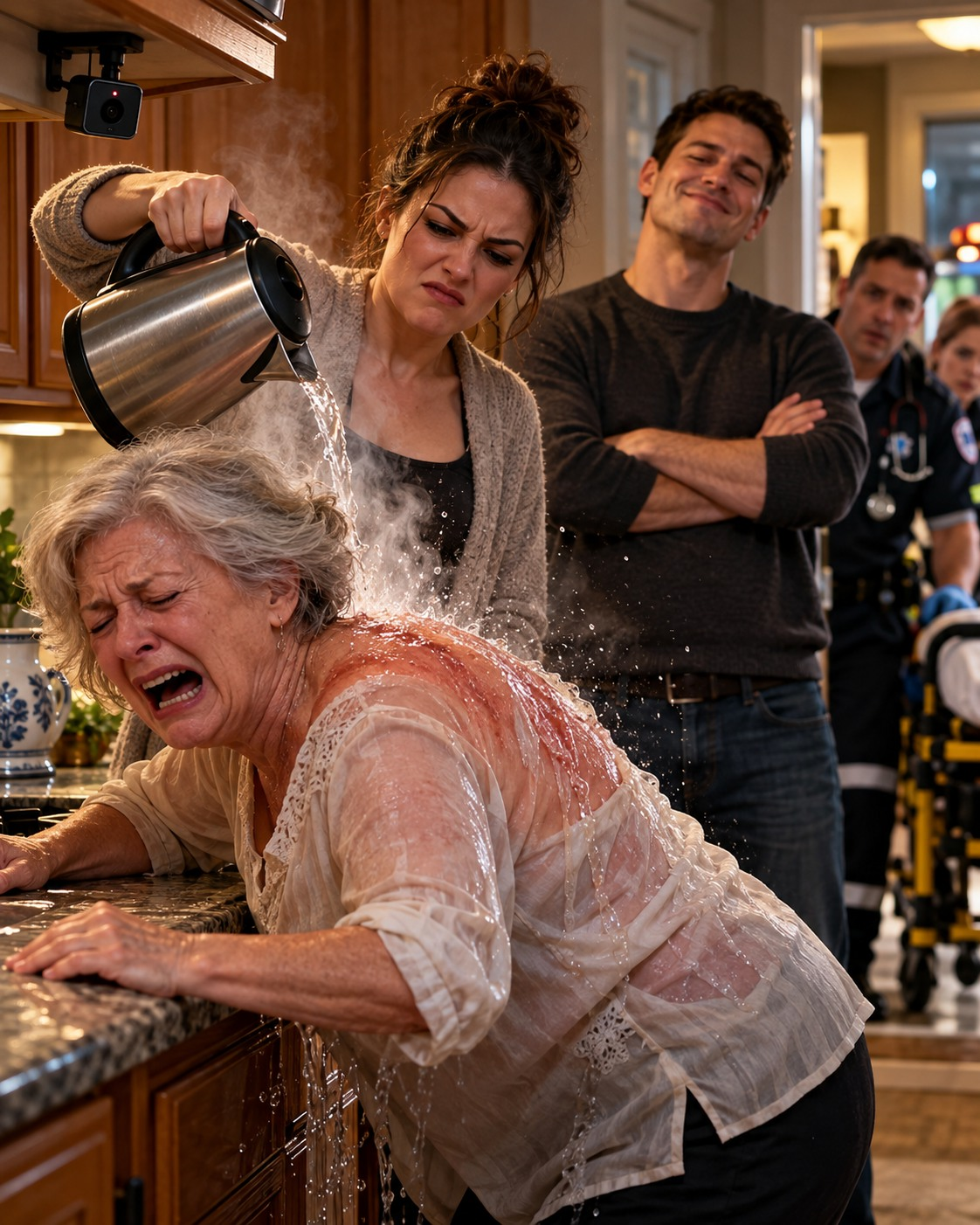
"Paul, there's something else you need to see."
Those eight words made my son turn toward the kitchen cabinet so quickly that I almost forgot the pain in my back.
Erin, the younger paramedic, was looking at the little black security camera mounted beneath the wooden shelf.
Daniel followed her gaze.
For the first time that afternoon, I saw something on my son's face that I hadn't seen when I screamed, when I begged for help, or when I collapsed against the counter.
Fear.
Not fear for me.
Fear for himself.
"Is that a security camera?" Erin asked.
Daniel hesitated.
Vanessa answered before he could.
"It's just an old thing Margaret put up months ago. I don't think it even works."
I wanted to tell her she was wrong.
I wanted to say that I'd seen the tiny red light glowing while I lay on the floor.
But my mouth was dry, my shoulders were burning, and every breath felt like an effort.
Paul glanced at the camera, then returned his attention to me.
"Margaret, we're going to get you to the hospital. We need to take care of these burns."
He turned toward Erin.
"Let's get her ready."
Daniel stepped forward.
"Shouldn't we check whether that camera recorded anything? I mean, just to see exactly how Mom knocked the kettle over?"
His voice sounded helpful.
Almost reasonable.
But I knew my son.
I had spent thirty-nine years learning the difference between his genuine concern and the careful tone he used when he wanted something.
He wasn't offering to help.
He was trying to get his hands on the evidence.
Paul looked at him.
"Right now, our priority is your mother's medical condition."
Daniel nodded quickly.
"Of course. Absolutely."
Vanessa stood beside the counter, twisting her wedding ring around her finger.
She had stopped looking at me.
Her eyes kept moving toward the camera.
I closed my own eyes.
And suddenly, in the middle of that terrible afternoon, I remembered another man standing in almost the same spot.
A man with sawdust in his hair, a pencil behind his ear, and a crooked smile that could make the hardest day feel manageable.
My husband.
Robert Hale.
The man who had built this kitchen with his own hands.
The man who had promised me that our home would always be a place where I felt safe.
And the man whose absence had made everything that followed possible.
Robert and I bought our house forty-three years earlier.
I was twenty-five, he was twenty-seven, and we had exactly eight hundred and sixty dollars left in our savings account after paying the down payment and closing costs.
I remember the number because Robert wrote it on the back of an envelope.
Then he held it up and grinned.
"Well, Maggie, we're officially homeowners."
I stared at the envelope.
"Robert, we can't even afford curtains."
"Then we'll enjoy the view."
"The view is Mrs. Peterson's garage."
"Beautiful garage," he said. "Very well maintained."
I laughed so hard that I had to sit on the kitchen floor.
Back then, the kitchen was nothing like the one where I would eventually be attacked.
The cabinets were painted a terrible shade of yellow.
The linoleum curled at the edges.
The faucet dripped constantly.
And the refrigerator made a noise like an old tractor every time its motor started.
But Robert saw possibilities everywhere.
He was a carpenter by trade, the kind of man who could look at a crooked wall and imagine exactly how to straighten it.
He had strong hands, patient eyes, and an almost unreasonable belief that anything broken could be repaired.
Our first winter in that house, the furnace stopped working two days before Christmas.
We couldn't afford a repairman.
Robert spent six hours in the basement figuring out what was wrong.
When the heat finally came back on, he climbed upstairs with black grease on his cheek and announced that he expected a medal.
I gave him a cup of hot chocolate.
He said it was close enough.
We didn't have much money.
But we had each other.
And somehow, that made the house feel rich.
Daniel was born two years after we moved in.
I remember bringing him home from the hospital, wrapped in a blue blanket my mother had knitted.
Robert carried the baby through the front door as carefully as if he were holding something made of glass.
He stood in the living room and looked around.
"Welcome home, buddy," he whispered.
Then he looked at me.
"Guess we'd better make this place worthy of him."
And he did.
Not all at once.
Not with borrowed money or expensive contractors.
He worked on our home slowly, one project at a time, after long days at his regular job.
He repaired the porch.
He replaced the windows.
He built shelves in Daniel's bedroom for toy trucks and baseball trophies.
When Daniel turned seven, Robert constructed a small wooden workbench in the garage so our son could pretend to help him.
Daniel loved it.
For months, he followed his father everywhere, carrying a plastic hammer and asking questions.
"Dad, why do you measure everything twice?"
"Because wood doesn't grow back after you cut it, son."
"Why do you always clean your tools?"
"Because you take care of what takes care of you."
I heard those conversations through the open kitchen window while preparing dinner.
At the time, they seemed ordinary.
Just a father teaching his son how to use his hands.
Looking back, I wonder how Daniel could have heard those lessons and forgotten what they meant.
Robert taught him patience.
Responsibility.
Respect.
He taught him to keep his promises.
And, most importantly, he taught him that being strong meant protecting people who needed help.
I believed those lessons would stay with our son forever.
I was wrong.
When Daniel was twelve, Robert decided to rebuild the kitchen.
We had been saving for nearly three years.
I wanted new cabinets, better lighting, and enough counter space to prepare Thanksgiving dinner without balancing dishes on the washing machine.
Robert wanted to do the work himself.
"Are you sure?" I asked.
He looked offended.
"Maggie, you married a carpenter."
"I married a man who once installed a bathroom shelf upside down."
"That shelf had character."
"It had everything sliding off it."
He laughed.
Then he kissed my forehead and promised the kitchen would be perfect.
For six weeks, our house was a disaster.
Cabinet doors leaned against the dining room wall.
Tools covered the hallway.
We ate sandwiches on paper plates because the stove was disconnected.
Daniel complained that the house smelled like sawdust.
But every evening, Robert worked until his shoulders ached.
He measured.
He sanded.
He fitted each cabinet door carefully.
He refused to rush.
One Saturday, I found him standing in front of the unfinished cabinets, staring at a piece of wood.
"What's wrong?" I asked.
"Nothing."
"Robert."
He sighed.
"I cut this panel a quarter inch too short."
I looked at it.
"Nobody will notice."
"I'll notice."
"Then put it somewhere nobody can see."
He shook his head.
"That's not how I want to build something for you."
He went back to the garage and made another panel.
I used to tease him about that moment.
But now, when I looked at those cabinets, I understood what he'd really been saying.
Love wasn't always flowers or grand speeches.
Sometimes it was a man working late into the night because he wanted the woman he loved to have a kitchen that would last.
Robert installed the final cabinet door on a Sunday afternoon.
He stepped back, wiped his forehead, and handed me a small brass key.
"What's this?"
"For the house."
"We already have house keys."
"I know."
He closed my fingers around it.
"But this one's special."
I looked at him.
He smiled.
"Promise me something, Maggie."
"What?"
"Never let anybody make you feel like a stranger in your own home."
I laughed softly.
"Why would anybody do that?"
He shrugged.
"People can get strange when they start thinking something belongs to them."
I didn't understand why he said it.
Not then.
I assumed he was talking about relatives who had argued over property after his father's death.
Robert had seen how quickly money could turn family members against one another.
He hated those arguments.
He always said a house was supposed to shelter a family, not destroy one.
I put the brass key in my jewelry box.
For years, I barely thought about it.
But after Robert died, I began carrying it in my purse.
It reminded me that he had wanted me to feel secure.
That he had built something lasting.
That the home belonged to our life together.
And that no one had the right to make me feel unwelcome inside it.
The happiest years of my marriage were not the years when we had the most money.
They were the years when our kitchen table was crowded.
Daniel would come home from school, drop his backpack beside the door, and immediately ask what was for dinner.
Robert would arrive twenty minutes later, wash his hands, and pretend he hadn't already smelled the food from the driveway.
We ate together almost every evening.
Sometimes Daniel talked so much that Robert couldn't get a word in.
Sometimes he sulked because a teacher had assigned too much homework.
Sometimes he argued about bedtime or chores.
We were an ordinary family.
We had disagreements.
We made mistakes.
But we loved each other.
At least, I believed we did.
One evening, when Daniel was fifteen, he came home furious because another boy at school had embarrassed him in front of his friends.
He wanted to fight.
Robert listened without interrupting.
Then he said, "You know what real strength is, son?"
Daniel shrugged.
"Winning?"
"No."
"Not letting people push you around?"
"Sometimes."
Robert leaned forward.
"Real strength is knowing you could hurt somebody and choosing not to."
Daniel rolled his eyes.
"Dad, that's corny."
Robert smiled.
"Maybe. But remember it anyway."
I remembered that conversation while lying injured on the kitchen floor.
My son had stood six feet away from a woman in terrible pain.
He had been strong enough to help.
Strong enough to intervene.
Strong enough to say no.
And he had chosen to smile.
I wondered whether Robert would have recognized him.
The thought hurt almost as much as the burns.
When Daniel left for college, Robert cried.
He tried to hide it.
He stood in the driveway waving until Daniel's car disappeared around the corner.
Then he went into the garage.
I found him sitting on his old workbench.
"He's going to be fine," I said.
Robert nodded.
"I know."
"Then why are you crying?"
He looked at me.
"Because I spent eighteen years teaching him how to leave, and nobody taught me how to watch him go."
I sat beside him.
We stayed there for a long time.
Over the years, Daniel visited less frequently.
He built his own life.
He changed jobs.
He moved apartments.
He dated women I rarely met.
Robert never complained.
"He's finding his way," he would say.
When Daniel introduced us to Vanessa, I wanted to like her.
She was confident, polished, and charming when she wanted to be.
She complimented my cooking.
She asked Robert questions about the house.
She told us how lucky Daniel was to have such loving parents.
I believed her.
Robert was quieter.
After their third visit, he stood beside me while I washed the dishes.
"What do you think of Vanessa?" I asked.
He dried a plate.
"Daniel seems happy."
"That's not what I asked."
He hesitated.
"She's very interested in the house."
I laughed.
"Well, it is a beautiful house."
"Yes."
He placed the plate in the cabinet.
"But she asked me three times whether we'd paid off the mortgage."
I turned toward him.
"Maybe she's just curious."
"Maybe."
He didn't say anything else.
Robert wasn't a suspicious man.
He believed in giving people the benefit of the doubt.
But he was also observant.
He noticed things other people missed.
I wish I'd listened more carefully.
Robert became ill four years before the attack.
At first, it was fatigue.
Then appointments.
Tests.
More appointments.
And finally, the kind of diagnosis that makes the world seem to tilt beneath your feet.
We tried everything the doctors recommended.
There were hopeful weeks.
Terrible weeks.
Days when he could sit outside and drink coffee.
Days when he barely had the strength to speak.
Daniel visited when he could.
Vanessa came occasionally.
But most of the time, it was Robert and me.
Just as it had been at the beginning.
One evening, near the end, I helped him into his favorite recliner.
The old brown chair had been with us for twenty-six years.
Its arms were worn.
One side sagged slightly.
Vanessa had once called it ugly.
Robert loved it.
He settled into the cushions and looked toward the kitchen.
"You remember when we bought this place?"
I smiled.
"Eight hundred and sixty dollars left in the bank."
He laughed weakly.
"And a refrigerator that sounded like a tractor."
I sat beside him.
He reached for my hand.
"Maggie, promise me something."
I felt my throat tighten.
"Anything."
"Don't let this house become a burden."
"It won't."
"If you ever want to sell it, sell it."
I shook my head.
"Robert—"
"I'm serious."
He squeezed my fingers.
"It's wood and brick. It's not me."
Tears filled my eyes.
"Don't say that."
He looked at me for a long moment.
Then he whispered, "But if you keep it, make sure you live in it. Don't just wait for somebody else to decide what happens next."
I promised.
He died seventeen days later.
For months, I couldn't bring myself to move his coffee mug.
I left his work boots beside the garage door.
I kept his recliner in the living room.
Sometimes I sat in the kitchen after midnight, listening to the refrigerator hum and imagining I could hear his footsteps in the hallway.
The house was full of memories.
But it was also painfully empty.
That loneliness was the reason I eventually opened my door to Daniel and Vanessa.
I thought family would bring warmth back into the rooms.
I didn't understand that loneliness could make a person overlook warning signs.
Or that the people you loved most could use your need for companionship against you.
"Margaret?"
Paul's voice pulled me back into the kitchen.
The memories vanished.
Robert was gone.
The paramedics were real.
The pain was real.
And my son was still standing beside the counter.
"Margaret, can you hear me?"
I nodded weakly.
"We're going to move you now."
Erin helped prepare the stretcher while Paul continued speaking calmly.
He explained what they were doing before they touched me.
He asked where the pain was worst.
He told me not to worry about answering every question immediately.
I wanted to thank him.
Instead, I began crying.
Not loudly.
Not dramatically.
Just tears slipping down my cheeks.
Paul paused.
"You're safe with us right now," he said.
I looked at him.
Then I looked at Daniel.
My son stood near the kitchen doorway, watching.
Vanessa was beside him.
They looked worried.
Anyone walking into the room would have thought they were a loving couple terrified for an elderly parent.
But I had seen their faces before the ambulance arrived.
I knew what they had said.
And I knew what they had done.
As Erin helped me onto the stretcher, Daniel approached.
"Mom, I'll follow you to the hospital."
I flinched.
I couldn't help it.
He noticed.
His expression tightened.
"Mom?"
I turned my face away.
Paul stepped between us.
"We need to get her transported."
Daniel backed off.
"Of course."
Vanessa reached for his arm.
I saw her whisper something.
Daniel glanced toward the cabinet.
Toward the camera.
Then he looked at me.
There was something calculating in his eyes.
I had seen that expression before when he was a teenager trying to talk his way out of trouble.
But this was no broken curfew.
No dented car.
No forgotten homework.
This was my life.
My safety.
My home.
As the paramedics wheeled me toward the hallway, I caught one final glimpse of Robert's kitchen.
The wooden cabinets.
The granite counter.
The ceramic pitchers.
The dinner I'd never finished cooking.
And the little black camera above the counter.
Its red light was still glowing.
I wanted to tell Erin to protect it.
I wanted to warn her that Daniel might try to remove it.
But the pain was overwhelming, and the words wouldn't come.
The stretcher turned toward the front door.
For a moment, I saw Robert's old recliner through the open garage doorway.
Vanessa had moved it there months earlier.
She said it made the living room look outdated.
I had argued.
Daniel had told me to stop making his wife uncomfortable.
Now the chair sat beneath a dusty sheet, surrounded by boxes that didn't belong to me.
I wondered how many pieces of my life they had already pushed aside.
And how many more they intended to take.
Outside, the evening air touched my face.
The paramedics lifted the stretcher into the ambulance.
Paul climbed in beside me.
Erin closed one of the rear doors.
Before she closed the other, I saw Daniel standing on the porch with his phone in his hand.
He was talking to Vanessa.
His expression was no longer frightened.
It was determined.
Then he turned toward the house.
Toward the kitchen.
Toward the camera.
I tried to sit up.
"Camera," I whispered.
Paul leaned closer.
"What was that, Margaret?"
I swallowed.
"The camera."
He looked toward the house.
Then back at me.
"Don't worry about that right now. We're going to take care of you."
I wanted to explain.
But Erin shut the ambulance door.
The outside world disappeared.
As the vehicle began moving, I closed my eyes and thought of Robert's final warning.
Don't just wait for somebody else to decide what happens next.
I had spent eleven months trying to keep peace with people who didn't want peace.
They wanted control.
And now I was being taken away from the only home I'd ever truly loved.
I didn't know whether I would be allowed to return.
I didn't know whether Daniel would destroy the recording.
And I didn't know whether anyone would believe an elderly widow over her own son.
At the hospital, the medical staff moved quickly.
A nurse asked questions while another prepared treatment for my burns.
Paul gave his report.
I heard him mention that the injury pattern appeared inconsistent with the explanation he'd been given.
The nurse looked at me.
"Margaret, do you feel safe at home?"
My lips parted.
For the first time in my life, I couldn't answer that question.
Then the nurse gently asked whether anyone had deliberately hurt me.
I looked toward the open doorway.
Daniel wasn't there.
Vanessa wasn't there.
For the first time that evening, neither of them was close enough to tell me what to say.
I took a shaky breath.
"Yes," I whispered.
The nurse stopped writing.
"Who hurt you?"
I began to cry.
"My daughter-in-law."
Her expression changed.
"And where was your son?"
I closed my eyes.
"He watched."
The nurse remained silent for a moment.
Then she placed a hand gently on my arm.
"Margaret, I'm going to make sure the right people hear what you've told me."
I nodded.
She stepped toward the doorway.
But before she could leave, another nurse appeared.
She was holding a telephone.
"There's someone calling about Mrs. Hale," she said.
The first nurse frowned.
"Who?"
The woman looked down at the message she'd written.
Then she looked directly at me.
"Someone who says they have information about what really happened in that kitchen."
She handed the telephone to the nurse.
The caller was still on the line.
And the first words I heard through the receiver were—
"Before Daniel gets back into that house, you need to know what he did eleven months ago."






Comments 0