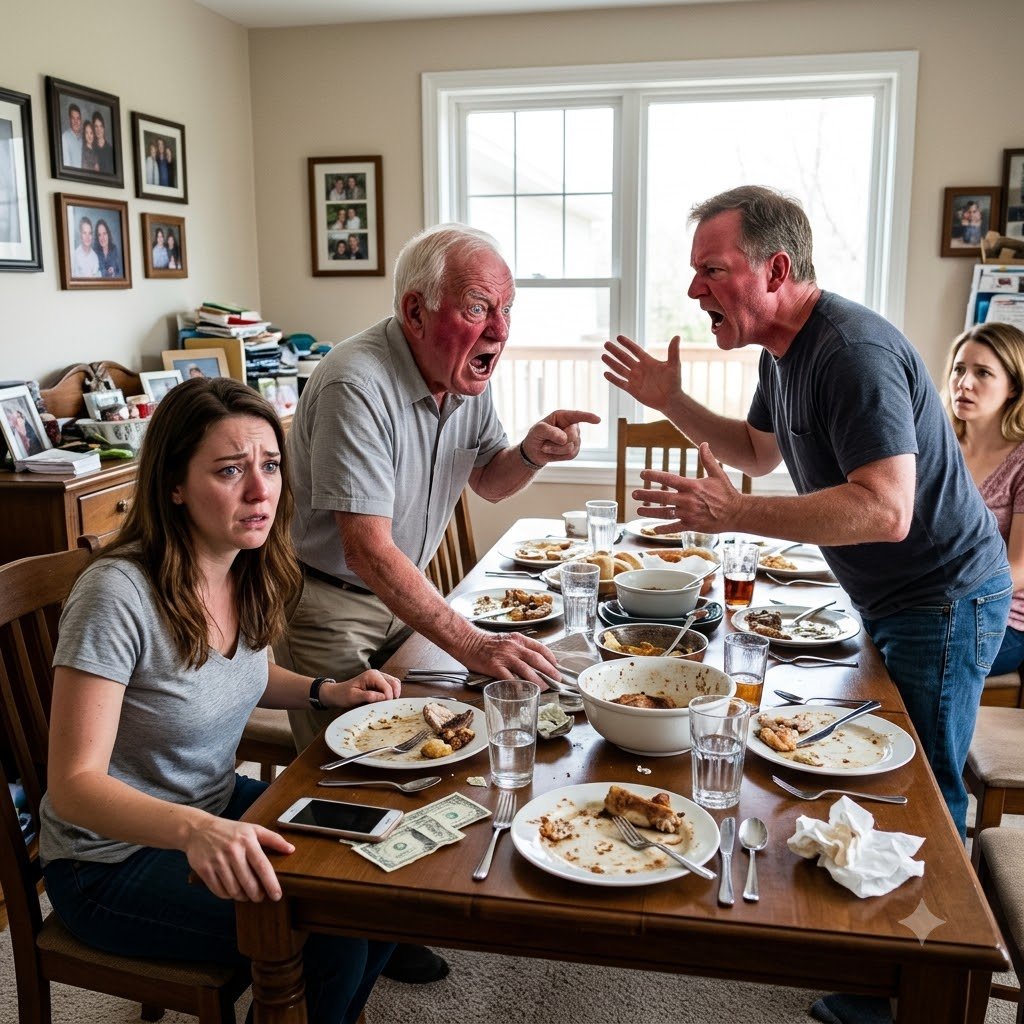
"Frank, there's another document. The one David never wanted Lauren to find."
My mother's voice trembled.
Nobody moved.
Dad stood beside the dining table, holding his phone. Grandpa looked at him with an expression I had never seen before.
Not anger.
Not disappointment.
Something much worse.
A complete loss of trust.
"What document?" Grandpa asked.
Mom looked toward the staircase.
"There's a blue folder in David's locked desk drawer. I saw it last month. He told me never to touch it."
Dad immediately turned toward her.
"Linda, stop."
She shook her head.
"No. I've kept quiet long enough."
I looked at my father.
"What is in that folder?"
He didn't answer.
Grandpa stepped forward.
"David, I want the truth. Right now."
Dad placed his phone on the table.
"You're all misunderstanding what's happening."
I almost laughed.
For months, that had been his favorite explanation.
Every document was misunderstood.
Every payment had another purpose.
Every promise meant something different from what he had told us.
But this time, nobody interrupted Mom.
She walked toward the hallway.
"The folder is in his office. I know where he keeps the key."
Dad moved toward her.
Grandpa stopped him.
"Let her go."
Mom disappeared into the hallway.
A few minutes later, she returned carrying a thick blue folder.
She placed it on the dining table.
Dad stared at it.
"Linda, you have no idea what you're doing."
Mom looked directly at him.
"I know exactly what I'm doing."
She opened the folder.
The first document was an insurance policy summary.
The second was a financial authorization.
The third was a letter concerning the proposed beneficiary arrangement.
My name appeared on every page.
And beside my father's name was the designation I had never knowingly approved.
I felt my stomach tighten.
"Mom, what is this?"
She turned the page toward me.
"Your father wanted to use your insurance policy as additional financial security."
I stared at the document.
It appeared to reference a policy associated with my personal information.
I had never agreed to make Dad the beneficiary.
I had never knowingly authorized him to change anything.
Grandpa looked at Robert's business card lying beside the folder.
"We're calling him."
Robert arrived shortly afterward.
He examined the documents carefully.
He didn't make assumptions.
He photographed each page, noted the dates, and separated the originals.
Then he asked me to explain what I remembered about the insurance policy.
"I remember getting a basic policy through work. Dad helped me organize some paperwork when I moved into the basement."
"Did you personally complete a beneficiary designation?"
"I don't remember choosing him."
"Did you authorize him to change an existing beneficiary?"
"No."
Robert nodded.
"Then we need to contact the insurance provider directly and establish the current policy status."
He looked at the document.
"The paperwork in this folder suggests an attempted change or authorization. It does not establish that the change was validly completed."
I felt relieved, but I was still frightened.
"Could he have received money?"
Robert shook his head.
"Nothing in these papers establishes that any benefit was paid. We will verify that with the provider."
Grandpa looked at Dad.
"How much further were you planning to go?"
Dad rubbed his forehead.
"I was trying to solve a financial problem."
"By using your daughter's insurance?"
"I wasn't going to hurt her."
I stared at him.
"Then why didn't you tell me?"
He looked at me.
For the first time, he seemed unable to find an answer.
Robert continued reviewing the folder.
He found another document near the back.
It was a handwritten financial plan.
The heading read:
FINAL FAMILY SETTLEMENT — AFTER PROPERTY TRANSACTION.
Beneath it were several amounts.
The proposed sale price.
The seventy-two-thousand-dollar debt.
The eighteen-thousand-five-hundred-dollar payment to Paul.
My thirty-nine-thousand-six-hundred-dollar contribution.
Megan's supposed eighteen-thousand-dollar distribution.
And a final figure beside my father's name.
I looked at the page.
"What is this last amount?"
Robert examined it.
"It appears to be the projected amount David expected to retain after the proposed transaction."
Grandpa's expression hardened.
"How much?"
Robert pointed to the number.
One hundred and ninety thousand dollars.
I stared at it.
Dad had planned to sell a house he didn't own, use my money to settle part of his debt, make me and Megan acknowledge payments we had never received, and retain the largest portion of the proceeds.
I looked at him.
"Was that always the plan?"
He lowered his eyes.
For several seconds, the dining room remained silent.
Then Dad finally spoke.
"I made mistakes."
Grandpa shook his head.
"That is not an explanation."
"I was under pressure."
"From whom?"
Dad looked toward the blue folder.
"Paul."
Robert immediately looked up.
"Explain."
Dad sat down.
He looked exhausted.
"Paul introduced me to someone who could help with my financial problems."
"Who?" Robert asked.
"I don't know all the details."
"Then tell us what you do know."
Dad took a breath.
Several years earlier, he had invested money in a business opportunity.
The investment failed.
He borrowed money to cover the losses.
Then he borrowed more to repay the first debt.
Eventually, the amount became difficult to manage.
He had initially intended to sell some personal assets.
But he didn't have enough.
Paul introduced him to people who were interested in property transactions.
Dad claimed he had discussed the family house with them.
He had told them he could arrange a sale.
But he hadn't owned the property.
Grandpa listened without interrupting.
"Why didn't you ask me?"
Dad looked down.
"Because I knew you'd say no."
"Exactly."
Dad continued.
He had initially planned to convince Grandpa to transfer the house to him.
When that failed, he began preparing documents suggesting that he already had authority to act.
The proposed power of attorney.
The family settlement.
The disputed authorization.
The paperwork claiming that I had agreed to financial contributions and that Megan had received money.
Robert asked him directly whether he had prepared the disputed signatures.
Dad became silent.
Then he said, "I didn't personally prepare every document."
"Did you submit documents containing signatures you knew had not been authorized?"
Dad looked at the table.
"I thought everything could be sorted out later."
Robert's voice became firm.
"That is not an answer."
Dad finally nodded.
"I knew some of the documents weren't properly completed."
My heart sank.
"So you knew."
He looked at me.
"Lauren, I thought I could fix it before anyone got hurt."
I shook my head.
"You already hurt us."
He didn't respond.
Robert explained that the documents would need to be reviewed by the appropriate professionals and that any potentially unauthorized financial or property activity would have to be addressed through the proper channels.
He also made it clear that Dad's explanation did not make the documents valid.
The property remained Grandpa's.
I had not knowingly agreed to guarantee Dad's debt.
Megan had not received the supposed eighteen thousand dollars.
And Mom's witness signature did not establish that Grandpa had signed anything in her presence.
Robert recommended that Grandpa immediately formalize his denial of authorization, protect the property title, and cooperate with the relevant institutions.
He also advised me to contact my insurance provider and financial institutions directly.
I followed his instructions.
Over the following days, several things became clear.
The proposed sale had not been completed.
The property representative confirmed that the transaction would not proceed without valid authorization from Grandpa.
The financial services company placed the disputed loan application under review.
The insurance provider confirmed that no benefit had been paid under the paperwork we discovered. It also froze the requested beneficiary change while verifying my instructions.
The documents bearing Grandpa's disputed signature were preserved for examination.
And the financial guarantee carrying my name was formally challenged.
I did not agree to repay my father's debt.
Megan did not accept the fictional distribution.
Neither of us signed the family settlement.
For the first time, the paperwork reflected what had actually happened.
Not what Dad wanted everyone to believe.
The next week, Grandpa invited us to his retirement condominium.
Megan came with her children.
Mom arrived separately.
Dad did not attend.
Grandpa had asked for some time before speaking with him again.
We sat around his dining table.
The children were eating sandwiches.
Megan's youngest was drawing on a piece of paper.
Grandpa watched them for a moment.
Then he turned toward me.
"Lauren, I've been thinking."
I smiled faintly.
"About what?"
"Your living arrangements."
I looked down.
"I've applied for an apartment."
"Good."
He nodded.
Then he reached into a drawer and removed an envelope.
"I want you to have something."
I opened it.
Inside was a letter.
It was written in Grandpa's handwriting.
He explained that he wanted to help me establish a secure home of my own.
He also wanted to make clear that any future gift or inheritance would be handled transparently, through proper legal documents, and without conditions involving my monthly income or financial obligations.
I looked up.
"Grandpa, you don't have to do this."
"I know."
He smiled.
"That's why I want to."
I felt tears forming.
He continued.
"I've watched you spend three years trying to make things easier for everyone else. I don't want you to feel that you have to keep doing that."
I folded the letter carefully.
"Thank you."
He reached across the table.
"You're welcome."
Then he looked toward Megan.
"And that goes for you too."
Megan smiled.
"Thank you, Grandpa."
He nodded.
"Both of you deserve a fair chance to build your lives."
For the first time in months, I felt genuinely hopeful.
The following weeks were difficult.
Dad had to deal with the consequences of the financial arrangements he had created.
The disputed loan application remained under investigation.
The property documents were reviewed.
The insurance authorization was withdrawn and replaced with instructions I personally approved.
The financial guarantee was not accepted as a valid obligation on my part.
The property remained in Grandpa's name.
The proposed sale was abandoned.
And Paul eventually stopped contacting me after Robert formally directed all communications through his office.
My thirty-six payments were documented.
The total remained $39,600.
Robert explained that recovering the entire amount might require a separate process because the money had been transferred to different accounts and used for different expenses.
I understood.
I wasn't expecting an overnight solution.
But I refused to let the matter disappear.
With Robert's help, I began pursuing repayment through the appropriate channels.
Some of the money was eventually returned through an agreed repayment arrangement.
The remainder became part of the ongoing financial resolution between the relevant parties.
It wasn't as simple as receiving one check.
But the important thing was that my claim was finally acknowledged.
Megan also clarified that she had never received the eighteen thousand dollars listed in the documents.
She refused to sign any acknowledgment saying otherwise.
Her children remained with her.
And she began making plans for a more stable future.
Mom was the first person to apologize.
She came to my new apartment one Saturday afternoon.
I had moved in three weeks earlier.
The place was small, bright, and close to work.
There were boxes in the hallway.
A secondhand sofa stood against the living room wall.
The kitchen still smelled of fresh paint.
Mom looked around.
"It's lovely."
"Thank you."
She held a small gift bag.
"I brought something."
Inside was a framed photograph of Grandma.
It was the same photograph Megan and I had found in my old bedroom.
Grandma stood between us in her garden.
All three of us were smiling.
I placed it on the bookshelf.
Mom sat down.
For a while, neither of us spoke.
Then she said, "I'm sorry, Lauren."
I looked at her.
She continued.
"I should have told you the truth. I should have asked questions. I should never have signed documents I didn't understand."
I nodded.
"Yes."
"I was afraid of upsetting your father."
I looked at the photograph.
"But you were willing to let me keep paying."
She lowered her eyes.
"I know."
I took a breath.
"Mom, I love you. But I can't pretend this didn't happen."
She nodded.
"I don't expect you to."
"And I need time."
"I understand."
For the first time, she didn't ask me to forgive her immediately.
She didn't tell me to think about the family.
She simply sat there and accepted that trust would take time to rebuild.
When she left, she hugged me.
I hugged her back.
It wasn't a complete reconciliation.
But it was honest.
And that was a beginning.
Megan's life began changing too.
She found a small rental house near her children's school.
It wasn't luxurious.
But it was affordable.
She decorated the living room with secondhand furniture and colorful cushions.
The children had their own bedrooms.
They were excited about choosing new curtains.
One afternoon, I visited.
Her youngest ran to the door.
"Aunt Lauren!"
I picked him up.
"How's the new house?"
He grinned.
"I have the blue room!"
Megan laughed from the kitchen.
"He picked it himself."
I looked around.
There were toys on the floor.
A school backpack beside the sofa.
A drawing taped to the refrigerator.
It was ordinary.
And that made it wonderful.
Megan handed me a cup of coffee.
"Do you remember when Dad said I needed more help because I had two children?"
I nodded.
She smiled sadly.
"I used to feel guilty whenever you paid more than I did."
I looked at her.
"You didn't make me pay."
"I know. But I should have asked more questions."
I shook my head.
"We both believed what we were told."
She reached across the counter.
"At least we know now."
I smiled.
"Yes."
Several months later, Grandpa invited the entire family to Sunday dinner.
The invitation came directly from him.
He asked Mom.
He asked Megan.
He asked the children.
And he asked me.
Dad was not included.
Not yet.
Grandpa had decided that any future relationship with his son would depend on accountability and genuine change.
He wasn't interested in pretending everything was normal.
Neither was I.
That Sunday, I arrived carrying a homemade apple pie.
Megan was already there.
Her children were playing in the living room.
Mom was setting the table.
Grandpa stood in the kitchen, preparing vegetables.
"Lauren!"
He turned and smiled.
"Come here. I need someone to taste this."
I tried the sauce.
"It's good."
"Are you sure?"
"Yes."
He narrowed his eyes.
"You're being polite."
I laughed.
"All right. It needs salt."
He laughed too.
For a moment, everything felt wonderfully ordinary.
We sat down to dinner.
There were no arguments about rent.
No financial forms.
No discussions about who owed whom.
Grandpa asked Megan about the children.
Mom talked about a new recipe.
I told them about my apartment and the promotion I had recently received at work.
Grandpa listened carefully.
Then he raised his glass.
"To new beginnings."
Megan raised hers.
Mom followed.
I smiled.
"To new beginnings."
After dinner, Grandpa asked me to walk with him through the living room.
He stopped beside an old photograph of Grandma.
"She would have liked how things turned out today."
I looked at the picture.
"I think she would have liked you telling Dad to explain himself."
Grandpa chuckled.
"Your grandmother was much better at that than I was."
We stood quietly.
Then he said, "I've made a decision about the house."
I turned toward him.
"What decision?"
"I'm keeping it."
I smiled.
"Good."
"I've arranged for the property records and my estate documents to be reviewed properly. Everything will be clear. No private promises. No informal arrangements."
He looked at me.
"And when the time comes, the house will go to the people I choose through a properly documented estate plan."
I nodded.
"That's how it should be."
He smiled.
"But there's one thing I want you to remember."
I waited.
"Your future doesn't depend on that house."
I looked at him.
He continued.
"You have your own job, your own home, and your own life. Whatever happens to the property someday, you've already built something that belongs entirely to you."
I felt my eyes sting.
I hugged him.
"Thank you, Grandpa."
He patted my back.
"Now go get your coat. You're going to be late."
I laughed.
"For what?"
"For enjoying your own life."
Dad eventually contacted me.
His first message was short.
I hope you're doing well.
I read it several times.
I didn't answer immediately.
A few weeks later, he sent another message.
He apologized for involving me in his financial problems.
He admitted that he had misrepresented the mortgage, used my payments without explaining where they went, and prepared documents that he should never have asked me to sign.
He also said he was working through his debts and cooperating with the necessary reviews.
I appreciated the apology.
But I understood that an apology wasn't the same as restored trust.
I agreed to meet him in a public place.
We sat across from each other at a coffee shop.
He looked older.
His hair had become thinner.
He stirred his coffee without drinking it.
"I know I hurt you," he said.
I nodded.
"Yes."
"I thought I could fix everything before anyone found out."
"You should have told us."
"I know."
He looked down.
"I was ashamed."
I listened.
Then I said what I had wanted to say for months.
"Dad, I would have understood if you had financial problems. I might even have helped if you had asked honestly. But you lied to me. You took money from me and told me it was for a mortgage that didn't exist."
He nodded.
"I know."
"You made me believe I was helping protect the family home."
"I know."
"And then you tried to make me responsible for your debt."
His eyes filled.
"I was wrong."
I took a breath.
"I'm not ready to pretend everything is fine."
He nodded slowly.
"I understand."
"If we rebuild our relationship, it has to be based on honesty. No more financial arrangements. No more documents I don't understand. And no more using family as an excuse."
He looked at me.
"I agree."
I didn't hug him.
I didn't promise that everything would be forgiven.
But I stood up and told him I would consider meeting again.
For now, that was enough.
A year after Grandpa stopped chewing during Sunday dinner and asked why I was paying my parents rent, I received a letter from Robert.
The financial dispute had reached a resolution.
My claim for the money I had paid was formally recognized.
The repayment arrangement had been completed according to the agreed terms.
The disputed property transaction had been abandoned.
The financial guarantee bearing my name was not treated as an obligation I had knowingly accepted.
The insurance beneficiary issue had been corrected according to my own instructions.
And Grandpa's ownership of the house remained protected.
I read the letter twice.
Then I called Megan.
She answered while driving home from work.
"What's wrong?"
"Nothing."
"Why are you calling like that?"
I laughed.
"Because I got the letter."
She went quiet.
"Really?"
"Yes."
"Is everything resolved?"
"Everything we were waiting for."
I heard her exhale.
Then she laughed.
"Lauren, that's amazing."
I smiled.
"It is."
She promised to come over that evening.
I placed the letter on my kitchen counter.
Then I looked around my apartment.
My apartment.
The place I had almost convinced myself I couldn't afford because my family needed my money.
There was a small plant beside the window.
A framed photograph of Grandma on the bookshelf.
My work bag near the door.
And a set of keys on the kitchen counter.
No one had given me permission to live there.
No one was collecting money from me under a false promise.
I had chosen it.
I had paid for it.
And it was mine.
That evening, Megan arrived with dinner.
We sat on the sofa and talked for hours.
At one point, she looked toward the framed photograph of Grandma.
"Do you think she'd be proud of us?"
I smiled.
"I think she'd be proud that we finally asked questions."
Megan laughed.
Then she became serious.
"Do you ever think about how different things might have been if Grandpa hadn't asked that question?"
I looked down at my hands.
"Sometimes."
I remembered the Sunday dinner.
Dad's dismissive explanation.
Mom's silence.
Grandpa putting down his fork.
That one question had exposed everything.
But it hadn't been the question alone that changed our lives.
It was what happened afterward.
The records we preserved.
The signatures we refused to accept.
The documents we questioned.
The boundaries we established.
And the decision to stop confusing family loyalty with blind obedience.
I looked at Megan.
"I'm glad he asked."
She nodded.
"Me too."
The following Sunday, Grandpa invited us over again.
This time, I arrived early.
He was sitting at the dining table, looking through an old family photograph album.
I sat beside him.
He turned a page.
There was a photograph of Grandma standing in front of the house in 1998.
The year they bought it.
She was smiling.
Grandpa looked at the picture for a long time.
"Your grandmother loved that place."
I nodded.
"I know."
"She always said a house was only worth something if the people inside felt safe."
I looked toward the dining room.
The same room where the truth had finally come out.
The same table where Dad had tried to convince us to sign away things that were never his to offer.
Grandpa closed the album.
"Would you like some coffee?"
I smiled.
"Yes."
He stood and walked toward the kitchen.
I looked at Grandma's photograph one more time.
For three years, I had paid $1,100 every month because I thought I was helping my family keep a home.
I had given away $39,600 believing that was what a good daughter was supposed to do.
But I had learned something far more valuable than the money I recovered.
Love didn't require me to surrender my judgment.
Family didn't give anyone the right to deceive me.
And a promise was worth nothing if the person making it couldn't be trusted.
Grandpa returned with two cups of coffee.
He placed one in front of me.
Then he sat down.
"Ready for dinner?"
I smiled.
"Absolutely."
And for the first time in a very long time, I sat at that table without feeling that I owed anyone an explanation for being there.
I was simply Lauren.
A granddaughter.
A sister.
A daughter learning to rebuild her boundaries.
And a woman finally living a life she had chosen for herself.






Comments 0