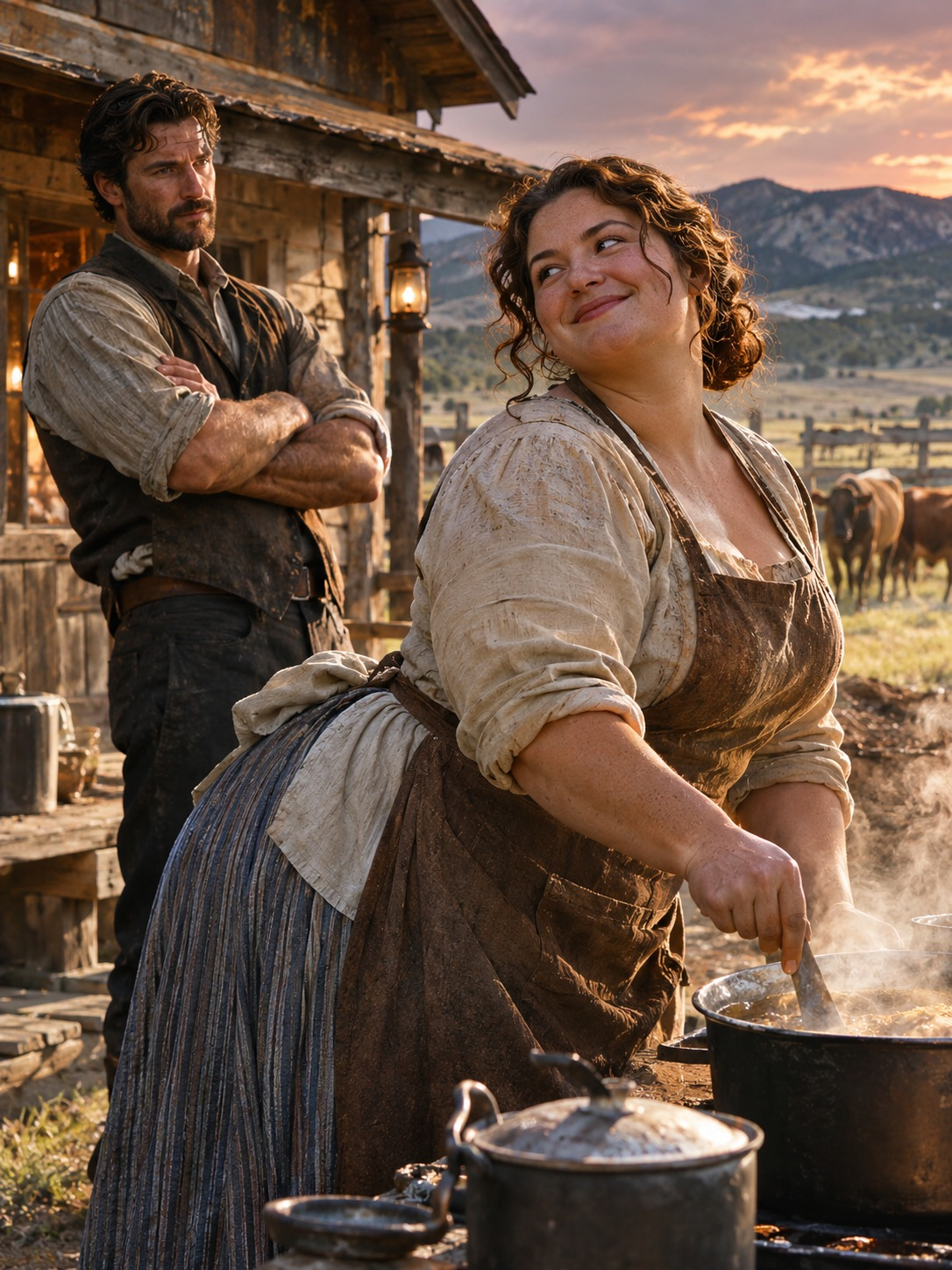
"Don't open that door!" Clara shouted as Silas reached for the iron ring set into the kitchen floor.
The knocking stopped.
For one terrible moment, the entire house seemed to hold its breath.
Silas stood motionless beside the cellar hatch, his hand suspended inches above the handle. His face had lost every trace of color.
Clara could hear the wind brushing against the windows. Somewhere outside, a horse stamped inside the barn.
Then came another sound.
A woman coughing.
Not from the kitchen.
Not from outside.
From beneath their feet.
Silas turned toward Clara.
"Tell me you heard that."
"I heard it."
His eyes moved toward the floor.
"That voice..."
Clara swallowed.
"What about it?"
Silas looked at her with an expression so devastated that she almost wished she hadn't asked.
"It sounded like Rebecca."
The name settled between them.
Rebecca Mercer.
His wife.
The woman buried beneath the cottonwood tree two years earlier.
Clara looked at the letter trembling in her hand.
Her mother's handwriting covered the page. Rebecca's name appeared beneath it, followed by a date that should have been impossible.
And now someone beneath the house had spoken in a voice Silas believed belonged to his dead wife.
Clara was not a superstitious woman.
She had spent too many years caring for sick people, balancing impossible accounts, and surviving disappointments to believe that ghosts simply appeared beneath kitchen floors.
But she did believe in secrets.
And she was beginning to understand that the Mercer ranch was full of them.
"Silas," she said carefully, "we don't know who's down there."
He stared at the hatch.
"I know what I heard."
"You heard a woman's voice."
"I heard my wife."
Clara stepped closer.
"Rebecca died two years ago."
His jaw tightened.
"Don't you think I know that?"
She immediately softened her voice.
"Of course you do."
Silas closed his eyes.
For a moment, he looked less like the strong rancher she had met beside the corral and more like a man standing at the edge of a grief he had barely survived the first time.
Then something struck the underside of the hatch.
Clara jumped.
Silas seized the iron ring.
"Move back."
"Silas—"
"Now."
His voice was sharp, but Clara recognized the fear beneath it.
She stepped toward the stove.
Silas pulled.
The hatch lifted several inches before stopping abruptly.
He pulled again.
Something was holding it from below.
A rope?
A chain?
Someone's hand?
"Who's down there?" Silas demanded.
No answer.
He braced one boot against the floor and pulled harder.
The hatch rose another inch.
Then a thin, frightened voice whispered:
"Please."
Clara felt the blood drain from her face.
Silas froze.
"Who are you?"
Silence.
Then the voice returned.
"Don't let him find me."
A sudden crash came from beneath the house.
Something heavy overturned.
The woman cried out.
Silas released the hatch and ran toward the back door.
Clara followed.
"Where are you going?"
"There's another entrance."
He grabbed a lantern from the wall.
"Stay inside."
Clara stopped.
Then she remembered the promise they had made the previous night.
No lying.
No hiding important things.
No pretending everything was fine.
She lifted her chin.
"No."
Silas turned.
"This isn't a discussion."
"It is if you expect me to spend thirty days helping protect this family."
"Clara, somebody may be hiding beneath my house."
"Exactly."
He stared at her.
She held his gaze.
Finally, he exhaled sharply.
"Stay behind me."
They hurried into the yard.
The outside cellar entrance stood beneath the rear porch, partially concealed by a stack of broken boards.
Clara had noticed it the previous afternoon but assumed it was an ordinary storage room.
Silas set the lantern on the ground and dragged the boards aside.
The cellar doors were secured with a heavy iron latch.
He frowned.
"That's strange."
"What?"
"I nailed these shut last winter."
Clara looked at the wood.
The nails were gone.
Fresh scratches marked the hinges.
Someone had opened the cellar recently.
Silas lifted the latch.
The doors creaked.
A smell of damp earth and old timber rose from the darkness.
"Who's there?" he called.
Nothing answered.
He descended the narrow steps.
Clara followed carefully.
The cellar was larger than she expected.
Stone walls surrounded shelves holding empty jars, broken tools, and sacks of spoiled grain. A narrow passage disappeared beneath the kitchen.
Silas raised the lantern.
The light moved across the floor.
A wooden crate lay overturned.
Beside it was a tin cup.
And near the far wall, Clara saw something that made her stop.
A woman's shoe.
Small.
Black.
Its leather was worn at the heel.
"Silas."
He followed her gaze.
His expression tightened.
"That wasn't here before."
Clara crouched beside the shoe.
The leather was dusty, but the inside lining was clean.
Someone had worn it recently.
She touched the floor.
There were footprints.
Small ones.
Leading toward a narrow opening behind the shelves.
"Someone came through here," she whispered.
Silas moved the lantern closer.
The opening was barely wide enough for an adult to squeeze through.
Beyond it, darkness stretched beneath the house.
Silas called again.
"Come out. Nobody's going to hurt you."
A faint scraping sound answered.
Then silence.
Clara leaned closer.
"Please," she said gently. "We're not the people you're afraid of."
Nothing.
She waited.
A minute passed.
Then another.
Finally, from somewhere deep in the darkness, a woman whispered:
"Is Whitcomb gone?"
Silas went rigid.
Clara felt her stomach twist.
"Yes," she answered. "He's gone."
"Are you certain?"
"He left last night."
A long silence followed.
Then the woman spoke again.
"Then tell Silas Mercer to look behind his wife's sewing chest."
Clara exchanged a glance with Silas.
"Who are you?" he demanded.
But the woman did not answer.
A faint movement came from the passage.
Silas lowered himself toward the opening.
"Wait," Clara said.
He stopped.
She pointed toward the floor.
A narrow line of daylight showed beneath the far wall.
"There's another way out."
Silas looked closer.
The passage led toward the old springhouse behind the property.
Someone had built a hidden route between the cellar and the springhouse.
And whoever had spoken was already escaping through it.
Silas pushed himself upright.
"Stay here."
He hurried toward the steps.
Clara followed.
By the time they reached the springhouse, the door was swinging in the wind.
Beyond it, a trail of small footprints disappeared into the grass.
No woman.
No horse.
No explanation.
Only a torn strip of pale blue cloth caught on a nail.
Silas removed it carefully.
His hands began to shake.
Clara noticed.
"What is it?"
He stared at the fabric.
"Rebecca had a dress this color."
Clara touched his arm.
"That doesn't mean—"
"I know."
He closed his eyes.
"I know what it doesn't mean."
But his voice broke anyway.
By the time they returned to the house, Annie and Tommy were awake.
Both children stood at the kitchen doorway.
Annie was holding her wooden doll.
Tommy carried a small stick as though it were a sword.
"Pa?" Annie asked. "Why were you running?"
Silas stopped.
Clara watched him struggle to find an answer.
He had spent two years protecting his children from pain by refusing to discuss anything difficult.
She could see the habit returning.
"Nothing," he began.
Clara gently touched his elbow.
He looked at her.
She didn't speak.
She didn't need to.
Silas took a breath.
"Someone was in the cellar."
Tommy's eyes widened.
"A robber?"
"We don't know."
"Did they steal anything?"
"Not that I can see."
Annie looked toward the floor.
"Was it the lady?"
Clara went still.
Silas turned sharply.
"What lady?"
Annie hugged her doll.
"The lady who sings."
The kitchen became silent.
Clara knelt beside her.
"What lady, sweetheart?"
Annie glanced at her father.
He looked stunned.
"The lady who sings under the floor."
Silas gripped the back of a chair.
"Annie, what are you talking about?"
The little girl lowered her eyes.
"Sometimes I hear singing at night."
"Why didn't you tell me?"
"I did."
Silas stared.
"When?"
"Last winter. You said I was dreaming."
His face changed.
Clara felt a sharp ache in her chest.
Annie continued quietly.
"She sings Mama's song."
Silas looked toward the cellar hatch.
Clara could see the terrible thought forming behind his eyes.
She moved closer to Annie.
"Do you remember when you last heard her?"
The child nodded.
"Two nights ago."
"Did you see her?"
"No."
"Only hear her?"
Annie hesitated.
Then she whispered, "I saw her hand once."
Silas made a strangled sound.
Clara kept her voice steady.
"Where?"
"By the kitchen floor."
Tommy suddenly spoke.
"I saw somebody too."
Everyone turned toward him.
He looked uncomfortable.
"Not a lady. A man."
Silas's expression hardened.
"When?"
"Three mornings ago."
"Where?"
"Behind the barn."
"What did he look like?"
Tommy thought carefully.
"Big hat. Brown coat. He had a horse."
"Did he speak to you?"
The boy shook his head.
"He was looking at the house."
Silas glanced toward Clara.
She understood immediately.
Someone had been watching the ranch before she arrived.
Perhaps longer.
And the children had been noticing things their exhausted father had dismissed.
Silas crouched before them.
"Listen carefully. If you see anyone you don't know, you come straight to me or Miss Bennett. Understand?"
Both nodded.
"And nobody goes near the cellar."
Tommy opened his mouth.
"Not even if—"
"Nobody."
The boy closed his mouth.
Clara gently placed a hand on Annie's shoulder.
"Now, how about breakfast?"
Annie looked relieved.
Tommy immediately asked whether they could have biscuits.
Clara smiled.
"Only if nobody adds wildlife to the flour."
The children laughed.
But Silas didn't.
He was still staring at the floor.
After breakfast, Clara found Rebecca's sewing chest.
It stood in the small sitting room beneath a window overlooking the pasture.
The chest was made of dark walnut, with brass corners and a carved flower on the lid.
Dust covered its surface.
Silas stood beside Clara.
"I haven't opened it since she died."
Clara looked at him.
"Would you rather do this alone?"
He shook his head.
"No."
He lifted the lid.
Inside were neatly folded pieces of fabric, thread, needles, unfinished children's clothing, and a small embroidered handkerchief.
Clara noticed how carefully everything had been arranged.
Rebecca had been a woman who believed order could protect a household from chaos.
Clara understood that instinct.
Silas picked up the handkerchief.
For a moment, his expression softened.
"She made this when we were courting."
Clara waited.
He turned the cloth over.
Two initials were stitched into the corner.
R.M.
"She said every rancher needed something clean to wipe his face before coming to supper."
Clara smiled gently.
"She sounds practical."
"She was."
His voice grew quiet.
"More practical than I ever was."
Clara didn't interrupt.
Silas folded the handkerchief and placed it back.
Then they began searching.
They removed the fabric.
The sewing supplies.
The unfinished dress.
Nothing unusual appeared.
Clara examined the inside walls.
"She said behind the chest," she murmured.
Silas frowned.
"Not inside?"
"Behind."
Together, they moved the heavy chest away from the wall.
The wallpaper behind it was faded.
A narrow crack ran along the baseboard.
Clara knelt.
There was a small brass nail protruding from the wood.
She pulled it.
A section of the baseboard loosened.
Behind it was a shallow compartment.
Inside lay a narrow wooden box.
Silas stared.
"I never knew that was there."
Clara carefully removed it.
The box was locked.
A tiny brass keyhole sat beneath the lid.
Silas searched the sewing chest again.
No key.
Clara examined the box.
There were initials carved into the underside.
R.M.
And beneath them, a date.
April 12, 1883.
Five days before Rebecca died.
Silas sank into a chair.
"She knew something was wrong."
Clara looked at him.
"Perhaps."
He shook his head.
"She was frightened that spring."
Clara sat beside him.
"Frightened of what?"
"I thought it was the fever. She kept asking whether the doors were locked. She wanted me to check the windows."
He swallowed.
"Once, she told me not to trust the bank."
Clara's heart quickened.
"What did you say?"
"I told her she was worrying too much."
He looked down at his hands.
"Then she got sick."
Clara placed the box on the table.
"Silas, you couldn't have known."
"Maybe I should have."
She didn't offer an easy answer.
Instead, she sat quietly beside him.
After a while, he looked at her.
"Why aren't you telling me everything will be fine?"
Clara met his eyes.
"Because I don't know that it will."
He stared.
She continued.
"But I know we're going to do everything we can to make it better."
Something in his expression shifted.
He nodded slowly.
"All right."
The key appeared in the most unexpected place.
Annie found it.
She came into the sitting room carrying her wooden doll and a piece of ribbon.
"Miss Clara?"
"Yes, sweetheart?"
"Can you fix her arm?"
Clara smiled.
"Of course."
She took the doll.
One wooden arm had come loose from its joint.
As Clara examined it, something rattled inside the doll's hollow body.
She frowned.
"What's that?"
Annie shrugged.
"Mama put something inside."
Silas looked up.
"What?"
Annie pointed toward the doll.
"She said it was a secret."
Clara carefully turned the doll over.
A small wooden plug was fitted into its back.
She removed it.
A tiny brass key fell into her palm.
Silas stood so quickly that his chair scraped across the floor.
"Where did that come from?"
Annie looked frightened.
Clara immediately softened her voice.
"It's all right, sweetheart."
She held up the key.
"Did your mother give you this doll?"
Annie nodded.
"Before she got sick."
Silas stared at the key.
Clara looked toward the locked box.
The shape was unmistakable.
She crossed the room.
Inserted the key.
Turned it.
The lock clicked.
Inside lay several folded documents, a small cloth pouch, and a photograph.
Clara lifted the photograph first.
It showed Rebecca standing beside a younger Silas in front of the ranch house.
Both were smiling.
Annie and Tommy were much smaller.
The family looked happy.
Whole.
Clara felt her throat tighten.
She handed it to Silas.
He stared at it for a long time.
Then he whispered, "That was the summer before everything changed."
Clara turned to the documents.
The first was a copy of the original ranch deed.
The second was a bank statement.
The third was a handwritten letter.
Rebecca's handwriting.
Silas recognized it immediately.
Clara unfolded the letter.
Silas,
If you find this, it means I was right to be afraid.
The money we borrowed was not recorded honestly. Someone has changed the terms, and I believe they intend to take the ranch.
I have hidden the original papers where they cannot easily be found.
Do not trust anyone who tells you the debt is greater than we agreed.
And please, whatever happens, protect the children.
Silas closed his eyes.
Clara continued reading.
There is something else.
The land beneath our house contains something the bank wants badly enough to destroy us for it.
I don't know everything yet, but I know enough to be frightened.
If I cannot tell you myself, the truth is hidden where the house first began.
The letter ended there.
No signature.
No explanation.
Clara looked up.
Silas was staring at the page.
"The house first began," he repeated.
"What does that mean?"
He shook his head.
"I don't know."
Clara examined the other papers.
The bank statement showed the original loan amount.
Eight hundred dollars.
The interest terms were clearly written.
And the figures were very different from those Harold had presented.
Clara's suspicions were confirmed.
Someone had altered the debt.
But why?
The answer seemed connected to the land.
And perhaps to Rebecca's death.
Silas looked toward the window.
His expression had changed.
For two years, he had believed his wife's illness was simply a tragedy.
Now he was beginning to wonder whether her fear had been justified.
Clara reached for his hand.
He looked at her.
"We'll find out," she said.
His fingers closed around hers.
"Together?"
She nodded.
"Together."
That afternoon, Silas rode into Mercy Creek.
Clara wanted to accompany him, but Annie had developed a slight fever, and she refused to leave the child alone.
Silas promised to speak with Amos Bell and ask whether anyone had seen a strange woman near the ranch.
He also intended to question the bank records.
Clara warned him not to confront Harold without proof.
Silas gave her a dry look.
"You're telling me to be careful?"
"Yes."
"After following me into a cellar where somebody was hiding?"
"That was different."
"How?"
"I was being sensible."
Silas laughed.
"Of course you were."
For a moment, they stood close together beside the porch.
Clara noticed the way the afternoon light caught the sandy strands of his hair.
Silas noticed the loose auburn curl resting against her cheek.
Neither spoke.
Then Annie called from inside.
"Miss Clara!"
Clara stepped back.
Silas cleared his throat.
"I'll be home before dark."
"Be careful."
He looked at her.
Something warm passed through his expression.
"I will."
Clara watched him ride away.
Then she returned to the house.
Annie's fever was mild.
Clara prepared a cool cloth and settled her beneath a quilt.
Tommy sat beside the bed, reading aloud from a worn schoolbook.
His voice stumbled over several words.
Clara gently corrected him.
Annie listened with sleepy eyes.
After a while, she reached for Clara's hand.
"Will you stay until I fall asleep?"
"Of course."
Tommy looked up.
"Can you stay after?"
Clara smiled.
"I'll be downstairs."
He shook his head.
"I mean after thirty days."
The question caught her off guard.
She looked at the boy.
He was trying very hard to appear indifferent.
But his eyes betrayed him.
Clara chose her words carefully.
"Your father and I haven't decided what happens after thirty days."
Tommy looked down.
"Everybody leaves."
Clara felt her chest tighten.
"Not everybody."
"Mrs. Turner left. Mrs. Bell left. Mrs. Haskins left."
He swallowed.
"Mama left too."
Clara moved closer.
"Tommy, your mother didn't choose to leave you."
He looked at her.
"I know."
But his voice suggested he didn't entirely believe it.
Clara gently brushed a strand of hair from Annie's forehead.
"Sometimes people leave because life is unfair. Sometimes they leave because they're frightened. And sometimes they leave because they don't understand what they're giving up."
Tommy listened.
"But that doesn't mean you weren't worth staying for."
The boy's eyes filled.
He looked away quickly.
Clara pretended not to notice.
After a moment, he whispered, "Pa doesn't laugh much anymore."
"I know."
"He laughed yesterday."
Clara smiled.
"Yes, he did."
Tommy looked at her.
"Maybe you can make him do it again."
Clara's throat tightened.
"I'll try."
By late afternoon, Annie was sleeping peacefully.
Tommy had gone outside to feed the chickens.
Clara returned to the kitchen.
The house was quiet.
For the first time since arriving, she had a moment to think.
She took out her mother's letter.
The strange instructions still troubled her.
Do not tell Silas Mercer why you were really sent to Montana until you have found the original deed.
She read the words again.
Her mother had never mentioned the Mercer family.
Never spoken of Rebecca.
Never discussed Montana.
Yet the letter suggested a connection that had existed long before Clara answered Harold's advertisement.
Clara examined the paper.
The handwriting was genuine.
She knew every curve.
But the ink seemed newer than it should have been.
She held the page toward the window.
There were faint marks beneath the writing.
As though another message had been pressed into the paper.
Clara remembered something her mother had taught her.
When writing on a stack of sheets, the pressure of the pen could leave impressions on the pages beneath.
She placed the letter on the table.
Then gently rubbed the side of a pencil across the blank lower section.
Words began to appear.
Faint.
Broken.
But readable.
North wall.
Third stone.
Under the foundation.
Clara stopped.
The house first began.
Rebecca's letter.
Her mother's warning.
The cellar.
Everything pointed toward the same place.
The foundation beneath the house.
Clara looked toward the kitchen floor.
Then toward the back door.
Silas wouldn't return for hours.
She should wait.
She knew she should wait.
But the thought of someone hiding beneath the house made her uneasy.
What if the woman returned?
What if Harold discovered the hidden passage?
What if the evidence disappeared before Silas came home?
Clara folded the letter.
Then she took the lantern from the wall.
The cellar was colder than before.
Clara descended carefully.
She had brought a small hammer, a candle, and the pencil-marked letter.
The north wall stood behind several shelves.
She moved the shelves aside.
One stone.
Two stones.
Three.
The third stone was slightly different.
Its edges were smoother.
The mortar around it had been disturbed.
Clara knelt.
She tapped the stone with the hammer.
A hollow sound answered.
Her pulse quickened.
She worked carefully around the edges.
After several minutes, the stone loosened.
She pulled it free.
Behind it was a narrow cavity.
Inside lay a small iron box wrapped in oilcloth.
Clara stared.
She reached inside.
The box was heavier than she expected.
She carried it toward the lantern.
A simple latch held it closed.
No lock.
She opened it.
Inside were several folded documents.
A leather pouch.
And a small notebook.
Clara lifted the notebook.
The cover bore Rebecca Mercer's initials.
She opened it.
The first pages contained household notes.
Then the handwriting changed.
The entries became hurried.
Uneven.
Frightened.
March 3, 1883.
Mr. Whitcomb came again. He asked about the mineral survey. I told him Silas knew nothing of it.
March 11.
The surveyor returned after dark. He said the land beneath the north pasture contains something valuable. He warned me not to trust the bank.
March 19.
Someone entered the cellar. I heard footsteps beneath the kitchen.
Clara's breathing quickened.
She turned the page.
April 2.
I found the altered loan papers. They intend to claim the ranch before Silas understands what has happened.
Another page.
April 9.
The doctor says my illness is unusual. I am frightened.
Clara froze.
She read the sentence again.
Then turned the page.
April 12.
If anything happens to me, the truth must reach someone outside Mercy Creek.
The next page contained a name.
Clara Bennett.
Her own name.
She stared.
Beneath it was another sentence.
Her mother knows what I discovered.
Clara felt the cellar tilt around her.
Her mother had known Rebecca Mercer.
Not casually.
Not through rumor.
She had known about the ranch.
The bank.
The hidden papers.
And perhaps the illness that killed Silas's wife.
Clara turned another page.
The writing became almost illegible.
I sent the letter east. If it reaches Margaret Bennett, she will know what to do.
Margaret Bennett.
Clara's mother.
Her hands trembled.
For months, she had believed Harold Whitcomb's letters were an unexpected opportunity.
A chance at marriage.
A chance at belonging.
But now she wondered whether someone had deliberately arranged for her to come to Montana.
Had her mother known?
Had Harold?
And if so, why had Harold rejected her the moment she arrived?
Clara turned to the final page.
There was only one sentence.
The truth is not in the mine. It is beneath the children's bedroom.
A sound came from behind her.
Clara froze.
A soft scrape.
Then a footstep.
She slowly turned.
The cellar was empty.
At least, the part she could see.
The lantern flickered.
Another sound came from the hidden passage.
Someone was moving through it.
Clara closed the notebook.
"Who's there?"
No answer.
She stood.
"Please. I know someone is there."
A shadow shifted beyond the shelves.
Clara took a step backward.
Then a woman's voice whispered:
"You found it."
Clara's heart hammered.
"Who are you?"
The woman remained hidden.
"You shouldn't have opened the box."
Clara gripped the notebook.
"Why?"
"Because now he'll know."
"Who?"
The woman gave a frightened breath.
"Whitcomb."
Clara stepped closer.
"Are you the woman who spoke beneath the kitchen?"
Silence.
"Did you know Rebecca Mercer?"
The shadow moved.
Then the woman answered.
"I was there when she died."
Clara felt cold spread through her body.
"Who are you?"
The woman hesitated.
Then whispered:
"My name is Eleanor Price."
Clara had never heard the name.
But the woman's next words made her blood run cold.
"Rebecca didn't die from fever."
Clara stopped breathing.
"What?"
"She was poisoned."
The lantern flame trembled.
Clara stared into the darkness.
"By whom?"
Eleanor began to answer.
Then stopped.
A heavy sound came from above.
The cellar doors slammed shut.
A metal latch scraped into place.
Clara spun toward the stairs.
Someone had locked them inside.
She hurried toward the entrance.
"Silas?"
No answer.
She climbed the steps and pushed against the doors.
They didn't move.
Behind her, Eleanor whispered urgently:
"Get away from there."
Clara turned.
"Why?"
The woman stepped into the lantern light.
She was thin, pale, and trembling.
Her dress was torn.
One side of her face bore an old scar.
She looked toward the ceiling.
Then toward the locked doors.
"Because the man who killed Rebecca is standing on the other side."
Clara's heart stopped.
Above them, a familiar voice spoke.
Calm.
Cold.
Almost amused.
"Miss Bennett, I believe you have something that belongs to me."
Harold Whitcomb.
Clara backed away from the stairs.
Eleanor seized her wrist.
"There's another way out," she whispered.
Clara looked toward the narrow passage.
"Through the springhouse?"
Eleanor shook her head.
"Not anymore."
"Then where?"
Eleanor pointed toward the far wall.
A section of stone had been concealed behind stacked crates.
"There."
Clara hurried toward it.
Together, they pushed the crates aside.
A narrow wooden door appeared.
Eleanor reached for the handle.
Then froze.
From the other side came three slow knocks.
Clara stared.
The same knocks they had heard beneath the kitchen.
Eleanor's face went white.
She stepped backward.
"No," she whispered.
Clara looked at her.
"What is it?"
Eleanor's lips trembled.
"That door hasn't been opened in two years."
Another knock sounded.
Then a small voice came through the wood.
A child's voice.
"Miss Clara?"
Clara's blood turned to ice.
It was Annie.
But Annie was supposed to be asleep upstairs.
Clara reached for the handle.
Eleanor grabbed her arm.
"Don't."
Clara turned.
"That's Silas's daughter!"
Eleanor shook her head violently.
"No. Listen carefully."
The child's voice came again.
"Miss Clara, please open the door."
Clara stared at the wood.
Then she noticed something.
A thin line of light beneath the door.
And a shadow.
Not the shadow of a seven-year-old girl.
The shadow of a grown man.
Eleanor leaned close to Clara's ear.
Her voice was barely audible.
"That's not Annie."
The handle began to turn.
Someone on the other side was opening the door.






Comments 0