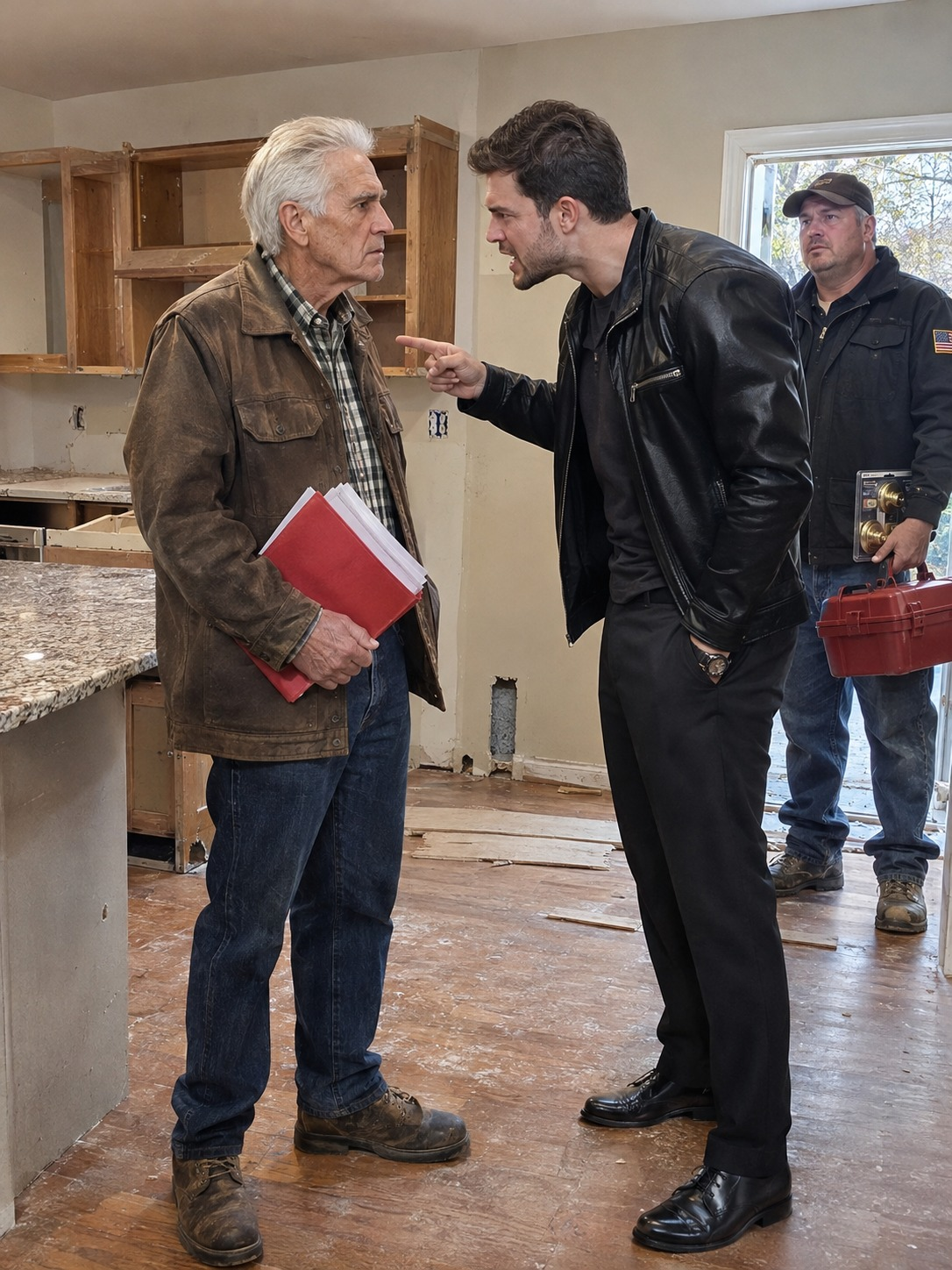
I tore open the crimson foreclosure envelope on my dead son's kitchen island.
"$380,000. That's what you're dealing with now," Travis Sterling said.
My name was Harrison Cole, and I was seventy-one years old.
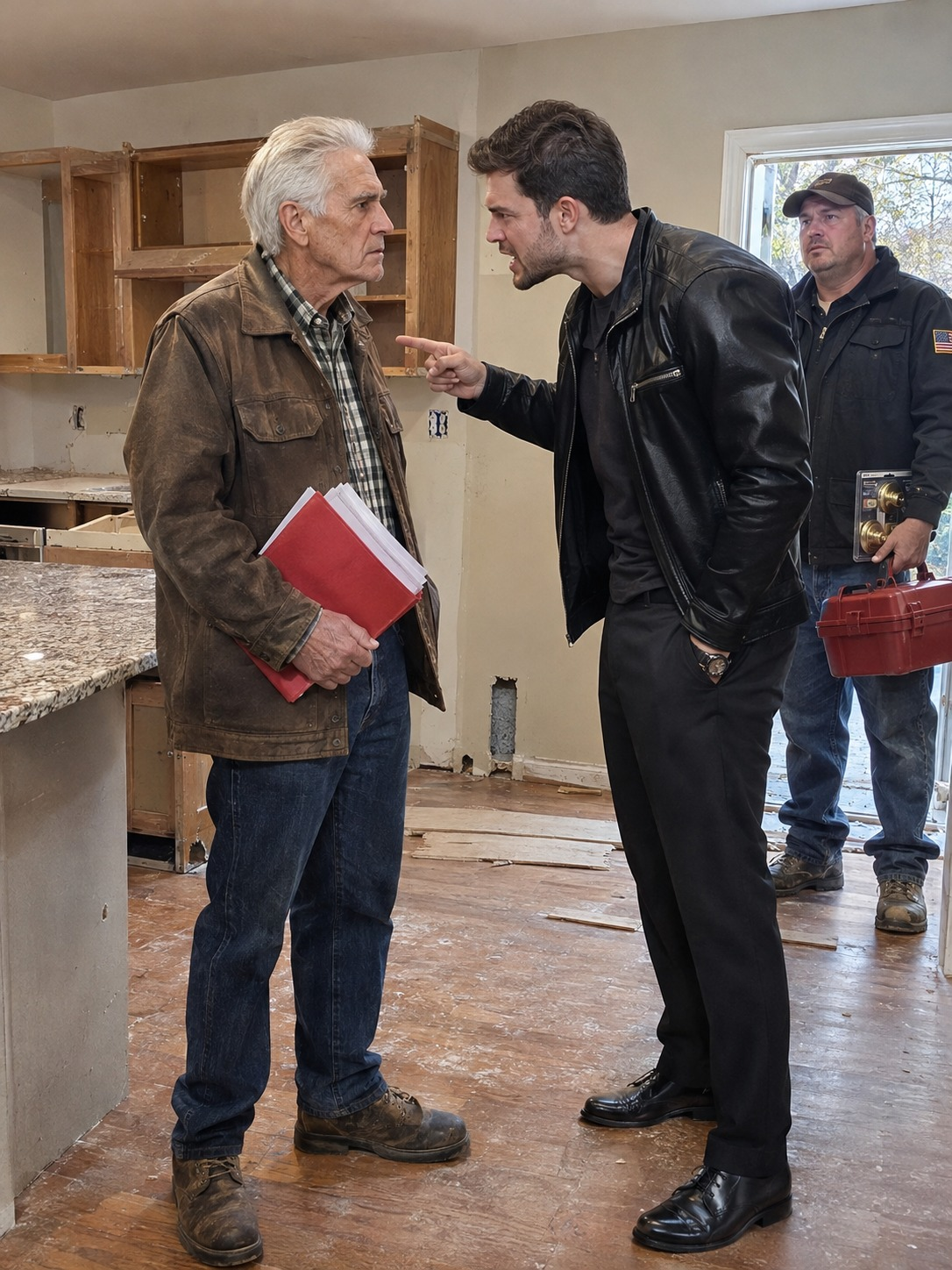
I looked at the younger man standing in front of me, then at the red toolbox in the hands of the locksmith behind him.
Something about the situation was terribly wrong.
My son's house had been emptied, his safe destroyed, and his four children had already lost both parents.
Now somebody wanted me gone.
Four months earlier, I had buried Garrett Cole and his wife, Hannah.
They had died on Interstate 70 when their SUV struck a highway barrier during an accident that left their vehicle beyond recognition.
Garrett was thirty-nine. Hannah was thirty-seven.
They left four children behind.
Liam was twelve, Noah was nine, and the twins, Maya and Tessa, were six.
I still remembered the funeral.
The children had stood together beside their parents' caskets, holding one another's hands while adults discussed what would happen next.
I had expected the family to come together.
Instead, I discovered how quickly people could calculate the inconvenience of loving someone else's children.
My daughter Diana was the first to speak.
"Victor and I have a commercial closing on Monday," she said, adjusting her black coat. "We're traveling constantly. We can't take four children."
I looked at her.
"You have five bedrooms."
"That doesn't mean we're equipped to raise them, Dad."
Hannah's mother, Beatrice Sterling, shook her head.
"My blood pressure can't handle that kind of stress. I live in a condominium. There isn't room."
Diana's husband, Victor Mercer, agreed.
"Taking on four children would completely change our lifestyle."
I glanced toward Liam.
He was standing near the chapel doorway, his face pale.
He had heard every word.
I walked over, lowered myself carefully onto one knee, and placed my hands on his shoulders.
"You're coming home with Grandpa," I told him.
He looked at his younger brother and sisters.
"All of us?"
"Every single one."
I meant it.
I just hadn't understood what that promise would cost.
My bungalow had two bedrooms and one bathroom. I gave the twins my bedroom, bought bunk beds for the boys, and moved my belongings into the living room.
My pension and Social Security brought in $2,450 every month.
That had been enough for one retired man.
It wasn't enough for four growing children.
Groceries exceeded $1,100 monthly. Then came school supplies, winter coats, electricity, heating, transportation, and the endless little expenses that came with raising children.
Garrett's financial accounts were inaccessible while his estate remained in probate.
I couldn't simply walk into his bank and withdraw money, even though I was responsible for his children.
By the second month, I had used the last $18,400 from the retirement savings Clara and I had spent decades building.
My wife had died six years earlier.
She used to keep a small notebook beside the kitchen telephone, recording every expense down to the last dollar.
I remembered her handwriting whenever I checked the shrinking balance.
Sometimes I felt as if I were spending the last thing she had left me.
Then I would see Maya asking for another helping of chicken soup, or Noah showing me a drawing from school, and the guilt would disappear.
They needed me.
So I found work.
The building supply warehouse hired me for overnight shifts.
The manager remembered my years as a structural building inspector and offered me fourteen dollars an hour.
Five nights a week, I worked between eleven at night and five in the morning.
I loaded lumber, moved drywall, and helped organize concrete supplies.
My knees hurt.
My lower back hurt.
Some mornings, I needed both hands to climb into my pickup truck.
But I never complained in front of the children.
I came home, washed the dust from my hands, prepared breakfast, and helped them get ready for school.
Then I slept while they were away.
Four months passed that way.
Not one relative offered to buy groceries.
Not one called to ask whether the twins had enough clothes.
Then attorney Evelyn Vance Ross finally contacted me.
She had been handling Garrett's estate and informed me that the property paperwork had progressed enough for me to receive the keys and begin inspecting the house.
I thought it was the first good news I had received in months.
I planned to rent the property for approximately $3,800 monthly.
That income could help me provide a stable home for the children and finally leave the warehouse.
I drove to Dublin on a Tuesday morning.
The brass key felt unusually heavy in my hand.
I unlocked the front door and stepped inside.
Then I stopped.
The living room was empty.
The television was gone. The sofas were gone. The rugs, lamps, bookshelves, and framed photographs had disappeared.
Even the family pictures that Hannah used to arrange along the staircase were missing.
I walked into the kitchen.
The refrigerator was gone.
Several cabinets had been removed, leaving rough rectangular marks against the walls.
The light fixtures had been taken from the ceiling.
It looked less like a house awaiting new tenants and more like a building somebody had deliberately dismantled.
I noticed the crimson envelope on the granite kitchen island.
Inside was a foreclosure notice.
The outstanding amount was $380,000.
I read it once.
Then again.
My son had been a senior supply chain engineer earning $145,000 annually.
He was careful with money. He had told me six months earlier that his mortgage was nearly paid off.
I remembered him standing in my kitchen, drinking coffee and joking that he might finally have enough time to teach his children how to fish.
"Almost there, Dad," he had said. "A few more years, and this place will be completely ours."
Yet somebody had borrowed $380,000 against his house.
The notice stated that three monthly payments had been missed.
I lowered myself onto the kitchen island's remaining stool.
My hands were shaking.
I had spent four months working through the night to keep my grandchildren fed, believing Garrett's property would provide the financial breathing room we desperately needed.
Now the bank might take it.
I folded the notice carefully and placed it inside my red document folder.
Then I walked toward Garrett's home office.
The damage there was worse.
Bookshelves had been overturned. Several floorboards had been pulled up. Papers were scattered everywhere.
The wall safe had been damaged beyond repair.
Dark scorch marks surrounded its edges.
I had spent forty years inspecting buildings, and I knew the difference between accidental damage and deliberate destruction.
Somebody had searched this room.
Not casually.
They had been looking for something.
I crouched beside the damaged safe and noticed a fragment of burned cream-colored paper near the baseboard.
I picked it up.
Most of the writing had disappeared.
But two details remained.
One referred to a college savings withdrawal.
The other contained an industrial vault serial number.
Beneath the number, I recognized Garrett's handwriting.
He had written a measurement and two words.
Clara's birthday.
I stared at the fragment.
Why would my son connect his grandmother's birthday to an industrial vault?
Before I could examine it further, I heard the back door unlocking.
A man entered carrying a toolbox.
Travis Sterling.
Hannah's thirty-four-year-old brother.
Behind him stood a locksmith wearing a navy work jacket and a baseball cap.
Travis stopped when he saw me.
"What are you doing here?"
I slowly stood.
"I'm inspecting my son's property."
He looked around the office, then at the damaged safe.
"You shouldn't be touching anything."
I glanced at the locksmith.
"Who hired you?"
"Travis," the locksmith answered cautiously.
I turned back toward Hannah's brother.
"Why are you changing the locks?"
"My mother and I are handling Hannah's property."
"Garrett owned this house. His estate is under legal administration. And I'm responsible for his children."
Travis laughed.
It wasn't a friendly laugh.
"You don't understand what you're dealing with, Harrison."
I tightened my grip on the folder.
"Then explain the missing furniture. Explain the damaged safe. Explain why somebody has removed nearly everything from this house."
He looked toward the locksmith.
The other man suddenly seemed uncomfortable.
Travis stepped closer.
"You're too old for this."
I had heard similar words before.
Usually from people who assumed age meant weakness.
I looked directly at him.
"I understand that you're trespassing. Leave."
For several seconds, neither of us moved.
Then the locksmith lowered his toolbox.
Travis pointed at me.
"By tomorrow morning, you'll be begging us to take this place."
He turned and walked toward the back door.
The locksmith followed him.
Before leaving, Travis looked over his shoulder.
"You're making a very expensive mistake."
The door slammed.
I remained in the office for another minute, listening to their footsteps disappear.
Then I photographed the damaged safe, the empty rooms, and the foreclosure notice.
I collected the burned paper fragment and placed it inside a small plastic sleeve.
Something had happened here.
And whatever it was, Travis clearly didn't want me investigating.
I drove home just before noon.
The children were still at school, so I placed the foreclosure notice and photographs on the kitchen table.
I examined the fragment beneath an old magnifying glass I had kept from my inspection days.
The writing was faint, but the first line became clearer.
It mentioned four college savings accounts.
One for each grandchild.
Below that was a transaction dated two days before the accident.
The amount was $142,000.
I leaned closer.
My son had never told me about withdrawing that money.
I was still examining the serial number when my phone rang.
It was Diana.
"Hi, Dad," she said, sounding unusually cheerful. "Victor and I would like to stop by tonight. We have something important to discuss about Garrett's house."
I looked at the foreclosure notice.
"How did you hear about the house?"
A brief silence followed.
Then she answered.
"People talk."
At seven that evening, Diana arrived with Victor and Beatrice.
My daughter carried a small plastic bag containing several bruised apples.
It was the first time she had visited in four months.
Beatrice looked around my living room, studying the children's belongings and the folded bedding on my sofa.
"This arrangement must be exhausting for someone your age," she remarked.
I asked the children to take their food into the bedroom.
Once the door closed, I placed the foreclosure notice on the kitchen table.
"Before we discuss anything else, I want to know what happened to Garrett's house."
Beatrice reached into her handbag and removed a lace handkerchief.
"Your son had financial problems, Harrison. He became involved in risky stock trading. Hannah tried to help him."
I looked at her.
"Garrett earned $145,000 a year. He had nearly paid off that mortgage."
"People hide their mistakes," she replied.
Victor opened his leather briefcase.
He produced a purchase agreement and placed it in front of me.
"My investment partners are prepared to purchase the property for $410,000."
I studied the document.
The house was worth considerably more.
"How much is the outstanding debt?"
"Three hundred and eighty thousand."
"And your partners are offering $410,000?"
"That's right. We'll handle the bank and give you thirty thousand dollars."
Diana leaned forward.
"Dad, take the money. You can't afford to maintain that property."
I looked at my daughter.
Then I looked at the purchase agreement.
They had refused to help raise four children.
They had ignored every request for assistance.
But somehow, they had found time and money to purchase Garrett's house.
I slowly closed the agreement.
"I'm not signing anything tonight."
Victor's smile disappeared.
"Then you might lose the property."
I placed the red folder on the table.
"Tomorrow, I'm going to find out who borrowed that money."
Diana stared at me.
And for the first time that evening, she looked frightened.
Later that night, after Diana and the others had left, I returned to the kitchen.
The purchase agreement was still on the table.
I picked it up and noticed something I hadn't seen earlier.
The buyer's company had been registered only three weeks before Garrett's foreclosure notice arrived.
I photographed the document and put it inside my folder.
Then I heard a faint noise from the hallway.
Someone was crying.
I found Liam sitting inside the boys' bedroom closet, wearing his father's old canvas jacket.
He looked up when I opened the door.
"Grandpa?"
I sat beside him.
"What's wrong, buddy?"
He gripped my hand.
"Please don't let Aunt Diana take us away."
I felt something tighten in my chest.
"Nobody is taking you anywhere."
Liam looked toward the bedroom door.
Then he leaned closer and whispered something that made the blood drain from my face.
"Grandpa, I know why they destroyed Dad's safe..."

Comments 0