"His father wasn't the only man who tried to protect you."
The silver-haired woman stood beneath the underground garage lights, holding an envelope that looked as though it had traveled through twenty-one years of silence.
I stared at her.
"Aunt Margaret?"
She smiled sadly.
"Not Margaret Vale, sweetheart. Margaret Ellis. Your mother's friend."
I remembered her now.
The woman who had brought casseroles after my father's funeral. The woman who used to sit with me in hospital waiting rooms while my mother received treatment. The woman who had disappeared from my life after Helen died, leaving a card with a telephone number I never called.
"You were at the hospital," I whispered.
Margaret nodded.
"Until the end."
My throat tightened.
"Why didn't you tell me?"
"Because Helen asked me to wait until you were ready to receive what she'd protected."
I looked at the envelope.
Then at the brass key in my hand.
"Who else tried to protect me?"
Margaret's eyes moved toward Adrian.
"Nathaniel Cross."
The name struck me like a slap.
I stepped backward.
"No."
"Maya—"
"No. Nathaniel took millions from my father's trust. He watched my mother struggle."
Margaret lowered her eyes.
"Yes. And he must answer for that."
"Then don't call what he did protection."
"I'm not excusing him."
She looked directly at me.
"Years ago, when Charles tried to have you declared the sole beneficiary of a fraudulent settlement, Nathaniel refused to sign the final transfer. It was one decent choice after many terrible ones. It preserved the legal possibility of recovering your father's interest."
I stared at her.
"One decent choice."
"Yes."
"After years of helping Charles."
"Yes."
I looked toward Adrian.
His expression was thoughtful.
He understood something I was only beginning to accept.
People were not always innocent or guilty in the simple ways we wanted them to be.
Nathaniel had helped preserve my legal claim.
He had also helped steal from me.
Both truths belonged in the record.
Neither erased the other.
Margaret held out the envelope.
"Your mother wanted you to know that before you decided what to do."
I took it.
My hands trembled.
The handwriting on the front was familiar.
For Maya, when she is finally free to choose.
My mother's handwriting.
I pressed the envelope against my chest.
For a moment, I couldn't speak.
Then Adrian touched my shoulder.
"You don't have to open it here."
I looked at him.
For twenty-one years, people had decided what I should know.
What I should believe.
What I could handle.
Now the choice was mine.
"Yes," I whispered. "I do."
I opened the envelope.
Inside was a letter.
Three pages.
Written in blue ink.
I recognized the slight rightward slant of my mother's handwriting, the way she crossed her sevens, the little loops she made when she wrote my name.
I began reading.
My beautiful Maya,
If you are holding this letter, then the truth has finally found its way to you.
I wish I could be there when it does.
My eyes filled with tears.
I kept reading.
Your father loved you more than anything in the world. He wanted you to grow up knowing that love, not the bitterness of what happened to him.
I made choices after he died that you may not understand. Some were brave. Some were foolish. Some were made because I was frightened.
I should have told you more. I am sorry.
I stopped.
My mother had apologized.
Not for being poor.
Not for being ill.
Not for failing to provide a perfect life.
For keeping me outside a truth that belonged to me.
I swallowed and continued.
Thomas left you something that Charles could not buy, Nathaniel could not sell, and Richard could not take away.
He left you the right to decide what his work should become.
I looked up.
Margaret was watching me.
"What does that mean?"
She nodded toward the bank entrance.
"You'll see."
The private bank's security manager led us through a quiet corridor.
Agent Grant walked beside him.
Adrian stayed close to me.
Margaret followed.
The building smelled faintly of polished stone and paper.
Everything was calm.
Ordinary.
After the chaos of the wedding and the airfield, the silence felt almost unreal.
We entered a secure room.
A steel compartment had been brought to a table under the bank's documented access procedure.
The manager checked my identification.
Then the key.
"Box two-fourteen," he said.
I nodded.
He looked toward Agent Grant.
"The preservation order is in place. No material will leave without an inventory and acknowledgment."
Grant nodded.
"Thank you."
The manager turned toward me.
"Ms. Bennett, this box is registered under your mother's name, with a designated succession instruction."
My heart tightened.
"She arranged that?"
"Yes."
I looked at Margaret.
She nodded.
"Helen was more careful than anyone realized."
The manager indicated the lock.
I inserted the brass key.
For a moment, I couldn't turn it.
My fingers were shaking too badly.
Adrian placed his hand over mine.
"Take your time."
I looked at him.
He smiled gently.
The same smile he'd given me when we were children and I was afraid to jump from the old wooden bridge into the river.
I took a breath.
Then turned the key.
The lock clicked.
The manager opened the compartment.
Inside was a wooden box.
Small.
Dark.
Beautifully made.
I recognized the craftsmanship immediately.
The dovetail joints.
The smooth edges.
The tiny brass hinges.
My father had made it.
I touched the lid.
And suddenly, I remembered sitting beside him in his workshop, watching him sand a piece of walnut.
"What's that for, Daddy?"
"A present."
"For who?"
He'd smiled.
"Someone very important."
I had assumed he meant my mother.
Now I understood.
I opened the box.
Inside lay my mother's silver necklace.
A bundle of letters.
Several photographs.
And a folded document wrapped in protective paper.
On top was a smaller envelope.
Maya Elizabeth Bennett.
My father's handwriting.
I picked it up.
The room blurred.
For a moment, I was seventeen again.
Standing in a hospital corridor.
Waiting for someone to tell me my father would wake up.
Waiting for a miracle that never came.
Adrian moved closer.
"Do you want me to read it?"
I shook my head.
"No."
I opened the envelope.
And began.
My little girl,
If you're reading this, then I wasn't there to tell you everything myself.
I am sorry for that.
I pressed a hand against my mouth.
You once asked me why I worked so hard.
I told you it was because I wanted to build things that lasted.
That was true.
But it wasn't the whole truth.
I worked hard because I wanted you and your mother to have choices.
The choice to live somewhere safe.
The choice to study whatever you loved.
The choice to say no to people who believed money gave them the right to control you.
Tears fell onto the paper.
I wiped them away carefully.
I helped build Whitmore Development because I believed we could create something worthwhile.
Richard believed that once too.
Charles did not.
I made the mistake of thinking I could persuade him.
I swallowed.
If something happens to me, there will be people who tell you I was foolish.
Perhaps I was.
But I was never ashamed of standing up for what was right.
I looked toward Adrian.
His eyes were wet.
I continued.
You do not have to fight my battles, Maya.
You do not have to hate anyone for me.
And you do not have to become wealthy to prove I mattered.
I mattered because I loved you.
My knees weakened.
Adrian caught my elbow.
I kept reading.
But what I earned belongs to you and your mother. No one has the right to take it.
The documents in this box will help establish that.
Use them if you choose.
And if you decide the fight has cost enough, I will understand that too.
I paused.
There was one final paragraph.
Whatever you do, promise me you'll build a life that makes you happy.
Not one that makes Charles Vale angry.
Not one that makes the Whitmores proud.
Yours.
All my love,
Dad.
I lowered the letter.
And cried.
Not quietly.
Not politely.
I cried the way I hadn't allowed myself to cry at seventeen, when relatives filled our house and everyone kept telling me to be strong.
Adrian held me.
Margaret stood nearby with tears streaming down her face.
Nobody rushed me.
Nobody told me to stop.
Nobody tried to turn my grief into something useful.
For the first time in twenty-one years, I felt as though my father had spoken directly to me.
And he hadn't asked me to avenge him.
He had asked me to live.
The document beneath the letters was the original Bennett Family Trust instrument.
Agent Grant examined it while the bank manager recorded the contents.
The signatures were genuine.
Thomas Bennett.
Richard Whitmore.
Nathaniel Cross.
Helen Bennett.
Attached were the original ownership schedules, correspondence, and instructions identifying my father's deferred eight-percent interest in Whitmore Development.
There were also records of designs and projects credited to other people after his death.
The documents didn't instantly place millions in my bank account.
They weren't magic.
They were evidence.
And for the first time, the evidence was complete enough to challenge the story Charles had spent decades constructing.
Grant looked at me.
"This is significant, Maya."
I nodded.
"Will it be enough?"
"It will need authentication, legal review, and a full accounting."
I swallowed.
"But it can be done?"
He looked at the documents.
"Yes."
I closed my eyes.
My father hadn't been imagining things.
He hadn't been greedy.
He hadn't been trying to take what belonged to someone else.
He had been fighting for what he helped create.
And now there was proof.
I looked at Adrian.
He was staring at the agreement.
His face was pale.
"Adrian?"
He looked up.
"I'm sorry."
I shook my head.
"You didn't sign it."
"No."
He swallowed.
"But my father did."
I looked at the document.
"Yes."
Adrian took a breath.
"Then the company has to honor it."
I stared at him.
He nodded.
"Whatever it costs."
I felt tears fill my eyes again.
"Adrian—"
"No."
His voice was steady.
"For years, people used the Whitmore name as an excuse to do the wrong thing."
He looked at me.
"I'm not going to do that."
I reached for his hand.
And held it.
The investigation lasted months.
Not days.
Not weeks.
Months of interviews, financial examinations, forensic reports, legal filings, and difficult conversations.
Charles Vale survived his gunshot wound.
He also survived long enough to hear the charges against him.
The recording Claudia made in his car became one part of a much larger body of evidence.
The video showing Margaret Vale placing poison in my father's coffee was authenticated alongside the older audio recordings and the surviving laboratory records.
Investigators established that Charles had directed the poisoning and then orchestrated the concealment.
Margaret Vale, who had died eleven years earlier, could no longer answer for her role.
But the evidence established what she had done.
The woman in the video had not been my mother.
Charles had deliberately used Helen's distinctive ring to create a misleading impression in the edited footage he kept for leverage.
It was one of many details that revealed how carefully he'd manipulated the truth.
The investigation also established that Richard Whitmore had helped conceal evidence after my father's death.
He had later attempted to reopen the case.
His final recording, recovered from Charles's archive, showed that Richard knew Charles intended to destroy Adrian's independence through a fraudulent medical declaration and a forced transfer of control.
Richard had warned Charles to leave his son alone.
Charles had threatened him.
A review of Richard's death found troubling circumstances but not enough reliable evidence to establish that he had been murdered.
Adrian struggled with that uncertainty.
Eventually, he accepted that not every question could be answered with absolute certainty.
What mattered was that the crimes investigators could prove were finally being prosecuted.
Charles was convicted of offenses connected to my father's death, the financial fraud, witness intimidation, and the conspiracy to seize control of Whitmore Development.
He received a lengthy prison sentence.
The man who had spent decades treating other people's lives as pieces on a board would never again control mine.
Nathaniel Cross cooperated with investigators.
He admitted helping divert trust assets and conceal records.
His testimony helped recover funds that had been hidden through several companies.
He also faced criminal penalties.
I didn't visit him.
I didn't write to him.
I didn't forgive him.
But I was grateful that his eventual cooperation helped establish the truth.
Claudia Renner gave a complete statement.
She admitted carrying the coffee to my father without knowing it had been poisoned, and she explained how Charles had threatened her into silence afterward.
Investigators corroborated her account.
She wasn't charged with knowingly participating in the poisoning.
She did, however, have to answer for later decisions she had made while helping conceal documents.
Her cooperation mattered.
So did her remorse.
Rebecca Shaw—Evelyn Hart—finally reclaimed her real name.
She testified about the financial records, the threats, and the years she had spent hiding.
Agent Grant's investigation also uncovered the source of the old security leaks that had forced her to disappear.
The people responsible were held accountable.
For the first time in decades, Evelyn could live without pretending to be someone else.
Vanessa's case was different.
She had participated in the attempted financial scheme.
She had helped alter the wedding arrangements.
She had concealed information from Adrian.
And she had knowingly assisted her father in preparing documents designed to transfer disputed assets.
Her decision to surrender the original recording did not erase those choices.
But it did matter.
She cooperated with investigators and accepted a negotiated resolution that included penalties, restitution obligations, and supervised probation.
Her involvement in the attempted fraudulent medical declaration was documented.
She lost her position in the Vale family businesses.
She lost much of the money she'd expected to control.
And she lost her marriage.
Adrian sought an annulment based on the deception surrounding the wedding.
The legal process took time, but it was eventually completed.
I saw Vanessa only once after the investigation began.
She asked to meet me in a quiet café.
I almost refused.
Then I decided I wanted to hear what she had to say.
She arrived without diamonds.
Without a designer handbag.
Without the perfect hair and makeup that had seemed so important on her wedding day.
She looked tired.
But she looked directly at me.
"Maya."
I nodded.
"Vanessa."
We sat across from each other.
For a moment, neither spoke.
Then she said, "I've thought about what I said to you."
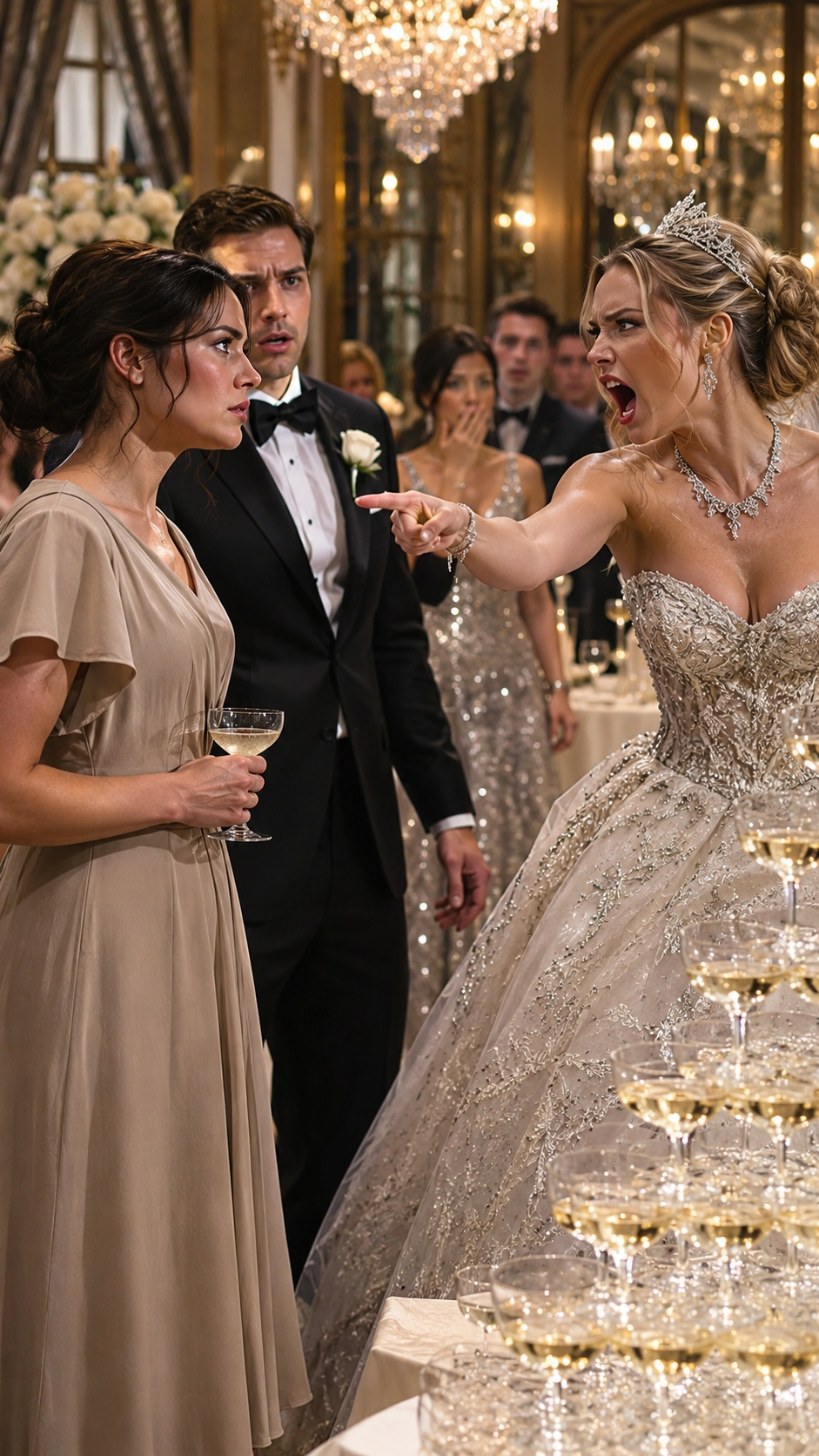
I waited.
"At the wedding."
I looked at her.
She swallowed.
"I called you scum because I wanted everyone to think you were beneath me."
I said nothing.
She continued.
"I wanted Adrian to choose me. I wanted the room to admire me. I wanted to feel powerful."
Her eyes filled with tears.
"And I thought humiliating you would give me that."
I studied her.
"Did it?"
She shook her head.
"No."
A tear rolled down her cheek.
"It made me the smallest person in the room."
I looked down at my coffee.
Vanessa took a breath.
"I don't expect forgiveness."
I nodded.
"Good."
She flinched slightly.
I looked at her.
"Because I'm not ready to give it."
She lowered her eyes.
"I understand."
I continued.
"But I hope you become someone who never does that to another person again."
Vanessa began crying.
"I want to."
I nodded.
"Then start there."
We finished our coffee.
When we stood, she hesitated.
"Can I ask you something?"
I looked at her.
"What?"
"How did you stay so calm that night?"
I thought about the ballroom.
The staring guests.
The champagne glass in my hand.
The way my heart had pounded while everyone waited for me to break.
Then I answered.
"I wasn't calm."
Vanessa frowned.
"What?"
"I was frightened. I was embarrassed. I wanted to disappear."
She stared at me.
"But you didn't."
I shook my head.
"No."
"Why?"
I smiled sadly.
"Because my mother spent thirty-eight years teaching me that someone else's cruelty doesn't determine my worth."
Vanessa looked down.
For several seconds, she said nothing.
Then she whispered, "I wish someone had taught me that."
I didn't answer.
Some lessons had to be learned after the damage was done.
We said goodbye outside the café.
And that was the last time I saw her.
One year after the wedding, the Bennett Family Trust settlement was finalized.
The financial accounting confirmed that my father's interest had been improperly withheld and that substantial distributions had been diverted.
Through restitution, recovered assets, and a negotiated settlement with Whitmore Development, the trust received the value of what it was owed.
The company also formally acknowledged my father's role as a founding contributor.
His name was restored to the historical records.
His designs were credited correctly.
And the original agreements were preserved in the company archive.
I received more money than I could ever have imagined when I was a child.
But the first thing I bought wasn't a car.
Or a house.
Or jewelry.
It was a small piece of land.
The land where my father's workshop had once stood.
The original building was gone.
The old floorboards had been destroyed years earlier.
But the property was still there.
And I wanted to bring something back.
I hired local craftsmen.
Architects.
Restoration specialists.
People who loved old buildings the way my father had.
Together, we built a workshop and training center.
A place where young people could learn carpentry, historic restoration, and practical building skills.
A place where talent mattered more than wealth.
A place where nobody had to apologize for where they came from.
We called it the Thomas Bennett Restoration Foundation.
On opening day, I stood beneath a simple wooden sign bearing my father's name.
Adrian stood beside me.
Eleanor sat in the front row.
Her injuries had healed.
Our relationship had taken longer.
She had apologized many times.
Not just for the secrets.
For the years she had allowed fear to become an excuse for silence.
I hadn't forgotten what she'd done.
But I had seen her change.
She helped establish an independent scholarship fund for students from low-income families who wanted to work in architecture and restoration.
She never asked for public credit.
And when I invited her to the opening, she cried.
Adrian looked at me.
"Ready?"
I smiled.
"I think so."
He squeezed my hand.
"Your dad would love this."
I looked toward the building.
The large windows.
The wooden beams.
The worktables waiting inside.
For a moment, I could almost see my father standing there.
His sleeves rolled up.
A pencil behind his ear.
Smiling.
I swallowed.
"I hope so."
Adrian smiled.
"I know so."
I stepped toward the microphone.
The crowd grew quiet.
I looked at the students.
The craftsmen.
The neighbors.
The people who had come because they believed something good could be built here.
Then I began.
"My father used to tell me that good work usually takes longer than you expect."
A few people laughed.
I smiled.
"He believed old things deserved a second chance. Buildings. Furniture. Sometimes even people."
I looked toward Eleanor.
Her eyes filled with tears.
"But he also believed that when something is damaged, you have to uncover the truth before you can repair it."
I took a breath.
"For a long time, I thought honoring my father meant proving that the people who hurt him were wrong."
I paused.
"Now I know it means building something he would have been proud of."
I looked at the workshop.
"Something that helps other people."
My voice trembled.
"So today, we open these doors in his name."
The crowd applauded.
I stepped away from the microphone.
Adrian embraced me.
And for the first time in years, I felt that the life ahead of me was larger than the tragedy behind me.
Six months later, I found the wedding invitation again.
It was tucked inside a drawer in my apartment.
Cream-colored paper.
Gold lettering.
My name written neatly on the front.
Maya Elizabeth Bennett.
Inside was Adrian's handwritten note.
Please come. It wouldn't be the same without you.
I sat on the edge of my bed and stared at it.
That invitation had brought me into the worst evening of my life.
It had led me through humiliation, betrayal, fear, and grief.
It had forced me to confront people I once trusted.
It had exposed lies that had shaped my childhood.
But it had also brought me back to my father.
To my mother's courage.
To the truth about who I was.
I ran my fingers over Adrian's handwriting.
Then my phone rang.
Adrian.
I smiled and answered.
"Hello?"
"Are you busy?"
"Not really."
"Good."
I laughed.
"Why?"
"Because I need your opinion on something."
I leaned back against the pillows.
"What?"
"There's an old house on the north side of the city."
I smiled.
"Of course there is."
He laughed.
"The roof needs work. The windows are original. The staircase is beautiful."
"Adrian."
"What?"
"Are you asking me to restore another building?"
"Maybe."
I shook my head.
"You know I have a foundation to run."
"I know."
"And a dozen projects already."
"I know."
"And absolutely no free time."
He paused.
Then said, "But the house has a blue front door."
I went still.
Then laughed.
A real laugh.
The kind that came without effort.
"You're impossible."
"I've been told."
I smiled.
"Send me the photographs."
"Already did."
I opened the message.
The house was beautiful.
Old stone walls.
Tall windows.
A neglected garden.
And a bright blue door.
I looked at it for a long moment.
Then I said, "It's perfect."
Adrian laughed.
"I knew you'd say that."
We talked for another hour.
About the house.
About the foundation.
About Eleanor's latest visit.
About the company Adrian was rebuilding with independent oversight and a new commitment to transparency.
He had stepped away from the old family arrangements and surrounded himself with people who would challenge him when necessary.
He was learning that leadership wasn't about never making mistakes.
It was about being willing to hear the truth.
And I was learning that friendship could survive even the most painful discoveries.
Before we ended the call, he said, "Maya?"
"Yes?"
"I'm glad you came to the wedding."
I looked at the invitation in my hand.
I thought about Vanessa.
The ballroom.
The silence after her insult.
The way Adrian had walked toward me when everyone else stood still.
I smiled.
"So am I."
He laughed softly.
"Even after everything?"
I looked toward the window.
The evening sun was shining across my apartment.
On the shelf beside my bed stood a photograph of my parents.
My father smiling.
My mother laughing.
Both of them young.
Both of them alive in that single captured moment.
"Even after everything," I whispered.
We said goodbye.
I placed the invitation beside the photograph.
Then I took out my father's letter.
I had read it so many times that I knew every word.
But there was one sentence I always returned to.
Whatever you do, promise me you'll build a life that makes you happy.
I looked around my apartment.
At the books.
The photographs.
The restoration plans scattered across my desk.
The little green plant my mother had given me years earlier, still growing beside the window.
I thought about the foundation.
The students.
The work waiting for me.
The people who loved me.
And I realized something.
I had kept my promise.
Not perfectly.
Not without grief.
But honestly.
I was building a life that belonged to me.
A life my father would have recognized.
A life my mother would have celebrated.
I stood and walked toward the window.
Outside, the city moved beneath the evening light.
Cars passed.
People hurried home.
Somewhere, a child was laughing.
Life continued.
Not because the past had disappeared.
But because it no longer controlled every step I took.
I touched the necklace around my throat.
My mother's silver necklace.
Then I looked at the photograph of my parents.
"Thank you," I whispered.
And for the first time since I was seventeen, those words didn't feel like a goodbye.
They felt like coming home.






Comments 0