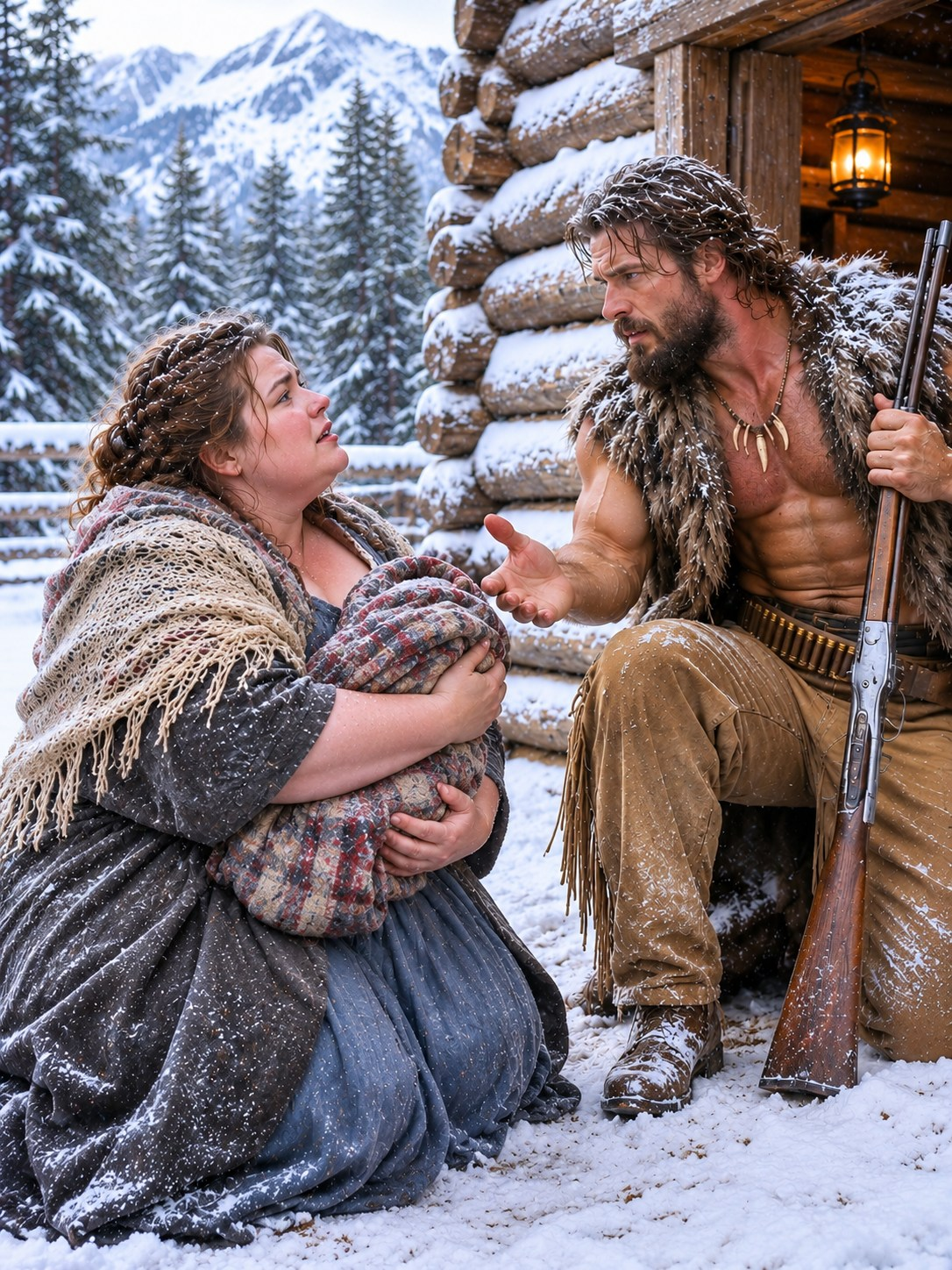
A barefoot woman slammed her frozen fist against a cabin door.
"Please! Just feed my babies!"
Cole Mercer opened the door with a Winchester rifle in his hand.
Beneath the woman's torn quilt, two tiny faces were barely moving.
He lowered the rifle.
The woman never saw him do it.
Her knees buckled, and she fell forward into the doorway.
Cole dropped the Winchester.
It struck the wooden floor with a metallic crash, but he barely heard it. His attention was fixed on the woman lying at his feet and the strange bundle she had refused to release even as she collapsed.
"Ma'am?"
He grabbed her beneath the shoulders.
Her coat was stiff with ice. Snow clung to her tangled auburn hair, and her lips had turned an alarming shade of blue.
She weighed almost nothing.
Cole had carried wounded soldiers across muddy battlefields. He had dragged men twice his size out of burning buildings. He knew what a dying person felt like in his arms.
This woman felt dangerously close to that.
"Stay with me."
Her eyelids fluttered.
"My babies," she whispered.
"I've got them."
"Please..."
Her fingers tightened around the quilt.
Cole looked down.
Two small shapes were pressed against her chest.
He understood.
The woman wasn't protecting her belongings.
She was protecting her children.
He lifted her carefully, gathered the bundled quilt against his other arm, and dragged them both across the threshold.
A blast of wind rushed into the cabin.
He kicked the heavy oak door shut.
The storm disappeared behind the thick logs, leaving only the crackling fireplace and the sound of his own breathing.
For several seconds, Cole stood motionless.
He had not spoken to another human being in nearly three weeks.
Now there was a woman unconscious on his floor, two children inside a frozen blanket, and a storm outside that could bury his cabin before morning.
He looked toward the fireplace.
"All right," he muttered. "Let's see what we've got."
He dropped to his knees.
The quilt was tied with several pieces of fraying cord. The knots were stiff from freezing water, and his thick fingers struggled to loosen them.
"Come on."
He pulled harder.
One knot finally gave way.
A little boy's face appeared.
The child couldn't have been more than three years old. His cheeks were pale, his lips cracked, and his sandy-blond hair was damp against his forehead.
His eyes were open.
But he wasn't crying.
That frightened Cole more than anything.
"Hey, little fellow."
The boy stared at him.
Cole gently touched his shoulder.
The child didn't move.
A second face appeared beneath the blanket.
A baby girl.
She was tiny, perhaps six months old, wrapped in a cream-colored cloth that had once been white.
Her lips moved.
A faint sound escaped her throat.
Cole felt something tighten in his chest.
"Lord Almighty."
He lifted the children out of the quilt.
The boy's body was stiff with cold. The infant barely stirred.
Cole carried them to the bearskin rug near the fireplace and laid them together.
He pulled a thick wool blanket over their bodies, leaving their faces uncovered.
Then he turned toward the woman.
She was still unconscious.
Her charcoal-gray coat was soaked through, and her thin mustard-colored dress clung to her legs.
He could see her hands.
They were swollen, pale, and covered with angry red patches.
Frostbite.
Cole knew enough about winter injuries to understand that careless warming could make matters worse.
He pulled another blanket from his trunk, covered her, and moved the hottest stones away from the immediate area beneath the children's blankets.
He would warm them gradually.
First, he needed to know whether they could swallow.
He returned to the boy.
"Can you hear me?"
Nothing.
Cole brought a tin cup to the stove and prepared a little warm sugar water.
He tested the temperature against his wrist.
Then he knelt beside the child.
"Open your mouth, son."
The boy's eyes shifted toward the cup.
Cole supported the back of his head.
"That's it."
The first sip barely passed his lips.
The second went down.
Then the boy swallowed again.
His small hands suddenly closed around Cole's wrist.
He wanted more.
Cole felt his throat tighten.
"Easy. We have enough."
He gave the child another small sip.
Then he turned toward the infant.
He had faced armed men without hesitation.
He had spent years learning how to survive situations that would have killed ordinary people.
But holding a six-month-old baby in his hands made him feel completely unprepared.
He dipped his clean little finger into the warm sugar water and gently touched the baby's lips.
The infant instinctively rooted and began sucking.
Cole watched her.
A tiny hand moved against the blanket.
"Well, I'll be damned," he whispered.
He continued carefully until her breathing became quieter.
Only then did he return to the woman.
He checked her pulse.
It was weak and rapid.
He placed another blanket around her shoulders and watched for signs that she was becoming more responsive.
The woman shivered.
Her entire body trembled beneath the wool.
Cole sat back.
"Good," he whispered. "Keep fighting."
He stood, picked up another log, and placed it in the fireplace.
The flames rose.
Outside, the wind slammed into the cabin hard enough to shake the wooden walls.
Cole glanced toward the frosted window.
The storm was getting worse.
He knew these mountains.
He knew what happened to people who tried to cross the high ridges in November.
He also knew that nobody should have been walking out there with two small children.
Yet someone had.
Someone had carried two babies through a wilderness that even experienced hunters avoided.
And that someone was now lying unconscious on his floor.
Cole rubbed his beard.
Five years.
Five years of silence.
Five years of waking alone, eating alone, and going to sleep without another voice disturbing the cabin.
He had built his life around one simple rule.
Never let the world back in.
Apparently, the world had ignored him.
He looked at the children.
The boy had finally closed his eyes.
The infant was breathing more steadily.
Cole pulled his chair closer to the fireplace and sat down.
He didn't sleep.
Every few minutes, he checked the children.
Every few minutes, he checked the woman.
At some point, the storm became so violent that the entire cabin seemed to groan under its weight.
Cole reached for his Winchester and rested it across his knees.
He had no idea who these people were.
He didn't know whether someone was following them.
He didn't know why a mother would risk crossing the highest part of the mountain with two children in the middle of winter.
But he knew one thing.
Nobody was coming through that door to hurt them while he was alive.
Three weeks earlier, I had still believed my husband would come home.
His name was Daniel.
He worked in the lower shaft of the Silverbend mining camp, where men spent twelve hours underground for wages that barely covered their food and lodging.
He wasn't a rich man.
He wasn't even a particularly lucky one.
But he was kind.
When our son Will was born, Daniel carved a little wooden horse for him.
When our daughter Clara arrived, he promised to build her a cradle from the pine trees behind our rented cabin.
He never got the chance.
The mine collapsed on a Tuesday.
The company sent a man to tell me on Thursday.
By Friday, I was standing in an office across from a clerk who had never once looked me in the eyes.
He pushed a ledger across his desk.
"Your husband owed the company money."
I stared at the numbers.
"That cannot be right."
"Tools. Lodging. Medical supplies. Food."
"Daniel paid every month."
The clerk shrugged.
"The books say otherwise."
I looked down at the ledger again.
The amount was more than my husband could have earned in several years.
"What am I supposed to do?"
The clerk leaned back.
"There's work available."
"What kind of work?"
He exchanged a glance with the man standing beside the office door.
I understood before he answered.
The company had arrangements with several saloons in the settlement.
Women with debts could work there until their accounts were cleared.
I held Clara closer.
"And my children?"
The clerk turned a page.
"Your son could be placed with a farming outfit in the valley. They take boys his age."
I felt the room disappear around me.
"He's three."
"Then he'll learn quickly."
I wanted to scream.
I wanted to throw the ledger into his face.
Instead, I looked at the door.
I understood something then.
The company didn't care that Daniel was dead.
It didn't care that I had two children.
It didn't care that the debt was invented.
It wanted something from me.
And if I stayed, it would take whatever it could reach.
That night, I packed what little we owned.
I wrapped Will and Clara in our old quilt.
I took Daniel's photograph, a small wooden horse, and the last piece of bread from our cupboard.
I left everything else.
Before sunrise, we were walking east of the settlement.
Then I changed direction.
The company expected me to take the main trail.
I took the mountain path instead.
I had no horse.
No money.
No proper winter clothing.
Only two children and the desperate belief that the wilderness might be kinder than the men who claimed to own us.
For four days, I kept walking.
I gave Will the food first.
When Clara cried, I held her against my chest and tried to keep her warm.
I removed my flannel shirt and knitted shawl and wrapped them around the children.
I kept my thin dress beneath my frozen coat.
By the third day, I could no longer feel my toes.
By the fourth, I had stopped thinking about how far we had traveled.
I thought only about the next step.
Then I saw a light.
A single orange light between the trees.
I walked toward it.
I remember raising my hand.
I remember knocking.
I remember saying the words that had become the only thing left in my mind.
Please, just feed my babies.
After that, everything disappeared.
Morning arrived without sunlight.
Gray light seeped through the cabin windows.
Cole was still sitting beside the fireplace.
His rifle rested across his knees.
The children were asleep beneath the blanket.
The woman had begun moving her fingers.
He noticed immediately.
Her brow tightened.
Her head shifted against the rolled-up coat he had placed beneath it.
Then her eyes opened.
She gasped.
For a moment, she looked at the ceiling without understanding where she was.
Then she saw the unfamiliar wooden walls.
The fireplace.
The massive man sitting across the room.
Her expression changed.
"My babies!"
She threw off the blanket.
Her legs failed beneath her, but she crawled toward the bearskin rug.
Cole stood.
"Easy."
She ignored him.
She reached the children and pulled the blanket back.
Will was sleeping.
Clara was awake, quietly chewing on the edge of the wool.
Sarah gathered them both into her arms.
She pressed her face against Will's hair.
Her shoulders began to shake.
No sound came out.
Cole looked away.
He had seen men die.
He had seen soldiers beg for their mothers.
He had never known what to do when someone cried without making a sound.
He moved toward the stove.
"Your children are alive," he said.
Sarah looked up.
Her eyes were green, rimmed with red, and full of fear.
"Where am I?"
"My cabin."
"Who are you?"
"Cole."
She glanced toward the rifle resting beside his chair.
Her arms tightened around the children.
Cole noticed.
He also noticed the way she positioned her body between him and the boy.
"You're on the high ridge," he explained. "About thirty miles north of the nearest valley."
She stared at him.
"How long was I unconscious?"
"Most of the night."
She looked at her hands.
The skin was swollen and angry.
Her face tightened, but she didn't complain.
Then she looked down at her clothing.
The coat had been opened, and she was now wrapped in blankets over her thin undergarments.
She pulled the wool tightly around herself.
"Did you...?"
"No."
His answer was immediate.
"I covered you. That's all."
She studied him.
Cole turned toward the stove and lifted the kettle.
"There's food."
Sarah didn't answer.
"Not much variety. Oats, salt pork, dried beans, and venison."
She looked at the children.
"The baby needs milk."
Cole paused.
"I don't have milk."
Sarah's face tightened.
"She's six months old."
"I know."
"I can't let her starve."
"Neither can I."
He poured warm water into a pot.
"I'll make something soft enough for the boy. We'll figure out what the little one can manage."
Sarah watched him.
He was a large man with a weathered face and a thick salt-and-pepper beard.
His dark reddish-brown hair was cut short, and his green wool shirt stretched across his shoulders.
He looked like someone who had spent his entire life fighting the wilderness.
But his hands were careful when he handled the kettle.
That confused her.
Men who looked like him were usually not gentle.
At least, that was what the world had taught her.
"What are their names?" Cole asked.
"Will. And Clara."
Cole nodded.
"All right."
He stirred the oats.
For several minutes, neither spoke.
Then he brought two tin bowls to the bearskin rug.
He placed one beside Will.
The second he kept near Sarah.
"Can you feed them?"
Sarah reached for the spoon.
Pain shot through her swollen fingers.
She hissed and dropped it.
The spoon struck the bowl.
Cole looked at her hands.
"Don't force them."
"I can do it."
"Not with those fingers."
"I said I can."
He watched her struggle to pick up the spoon.
Finally, he knelt.
"Your hands need time."
Sarah's eyes narrowed.
Cole picked up the spoon and scooped a little oatmeal.
He blew on it.
Then he held it toward Will.
The boy looked at his mother.
Sarah hesitated.
She looked at Cole.
Then at the spoon.
Finally, she gave a small nod.
Will opened his mouth.
Cole fed him.
One spoonful.
Then another.
The boy slowly began eating.
Cole watered down the remaining oats until they were soft enough for Clara.
He offered a tiny amount to the infant, watching her response carefully.
Sarah observed every movement.
The large hands.
The scarred knuckles.
The patience.
She had expected him to be impatient.
She had expected him to demand something in return.
Instead, he simply continued feeding her children.
When he finished, he looked at the second bowl.
"You need to eat."
"I'm not hungry."
Her stomach betrayed her.
Cole raised an eyebrow.
"Your stomach disagrees."
Sarah looked away.
He pushed the bowl closer.
"If you become sick, those children have nobody."
The words were blunt.
But she understood their meaning.
She picked up the bowl and drank the softened oatmeal slowly.
Cole returned to his chair.
He studied her for a moment.
Then he asked the question she had been dreading.
"How did you end up on my mountain, Sarah?"
Sarah lowered her bowl.
"We came from Silverbend."
Cole stopped moving.
He knew that settlement.
Fifty miles down the eastern slope. A lawless mining camp where desperate men worked themselves to death and desperate women struggled to keep their families alive.
"That's four days on foot in good weather," he said. "With two children, in November?"
Sarah looked down.
"My husband died three weeks ago. A cave-in at the lower shaft."
Cole said nothing.
"The company claimed he owed them money. They wanted me to work it off."
Her voice became quieter.
"At the saloons."
Cole's jaw tightened.
Sarah pulled Will closer.
"They also offered to take my son. They said a farming outfit in the valley would accept him."
For the first time that morning, Cole's expression changed.
"They wanted to buy your boy?"
"They called it settling the account."
Sarah swallowed.
"I left before they could come back."
Cole slowly stood.
He walked toward the old wooden trunk beside his bed.
"How many people know where you went?"
"Nobody."
"Did anyone follow you?"
"I don't know."
He opened the trunk and removed a pair of thick wool trousers, a canvas shirt, and knitted socks.
He placed them beside her.
"Put those on. They're dry."
Sarah stared at the clothes.
"Why are you helping us?"
Cole looked toward the fireplace.
For several seconds, he didn't answer.
Then he said something that Sarah would remember for the rest of her life.
"Because somebody should have helped you before you reached my door."
He turned his back to give her privacy.
But Sarah had one more question.
"Mr. Mercer?"
He stopped.
"The men from Silverbend..."
She hesitated.
"They said they would never stop looking for what my husband owed."
Cole slowly turned his head.
Outside, the wind pressed against the cabin windows.
He looked at the two sleeping children.
Then at the woman who had carried them across four days of frozen wilderness.
"Sarah," he said quietly, "there's something you need to understand about this mountain."
She looked up.
"Nobody comes up here in November unless they're desperate."
He glanced toward the Winchester beside his chair.
"And nobody comes up here looking for a family unless they intend to take something."
**For the first time since opening his door, Cole wondered whether the storm outside was the greatest danger they faced.






Comments 0