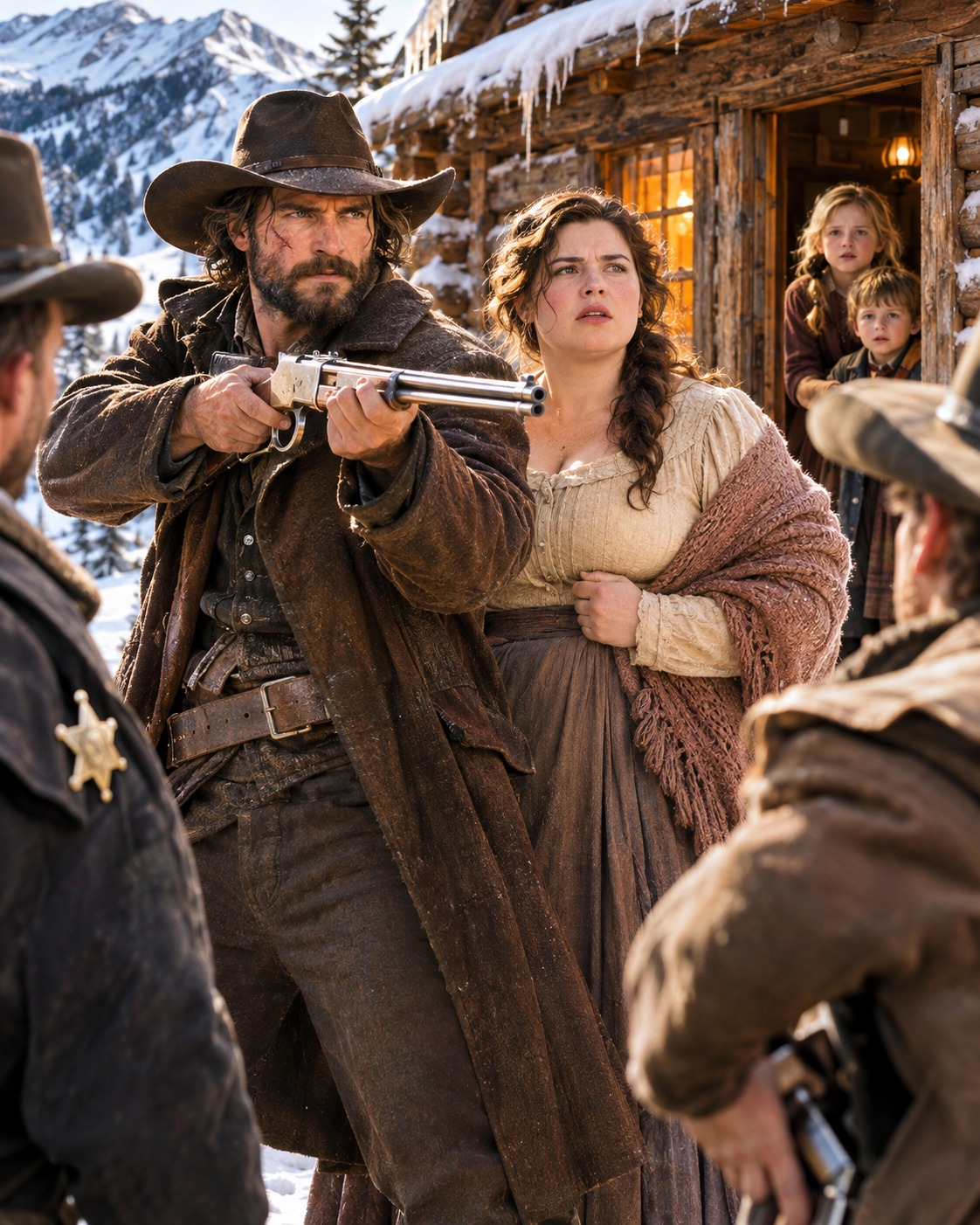
The moment Silas Vane spoke, Cannon Jimenez knew his wife's death had not been the simple tragedy he had believed for three years.
He had buried Mary beneath a stand of pines on a cold October morning.
He had carved her name into a wooden marker with his own hands.
He had told his children their mother had gone somewhere peaceful.
And every night since, he had blamed himself for not reaching her in time.
Now a stranger had looked at a letter written by Mary and said it should have burned.
Cannon's rifle did not waver.
"Explain yourself."
Silas said nothing.
Deputy O'Reilly turned sharply toward him.
"You fool."
Cannon heard the words.
So did Aurelia.
And in that instant, the entire confrontation changed.
The deputy was no longer merely trying to retrieve a fugitive wife.
He was trying to keep something buried.
Something connected to Mary.
"Sadie," Cannon said, "take your brother upstairs."
"But Papa—"
"Now."
The girl looked at him.
She had never heard that tone in his voice before.
She hurried inside, clutching the letter.
Aurelia watched her disappear toward the loft.
Then she turned back to Cannon.
His face had become frighteningly still.
She had learned, during the four days she spent in his cabin, that Cannon rarely raised his voice.
When Wyatt spilled a bowl of soup, Cannon simply fetched a cloth.
When Sadie argued about bedtime, he listened before answering.
Even when the storm damaged part of his roof, he worked without complaint.
But now his silence was different.
It was the silence of a man holding himself together by force.
"Deputy," he said, "you have ten seconds to tell me how that man knows my wife."
O'Reilly swallowed.
"Jimenez, I suggest you calm down."
"Nine."
"You're making this worse."
"Eight."
Silas shifted in his saddle.
"Don't threaten us."
"Seven."
Aurelia stepped closer.
"Cannon."
He did not look at her.
"Six."
O'Reilly raised both hands.
"All right."
Cannon stopped counting.
The deputy took a slow breath.
"Your wife worked for Andrew Long."
Cannon stared at him.
"No."
"She did."
"Mary never worked for a railroad company."
"Not directly."
O'Reilly glanced toward Silas.
Then he continued.
"She copied documents. Records. Correspondence. Things Long needed handled quietly."
Cannon shook his head.
"Mary was a schoolteacher."
"Before she married you."
Cannon felt the first sharp movement of doubt.
Mary had been a schoolteacher in Denver.
That much was true.
She had worked there before they met.
She had rarely spoken about her years in the city.
When he asked, she always smiled and told him there was nothing worth remembering.
He had believed her.
Why wouldn't he?
She was his wife.
The mother of his children.
The woman who had walked beside him through seven winters, two difficult births, and years when the mountain gave them little more than enough to survive.
He knew the way she laughed.
He knew how she tucked her hair behind her ear when she was thinking.
He knew she hated bitter coffee and loved the smell of fresh-cut pine.
But perhaps he had not known everything.
"What documents?" he asked.
O'Reilly hesitated.
"Business records."
"Whose business?"
"Long's."
"What kind of records?"
"Land transfers."
Aurelia's breath caught.
Cannon heard it.
He looked toward her.
She was staring at the deputy.
"Land transfers?" she repeated.
O'Reilly's expression tightened.
"That's what I said."
Aurelia took another step forward.
"Did Mary work for my father?"
Silas cursed.
O'Reilly closed his eyes briefly.
And Cannon knew the answer before anyone spoke.
Aurelia looked at him.
"My father owned land outside Denver," she explained. "Thousands of acres. Some of it ran along the route Andrew wanted for his railroad."
Cannon remained silent.
"When my father refused to sell, Andrew began looking for another way to acquire it."
She swallowed.
"My father died six months later."
Cannon's eyes narrowed.
"How?"
"They said his heart failed."
"And you believed them?"
"I was twenty-three. He had been ill before."
Her voice trembled.
"I had no reason to think anyone wanted him dead."
Silas laughed bitterly.
"You're getting carried away."
Aurelia turned toward him.
"Then why are you afraid of a dead woman's letter?"
He stopped laughing.
Cannon noticed.
And something inside him hardened.
He had spent three years accepting the explanation he had been given for Mary's death.
A riding accident.
A frightened horse.
A steep trail.
A fall that broke her neck.
He had found her near the creek below the old mining road.
Her horse had returned home alone.
The sheriff had called it a terrible accident.
Cannon had believed him because the alternative was unbearable.
Now he remembered something.
Mary had been frightened in the weeks before she died.
Not openly.
She never wanted the children to worry.
But she had started checking the door latch twice before bed.
She had asked Cannon whether anyone had been seen near the property.
And once, while he was cleaning his rifle, she had asked him a question he had never understood.
"If something happened to me, would you promise not to trust a man simply because he wore a badge?"
Cannon had laughed.
He remembered that now.
He had laughed and kissed her forehead.
"Nothing's going to happen to you."
Two weeks later, she was dead.
He looked at O'Reilly.
"Who investigated Mary's accident?"
The deputy said nothing.
Cannon's voice sharpened.
"Who?"
O'Reilly looked away.
Cannon felt the answer settle over him like ice.
"You did."
O'Reilly lowered his eyes.
"Jimenez—"
"You came to my house."
The words emerged slowly.
"You told me her horse slipped."
"Cannon, listen—"
"You told me there was nothing suspicious."
"I was following the evidence."
"You told me to bury my wife."
The deputy's face tightened.
Aurelia reached for Cannon's arm.
He barely felt her touch.
His mind was already returning to that October morning.
Mary lying motionless beneath a blanket.
Sadie crying at the cabin door.
Wyatt too young to understand why his mother would never come home.
And O'Reilly standing beside the body, telling him there was nothing anyone could have done.
Cannon looked at Silas.
"Was he there?"
O'Reilly frowned.
"What?"
"When Mary died. Was your hired gunman there?"
Silas's hand twitched.
Cannon raised the rifle slightly.
"Answer."
Silas stared at him.
Then he said something that made Aurelia's blood run cold.
"Your wife should've minded her own business."
Cannon moved.
Not toward the gunman.
Toward the edge of the porch.
His boots struck the wood with a force that made Aurelia flinch.
"Say that again."
Silas's eyes widened.
"Easy."
"Say it."
O'Reilly pulled his horse sideways.
"Jimenez, you're going to get yourself killed."
Cannon did not even glance at him.
"Then you better hope I don't."
For a moment, nobody moved.
The wind pushed loose snow across the clearing.
A horse snorted.
Somewhere in the forest, a branch cracked beneath the weight of ice.
Then Aurelia spoke.
"Cannon."
He turned his head slightly.
She was looking at him with tears in her eyes.
"Mary may have been trying to protect my family."
The words struck him harder than anything the deputy had said.
Aurelia continued.
"If she copied the original land records, she might have discovered what Andrew was doing."
Cannon stared at her.
"And if she discovered it," Aurelia whispered, "she may have tried to stop him."
Silas suddenly pulled hard on his reins.
His horse turned.
Cannon swung the rifle.
"Stay where you are."
But the gunman was already moving.
He kicked his horse forward.
A shot cracked through the clearing.
Aurelia screamed.
Snow exploded from the porch railing beside Cannon.
He dropped to one knee.
His Winchester answered with a deafening report.
Silas's hat flew from his head.
The gunman ducked and galloped toward the trees.
O'Reilly shouted.
The third rider wheeled his horse.
Within seconds, all three men were retreating down the narrow mountain trail.
Cannon remained on one knee, rifle trained toward the forest.
He could have fired again.
He did not.
Not with Aurelia standing behind him.
Not with his children inside.
He waited until the riders disappeared.
Then he lowered the Winchester.
Aurelia rushed toward him.
"Are you hurt?"
"No."
"Are you sure?"
He looked at the splintered porch railing.
"Close enough."
She touched his shoulder.
His coat was covered with snow and wood fragments.
But there was no blood.
She let out a trembling breath.
Inside the cabin, Wyatt began crying.
Cannon stood immediately.
"Children."
He hurried through the doorway.
Sadie was sitting on the floor with Wyatt wrapped in her arms.
The boy sobbed when he saw his father.
"Papa!"
Cannon dropped to his knees and gathered both children against him.
"I'm here."
Wyatt buried his face in Cannon's coat.
"Was that thunder?"
"No, son."
"Are the bad men gone?"
"For now."
Sadie looked up.
"Did you shoot somebody?"
Cannon closed his eyes.
"No, sweetheart."
He held her tighter.
"Nobody got hurt."
Aurelia stood in the doorway, watching them.
Her heart ached.
This was what Andrew Long could never understand.
A home was not made from money.
It was made from people who would stand between one another and danger.
Cannon looked over the children's heads.
Their eyes met.
Neither spoke.
But Aurelia understood.
He had protected her.
And now he knew that doing so might have brought his wife's killers back to his door.
Later, after the children had settled, Cannon placed Mary's letter on the kitchen table.
He had read it three times.
It was dated September 18, 1880.
Just weeks before Mary died.
The letter was addressed to a man named Thomas Bell.
Cannon did not recognize the name.
The message was brief.
Mr. Bell,
I have discovered irregularities in the Brooks property transfers. The signatures do not match the original records, and I believe Mr. Long has used false documents to obtain the land.
I cannot bring the evidence to Denver safely.
Please meet me at the old mining road before October first.
If anything happens to me, the truth must not disappear.
Mary Jimenez.
Beneath her signature was a second name.
Andrew Long.
Not as a signature.
As a notation.
Andrew Long — original deed, ledger 47.
Cannon stared at those words.
Aurelia leaned over the table.
"Ledger forty-seven," she whispered.
He looked up.
"You know it?"
She nodded slowly.
"My father kept numbered ledgers for every property transaction."
"Where are they?"
"Most were taken after his death."
"By Long?"
"Yes."
Cannon looked back at the letter.
"What about forty-seven?"
Aurelia hesitated.
Then she said, "I saw it once."
"Where?"
"In Andrew's private office."
Cannon waited.
She continued.
"It was locked in a cabinet behind his desk. He never allowed anyone near it."
"Did you open it?"
"Once."
"What was inside?"
Her face paled.
"Copies of land deeds. Bank transfers. Letters."
She swallowed.
"And a list of names."
Cannon frowned.
"What names?"
"Men who had accepted payments from Andrew."
"Politicians?"
"Some."
"Judges?"
She nodded.
"Sheriffs?"
Aurelia looked at him.
"Yes."
Cannon slowly sat back.
O'Reilly.
Of course.
The deputy had not merely been paid to retrieve Aurelia.
He was part of the scheme.
Cannon looked toward the window.
The forest was empty.
But he knew the riders would return.
Perhaps with more men.
Perhaps after dark.
And this time, they would not waste time talking.
"We need to leave," he said.
Aurelia stared at him.
"What?"
"Before they come back."
"Where would we go?"
"There's a trading post two days south. From there, we can reach someone I trust."
"Who?"
Cannon hesitated.
"An old friend."
Aurelia shook her head.
"The children can't travel through this snow."
"I know."
"Wyatt's barely recovered."
"I know."
"Then what are we going to do?"
Cannon looked at Mary's letter.
He had no answer.
Not yet.
But he knew one thing.
He was no longer protecting Aurelia simply because she had saved his son.
He was protecting her because she might be the only person alive who could tell him why his wife had died.
That evening, while Cannon checked the shutters and prepared extra firewood, Aurelia helped the children into bed.
Wyatt was unusually quiet.
She tucked the blanket beneath his chin.
"Are you feeling all right?"
He nodded.
"Miss Aurelia?"
"Yes, sweetheart?"
"Are you going away?"
She paused.
"I don't know."
His eyes filled with tears.
"Please don't."
She sat beside him.
"Wyatt—"
"I know you're not my real mama."
The words caught in her throat.
He looked at her.
"But when I was sick, you held me like she used to."
Aurelia's eyes burned.
He reached for her hand.
"Can you stay?"
She leaned forward and kissed his forehead.
"I'll do everything I can."
He closed his eyes.
For a moment, she thought he had fallen asleep.
Then he whispered:
"Papa smiles when you're here."
Aurelia turned away before he could see her tears.
Downstairs, Cannon stood beside the kitchen table.
He had opened a small wooden box that belonged to Mary.
Inside were a silver hairpin, a ribbon, two photographs, and several folded letters.
He had not touched the box in years.
Now he searched through it carefully.
At the bottom, beneath the photographs, he found something he had never noticed before.
A small brass key.
Attached to it was a faded paper tag.
Three words were written in Mary's handwriting.
Under the hearthstone.
Cannon stared at the key.
Then he looked toward the fireplace.
The stones were old.
He had laid most of them himself.
But Mary had once insisted that one loose stone near the back should never be cemented into place.
He had forgotten why.
Until now.
He knelt beside the hearth.
The fire had burned low.
Using the iron poker, he carefully shifted the stone.
It moved.
Behind it was a narrow hollow.
And inside the hollow sat a small metal box.
Cannon pulled it free.
The brass key fit perfectly.
His hands trembled as he turned it.
The lock clicked.
Inside were several folded documents, a small leather notebook, and a sealed envelope.
The envelope bore his name.
Cannon.
He recognized Mary's handwriting immediately.
For a long moment, he could not bring himself to open it.
Then he broke the seal.
The first line made his heart stop.
My dearest Cannon,
If you are reading this, then I was right to be afraid.
He swallowed.
His eyes moved to the next sentence.
There is something I must tell you about Andrew Long, the Brooks family, and the night our daughter was born.
Cannon went completely still.
Upstairs, Sadie laughed softly at something Aurelia had said.
Cannon looked toward the ceiling.
Then back at the letter.
Because Mary had never told him there was anything unusual about Sadie's birth.
But the next line began with six words that made his blood turn cold.
Sadie was not the only child...






Comments 0