"Ryan just admitted whose sample he actually sent."
I read Evelyn's message three times.
My hand was still resting on the sealed envelope from the genetic testing laboratory.
On the phone, Dr. Rebecca Lawson waited for my response.
"Mr. Brooks? Are you still there?"
I swallowed.
"Yes."
"Did you authorize Ryan Prescott to submit a sample under your name?"
"No."
"Have you ever provided a sample to our laboratory?"
"No."
"Thank you. I need to make that clear in our records."
I stared at the envelope.
"Doctor, what exactly happened?"
She paused.
"An order was submitted identifying you as the alleged father. We subsequently received information that the identification attached to the submitted sample may be incorrect. The testing process has been stopped, and any preliminary material associated with that order must not be treated as a valid paternity determination."
My stomach tightened.
"So there's no legitimate result?"
"Not from that submission. The identity of the person who provided the sample has not been reliably established through our verification procedures."
I closed my eyes.
"Okay."
"We are reviewing the circumstances. If you receive paperwork claiming to establish paternity from this submission, please do not rely on it."
I looked down at the envelope.
"Should I open it?"
"You may review the correspondence, but please preserve the envelope and contents. It is not a valid determination of your parentage."
I thanked her.
After hanging up, I called Evelyn.
She answered immediately.
"Nathan."
"What did Ryan admit?"
She took a breath.
"He used his own sample."
I sat down.
For several seconds, I couldn't speak.
Then I asked, "Why would he put my name on it?"
"Because he thought he could control what the paperwork showed."
I rubbed my forehead.
"That doesn't make sense."
"I know."
She sounded exhausted.
"He said Olivia had been asking for proof. He wanted to find out whether he was the father without having his own name connected to the order."
I stared at the kitchen wall.
"So he used mine."
"Yes."
"And then he planned to show Olivia the result?"
"That's what he told me."
I closed my eyes.
Another deception.
Another attempt to make reality fit whatever was most convenient.
Evelyn continued.
"I told him I wouldn't help him hide it."
I nodded.
"Good."
"I also told him to speak to his attorney and correct everything."
I looked toward the envelope.
"Has he?"
"He's agreed to cooperate with the laboratory's investigation."
I took a slow breath.
"Thank you for telling me."
Evelyn was quiet for a moment.
Then she said, "Nathan, I hope this is the last time either of us has to discover something like this."
I looked out the window.
"Me too."
I didn't open the envelope alone.
The next morning, I took it to Claire Harrison's office.
She examined the label, photographed the packaging, and asked me to explain my conversation with Dr. Lawson.
Then we opened it together.
Inside was a notice concerning a disputed testing submission.
There was no verified paternity result.
No legally reliable conclusion.
Just documentation of a process that had been compromised by false identifying information.
Claire placed the pages on her desk.
"All right."
I looked at her.
"All right?"
She nodded.
"This confirms that we should not rely on this submission. We'll preserve the records and communicate with the appropriate parties through counsel."
I leaned back.
"Can someone just put another person's name on a test?"
"An improperly submitted order can contain false information. That doesn't make it valid evidence of parentage."
I nodded.
She continued.
"We'll also address the document bearing your copied signature. These are separate issues, and neither should be ignored."
I looked at the papers.
"Am I going to spend years dealing with this?"
Claire's expression softened.
"Not necessarily. We have a clear record of your objections, and we can pursue an orderly resolution."
I stared at my hands.
For weeks, I'd felt as though everyone else was making decisions about my future.
Olivia.
Ryan.
Their attorneys.
Their families.
Even the paperwork seemed to have a life of its own.
I looked up.
"What do I do next?"
Claire closed the folder.
"You continue with the divorce process. You don't make any unauthorized acknowledgments. And you let the appropriate testing and legal procedures establish the facts."
I nodded.
Then she asked, "How are you doing personally?"
The question surprised me.
I almost gave my usual answer.
Fine.
Busy.
Managing.
Instead, I said, "I'm tired."
Claire nodded.
"I imagine you are."
I looked toward the window.
"And I'm sad."
She waited.
"I thought leaving would make me feel better immediately."
"Sometimes relief and grief arrive together."
I nodded slowly.
"Yeah."
Then I said something I hadn't admitted aloud.
"I miss the woman I thought I married."
Claire didn't rush to answer.
Finally, she said, "You can grieve that relationship and still decide it isn't safe for you to return to it."
I sat quietly.
For the first time, I understood that moving forward didn't require pretending the past had meant nothing.
Over the next several weeks, the situation became clearer.
Ryan, through his attorney, acknowledged that he had submitted his own sample while identifying the alleged father as me.
The laboratory confirmed that the compromised submission would not be used to establish paternity.
Ryan also acknowledged that he had received the private agreement from Olivia and had never witnessed me sign it.
Olivia provided a written statement admitting that she'd copied my signature onto the document without my authorization.
She also acknowledged that I'd never agreed to assume responsibility for the pregnancy.
Claire made sure those admissions were preserved.
There were legal discussions.
Requests for records.
Formal communications.
More paperwork than I ever wanted to see.
But gradually, the chaos began turning into something manageable.
Then came the most important development.
Olivia agreed to participate in properly authorized testing to resolve the paternity question.
I wasn't involved in providing a sample.
I had no reason to be.
The timeline and the information already available made the situation clear enough for the appropriate parties to focus on Ryan.
The testing was arranged with verified identities and the necessary consent.
And when the results came back, they established that Ryan was the biological father.
I was not.
I sat in Claire's office when she told me.
For a moment, I felt nothing.
Then I exhaled.
A long, slow breath.
It wasn't happiness.
A child was still going to be born into a complicated situation.
Two marriages had been damaged.
Several people had been hurt.
But the uncertainty that had followed me for months was finally gone.
"Are you okay?" Claire asked.
I nodded.
"Yes."
Then I corrected myself.
"I think I will be."
Olivia called me two days later.
I hadn't spoken to her directly since the hospital.
Most of our communication had gone through attorneys.
When her name appeared on my phone, I hesitated.
Then I answered.
"Hello?"
"Nathan."
Her voice sounded different.
Quieter.
"Hi."
She took a breath.
"Mom told me the results were finalized."
"Yes."
A pause.
Then she whispered, "I'm sorry."
I looked out the window of Michael's guest room.
"I know."
She began crying.
"I don't know how I became this person."
I closed my eyes.
For a moment, I remembered the woman who'd danced barefoot in our kitchen after we bought the house.
The woman who'd brought me soup when I was sick.
The woman who'd held my hand at my father's funeral.
Those memories were real.
But so were the lies.
"I don't know either," I said.
She cried quietly.
Then she said, "I've started seeing a therapist."
I opened my eyes.
"Good."
"Mom helped me find someone."
"I'm glad."
She took another breath.
"I told her everything. About Ryan. About the money. About what I did to you."
I remained silent.
Olivia continued.
"She asked me why I thought I could make you stay."
I looked down.
"What did you tell her?"
Her voice broke.
"Because you'd always been the one person who didn't leave when things got hard."
I swallowed.
She continued.
"And I treated that like permission to do whatever I wanted."
For several seconds, neither of us spoke.
Then I said, "Olivia, being dependable didn't mean I had no limits."
"I know that now."
I nodded.
She cried again.
"I wish I'd known it before."
I looked toward the window.
"So do I."
The divorce took several months.
It wasn't easy.
There were discussions about the house.
Savings.
Furniture.
Retirement accounts.
The practical pieces of a marriage that had once felt permanent.
But Olivia didn't fight me over the divorce itself.
She cooperated with the process.
We reached a financial settlement through our attorneys.
The house was sold.
The proceeds were divided according to our agreement.
Neither of us received everything we wanted.
But we both received enough to begin again.
The disputed signature was addressed through the legal process, with Olivia's written admission and the original documents preserved. I chose to let my attorney handle the consequences rather than turn every conversation into another confrontation.
The proposed payment from Ryan never happened.
There was no two-hundred-and-fifty-thousand-dollar windfall.
No secret settlement that could repair the damage.
Ryan's financial arrangement with Olivia was abandoned.
Evelyn pursued her own separation.
She later told me that Ryan had moved out of their house.
I didn't ask for details.
Their marriage was theirs to resolve.
But I was relieved that she finally had the information she'd been denied.
As for the baby, Ryan accepted his established paternity and began working with Olivia through their attorneys to arrange appropriate support and future parenting responsibilities.
I hoped they would handle those responsibilities honestly.
Not for their sake.
For the child's.
The baby deserved a beginning that wasn't built on deception.
I stayed with Michael for almost three months.
At first, I felt embarrassed.
I was forty-two years old.
A construction project manager.
A man who could coordinate hundreds of workers and millions of dollars in equipment.
And I was sleeping in my younger brother's guest room.
Michael never made me feel small.
Neither did Meredith.
They gave me space.
Invited me to dinner.
Let me sit quietly when I didn't feel like talking.
And Cooper seemed delighted to have another person around.
Every morning, the dog appeared beside my bed with a tennis ball in his mouth.
At first, I ignored him.
Then one morning, I got up.
Put on my shoes.
And took him for a walk.
We went around the block.
Then farther.
Eventually, those walks became the best part of my day.
There was something comforting about a dog who didn't care about complicated explanations.
Cooper wanted breakfast.
Fresh air.
A tennis ball.
And someone willing to throw it.
I could manage that.
One evening, Michael found me sitting on the back porch.
I had a cup of coffee.
Cooper was asleep beside my chair.
Michael sat down.
"How was work?"
"Good."
"Hospital project?"
"Almost finished."
He nodded.
"Nice."
We sat quietly.
Then he asked, "You thought about getting your own place?"
I looked at him.
"Yeah."
"Found anything?"
"A townhouse in Kirkland."
He smiled.
"Really?"
"Two bedrooms. Small backyard. Close to work."
"Sounds good."
I nodded.
"It does."
Michael leaned back.
Then he said, "You know you can stay here as long as you need."
I looked at him.
"I know."
He smiled.
"But?"
I looked toward the yard.
"But I think it's time."
Michael nodded.
"Yeah."
I took a breath.
"I need a place that belongs to the life I'm building now."
He smiled.
"Then go get it."
I moved into the townhouse on a Saturday in early spring.
Michael helped carry boxes.
Meredith brought lunch.
Cooper supervised.
By late afternoon, the furniture was arranged.
The kitchen was stocked.
The bed was made.
There were still boxes everywhere, but I didn't mind.
I stood in the living room looking around.
The walls were pale gray.
The windows faced a row of cedar trees.
The backyard was small, but it had enough space for a table and two chairs.
For the first time in months, I felt excited about something.
Michael came in carrying a lamp.
"Where do you want this?"
I pointed toward the corner.
"Over there."
He set it down.
Then looked around.
"Not bad, big brother."
I smiled.
"Not bad."
Meredith appeared in the doorway.
"Pizza's here."
Michael grinned.
"Perfect."
We ate on paper plates because I hadn't unpacked the dishes.
Cooper sat hopefully beside the table.
And somewhere between the second slice of pizza and Michael complaining about my terrible furniture arrangement, I laughed.
Really laughed.
Not the polite kind.
Not the kind you use when you're trying to convince people you're okay.
The kind that catches you by surprise.
Michael looked at me.
Then smiled.
He didn't say anything.
He didn't need to.
The divorce became final in the summer.
I received the confirmation while I was at work.
I read it in my office.
Then I sat quietly for a few minutes.
Seven years.
A wedding.
A house.
Holidays.
Arguments.
Birthdays.
Plans.
And now, a legal document confirming that the marriage had ended.
I expected to feel devastated.
Instead, I felt sad and relieved.
Both at once.
I called Michael.
"It's done."
He was quiet.
Then he said, "How do you feel?"
I looked at the document.
"Like something heavy finally stopped pressing on my chest."
He nodded.
"That sounds about right."
I smiled faintly.
"Want to get dinner tonight?"
"Absolutely."
"Meredith too."
"She'll be there."
I looked toward the window.
"Thanks, Mike."
"For what?"
I swallowed.
"For being there."
He laughed softly.
"That's what brothers are for."
A few weeks later, Margaret called.
I hadn't heard from her in some time.
"Nathan?"
"Hi, Margaret."
"How are you?"
"I'm doing well."
"I'm glad."
She hesitated.
"I wanted to let you know Olivia had the baby."
I sat down.
For a moment, I didn't speak.
Then I asked, "Is everyone healthy?"
"Yes."
I felt relief.
"Good."
Margaret's voice softened.
"It's a little girl."
I looked out the window.
"That's wonderful."
"Her name is Grace."
I smiled faintly.
"That's a beautiful name."
Margaret was quiet.
Then she said, "Olivia asked me to tell you she's doing her best to make things right."
I nodded.
"I hope she does."
"She's continuing therapy. She's working with Ryan on parenting arrangements. Things aren't easy, but she's trying."
I looked down.
"That's good."
Margaret hesitated.
"She also wanted me to thank you."
I frowned.
"For what?"
"For not turning your anger toward the baby."
My throat tightened.
I looked toward the window.
"Grace didn't do anything wrong."
Margaret began crying quietly.
"I know."
I took a breath.
"Tell Olivia I wish her and Grace well."
"I will."
After we hung up, I sat for a long moment.
I thought about the family I'd once imagined.
A child running through our house.
Birthday parties.
School mornings.
Little shoes by the front door.
For years, I'd pictured those things with Olivia.
Now that future belonged to someone else.
It hurt.
But not in the way it once had.
Because I no longer confused losing one imagined future with losing the possibility of happiness.
By autumn, my life had found a rhythm.
I worked.
I cooked.
I spent weekends with Michael and Meredith.
I joined a hiking group.
I started running again.
I bought a bicycle.
And I began doing something I hadn't done in years.
Making plans that belonged entirely to me.
One Saturday, I drove to the coast.
No schedule.
No obligations.
No one waiting for me to explain why I was late.
I walked along the beach beneath a pale blue sky.
The wind was cold.
The water stretched endlessly toward the horizon.
I sat on a piece of driftwood and watched the waves.
For a while, I thought about Olivia.
Not with anger.
Not with longing.
Just with sadness for what we'd lost.
I wondered whether she was happy.
Whether she was learning to be honest.
Whether Grace would grow up surrounded by people who told her the truth.
I hoped so.
Then I stood.
Brushed sand from my jeans.
And continued walking.
The following year, I met someone.
Her name was Sarah Bennett.
She was forty, a landscape architect, and a friend of Meredith's.
We met at a backyard barbecue.
I wasn't looking for a relationship.
In fact, I'd become quite comfortable being single.
Sarah didn't change that overnight.
She simply made me curious.
She had short auburn hair.
A quick laugh.
And a habit of asking questions she genuinely wanted answered.
We talked about work.
Books.
Travel.
The strange things people do when they're nervous.
At one point, she asked whether I'd ever been married.
I nodded.
"Yes."
She didn't look surprised.
"Me too."
I smiled.
"How'd that go?"
She laughed.
"Well, we're not married anymore."
I laughed too.
Then she said, "I don't think every relationship that ends was a waste."
I looked at her.
"No?"
She shook her head.
"Sometimes you learn what you need. Sometimes you learn what you can't accept."
I thought about that.
Then I nodded.
"Yeah."
We exchanged numbers.
A week later, we had coffee.
Then dinner.
Then another dinner.
There were no dramatic declarations.
No sudden promises.
No pressure to move faster than I was ready for.
Just two people getting to know each other.
Slowly.
Honestly.
Six months into our relationship, I told Sarah the full story.
Not every detail.
But enough.
The affair.
The pregnancy.
The forged signature.
The money.
The divorce.
She listened without interrupting.
When I finished, I stared at my coffee.
"I know it's a lot."
She nodded.
"It is."
I looked at her.
"I understand if it changes how you see me."
She frowned.
"Why would it?"
I shrugged.
"Because I stayed longer than I should have. Because I missed things. Because I trusted someone who was lying to me."
Sarah reached across the table.
Not dramatically.
Just enough to rest her hand beside mine.
"Nathan, trusting your wife wasn't a character flaw."
I looked at her.
She continued.
"What matters to me is how you handled what happened after you learned the truth."
I swallowed.
"I didn't always handle it perfectly."
"Nobody does."
I looked down.
Then she said, "I'm not asking you to be perfect."
I met her eyes.
"What are you asking?"
She smiled gently.
"Just be honest with me."
For a moment, I couldn't speak.
Then I nodded.
"I can do that."
We took our time.
A year later, Sarah still had her apartment.
I still had my townhouse.
We spent weekends together.
Traveled occasionally.
Cooked meals.
Argued about which movies were worth watching.
And when something bothered us, we talked about it.
Sometimes awkwardly.
Sometimes imperfectly.
But we talked.
I learned that intimacy wasn't something you begged for.
It was something two people built together.
I learned that affection didn't need to be earned by accepting disrespect.
And I learned that a peaceful relationship didn't mean never disagreeing.
It meant being able to disagree without fear of humiliation.
One evening, Sarah came over after a difficult day at work.
I was making dinner.
She stood in the kitchen doorway.
"Can I help?"
I smiled.
"Sure. Chop the vegetables."
She washed her hands and joined me.
For a while, we worked quietly.
Then she leaned against my shoulder.
I looked at her.
"What?"
She smiled.
"Nothing."
I laughed.
"That's suspicious."
She shook her head.
"I'm just happy."
I looked around the kitchen.
The vegetables.
The simmering sauce.
The open window.
The woman beside me.
Then I realized something.
I was happy too.
Not because my past had disappeared.
Not because I'd forgotten what happened.
But because the life I was living no longer required me to pretend.
Two years after the divorce, I received one final message from Olivia.
It arrived on a Sunday afternoon.
I was sitting in the backyard with Sarah.
She was reading.
I was drinking coffee.
My phone vibrated.
I looked at the screen.
Olivia.
For a moment, I hesitated.
Then I opened the message.
Nathan, I hope you're doing well. Grace is growing fast, and I'm learning how to be the mother she deserves. I know I can never undo what I did to you. I don't expect forgiveness or a reply. I just wanted to say that I understand now how deeply I hurt you. You gave me loyalty, and I treated it like something I could use. I'm sorry. I hope you've found happiness.
I read it slowly.
Then I set the phone down.
Sarah looked up.
"Everything okay?"
I nodded.
"Yeah."
She studied my face.
"Are you sure?"
I smiled faintly.
"It's Olivia."
Sarah closed her book.
"Oh."
I looked toward the trees.
"She apologized."
Sarah waited.
Then she asked, "How do you feel?"
I thought about it.
Really thought about it.
Then I said, "Peaceful."
Sarah smiled.
"That's good."
I nodded.
"It is."
I picked up the phone.
Typed a short reply.
Thank you, Olivia. I wish you and Grace a good life. Take care of yourselves.
I sent it.
Then I placed the phone face down on the table.
There was nothing else I needed to say.
No argument left to win.
No explanation left to demand.
No future left to negotiate.
Our story had ended.
And that was okay.
That evening, Sarah and I cooked dinner together.
We made roasted chicken, potatoes, and a salad.
Nothing elaborate.
Just a quiet Sunday meal.
Afterward, we sat outside beneath the warm glow of the patio lights.
The air smelled faintly of cedar.
Somewhere in the neighborhood, children were laughing.
Sarah rested her head against my shoulder.
I looked up at the evening sky.
For a moment, I remembered another dinner.
Another house.
Another version of myself.
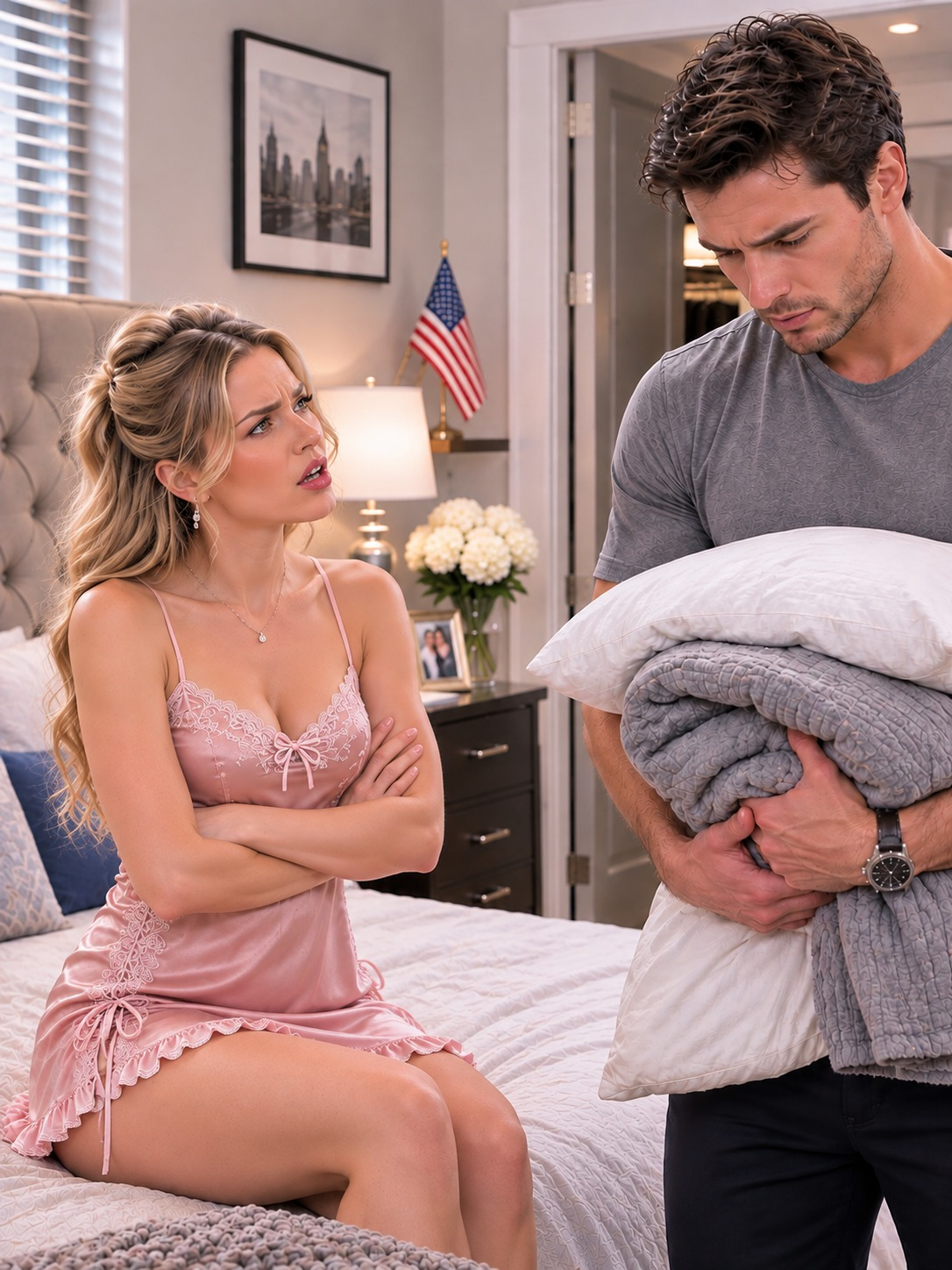
A man standing beside a bedroom door with a pillow in his arms.
A man who'd been told that wanting affection made him pathetic.
A man who'd believed the woman he loved could decide whether he was worthy of being loved back.
I wished I could speak to him.
Not to warn him about every lie.
Not to tell him exactly what was coming.
But to tell him that the pain wouldn't last forever.
That he would survive losing the marriage.
That he would find his brother waiting when he needed help.
That he would build another home.
That one day, he'd sit beside someone who didn't make him feel ashamed for wanting closeness.
Sarah looked up.
"What are you thinking about?"
I smiled.
"How different my life is now."
She studied me.
"Different good or different bad?"
I looked around.
At the little backyard.
The lights.
The home I'd made.
The woman sitting beside me.
Then I took her hand.
"Different good."
She smiled.
"That's my favorite kind."
I laughed.
And as the evening settled around us, I realized I no longer measured my life by what Olivia had taken from me.
I measured it by what I'd built afterward.
A home where honesty mattered.
A relationship where kindness went both ways.
A future I could look forward to without fear.
For seven years, I'd believed that keeping my marriage together was the most important promise I could make.
But the promise that finally saved me was much simpler.
I would never again abandon myself to keep someone else comfortable.
Sarah squeezed my hand.
"Ready to go inside?"
I looked at her.
"Yeah."
We stood together.
She turned off the patio lights.
I locked the back door.
And we walked into our home.
Together.
Not because either of us needed the other to hide a mistake.
Not because one of us was afraid to be alone.
Not because a promise had been forced, purchased, or stolen.
But because we both wanted to be there.
And for the first time in a very long time, that was enough.






Comments 0