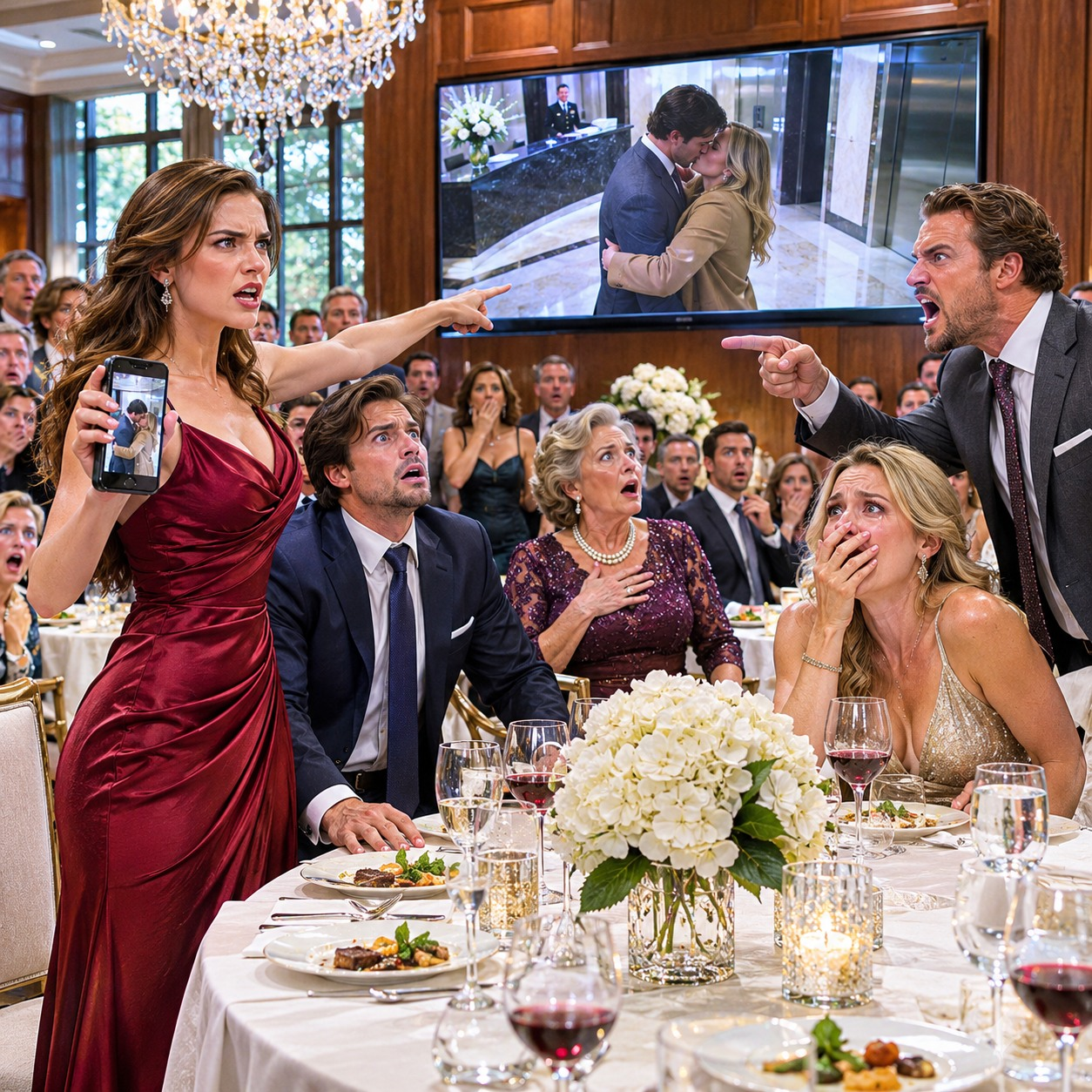
Three months after the anniversary dinner, I stood inside the conference room at Dixon Freight and watched the final documents being signed.
The investigation had taken longer than anyone expected.
There had been interviews, financial audits, legal reviews, and several uncomfortable meetings with people who had once considered the Daniels family untouchable.
But the truth had finally emerged.
Northbridge Advisory had been created to receive money from Dixon Freight through consulting agreements that lacked legitimate supporting services. Caleb had authorized several payments, Ashley had signed documents establishing the intermediary company, and Connie had used family financial accounts to support the arrangement.
The attempted transfer of Tucker Row's voting rights had never been valid.
The forged amendments to my marriage agreement had been rejected.
The suspicious $250,000 transfer had been stopped before the funds could leave the protected banking system.
And the $2.5 million guarantee had been formally withdrawn.
The handwriting examiner confirmed that the signatures attributed to me on the disputed documents were not genuine.
My grandmother's original investment agreements also established that Connie had never possessed the authority she claimed.
There was no legitimate family entitlement.
There had never been one.
Caleb eventually cooperated with the investigation.
He provided emails, financial records, and statements identifying the people who had helped establish Northbridge. He admitted that he had approved payments without verifying the underlying services and that he had knowingly concealed his relationship with Ashley.
His employment at Dixon Freight was terminated following the company's independent review.
The matter was referred to the appropriate authorities, and the financial conduct of everyone involved was examined separately.
Connie also faced serious consequences.
Her involvement in the unauthorized transactions and attempted financial arrangements became impossible to deny. The family trust recovered part of the missing money, and the remaining disputed funds became the subject of formal recovery proceedings.
For years, she had believed that reputation could protect her from consequences.
This time, it couldn't.
Mason's life changed in ways I hadn't expected.
He separated from Ashley shortly after the anniversary dinner.
For several weeks, he barely spoke to anyone.
He eventually moved into a small apartment near his dealership and began working with a counselor.
I saw him occasionally.
Sometimes we exchanged messages.
Sometimes we met for coffee.
Our conversations were never particularly cheerful, but they were honest.
One afternoon, he told me that he had filed for divorce.
"I don't hate her," he said.
We were sitting outside a small café.
"But I don't think I can trust her again."
I nodded.
"That's understandable."
He looked down at his coffee.
"I keep thinking about that night."
"The anniversary dinner?"
"Yes."
He laughed quietly.
"Sixty people watching me discover my wife was sleeping with my brother."
I didn't know what to say.
He continued.
"I used to think the worst thing that could happen to a man was losing his business. Now I think it's discovering that the people closest to him never really respected him."
I looked at him.
"Trust is difficult to rebuild once someone deliberately destroys it."
He nodded.
Then he smiled faintly.
"You know something?"
"What?"
"I used to think you were too quiet."
I raised an eyebrow.
"And now?"
"Now I think I was too loud."
I laughed.
It was the first time we had shared a genuinely light moment since everything happened.
Mason eventually sold one of his dealership investments and focused on rebuilding his business.
He didn't become a different person overnight.
But he became more thoughtful.
He stopped measuring his worth through expensive possessions and other people's approval.
And for the first time, he began making decisions that belonged entirely to him.
Ashley sent me a letter six weeks after the investigation began.
I almost didn't open it.
But eventually, curiosity won.
She apologized for the affair.
She apologized for pretending I was lying at the anniversary dinner.
She apologized for allowing Caleb to use her company as an intermediary.
She admitted that she had been attracted to the excitement of being admired by a man who seemed successful and powerful.
She had convinced herself that her relationship with Caleb was different.
It wasn't.
She wrote that she had finally understood how deeply she had hurt Mason.
At the end, she asked whether I could forgive her.
I read the letter twice.
Then I placed it in a drawer.
I didn't hate Ashley.
But forgiveness wasn't something I owed her simply because she had finally become uncomfortable with her own decisions.
I wished her the ability to build a better life.
That was enough.
The most difficult conversation was with Russell.
He came to my apartment one Saturday afternoon carrying a small wooden box.
"I thought you might want this."
I opened it.
Inside was an old photograph of my grandmother and Russell standing together at a charitable business event.
Behind them was a younger Connie.
I looked up.
"Where did you find this?"
"In the family records."
He sat down.
"I wanted you to have it."
I studied the photograph.
"Thank you."
Russell looked around my apartment.
"Your grandmother must have been proud of you."
I smiled faintly.
"I hope so."
He lowered his eyes.
"Danielle, I owe you an apology."
"You've already apologized."
"Not properly."
He leaned forward.
"I watched my family treat you as though you were less important because you didn't advertise your success. I allowed Connie to make comments about your work. I allowed Caleb to believe he was entitled to everything."
He paused.
"I should have spoken up."
I looked at him.
"Why didn't you?"
He sighed.
"Because it was easier to keep the peace."
I understood that.
It was the same reason I had remained silent for so many years.
Sometimes silence felt safer than confrontation.
But silence could also allow people to continue doing things they should never have been allowed to do.
"I hope things are different now," I said.
"They will be."
He stood.
Before leaving, he placed the wooden box beside my grandmother's photograph.
"I think Eleanor would have liked the woman you've become."
I smiled.
"She probably would have told me to stop being so polite."
Russell laughed.
"She would have."
Tucker Row continued operating.
In fact, the company became stronger.
The investigation had exposed weaknesses that we had previously overlooked. Rebecca introduced stricter financial approval procedures, and Laura helped establish additional safeguards for ownership records and executive authorizations.
We also expanded our investment portfolio.
Rather than focusing only on acquiring companies, we began supporting smaller transportation businesses that needed financial restructuring and better operational systems.
I wanted Tucker Row to become what my grandmother had originally imagined.
A company that helped people build something lasting.
Not a symbol of wealth.
Not a weapon.
A foundation.
Several months later, I attended the opening of a new logistics training center funded through one of our investment programs.
There were drivers, warehouse employees, students, and local business owners.
Nobody asked how much my dress cost.
Nobody cared whether I was married to an executive.
They wanted to know what the program could do for their families.
I loved that.
During the opening ceremony, a young woman approached me.
She introduced herself as Emily.
She was twenty-four and had recently started working in transportation management.
"I heard you built this company," she said.
"Part of it."
She smiled.
"I want to do something similar someday."
I looked at her.
"Then start learning everything you can."
She nodded.
"Even the boring parts?"
"Especially the boring parts."
She laughed.
I realized how much I had missed conversations like that.
Conversations with people who wanted to learn rather than judge.
Six months after the anniversary dinner, I received an unexpected invitation.
It was from an old friend named Daniel Brooks.
We had known each other through the transportation industry for several years. He was a widower, a father, and the owner of a regional logistics consultancy.
He had always been kind.
But I had never considered him romantically.
He invited me to dinner.
I almost declined.
Then I remembered how many things I had avoided because I was afraid of disappointing someone.
So I accepted.
We met at a small Italian restaurant downtown.
There were no chandeliers.
No elaborate anniversary decorations.
No sixty guests watching us.
Just a quiet table near the window.
Daniel asked about Tucker Row.
I told him about the company.
He listened.
He asked questions.
When I finished, he smiled.
"You built something remarkable."
I laughed.
"I made plenty of mistakes."
"That doesn't make it less remarkable."
He didn't ask how much money I had.
He didn't compare my achievements with his own.
He didn't seem threatened when I explained that I had a larger investment portfolio.
For the first time in years, I felt comfortable talking about my work without worrying that someone would interpret my success as a challenge.
We continued seeing each other.
Slowly.
Without promises we couldn't keep.
Daniel never tried to rescue me from my past.
He simply respected the person I was becoming.
And that meant more than I could explain.
One year after the anniversary dinner, I received an invitation to another family gathering.
This time, it was from Russell.
He had organized a small dinner to celebrate his birthday.
I considered declining.
Then I decided to attend.
The gathering was much smaller than the anniversary celebration.
There were only twelve guests.
Connie wasn't there.
Caleb wasn't there.
Mason attended alone.
He looked healthier.
His divorce had been finalized, and he had begun rebuilding his life.
Russell greeted me at the door.
"Danielle. I'm glad you came."
I handed him a gift.
"Happy birthday."
He hugged me.
"Thank you."
Mason approached.
"Good to see you."
"You too."
We sat together during dinner.
Nobody mentioned the anniversary.
Nobody discussed the investigation.
Nobody asked about Caleb.
For once, the Daniels family wasn't trying to pretend everything was perfect.
They were simply allowing the evening to happen.
After dinner, Russell brought out a small envelope.
"I have something for you."
I opened it.
Inside was a handwritten note from him.
He thanked me for the way I had handled the investigation and acknowledged that I had protected the company without allowing the family conflict to destroy its employees' livelihoods.
At the bottom, he had written:
You were never the person who needed to prove your worth to this family.
I folded the note carefully.
Then I looked at him.
"Thank you."
He smiled.
Two years after that terrible anniversary dinner, I stood inside Tucker Row's headquarters watching the morning sunlight fall across the conference table.
The company had expanded into three additional states.
Our investment portfolio was stronger.
Our financial controls were more secure.
And I had finally stopped thinking of my success as something I needed to hide.
My relationship with Daniel had grown naturally.
We eventually married in a small ceremony attended by close friends and family.
There was no elaborate performance.
No one was trying to impress anyone.
We simply promised to be honest with each other.
That was enough.
Sometimes I still remembered the night at the Brass Lantern.
The wineglass.
The dropped fork.
Mason's expression.
Caleb's pale face.
The television displaying the hotel footage.
And that cream-colored folder bearing the name Tucker Row Holdings.
I remembered how frightened I had been before I finally exposed the truth.
Not frightened of losing money.
Not frightened of losing a house.
I had been frightened of admitting that someone I loved had spent years treating me as though I was worth less than I actually was.
But I no longer carried that fear.
One evening, Daniel found me looking at my grandmother's photograph.
"What are you thinking about?" he asked.
I smiled.
"How much has changed."
He sat beside me.
"Good changes?"
I nodded.
"The best kind."
He took my hand.
Outside, the city continued moving.
Trucks crossed the highway.
Office lights came on.
People were going home to their families.
And somewhere, a woman who had once believed she needed to remain silent was finally living without fear of being underestimated.
I had lost a marriage.
I had lost the future I once imagined.
But I had kept my name, my company, my independence, and the ability to trust myself.
More importantly, I had learned that being loved should never require becoming smaller.
I looked at Daniel and smiled.
For the first time in a very long time, I wasn't waiting for someone else to decide whether I deserved a good life.
I was already living one.
And that was the happiest ending I could have chosen.






Comments 0