Peter Langford tore the envelope open.
I watched his fingers slide beneath the flap.
The words on the front seemed to grow larger.
OPEN AFTER JUDITH DIES.
My husband had written them.
My husband, who used to kiss my forehead before bed.
My husband, who had watched me struggle to walk.
My husband, who had kept making my nightly tea.
Peter pulled out a folded sheet of paper.
"Your husband says you were never supposed to survive long enough to read this."
My heart hammered.
Then I noticed something.
Peter wasn't looking at me.
He was looking at my phone.
Officer Harris was still on the line.
I tightened my grip.
"Officer Harris," I said clearly, "Peter Langford is in my room."
Peter's expression changed.
"Judith, there's no need—"
"He's here without my permission."
The voice from my phone became sharp.
"Judith, press your call button. Do not let him take anything."
Peter reached toward me.
I pressed the button.
Then I shouted.
"Caroline!"
My sister woke instantly.
She saw Peter standing over my bed.
And she moved.
"Get away from her."
Peter stepped back.
"I'm here on legal business."
"Then conduct it through her lawyer," Caroline snapped.
He raised the paper.
"Mrs. Santana needs to understand what she's signed."
"I haven't signed anything tonight," I said.
Peter looked at me.
For the first time, he seemed uncertain.
Footsteps sounded in the hallway.
A nurse appeared.
Then hospital security.
Peter tried to explain.
But the nurse had already heard me say I didn't want him there.
Security moved between us.
Peter lowered his hands.
The envelope slipped from his fingers and landed on my blanket.
I looked at it.
Then at him.
"Leave."
He opened his mouth.
I didn't wait.
"Now."
Security escorted him into the hallway.
Caroline shut the door.
And for the first time since my collapse, I watched a man sent by my husband leave because I told him to.
Officer Harris arrived less than half an hour later.
A hospital security supervisor accompanied him.
Peter had been detained for questioning about his unauthorized visit and the document he'd brought.
The envelope remained on my bedside table.
Nobody had touched it.
Officer Harris examined it carefully.
"Judith, are you comfortable with us documenting this?"
I nodded.
"Yes."
He photographed the envelope.
Then, with my permission, unfolded the paper Peter had started to remove.
It wasn't a death certificate.
It wasn't a will.
It was a set of instructions.
The heading read:
Contingency Procedure — Santana Family Holdings.
Below it were references to insurance benefits, disputed property records, and an anticipated claim that I could no longer manage my affairs.
My stomach tightened.
Officer Harris read silently.
Then he looked up.
"These appear to be instructions for what certain people intended to do if you died or became incapacitated."
I swallowed.
"Did Leo write them?"
"Some handwriting appears consistent with his. We'll need to establish who prepared the document."
I nodded.
Then I pointed to a paragraph near the bottom.
"What does that mean?"
Officer Harris read it.
His expression hardened.
The paragraph instructed Peter to retrieve the original agreement from the hospital, prevent its disclosure to me, and deliver it to Freya.
There was a final handwritten note.
If Judith survives, obtain her signature before she learns about Claire.
I stared at those words.
My throat tightened.
"So he wasn't bringing me the truth."
Officer Harris looked at me.
"Apparently not."
"He was trying to get something from me."
"That's consistent with the instructions."
I closed my eyes.
Peter had walked into my hospital room carrying a threat disguised as a document.
And I'd nearly let him read it to me as though it were the final word on my life.
The next morning, Detective Ruiz returned with Officer Harris.
This time, they had answers.
Not every answer had been easy to find.
Some required records from banks, insurers, hospitals, and county offices.
Others came from people who had finally decided to speak.
My father.
Claire.
Miriam.
Elaine.
Vanessa.
And Leo.
Detective Ruiz sat beside my bed.
"Judith, I want to explain what we've established so far, and what remains subject to the legal process."
I nodded.
Caroline sat on my other side.
The detective opened her folder.
"Your father has admitted that he helped Freya conceal Claire's whereabouts years ago."
My chest tightened.
I looked down.
"He says he believed Claire was experiencing a mental health crisis," she continued. "But he also acknowledges that she repeatedly asked to leave, and he failed to get independent help."
I swallowed.
"Why?"
"Freya had evidence of financial misconduct involving him. She used it to pressure him into cooperating."
I closed my eyes.
My father had been afraid of losing his reputation.
His money.
His family.
So he'd helped another woman take away his sister's freedom.
"And Claire?" I whispered.
"She's receiving medical care and has been able to give investigators a detailed account."
I nodded.
"Was she kept in that house all those years?"
"Not continuously. She was moved between locations and subjected to periods of isolation and control. Some of her movements were restricted through threats, withheld documents, and false claims about her capacity."
I felt sick.
"Why didn't she escape?"
Detective Ruiz looked at me gently.
"She did try. More than once."
I thought about my own marriage.
How many times had I wanted to leave?
How many times had Leo made it seem impossible?
I understood more than I wanted to.
Then Detective Ruiz turned to the marriage records.
"The certificate showing Leo married Claire was not a valid record of a lawful marriage between them."
I stared at her.
"What?"
"It was assembled using information from other documents. Investigators found evidence of altered identifying details and a fabricated filing image."
I exhaled shakily.
"So Leo wasn't married to Claire?"
"Not according to the verified records."
I looked at Caroline.
She closed her eyes.
"And my marriage?" I asked.
"Your marriage to Leo was legally recorded. We're not seeing evidence that you married under a false identity."
I stared at my hands.
For days, I'd wondered whether even my name belonged to me.
Now I finally had an answer.
But another question remained.
"The other Judith Bennett."
Detective Ruiz nodded.
"The deceased woman in the file was a real person. She was a distant relative in your father's extended family, and she died years before you met Leo."
My heart pounded.
"Did she look like me?"
"No. The photograph you saw had been altered. Your image was placed onto an older document."
I closed my eyes.
"The two folders?"
"Freya used the older woman's records, along with information taken from you and Claire, to construct conflicting identity and inheritance claims."
I swallowed.
"Why?"
"Because Claire had an interest in property that Freya wanted to control. Freya was trying to create documentary confusion that could support fraudulent transfers and discourage challenges."
The detective paused.
"Your family connection gave Freya access to records and people she couldn't otherwise reach."
I stared at the wall.
"So that's why she wanted Leo to marry me."
"That appears to have been a significant part of the plan."
My stomach turned.
Leo hadn't stumbled into my life by accident.
His mother had helped put him there.
Miriam visited that afternoon.
She wore the same pale blue coat.
The gold heart necklace rested against her chest.
I recognized it immediately.
"That's my necklace."
Miriam nodded.
"Leo took it from you. I recovered it from documents and belongings Freya kept at Willow Street."
She removed it carefully.
Then placed it in my palm.
The clasp was still broken.
I ran my thumb over the little heart.
"My mother gave this to me."
Miriam smiled sadly.
"I know."
I looked up.
"How?"
"Claire told me."
Miriam sat down.
She explained that the necklace had originally belonged to Claire.
Years earlier, Claire had given it to my mother for safekeeping.
My mother later passed it to me.
Freya recognized it at my wedding.
And Leo eventually took it, claiming he wanted to repair it.
"It was one of the things Claire had used to prove her connection to your family," Miriam said.
I looked at the necklace.
Such a small object.
Such a long history.
"Why did you come to the hospital with that identity record?"
"Because I wanted you to see what Freya had been doing with your information."
I swallowed.
"And why didn't you just tell me?"
Miriam looked ashamed.
"I was afraid she'd find Claire before we could get her somewhere safe."
I nodded.
I didn't like the secrecy.
But at least now someone was explaining it.
Then Miriam told me about the photograph.
The one showing Vanessa, Elaine, Rachel, and a woman in a hospital gown.
"That was Claire," she said.
I stared at her.
"The woman with the necklace?"
"Yes."
"The photograph was real?"
"The group photograph was. The image in the deceased file was the one that had been altered."
I swallowed.
"Why was Rachel there?"
Miriam hesitated.
"Rachel knew Elaine through volunteer work. She helped Claire obtain information about available medical and legal assistance."
I frowned.
"Then why did Rachel act like she barely knew Elaine?"
"She was frightened. Freya had threatened to expose private information about people who helped Claire."
I looked down.
Rachel had told me part of the truth.
But not all of it.
Again.
Miriam continued.
"Claire had been trying to warn women connected to Leo for years."
"Vanessa?"
"Yes."
"And me?"
Miriam nodded.
"She sent the letter before your wedding."
My throat tightened.
The letter Freya had taken.
The warning I never read.
I looked at Miriam.
"Was Claire really married to Leo?"
"No."
"Then why did she have documents saying she was?"
"Because Freya used that claim to confuse people and pressure Claire. Claire kept copies because she wanted to expose the fraud."
I nodded slowly.
At last, the pieces began to fit.
Not perfectly.
Not neatly.
But enough.
Two days later, Dr. Cole came into my room with the rehabilitation physician.
He had the results of additional testing.
The laboratory findings supported a diagnosis of toxic injury affecting my nervous system.
The contaminant identified in recovered tea material was consistent with the exposure being investigated.
Dr. Cole explained that the evidence strongly supported a connection between my illness and what I'd been consuming, while the legal question of who deliberately contaminated it belonged to investigators.
I listened.
Then I asked, "Was it really the tea?"
He nodded.
"The combined medical history and testing make that the leading explanation."
I stared at him.
Five months.
Five months of weakness.
Dizziness.
Blurred vision.
Fear.
Five months of being told I was pretending.
And now a doctor was looking me in the eye and telling me there had been a physical cause.
I started crying.
Not quietly.
Not politely.
I cried until Caroline wrapped her arms around me.
Until Dr. Cole handed me a tissue.
Until I could finally breathe.
The criminal investigation continued.
Freya was charged in connection with the unlawful confinement of Claire, document fraud, and offenses arising from the evidence of intentional contamination.
Leo faced charges related to his participation in the scheme, including his admitted role in continuing to give me the nightly drink while concealing what he knew.
Peter's conduct was investigated separately.
My father also faced legal consequences for his actions involving Claire.
I learned that Elaine had preserved recordings and documents despite Freya's threats.
Tanya Eastman's observations at the birthday party had helped investigators recognize the possible exposure.
Daniel and Mark had survived the frightening incident outside the diner. Their accounts and the material Mark recovered became part of the evidence.
Rachel cooperated with investigators and provided records showing that her signature had been used without her authorization on one insurance form.
The insurers reviewed the disputed applications and beneficiary changes.
The questionable claims were frozen or rejected pending investigation.
The proposed guardianship petition never became an order.
And the original agreement hidden in the envelope Tanya recovered revealed something important.
Freya and my father had arranged for Leo to gain access to certain family financial records through marriage.
A later clause contemplated using my incapacity to obtain control over property interests tied to Claire.
The documents were not proof that Freya had any lawful right to take my life apart.
They were evidence of what she'd tried to do.
The second envelope, hidden beneath Elaine's cake box, contained copies of communications linking the plan to Freya and Leo.
Elaine had concealed it there because she feared Freya would search her belongings.
Mark found it after the party.
Between the two envelopes, the recordings, the medical evidence, and the witness statements, the story Freya had constructed began to collapse.
I didn't see Leo again for several months.
I didn't want to.
When he sent a letter through his attorney, I asked my lawyer to handle it.
I didn't read the apology.
I didn't need to.
I had spent nearly four years listening to Leo explain why my feelings were wrong.
Why my memories were unreliable.
Why his mother knew best.
Why I should stop asking questions.
I was finished listening.
My lawyer helped me begin divorce proceedings.
I also worked with the hospital's patient advocate and a financial counselor to secure my accounts, correct records, and protect my personal information.
The house became part of the legal and financial proceedings.
I didn't go back to live there.
Not once.
Caroline helped me find a small apartment with wide doorways, an accessible bathroom, and a balcony overlooking a courtyard.
The first time I saw it, I cried.
There was no spare key for Freya.
No safe I wasn't allowed to open.
No drawer I wasn't supposed to touch.
Just rooms.
Quiet rooms.
Mine.
Recovery was slow.
Painfully slow.
There were days when I could barely lift my foot.
Days when the tingling kept me awake.
Days when I was so exhausted that brushing my teeth felt like a victory.
But there were other days.
Days when I stood longer.
Days when I transferred from the bed to a chair with less help.
Days when I took a few supported steps.
Then more.
My therapists celebrated every improvement.
I learned to use a walker.
Later, I practiced with a cane.
I still needed rest.
I still had symptoms.
But I was moving forward.
One morning, nearly eight months after the birthday party, I walked from my bedroom to the kitchen without anyone holding me.
Slowly.
Carefully.
With my cane.
I reached the counter.
Placed my hand against it.
And stood there.
Alone.
I began laughing.
Then crying.
Then laughing again.
A year after my collapse, I attended the final court hearing connected to Freya's case.
I wore a navy dress.
Comfortable shoes.
And my mother's gold heart necklace, repaired at last.
Caroline sat beside me.
Vanessa and Elaine were there.
Miriam sat with Claire.
My aunt looked older than I remembered from the photographs.
Her hair was gray.
Her hands trembled.
But she was free.
She had her own place to live.
Her own medical care.
Her own lawyer.
And people who believed her.
Freya had been convicted on multiple charges after the evidence was presented in court.
Leo had entered a guilty plea to charges arising from his role in the scheme.
Both received custodial sentences.
The financial and property disputes were addressed through separate proceedings, with fraudulent documents challenged and corrected.
My father's case had its own consequences.
He had begun cooperating with Claire's efforts to recover what had been taken from her.
It didn't erase what he'd done.
Nothing could.
But Claire was no longer required to protect his reputation at the expense of her own life.
When the hearing ended, I stood.
My cane was in my right hand.
Caroline reached toward me.
I smiled.
"I've got it."
She lowered her hand.
I took one step.
Then another.
And walked out of the courtroom.
Outside, Claire waited beside the courthouse steps.
She looked at me for a long moment.
Then smiled.
"You look like your mother."
My throat tightened.
"I've been told that."
She reached for my hand.
"I'm sorry I couldn't warn you."
I shook my head.
"You tried."
Her eyes filled with tears.
"I wish I'd done more."
I looked at her.
"Me too."
We stood quietly.
Then I squeezed her hand.
"But you're here now."
She nodded.
"So are you."
Miriam joined us.
Vanessa and Elaine stood nearby.
Caroline took a photograph.
Five women.
Different histories.
Different wounds.
All standing in the sunlight.
No one was hiding.
No one was asking permission to leave.
That autumn, I returned to work part-time.
Rachel welcomed me back.
We talked about the things she'd concealed.
She apologized without excuses.
I told her rebuilding trust would take time.
She understood.
I started with shorter days.
Sometimes I needed to sit down.
Sometimes my feet hurt.
Sometimes I went home early.
But nobody called me lazy.
Nobody accused me of pretending.
And when I needed medical appointments, I went.
I paid my bills from an account only I controlled.
I kept my own documents.
I chose who had a key to my apartment.
Caroline had one.
That was all.
On the anniversary of the birthday party, I woke before sunrise.
For a moment, I lay still.
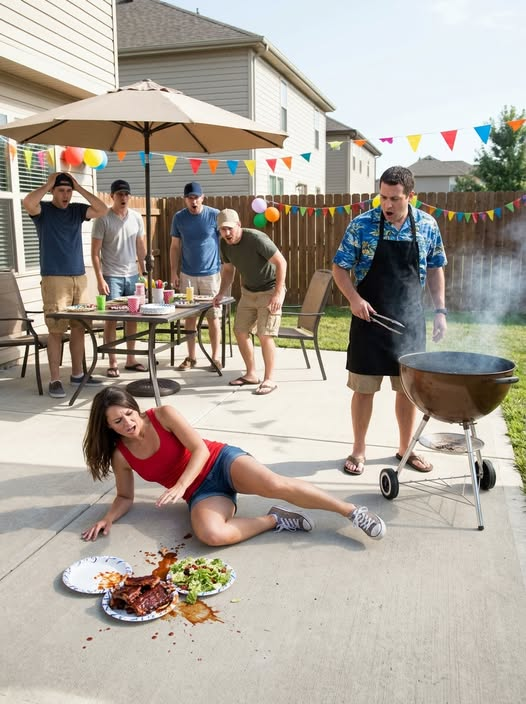
I remembered the driveway.
The spilled brisket.
Leo's voice.
Get up. You're embarrassing yourself.
I remembered the terrible feeling of telling my legs to move and getting nothing in return.
Then I pushed back the blanket.
Sat up.
Placed my feet on the floor.
And stood.
It took effort.
It still did.
But I stood.
I walked into the kitchen.
The morning light was soft.
Rain tapped against the window.
I filled the kettle.
Opened a new box of chamomile tea.
And placed one tea bag in my favorite mug.
No honey.
No lemon.
No bitter aftertaste.
Just tea.
Made by me.
I carried it carefully to the small table beside the window.
Then I sat down.
My phone buzzed.
A message from Caroline.
Caroline: Breakfast at ten? My treat.
I smiled.
Me: Only if you let me pick the restaurant.
Her reply came immediately.
Caroline: Deal.
I put the phone down.
Outside, the courtyard was beginning to wake.
A woman walked her dog.
Someone opened a window.
A child laughed somewhere below.
Ordinary sounds.
Ordinary life.
For so long, I'd wanted something extraordinary to happen.
A cure.
A confession.
A single moment when everything would finally make sense.
But the best thing waiting for me wasn't extraordinary.
It was this.
A morning I could choose.
A home where nobody watched what I drank.
A future that belonged to me.
I looked at the gold heart resting against my chest.
Then at the cane leaning beside my chair.
I still had work to do.
More therapy.
More healing.
More days when my body would remind me of what had happened.
But I wasn't waiting for Leo to believe me anymore.
I wasn't waiting for Freya to approve.
I wasn't waiting for anyone to tell me I was allowed to live.
I lifted my mug.
Took a sip.
And smiled.
Because the woman they thought would never walk again had walked out of their lives.
And this time, nobody could make her come back.






Comments 0