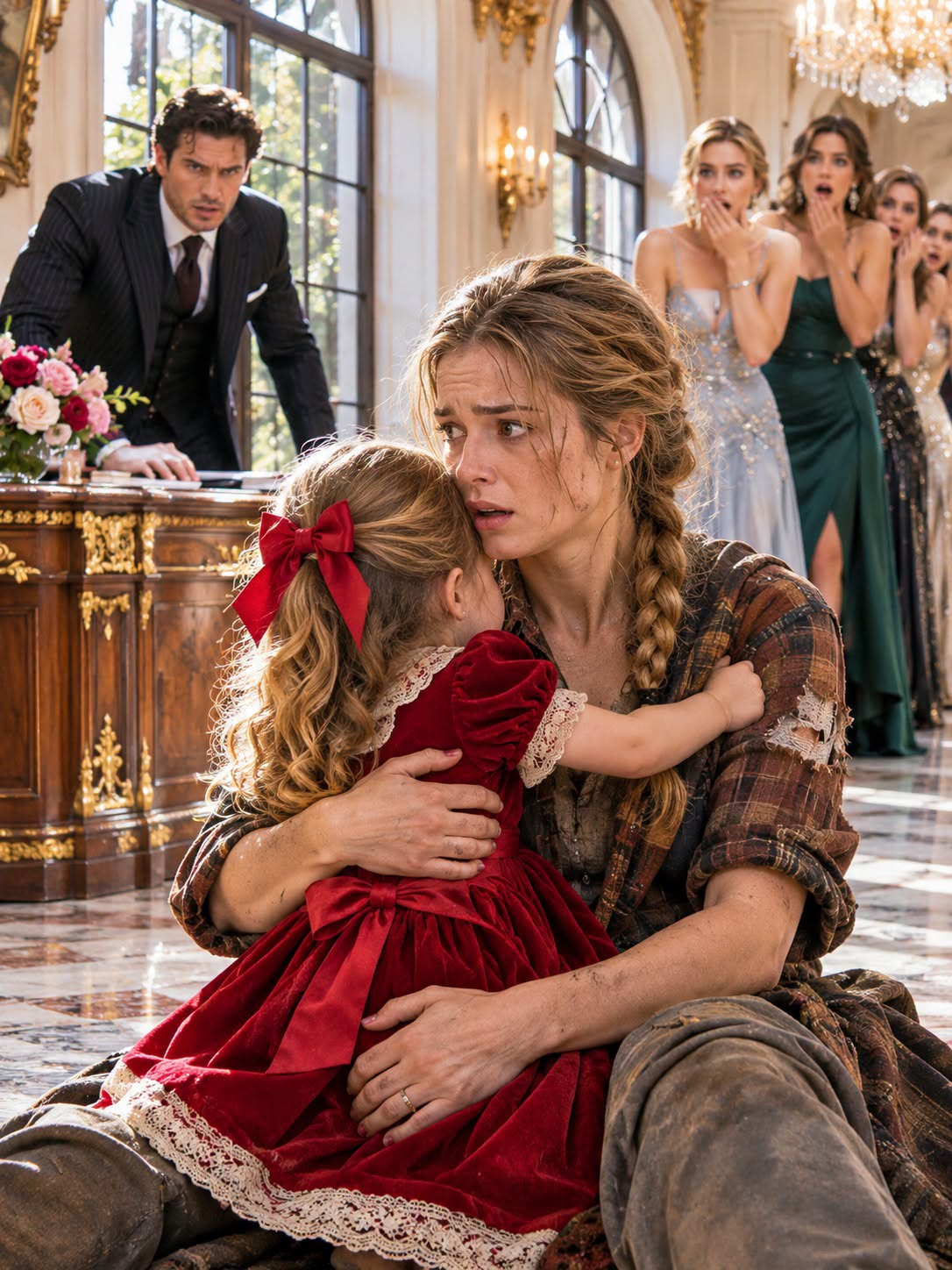
"Don't you dare touch her drawing!" Clara Bennett shouted as a wealthy woman ripped a sketchbook from a little girl's hands.
Across the restaurant, billionaire Julian Hawthorne stopped beside a polished wooden table. A torn page lay near his daughter's untouched lunch.
On the corner of the paper were three carefully written words.
Please find her.
Julian had spent two years believing his daughter had nothing left to say.
He was wrong.
"Are you going to eat that or just stare at it all afternoon?"
The woman's voice carried across the restaurant with the precision of a knife.
Clara Bennett was balancing a tray of water glasses when she heard it.
She had worked at Bellamy's for eleven weeks, long enough to recognize the difference between an impatient customer and someone who enjoyed making other people feel small.
The woman at table twelve belonged to the second category.
She was beautiful in the expensive, carefully maintained way Clara had come to associate with women who never checked their bank balances before buying groceries.
Her cream blazer looked freshly pressed. Her dark hair fell in glossy waves over one shoulder. A diamond bracelet glittered whenever she moved her wrist.
Across from her sat a little girl.
Seven years old, perhaps.
Straight brown hair. Large, watchful eyes. A red velvet dress with delicate cream lace around the collar.
In front of her was a plate of roasted chicken that hadn't been touched.
Beside it lay a sketchbook.
The child was drawing a rabbit.
Clara noticed that first because her younger brother, Danny, used to draw animals whenever their stepfather started drinking.
He had drawn dogs, birds, horses, and once an entire family of turtles.
Anything that allowed him to disappear into a world where adults couldn't hurt him.
The little girl held her pencil the same way.
Too tightly.
As though the smallest mistake might have consequences.
"Honestly, Lily," the woman continued, "your father pays a fortune for your education, your clothes, your food, and your ridiculous little hobbies. The least you could do is behave like a normal child."
The girl's pencil stopped.
Clara slowed.
"Look at me when I'm speaking to you."
The child lifted her head.
Her eyes were brown.
Not ordinary brown.
They were the deep, frightened brown of someone who had learned to study a room before deciding whether it was safe to breathe.
"That's better," the woman said. "Now put that stupid drawing away."
The girl lowered her gaze again.
She didn't speak.
"Did you hear me?"
A tiny nod.
"Then answer."
Nothing.
The woman exhaled dramatically.
"Oh, for heaven's sake. Seven years old, and still this nonsense. Your father has spent enough money on specialists to buy a hospital. Yet you can't manage one simple conversation."
Clara felt something tighten inside her chest.
She had heard those words before.
Not exactly those words.
But close enough.
Look at me when I'm talking.
Answer me.
Don't act stupid.
She remembered being eight years old, standing barefoot in her mother's kitchen in Bensonhurst while her stepfather explained that children who didn't contribute to the household didn't deserve opinions.
She remembered learning that silence sometimes protected you.
And sometimes it made things worse.
The woman reached across the table.
"Give me that."
She snatched the sketchbook away.
The pencil dragged across the paper, leaving a dark streak through the rabbit's ear.
The little girl flinched.
Clara stopped walking.
"Excuse me, ma'am."
The woman looked up.
Clara set her tray on an empty table.
"There's no reason to speak to her like that."
For a moment, the woman appeared genuinely confused.
Then she smiled.
It wasn't a pleasant smile.
"I'm sorry. Were you speaking to me?"
"Yes."
"Then I suggest you return to whatever you're being paid to do."
Clara glanced at the child.
The little girl's eyes had dropped to the damaged drawing.
Her hands were folded tightly in her lap.
"She's just a kid," Clara said. "You don't have to embarrass her in front of everyone."
The woman's smile disappeared.
"Do you have any idea who I am?"
"No, ma'am."
"Then perhaps you should learn before opening your mouth."
Clara took a breath.
She needed this job.
That fact stood between her and every word she wanted to say.
Her rent was overdue.
Her phone bill was due Friday.
Her mother had needed help paying for a prescription the previous week, and Clara had sent the money without admitting she'd been living on instant noodles since Tuesday.
She couldn't afford to lose another paycheck.
But then the little girl looked up.
And Clara recognized something in her expression.
Not embarrassment.
Not ordinary sadness.
Resignation.
The kind that came when a child stopped expecting anyone to defend her.
Clara made her decision.
"Whoever you are," she said quietly, "you don't get to humiliate a little girl just because she's too frightened to answer you."
A nearby conversation stopped.
The woman's face changed.
"How dare you?"
Clara remained still.
"Please give her drawing back."
The woman stood so abruptly that her chair scraped across the marble floor.
"You're a waitress."
"Yes, ma'am."
"You serve food."
"That's right."
"You do not lecture my family."
Clara glanced at the child.
"Then someone in her family should have spoken up first."
Silence spread across the surrounding tables.
A businessman in a gray suit lowered his fork.
Two women near the window exchanged uncomfortable looks.
The woman's cheeks flushed.
"You insolent little nobody."
Clara said nothing.
"I could have you fired in thirty seconds."
"Maybe."
"Maybe?"
Clara met her eyes.
"But you still shouldn't treat her that way."
The woman reached for her handbag.
"Manager. Now."
Dominic arrived less than a minute later.
Clara had worked under enough restaurant managers to recognize the expression on his face.
Fear.
Not anger.
Fear.
"Miss Drake," he said, forcing a smile. "Is everything all right?"
"No, Dominic. Everything is not all right."
Vivian Drake pointed directly at Clara.
"Your employee has insulted me, interfered with a private family matter, and embarrassed me in front of half your customers."
Dominic turned toward Clara.
"Is that true?"
Clara looked at the child.
"She was being cruel to the little girl."
Vivian laughed.
"Unbelievable."
Dominic closed his eyes briefly.
"Clara. Kitchen. Please."
"Dominic—"
"Now."
Clara bent to retrieve the sketchbook from the table.
Vivian's fingers tightened around it.
"Leave it."
Clara looked at her.
Then at the girl.
"May I?"
For the first time, the little girl made a deliberate movement toward Clara.
She reached out one small hand.
Clara gently took the sketchbook from Vivian and placed it in the child's lap.
The rabbit had a long gray mark across one ear.
Clara smoothed the page.
"Hey," she whispered.
The child looked up.
"That's a really good bunny."
The girl's eyes widened slightly.
"I mean it. Look at those ears. And that little face."
Clara smiled.
"Way more interesting than a boring designer purse."
A tiny change passed over the girl's face.
Almost a smile.
Almost.
Then her lips parted.
Clara waited.
The child whispered something so quietly that Clara nearly missed it.
"Thank you."
Two words.
Barely audible.
Clara felt an unexpected warmth spread through her chest.
"You're welcome, sweetheart."
She stood.
Dominic was waiting.
And Vivian Drake was watching her with an expression Clara couldn't quite understand.
It was no longer simple anger.
For one brief moment, the woman looked frightened.
"Do you understand what you've done?"
Dominic shut the kitchen door behind them.
Clara leaned against a stainless-steel counter.
"I defended a child."
"You insulted Vivian Drake."
"She was humiliating a seven-year-old."
"She's a Hawthorne family associate!"
Clara frowned.
"What's that supposed to mean?"
Dominic stared at her.
"Julian Hawthorne."
The name meant something even to Clara.
Everyone in New York had heard of Julian Hawthorne.
His legitimate empire included shipping terminals, commercial real estate, private security companies, and luxury hotels.
His photograph appeared regularly in financial magazines.
Some called him a brilliant businessman.
Others whispered that his family's fortune had been built through connections nobody discussed in public.
The newspapers preferred the phrase controversial billionaire.
People in Brooklyn used a different word.
Mafia.
Clara had never cared enough to separate rumor from truth.
Rich men lived in a different universe.
Their problems rarely touched hers.
Until now.
"Vivian Drake is close to him," Dominic continued. "Very close. That little girl is his daughter."
Clara glanced toward the kitchen door.
"The little girl?"
"Lillian Hawthorne."
Clara remembered the child's frightened eyes.
"Does her father know how Vivian talks to her?"
Dominic looked exhausted.
"That's not our concern."
"It should be someone's."
"Clara."
He lowered his voice.
"I'm sorry."
She understood immediately.
"You're firing me."
He didn't answer.
He didn't have to.
Clara reached behind her back and untied her apron.
The strings were stiff from years of washing.
She folded it carefully.
Placed it on the counter.
"Okay."
Dominic looked miserable.
"You're a good worker."
"Apparently not good enough."
"That's not fair."
Clara gave a small, tired smile.
"Neither was what happened to that kid."
She collected her purse from her locker.
Forty-three dollars in tips.
A half-empty bottle of water.
A photograph of her mother and Danny.
That was everything.
Six jobs in one year.
And now seven.
She was beginning to wonder whether she was the problem.
Outside, Brooklyn was cold and gray.
A light drizzle had started.
Clara stood beneath the restaurant awning and counted her money again, as though the bills might have multiplied while she wasn't looking.
Forty-three dollars.
Rent was due in four days.
She laughed softly.
"Fantastic."
A black SUV waited near the curb.
Its windows were dark enough to reflect the buildings opposite.
A uniformed driver stood beside the rear passenger door.
Clara barely noticed him.
She was already calculating how many shifts she could pick up at the bakery where she'd worked last winter.
Then she heard a voice.
"Miss?"
She turned.
The little girl stood near the restaurant entrance.
Her red dress was partly hidden beneath a dark coat.
She held the sketchbook against her chest.
A tall woman in black stood behind her.
The woman looked like a governess.
Or a bodyguard.
Possibly both.
"Lily," the woman said sharply. "Come along."
The child ignored her.
She looked directly at Clara.
Then she lifted one hand.
A tiny wave.
Secret.
Careful.
Clara smiled.
She waved back.
"Keep drawing, okay?"
The little girl pressed the sketchbook closer.
Her lips moved.
Clara couldn't hear what she said.
The woman took her hand.
"Lillian. Now."
The child was pulled toward the waiting vehicle.
But just before the door closed, she turned once more.
And looked at Clara as though she were trying desperately to remember her face.
That evening, Clara climbed three flights of narrow stairs to her apartment above a laundromat.
The hallway smelled of detergent, old paint, and somebody's burned dinner.
Her apartment was one room.
A narrow bed.
A secondhand sofa.
A kitchenette with two mismatched mugs.
A window overlooking a brick wall.
It wasn't much.
But it was hers.
For now.
She removed her damp shoes and sat on the edge of the bed.
Her phone buzzed.
A message from Danny.
Heard you got fired again lol. Mom says don't panic. Love u.
Clara smiled despite herself.
Already panicking. Tell Mom I'm fine. Love you more.
She set the phone down.
Then picked it up again.
Her brother was nineteen.
He worked part-time at an auto shop while taking community college classes.
Their mother cleaned offices at night.
Clara had promised herself that one day she'd earn enough money to make their lives easier.
Instead, she couldn't even keep a restaurant job.
She lay back.
Closed her eyes.
And saw the little girl.
The pencil stopping.
The shoulders tightening.
The way she'd whispered thank you as though gratitude were something she had to hide.
Clara opened her eyes again.
"Somebody needs to look after you, kid."
She didn't know why she said it aloud.
Perhaps because nobody had said those words to her when she was seven.
Across the city, inside a guarded Manhattan townhouse, Julian Hawthorne was staring at his daughter's sketchbook.
He had returned from a meeting to find Vivian waiting in his study.
She was furious.
"Your daughter embarrassed me today."
Julian removed his watch.
"What happened?"
"She refused to eat. Again."
He said nothing.
"And then some waitress decided to interfere."
Julian looked up.
"A waitress?"
Vivian folded her arms.
"An insolent little girl who apparently believes she can lecture people who pay her salary."
Julian's expression remained unreadable.
"What did she do?"
"She made a scene."
"Vivian."
His voice was quiet.
"Tell me exactly what happened."
Vivian hesitated.
Then gave him a carefully edited version.
The waitress had been rude.
Aggressive.
Disrespectful.
She had upset Lillian.
She had embarrassed Vivian.
And she'd been dismissed.
Julian listened without interrupting.
When Vivian finished, he asked one question.
"Did Lily cry?"
Vivian blinked.
"What?"
"Did my daughter cry?"
"No."
"Did she speak?"
Vivian looked away.
"Of course not."
Julian nodded.
"Thank you. You can go."
Vivian stared at him.
"That's all?"
"That's all."
After she left, Julian sat alone for several minutes.
Then he pressed a button on his desk.
"Mrs. Whitmore."
His daughter's governess appeared.
"Sir?"
"Bring me Lily's sketchbook."
The woman hesitated.
"Mr. Hawthorne—"
"Please."
A moment later, she returned with the small blue notebook.
Julian opened it.
Page after page contained drawings.
Animals.
Trees.
Windows.
A little house.
A woman holding a child's hand.
He stopped.
The woman's face had been drawn carefully.
Long hair.
A gentle smile.
Simple clothes.
Underneath, in uneven pencil letters, was one word.
Mama.
Julian's jaw tightened.
His daughter had not spoken normally since the night her mother disappeared from their lives two years earlier.
Doctors had called it trauma-related selective mutism.
Specialists had offered treatment plans.
Therapists had recommended patience.
He had hired caregivers, tutors, and nannies.
Some stayed a week.
Others lasted an afternoon.
Over two years, his staff had contacted or screened nearly a thousand candidates.
Lily rejected almost everyone.
Sometimes she hid.
Sometimes she refused food.
Sometimes she simply stared at the floor until the stranger left.
Julian had tried everything money could buy.
Nothing had brought his daughter back.
He turned another page.
A rabbit.
One ear crossed by a dark pencil mark.
And beside it, a small figure with long hair.
The figure was kneeling.
Holding out a hand.
Julian studied the drawing.
"Mrs. Whitmore."
"Yes, sir?"
"Who is this woman?"
The governess looked down.
"The waitress, I believe."
"Did Lily draw this today?"
"Yes."
Julian turned the page.
There was another picture.
The same woman.
This time holding Lily.
Beneath it, in careful handwriting, were three words.
Please find her.
Julian felt something move inside his chest.
Hope.
A dangerous emotion.
One he had spent two years trying not to feel.
"Find out who she is," he said.
Mrs. Whitmore hesitated.
"Sir?"
"The waitress."
He closed the sketchbook.
"I want her name."
At 2:13 in the morning, Clara was still awake.
Rain tapped against the window.
She made tea.
Rinsed the mug.
Checked her phone.
No messages.
She had an interview scheduled at a grocery store on Thursday.
Perhaps they would hire her.
Perhaps they wouldn't.
She climbed back into bed.
A few minutes later, her phone lit up.
Unknown number.
She frowned.
The message contained no greeting.
Only one sentence.
Stay away from the Hawthorne child.
Clara sat upright.
She read it twice.
Then a second message appeared.
You have no idea what you're getting involved in.
Her mouth went dry.
She typed a reply.
Who is this?
The message showed as delivered.
No answer.
She waited.
Five minutes.
Ten.
Nothing.
Finally, she blocked the number.
But sleep didn't come.
At seven the next morning, someone knocked on her apartment door.
Three firm knocks.
Clara froze.
Nobody visited her this early.
She approached quietly.
"Who is it?"
A man's voice answered.
"Miss Bennett?"
She looked through the peephole.
A tall man stood in the hallway.
Dark hair.
Charcoal overcoat.
Expensive shoes.
His face was strikingly handsome, but there was something intimidating about the way he stood.
Beside him was a little girl in a yellow raincoat.
Clara's breath caught.
Lily.
She opened the door with the security chain still attached.
"Can I help you?"
The man looked directly at her.
"Clara Bennett?"
"Yes."
"My name is Julian Hawthorne."
Clara stared.
The billionaire.
The man whose daughter she had defended.
The man whose name had cost her a job.
He glanced down at the little girl.
"I believe you met my daughter yesterday."
Lily stepped forward.
Her small fingers tightened around her father's hand.
Then she saw Clara clearly.
Something changed in her face.
Her eyes widened.
Her mouth opened.
And before Julian could stop her, she slipped from his grasp.
"Mom!"
The word came out broken.
Desperate.
Clara barely had time to unhook the chain before the child threw herself against her.
Two small arms wrapped around her waist.
Lily buried her face in Clara's shirt.
"Mom," she whispered again.
Clara stood motionless.
Julian looked as though someone had struck him.
For two years, his daughter had barely spoken.
And now she was calling a complete stranger her mother.
Clara slowly knelt.
"Sweetheart," she whispered, "I think you've made a mistake."
Lily shook her head.
Hard.
Her fingers gripped Clara's shirt.
"No."
Clara looked up at Julian.
His face had gone pale.
"Mr. Hawthorne?"
He didn't answer immediately.
He was staring at his daughter.
Then at Clara.
Then back at the child.
Finally, he reached into his coat.
"I came here to offer you a job."
He withdrew a cream-colored envelope.
"But now..."
His voice faded.
Clara noticed something on the back.
A handwritten name.
Not hers.
Not Lily's.
A name she hadn't seen in seventeen years.
She reached for the envelope.
Julian watched her expression change.
"Miss Bennett?"
Clara's fingers began to tremble.
Because the name written on the envelope belonged to someone who was supposed to be dead.
And beneath it was an address.
The address of the house where Clara had lived as a child.






Comments 0