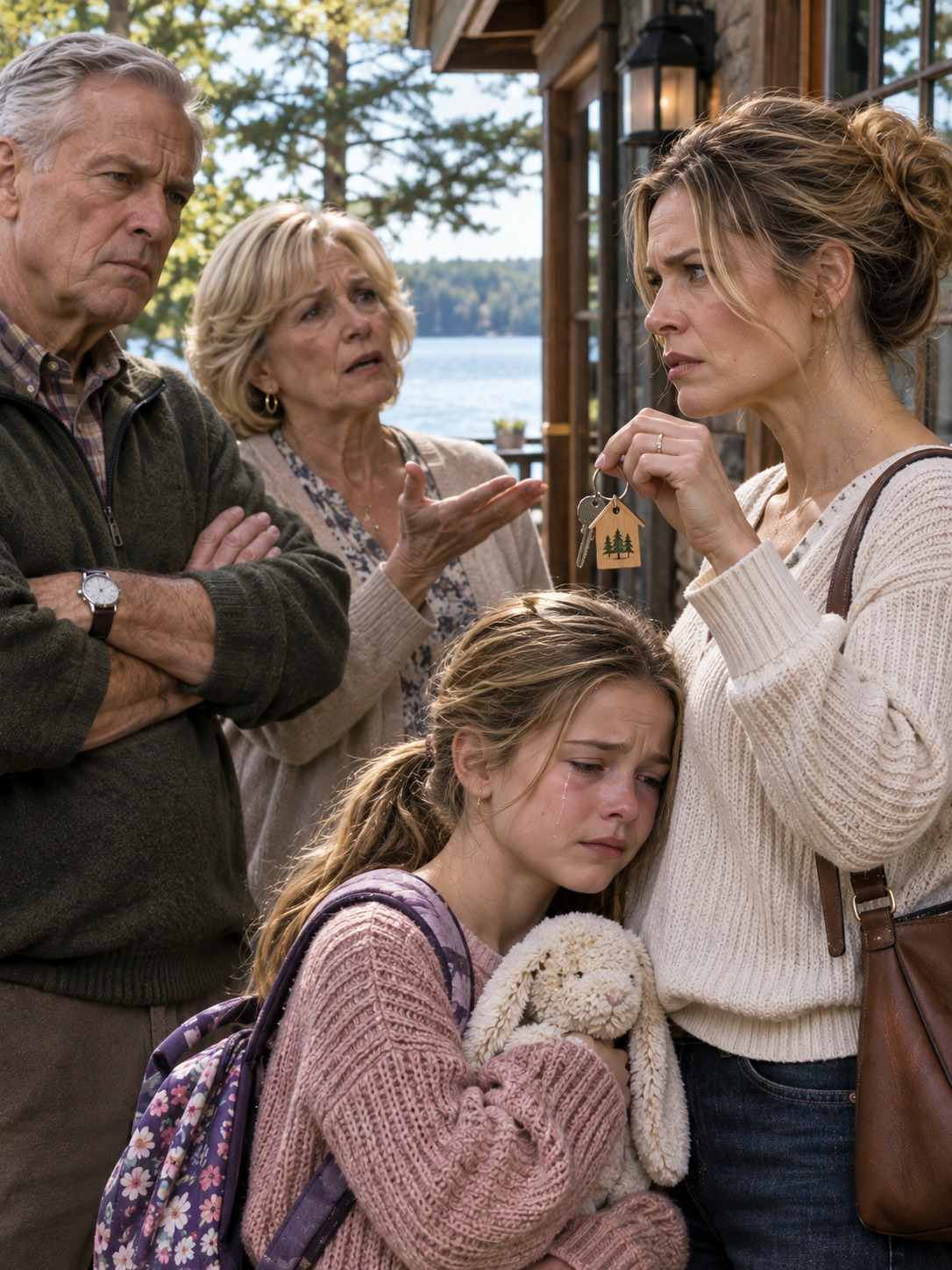
A nine-year-old girl sat outside her elementary school, clutching a deck of playing cards.
"Mommy, Grandpa said he was coming."
When emergency room nurse Tessa Sorenson finally arrived, she found a forgotten pickup authorization form beside her daughter.
One name had been circled in red.
Her grandfather's.
And he hadn't come.
My daughter was still wearing her backpack when I found her.
That was the first thing I noticed.
The second was the sandwich.
Half of it remained wrapped in wax paper on her lap, its edges slightly crushed from being held too long.
The third was her face.
Willa had been crying.
Not the loud, dramatic kind of crying children sometimes do when they're frustrated or tired.
These were the quiet tears of a little girl who had spent too long trying not to cry because she believed somebody might still come for her.
I dropped my bag and knelt in front of her.
"Sweetheart."
She looked up.
For a moment, she simply stared at me.
Then she jumped off the bench.
"Mom!"
I caught her as she threw her arms around my neck.
Her small body trembled against mine.
I held her tightly, pressing my cheek against her hair.
"I'm here. I've got you."
She gave a tiny laugh.
It was the kind of laugh children make when they're relieved but still confused about whether everything is actually okay.
Then she whispered something that nearly broke me.
"I'm sorry."
I pulled back.
"What?"
"For making you leave work."
I felt something tighten in my chest.
"Willa, look at me."
She raised her eyes.
"You did absolutely nothing wrong."
"But Mr. Whitaker had to stay."
"That's his job, sweetheart. And my job is to come get you."
She nodded, but her eyes drifted toward the parking lot.
"Do you think Grandpa forgot?"
I didn't answer immediately.
I couldn't.
Because I already knew he hadn't simply forgotten.
I had seen the photograph.
I had seen his smiling face beside the elephant enclosure.
I had seen my sister's caption.
And I had spent the entire drive to the school trying to understand how a man could knowingly leave one grandchild waiting while taking two others on an afternoon outing.
But I wasn't ready to explain that to a nine-year-old.
Not while she was still holding the cards she'd prepared for him.
Principal Dean Whitaker approached us quietly.
"Ms. Sorenson, I'm glad you made it."
I stood while keeping one arm around Willa.
"Thank you for staying with her."
"Of course."
He looked toward my daughter.
"She's been very patient."
Willa lowered her eyes.
Mr. Whitaker continued.
"We called the number listed for her grandfather several times. We also tried the emergency contacts."
"I know. I'm sorry."
"You don't need to apologize. We understand emergencies happen."
His expression suggested he didn't entirely believe that was what had happened.
Neither did I.
He handed me a printed copy of the school's late-pickup report.
The form listed the scheduled dismissal time as 3:10 p.m.
Below it were the attempted contact times.
3:24.
3:41.
4:02.
4:28.
The final entry showed that the school had reached me through the hospital.
I looked at the clock on the wall.
It was nearly five.
Almost two hours.
Two hours during which my daughter had watched every approaching vehicle.
Two hours during which she'd wondered whether she'd somehow done something wrong.
"Has this happened before?" I asked.
Mr. Whitaker hesitated.
"Not with your father."
That answer stayed with me.
He explained that Willa had been perfectly behaved.
She'd completed her homework.
She'd asked whether she could wait near the entrance because she didn't want her grandfather to miss her.
Eventually, the staff brought her inside.
They gave her something to eat.
When she became concerned that her grandfather might have been in an accident, Mr. Whitaker reassured her that they had no reason to believe that.
I thanked him again.
Then I asked him to remove my father's name from the authorized pickup list.
"Immediately, please."
"Certainly."
He took the form and made the change.
Willa watched him.
"Does that mean Grandpa can't pick me up anymore?"
I looked down at her.
"Not unless Mommy says it's okay."
She nodded.
Then she reached into her backpack.
"I brought these."
She handed me a small deck of playing cards.
The corners were slightly bent.
"I was going to teach Grandpa the game."
I took them carefully.
"That's really sweet."
"I practiced all weekend."
I looked at the cards.
There was a little handwritten scoreboard folded between them.
Willa had written two names at the top.
GRANDPA.
WILLA.
She'd even drawn a tiny crown beside her name.
I swallowed.
"Come on, sweetheart. Let's go home."
On the drive, she sat in the back seat with the cards in her lap.
For several minutes, neither of us spoke.
I kept checking the rearview mirror.
Her little sneakers rested against the seat.
Her backpack was beside her.
She was looking out the window.
Then she asked the question I had been dreading.
"Mom?"
"Yes?"
"Did Grandpa forget me, or did he just not want to come?"
My hands tightened around the steering wheel.
I wanted to tell her that her grandfather had made a mistake.
I wanted to tell her that sometimes adults got distracted.
I wanted to tell her that everything would be fine.
But I couldn't bring myself to lie.
"I don't know why he didn't come, sweetheart."
She looked down.
"But I promise you something."
"What?"
"You will never have to wonder whether you're worth showing up for."
She didn't answer.
She simply ran her thumb along the edge of the cards.
I watched her in the mirror.
And suddenly, I wasn't thirty-six anymore.
I was twelve.
I was sitting alone on a wooden bench beside a softball field.
The other girls had already gone home.
My father had promised to collect me after practice.
He'd even told me to wait because he wanted to hear about the game.
But he never arrived.
I remembered the coach checking her watch.
I remembered pretending I wasn't upset.
I remembered telling everyone that my father was probably stuck in traffic.
Eventually, my grandmother arrived.
She was wearing her old blue cardigan.
She didn't ask me why I was crying.
She simply sat beside me and wrapped an arm around my shoulders.
"Come on, honey. You're coming home with me."
That was Grandma.
She never made promises she couldn't keep.
She just showed up.
When my mother missed my school concert, Grandma came.
When Dad forgot my birthday dinner, Grandma took me out for pancakes.
When I failed my first driving test, she sat with me in the car until I stopped crying.
She never told me that family was supposed to tolerate disappointment.
She taught me that love was something people demonstrated.
And yet, somehow, I'd spent most of my adult life accepting exactly the opposite from my parents.
I glanced at Willa again.
She had fallen quiet.
I wondered how many times she'd already experienced that same feeling.
The feeling of waiting for someone who had promised to come.
My name is Tessa Sorenson.
I'm thirty-six years old.
I'm an emergency room nurse, and I've raised my daughter alone since she was two.
Her father left when she was little.
He never became a consistent presence in her life.
I stopped expecting him to change years ago.
Instead, I concentrated on building a stable home for Willa.
I worked holidays.
I accepted overnight shifts.
I missed birthdays and family dinners when the hospital needed extra hands.
Sometimes I came home so exhausted that I fell asleep before removing my shoes.
But I never wanted my daughter to feel that she was an inconvenience.
I wanted her to grow up knowing she was loved.
My parents and my younger sister Paige were supposed to be part of that support system.
Especially my father.
He'd retired after thirty-one years working for the County Roads Department.
At his retirement party, he'd stood beneath a banner surrounded by coworkers and family members.
He'd raised his glass and announced that he was finally going to spend time on the things that mattered.
"Family first," he'd said.
Everyone applauded.
I remembered that speech when I called him on Sunday afternoon.
Our neighbor, who normally watched Willa after school, had recently undergone knee surgery.
She couldn't manage the stairs, and I didn't want to burden her.
The hospital had been short-staffed for weeks.
I'd agreed to cover a particularly long shift from seven in the morning until eleven at night.
The overtime would help pay for Willa's new school shoes and repairs to my aging car.
I needed somebody dependable.
So I called Dad.
"Hey, Dad. Can I ask you something?"
"What's up?"
"Would you be able to pick up Willa tomorrow? I have a long shift."
"Of course."
"School lets out at 3:10."
"I know when school lets out, Tessa."
I smiled.
"Sorry. I just wanted to make sure."
He laughed.
"I raised two daughters. I think I can handle one nine-year-old."
"Can you make sure she gets dinner and finishes her spelling homework?"
"Absolutely."
He promised to take her for burgers.
Then he said they could play cards afterward.
Willa overheard the conversation.
She came running into the kitchen.
"Grandpa's picking me up?"
"Yes, sweetheart."
"Can I teach him my new game?"
"Of course."
She practically bounced.
That evening, she arranged the cards on the living room floor.
She practiced explaining the rules.
She drew a scoreboard.
She even asked me whether Grandpa preferred winning or losing.
I laughed.
"Your grandfather likes winning."
"Then I'll let him win the first game."
I kissed her forehead.
"That's very generous."
She smiled.
For the first time in weeks, I felt relieved about the following day.
I believed Willa would be safe.
I believed she would have fun.
And I believed my father would keep his promise.
The next morning, I left for work before Willa had finished breakfast.
I kissed her forehead.
"Have a good day."
"Grandpa's coming!"
"I know."
She smiled sleepily.
I adjusted the collar of her jacket.
"Be good for your teacher."
"I will."
Then I left.
At noon, the emergency department became overwhelmed.
A serious highway collision brought several patients in close succession.
Ambulances arrived one after another.
The waiting room filled.
Doctors were calling for additional staff.
I barely had time to drink water.
My personal phone was secured in my locker.
The hospital could reach me through the charge nurse if something urgent happened.
Late that afternoon, I was preparing medication when my charge nurse approached.
"Tessa?"
I looked up.
"Yes?"
"Your daughter's school is calling."
My stomach dropped.
"Why?"
"The principal says it's urgent."
I immediately stepped away after arranging coverage.
The moment I reached the phone, I heard Principal Whitaker's voice.
"Ms. Sorenson, Willa is safe. I want you to know that first."
My knees nearly gave way.
"What happened?"
"She's still here. Her grandfather hasn't arrived."
I stared at the wall.
"What?"
"He's listed as today's authorized pickup. We've called him several times, but we haven't been able to reach him."
I looked at the clock.
Willa should have been home long ago.
"I'm coming."
"We'll stay with her until you arrive."
I thanked him.
Then I hurried to my locker.
There were several missed calls from the school.
I called Dad twice.
Both attempts went straight to voicemail.
I called Mom.
No answer.
Then Paige.
Nothing.
My hands were shaking.
I opened Facebook.
I wasn't looking for anything specific.
I just wanted an explanation.
Maybe Dad had gotten sick.
Maybe there had been a family emergency.
Maybe somebody had taken him to the hospital.
Then I saw the photograph.
Paige had uploaded it less than an hour earlier.
My father stood beside an elephant enclosure at the zoo.
He was smiling broadly.
One of Paige's four-year-old twins sat in his arms.
The other stood beside him holding an enormous pink cotton candy.
The caption read:
Another wonderful afternoon with the best grandpa in the world!
I stared at the screen.
I enlarged the photograph.
There was Dad.
There was Paige.
There were her children.
They looked perfectly happy.
And somewhere across town, my daughter was sitting outside her school with a half-eaten sandwich.
Waiting.
I looked at the photograph again.
Then I noticed something.
My father's phone was visible in his jacket pocket.
I knew that phone.
I'd helped him replace it the previous Christmas.
It was the same phone I'd been calling all afternoon.
The same phone that had gone directly to voicemail.
I stood motionless.
The charge nurse called my name.
"Tessa?"
I looked up.
"I need to go."
She nodded immediately.
"Go. We'll cover you."
I grabbed my coat and hurried toward the exit.
I didn't cry.
I didn't scream.
I didn't call my father again.
I simply drove toward my daughter's school.
And as I turned into the parking lot, I saw Willa sitting beside Principal Whitaker.
Her backpack was still on.
Her sandwich was still in her lap.
And the deck of cards she'd prepared for her grandfather was resting beside her.
She looked up when my car stopped.
Her face changed.
"Mommy!"
I opened the door.
She ran toward me.
I caught her.
And while she held me, I made a decision.
My daughter would never again be placed in a position where she had to wait for someone who considered her optional.
Not even if that person was her grandfather.
I didn't know yet how much that decision would change my family.
I only knew that something had finally broken.
And it wasn't my daughter's heart.
It was my willingness to keep pretending everything was fine.
That night, after Willa fell asleep, I would finally hear my father's explanation.
But first, I needed to find out what else he'd been doing while I was busy trusting him.
Because the photograph from the zoo wasn't the only thing waiting for me.
And two days later, a property manager named Cody Mercer would call with a discovery that would change everything.
Comments 0