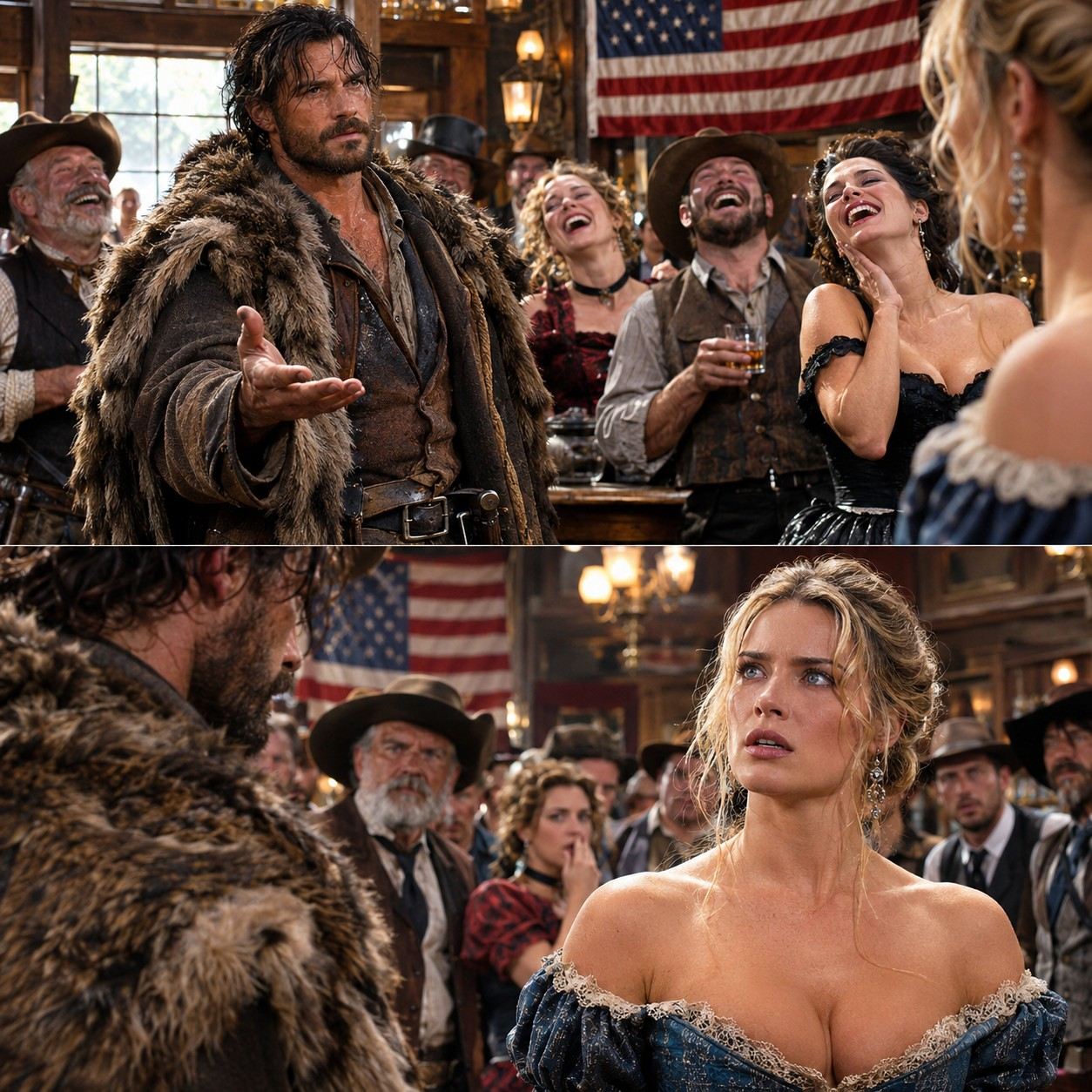
"Somebody marry me before morning," the mountain man said, holding out his empty hand.
Silas Mercer stood inside the crowded saloon with a folded county order in his coat pocket.
Two rust-stained holes marked the bottom of the paper.
Someone had removed a page.
And the man everyone feared had no idea he was carrying evidence.
The laughter started at the far end of the bar.
It came from a cattle driver named Amos Pike, a broad-faced man who had spent the better part of the evening drinking whiskey he could scarcely afford.
Amos slapped his knee.
"Well, I'll be damned! Did everybody hear that?"
A few men turned toward him.
Amos pointed his glass at the enormous figure standing beside the entrance.
"Silas Mercer wants himself a wife!"
That was all it took.
Laughter rolled through the Briar Hollow Saloon like a wagon losing its brakes on a mountain road.
A woman in a burgundy dress covered her mouth with one hand. Two ranch hands leaned against each other, laughing so hard they nearly spilled their drinks. Behind the bar, the proprietor, Walter Briggs, shook his head with an expression of delighted disbelief.
Even the old men near the stove joined in.
Silas did not.
He stood just inside the doorway, his broad shoulders wrapped in a heavy charcoal coat, his weathered face almost completely still.
His ash-blond hair was tied loosely behind his neck. His reddish-brown beard had grown thick during the winter, and a pale scar ran from the edge of his jaw toward his left ear.
There were men in Briar Hollow who swore Silas had earned that scar fighting a wolf with his bare hands.
Others insisted it had come from a knife fight in Montana.
Silas had never bothered correcting either story.
He rarely bothered correcting anything.
He came down from the mountains twice a month, sometimes less. He purchased flour, salt, coffee, lamp oil, and whatever supplies he could not produce himself. He paid in cash, spoke little, and returned to his cabin before anyone could persuade him to stay.
Children stepped aside when they saw him.
Dogs watched him carefully.
Grown men lowered their voices.
Tonight, those same grown men were laughing in his face.
Silas waited until the noise softened.
Then he spoke again.
"I need to be married before sunrise."
Another burst of laughter.
"Before sunrise?" Amos repeated. "Mercer, you planning to court a woman or rob a bank?"
"Maybe he's got a preacher waiting in the woods!" someone shouted.
"Maybe he finally figured out a bear can't cook supper!"
The room erupted again.
Silas lowered his eyes.
Only for a moment.
Then he raised them.
"I'm asking you to hear me out."
His voice was deep, steady, and almost painfully quiet.
That should have changed something.
It didn't.
Amos leaned forward.
"Tell you what, Mercer. I've got a cousin over in Dry Creek. She's sixty-two, missing three teeth, and mean enough to frighten the devil. You two might get along."
More laughter.
Silas did not answer.
He simply looked across the room.
For the first time in his life, the strongest man in Briar Hollow seemed unable to move anyone.
And nobody understood why.
Nobody except the woman sitting alone at the table beside the western window.
Clara Bennett had been watching him since he entered.
She was thirty-eight, with dark auburn hair pinned into a neat braid and hazel eyes that missed very little.
Her emerald-green dress was modest, its cream lace collar fastened beneath a small bronze brooch.
She had come to the saloon for supper, as she did most evenings.
Not for company.
Certainly not for entertainment.
Clara had spent enough years listening to men laugh at things they did not understand.
She knew the difference between a joke and a desperate man being treated like one.
And Silas Mercer was desperate.
Not drunk.
Not foolish.
Desperate.
His right hand had opened and closed three times since he entered.
He kept glancing toward the clock above the bar.
When Amos made another joke, Silas did not look offended.
He looked as though he were calculating how much time the laughter was costing him.
Clara set down her fork.
"Mr. Mercer."
Her voice was not particularly loud.
Still, something in its clarity reached him.
Silas turned.
Clara gestured toward the empty chair across from her.
"Would you like to sit down?"
A few men snickered.
"Careful, Miss Bennett," Amos called. "He might take that as a proposal."
Clara did not look at him.
Silas shook his head.
"Thank you, ma'am. But I can't stay long."
"Then perhaps you'd better tell us why you're here."
He studied her.
For a moment, Clara thought he might refuse.
Then his gaze moved toward the clock again.
Nine minutes past ten.
Less than nine hours until sunrise.
"My sister died six weeks ago," he said.
The laughter weakened.
A man near the stove cleared his throat.
Silas continued.
"Her name was Rebecca. She had a little girl."
Clara sat straighter.
"How old?"
"Seven."
Something changed in his expression when he said the child's age.
His mouth tightened.
Not with anger.
With pain.
"Her name's Lily."
Nobody laughed now.
Silas looked down at his hands.
"Rebecca was sick a long time. Before she passed, she asked me to take care of Lily."
He swallowed.
"I promised her I would."
Walter Briggs slowly placed a clean glass beneath the bar.
Silas continued.
"She's been living with me since the burial. I've got a good cabin. Food enough for winter. A proper bed. A stove that works. I made her a little desk by the window because she likes drawing."
Clara noticed how carefully he listed these things.
As though he had been rehearsing the evidence of his own worthiness.
As though someone had already convinced him it might not be enough.
"Yesterday," Silas said, "a county deputy came up the mountain."
His voice grew quieter.
"He brought an order."
Clara's fingers tightened around the edge of her napkin.
"What kind of order?"
"Said Lily couldn't stay in my household."
"Why?"
"Because I'm unmarried."
A murmur moved through the room.
Silas reached into his coat.
"He said a child needs a respectable home with a married woman in it. Said the county wouldn't leave her with a bachelor living alone in the mountains."
He withdrew a folded paper.
"He gave me until sunrise."
Clara stared at the document.
"Until sunrise to do what?"
"Produce a marriage certificate."
Someone at the bar muttered, "Good Lord."
Silas looked toward the crowd.
"That's why I'm here."
His voice nearly broke.
He caught it before anyone could hear.
"I know I'm not much to look at. I know people tell stories. But I've got a decent home, and I don't drink, and I won't mistreat a woman."
The room remained silent.
"I can provide for her. She'd have her own room. I'd never ask anything of her she wasn't willing to give."
He paused.
Then said the words that seemed to cost him more than all the others.
"I just need somebody to help me keep my little girl."
Clara felt something tighten beneath her ribs.
Not pity.
Something sharper.
Because she had heard men make promises before.
She had heard them boast about the things they could provide.
But Silas Mercer was not boasting.
He was offering everything he possessed in exchange for the chance to keep a promise to a dead woman.
Across the room, Amos Pike lowered his eyes.
Walter Briggs removed his hat.
Nobody knew what to say.
Finally, a man near the stove spoke.
"Why not hire a housekeeper?"
Silas shook his head.
"Deputy said that wouldn't do."
"Then take the girl somewhere else."
"Where?"
The single word silenced him.
Silas looked around.
"She's seven years old. She lost her mama. She's afraid of sleeping without a lamp. She keeps asking whether people disappear when they die."
His voice grew rough.
"I told her I wasn't going anywhere."
He took a breath.
"And I won't."
Clara stood.
Her chair scraped softly against the wooden floor.
"Mr. Mercer."
He turned toward her.
"May I read that paper?"
Silas hesitated.
The entire saloon watched.
"Why?"
"Because I used to work at the county courthouse."
Something flickered across his face.
"You're a lawyer?"
"No."
She approached slowly.
"I copied legal documents for four years. Orders, deeds, guardianship petitions, probate records. Enough to recognize when something isn't right."
Silas glanced at the folded notice.
"Deputy said it was official."
"Perhaps it is."
Clara held out her hand.
"But I'd like to see it."
He looked at her for several seconds.
Then placed the paper in her palm.
His fingers were enormous compared with hers.
The paper itself was warm from being carried inside his coat.
Clara returned to her table.
She moved her supper plate aside and drew the oil lamp closer.
The room remained quiet.
Even Amos stopped drinking.
Clara unfolded the notice.
The county seal was embossed at the top.
The language was formal.
The signature belonged to Deputy Marshal Edwin Rusk.
She recognized the name immediately.
Rusk had been appointed after she left the courthouse.
She had encountered him only twice.
Neither meeting had left her with a favorable impression.
She read the document once.
Then again.
Her eyes stopped near the bottom.
A narrow crease ran across the page.
Below it were two tiny punctures.
Rust-colored stains surrounded each hole.
Clara leaned closer.
Something had been fastened there.
Something metal.
A staple, perhaps, or a pair of small binding pins.
She looked at the final paragraph.
The notice ordered that Lily Mercer be transferred from her uncle's custody at sunrise, pending a determination of suitable placement.
But it did not identify the receiving household.
That was wrong.
Very wrong.
Clara lifted the paper toward the lamp.
"Mr. Mercer."
Silas approached immediately.
"Yes, ma'am?"
"Where's the second page?"
His brow furrowed.
"What second page?"
"The attachment."
He looked down.
"That's everything the deputy gave me."
"Are you certain?"
"Yes."
Clara placed the document flat on the table.
"Look here."
She pointed to the punctures.
"Something was attached to this notice."
Silas bent forward.
His face darkened.
"Could've been another paper?"
"It was another paper."
"How do you know?"
"Because the document refers to an attached placement designation, but no designation appears here."
He stared at her.
Clara continued.
"A proper transfer order identifies the person or household receiving the child. Without that information, this notice is incomplete."
Silas gripped the back of the chair.
The wood creaked beneath his fingers.
"Can they still take her?"
Clara chose her words carefully.
"Someone might attempt to. That doesn't mean the attempt would be lawful."
His eyes widened slightly.
"Then marrying wouldn't stop them?"
"Not necessarily."
For the first time since entering the saloon, Silas looked genuinely frightened.
Not of her.
Not of the crowd.
Of what her answer meant.
He had come down the mountain believing he had one impossible problem.
Find a wife.
Get married.
Bring the certificate home before sunrise.
Now a woman he had never spoken to was telling him that the problem might be something else entirely.
Something he could not solve with a marriage.
Something much worse.
"Miss Bennett," he said quietly, "are you telling me somebody lied?"
Clara looked at the paper.
"I'm telling you this document is missing information."
"Why would they leave it off?"
"That's what I'd like to know."
A glass struck the bar.
Hard.
Clara looked up.
Near the far end stood a man in a dark brown waistcoat.
He was perhaps forty-five, neatly dressed, with a narrow mustache and polished boots.
Unlike the cowboys around him, he wore no dust on his clothes.
His name was Horace Bell.
Clara knew him.
Everyone did.
Bell had arrived in Briar Hollow two years earlier, purchased several parcels of land, and begun lending money to ranchers who could not secure credit elsewhere.
He smiled often.
He spoke politely.
And somehow, nearly every man who borrowed from him ended up owning less land than before.
Bell noticed Clara looking at him.
He lifted his glass.
"Something troubling you, Miss Bennett?"
"Not at all."
She returned her attention to the paper.
But she had seen his expression.
For one brief instant, before he rearranged his features into a smile, Horace Bell had looked alarmed.
Clara folded the notice carefully.
"Mr. Mercer, did your sister own property?"
Silas nodded.
"Her cabin. Some land along Willow Creek."
"How much land?"
"Forty acres, near enough."
"Anything valuable?"
He looked confused.
"Depends what you call valuable."
"Timber? Minerals? Water?"
At the last word, something shifted in his eyes.
"There's a spring."
Clara waited.
"A good one," Silas continued. "Runs all year. Even when everything else freezes."
"Did anyone ever offer to buy it?"
Silas stared at her.
"Two men."
Clara felt the first cold thread of certainty.
"When?"
"Last autumn. Rebecca was already sick."
"Who were they?"
Silas glanced toward the bar.
"One was a fellow from the railroad company. Other one handled the money."
"Did your sister sell?"
"No."
"Why not?"
"She said the spring belonged to Lily."
Clara looked down at the notice.
The document had suddenly become much more interesting.
And much more dangerous.
"Did those men return?"
Silas nodded slowly.
"After the funeral."
"What did they want?"
"Same thing."
"Did you sell?"
"No."
"Why?"
Silas's expression hardened.
"Because Rebecca said no."
Clara studied him.
He had answered without hesitation.
Not because he understood the financial value of the spring.
Because his sister had made a decision, and he intended to honor it.
That told Clara something important about Silas Mercer.
It also told her something about the people trying to take Lily.
If someone wanted the land badly enough, removing a seven-year-old heir from her uncle's protection might make the property easier to control.
But that was still a suspicion.
Clara would need proof.
"Mr. Mercer, did the deputy tell you where Lily would be taken?"
"No."
"Did you ask?"
"Three times."
"What did he say?"
"That it wasn't my concern."
Clara looked toward the bar again.
Horace Bell was no longer smiling.
He had turned slightly away.
His right hand rested on the polished wood.
His fingers were moving.
One.
Two.
Three.
A nervous rhythm.
Clara knew that rhythm.
She had seen it in the courthouse.
Men who believed they controlled a situation often developed small, involuntary habits when they realized someone else had begun asking the right questions.
She returned her attention to Silas.
"Where is Lily tonight?"
"At my cabin."
"Alone?"
"No. Mrs. Whitcomb's with her. She's a widow from the next ridge. Been helping since Rebecca died."
"Does she know about the order?"
"Yes."
"Does Lily?"
Silas looked away.
"She knows somebody might come."
Clara felt a dull ache in her chest.
"What did you tell her?"
"That I'd fix it."
He paused.
"She asked if I was going to bring her a new mama."
The words hung between them.
Silas looked ashamed.
"I told her I didn't know."
Clara said nothing.
"Then she asked if she had done something wrong."
He swallowed.
"I couldn't answer her for a minute."
Clara looked at his enormous hands.
Hands that could split logs, haul fallen trees, and carry heavy sacks through mountain snow.
Hands that had probably never trembled in a fight.
They were trembling now.
Silas noticed her looking.
He closed them.
"Miss Bennett, I know how this sounds."
"Do you?"
"A man coming into a saloon asking a stranger to marry him."
He gave a humorless breath.
"I wouldn't blame you for laughing."
"I wasn't laughing."
"No, ma'am."
He looked directly at her.
"You weren't."
For several seconds, neither spoke.
Around them, the saloon had resumed a low murmur.
But the laughter was gone.
Clara considered the situation.
A seven-year-old girl.
A dead mother.
A frightened uncle.
An incomplete county order.
A valuable spring.
And a wealthy land speculator who had suddenly become very interested in the conversation.
She had spent four years copying documents for men who wore expensive coats and spoke about justice as though it were something they personally owned.
She had seen farmers lose their homes because of missing signatures.
Widows surrender property because someone told them the law required it.
Children transferred between households with little explanation.
And she had learned one bitter lesson.
A document could look official without being honest.
"Mr. Mercer," she said, "I need to ask you something."
"Anything."
"Did your sister leave a will?"
"Yes."
"Where is it?"
"At the cabin."
"Who witnessed it?"
"Mrs. Whitcomb and a preacher named Reverend Hale."
Clara nodded.
"Does it name you as Lily's guardian?"
"Yes."
"Are you certain?"
"Rebecca read it to me."
Clara leaned forward.
"Then why did the deputy claim you had no right to keep her?"
Silas shook his head.
"I don't know."
"Did he examine the will?"
"No."
"Did he ask to see it?"
"No."
"Did he tell you there had been a hearing?"
"No."
"Did he show you a judge's signature?"
Silas looked down at the paper.
Clara waited.
Finally, he said, "I thought the seal meant a judge had approved it."
"Not necessarily."
He stared at her.
For a moment, Clara saw something in his expression that made her wish she had spoken more gently.
He was not a stupid man.
He was a man who had spent his life trusting his hands, his judgment, and the promises people made face-to-face.
The language of courts was foreign to him.
Someone had counted on that.
"How much time do I have?" he asked.
Clara looked at the clock.
Ten forty-three.
"Until sunrise?"
"Yes."
"Not much."
His shoulders lowered.
Only slightly.
But Clara saw it.
He was beginning to believe he had already failed.
She did not intend to let that happen.
"Sit down, Mr. Mercer."
He hesitated.
"Ma'am?"
"Sit."
Silas pulled out the chair.
It looked almost comically small beneath his broad frame.
He sat carefully, as though afraid of breaking it.
Clara took the opposite seat.
"Tell me everything the deputy said. Every word you remember."
Silas began.
He described Rusk arriving at the cabin just after noon.
The deputy had ridden a gray horse.
He wore a dark coat and carried a leather document case.
He had refused coffee.
He had asked to see Lily.
Silas had told him she was resting.
Rusk had insisted.
When Lily appeared, he questioned her about her mother's death.
He asked whether she attended school.
Whether she had proper dresses.
Whether her uncle drank.
Whether he had ever struck her.
Silas's voice changed as he repeated the questions.
Not louder.
Colder.
"She started crying," he said.
Clara's pen stopped.
She had borrowed it from Walter Briggs and was writing notes on the back of an old supper receipt.
"What did Rusk do?"
"Nothing."
"And you?"
"I told him to leave her alone."
"Did you threaten him?"
"No."
Silas paused.
"I wanted to."
Clara looked up.
"But you didn't?"
"No."
"Good."
He continued.
Rusk had then produced the notice.
He said the county considered the cabin unsuitable for an unmarried man raising a young girl.
He claimed a new household had already been selected.
But when Silas asked for the name, Rusk refused.
Finally, the deputy offered what he called a compromise.
If Silas married before sunrise, the transfer could be delayed.
Clara stopped writing.
"His exact words?"
Silas frowned.
"He said, 'Bring me a certificate before daybreak, Mercer, and perhaps we can make this unpleasant business disappear.'"
Clara stared at him.
"Perhaps?"
"Yes."
"He said perhaps?"
Silas nodded.
Clara slowly lowered her pen.
That single word troubled her more than anything else.
A lawful order did not disappear because a deputy felt generous.
And a legal guardianship decision was not ordinarily something a deputy could bargain away over a kitchen table.
The marriage demand sounded less like a requirement than a test.
A way to make Silas desperate.
A way to force him into making a decision he did not understand.
Clara glanced toward Horace Bell.
He was speaking quietly to a younger man beside the bar.
The younger man wore a gray hat and a black vest.
Clara recognized him as Nathan Cole, a clerk who occasionally carried messages for the county office.
Nathan looked pale.
Bell leaned close to his ear.
Whatever he said caused Nathan to glance directly toward Clara's table.
Then Nathan hurriedly looked away.
Clara returned to her notes.
"Mr. Mercer, did Rusk say who requested the transfer?"
"No."
"Did he mention a complaint?"
"No."
"Did he say anything about your sister's property?"
Silas went still.
Clara noticed immediately.
"What is it?"
He rubbed one hand across his beard.
"There was something."
"Tell me."
"After he gave me the paper, he asked whether I'd reconsidered selling the spring."
Clara felt her stomach tighten.
"Deputy Rusk asked that?"
"Yes."
"What exactly did he say?"
Silas looked toward the window, searching his memory.
"He said owning land wasn't worth much if I had nobody left to share it with."
Clara's pen slipped from her fingers.
It struck the table.
Silas looked at her.
"Miss Bennett?"
She picked up the pen.
Her hand was steady.
Her thoughts were not.
That was not a casual remark.
It was a warning.
A deliberate one.
And it connected the threatened removal of Lily to the property her mother had refused to sell.
Clara looked again at the missing attachment.
Somewhere, another page existed.
Somewhere, a name had been written.
The name of the person who intended to receive Lily Mercer.
And Clara had begun to suspect that whoever arranged the transfer was sitting in the same room.
"Mr. Mercer," she said, "I don't think you came down this mountain because you needed a wife."
Silas stared at her.
"Then why did I come?"
"Because someone wanted you frightened enough to stop asking questions."
He said nothing.
Clara leaned closer.
"And I think that someone made a mistake."
"What mistake?"
"They assumed nobody would read the order carefully."
Silas looked at the paper.
Then at her.
For the first time that evening, something other than desperation appeared in his eyes.
Hope.
It was small.
Fragile.
But unmistakable.
"Can you help me?" he asked.
Clara held his gaze.
She thought of Lily, alone in a mountain cabin, waiting for the uncle who had promised to return.
She thought of Rebecca Mercer, buried six weeks earlier, leaving behind a child and a piece of land someone desperately wanted.
And she thought of the years she had spent watching powerful men hide cruelty beneath official seals.
"Yes," Clara said.
Silas drew a breath.
It sounded as though he had been holding it for hours.
"But first," she continued, "we need to find out who prepared this document."
He nodded.
"How?"
Clara glanced toward the bar.
Nathan Cole was no longer standing beside Horace Bell.
She looked toward the entrance.
The young clerk was moving quickly toward the rear hallway.
His hat was pulled low.
One hand held something beneath his coat.
Clara stood.
"Mr. Mercer, stay here."
Silas rose immediately.
"What's wrong?"
"That young man works for the county."
"Which one?"
"The one leaving."
Silas turned.
Nathan disappeared behind the narrow door beside the stove.
Clara moved around the table.
She had barely taken three steps when Horace Bell spoke.
"Miss Bennett."
His voice was pleasant.
Too pleasant.
She stopped.
Bell stood beside the bar, holding his whiskey glass.
"I'd be careful about interfering in official county business."
Clara faced him.
"Why?"
"Because people sometimes misunderstand things."
"Such as?"
"Documents. Legal matters. The intentions of respectable men."
Clara studied him.
"Are you speaking from experience, Mr. Bell?"
His smile thinned.
"I'm offering friendly advice."
"Then I'll offer some in return."
She stepped closer.
"Don't mistake a quiet woman for an ignorant one."
Several men near the bar turned toward them.
Bell's eyes hardened.
For one brief instant, his polite expression disappeared completely.
Clara saw the man beneath it.
Cold.
Calculating.
Angry.
Then the smile returned.
"Of course, Miss Bennett."
He lifted his glass.
"Good evening."
Clara walked past him.
Silas followed a few steps behind.
At the rear hallway, she stopped.
The door Nathan had used stood slightly open.
Beyond it lay a narrow passage leading toward the storeroom.
Clara could hear footsteps.
Then a faint metallic sound.
A key turning.
She looked at Silas.
"Wait here."
He frowned.
"You're not going back there alone."
"Mr. Mercer—"
"Silas."
She paused.
"What?"
"My name's Silas."
For the first time, Clara saw the man beneath the frightening reputation.
Not the giant from the mountain.
Not the subject of wild stories.
Just a tired uncle who had ridden into town believing the only way to save a child was to beg a stranger to marry him.
"All right, Silas."
His expression softened.
"Then you should call me Clara."
He nodded.
"Clara."
The way he said her name was careful.
Almost reverent.
She turned toward the hallway.
"Stay close."
They moved quietly past the stove.
The noise from the saloon faded behind them.
Clara reached the storeroom door.
It was closed.
She heard voices inside.
One belonged to Nathan Cole.
The other was deeper.
Older.
Angry.
Clara pressed her ear toward the wood.
"...wasn't supposed to read it," Nathan whispered.
The other man answered.
"Then you should have made certain she never saw the paper."
Clara felt Silas stiffen behind her.
Nathan spoke again.
"What about the girl?"
A pause.
Then the older voice said something that made Clara's blood turn cold.
"The girl is only useful until the deed is signed."
Silas moved.
Clara caught his wrist.
He looked down at her.
His eyes were no longer frightened.
They were dangerous.
She shook her head once.
Not yet.
Inside the room, paper rustled.
Nathan whispered, "And the missing attachment?"
The older man replied, "Burn it."
Clara looked toward the narrow gap beneath the door.
A warm orange light flickered across the floorboards.
Someone had struck a match.
She reached for the handle.
It turned beneath her fingers.
The door was unlocked.
And from inside the room, a man's voice suddenly said:
"Come in, Miss Bennett. We've been expecting you."






Comments 0