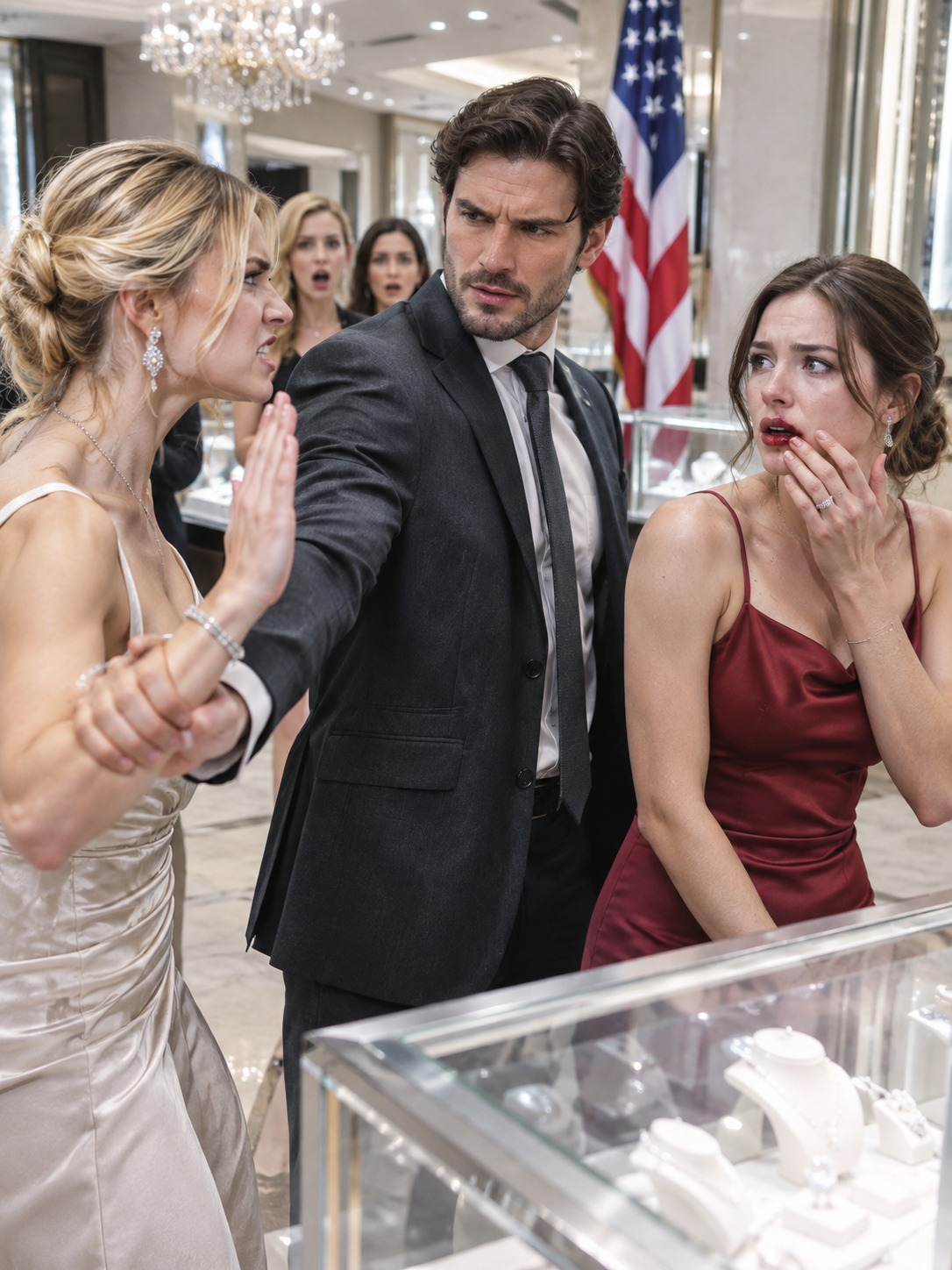
Stellan chose a café two blocks away from Calloway's.
It wasn't particularly large, but it was quiet. The kind of place where executives could sit without being interrupted every thirty seconds by someone asking for a photograph.
He ordered an espresso.
I ordered green tea and asked for a little ice wrapped in a napkin.
The barista glanced at my lip.
"Rough morning?"
"You could say that."
Stellan pulled out a chair.
"Sit down. I'll get the drinks."
I placed my shopping bag beside the chair and lowered myself onto the seat.
For the first time that day, I had an opportunity to examine what had happened.
My cheek was beginning to swell.
My lower lip stung whenever I moved it.
The ice pack was already melting.
I took out my phone and opened the camera.
The mark was visible.
I took several photographs.
Then I photographed the blood on the tissue.
Stellan returned with our drinks.
"Documenting it?"
"Yes."
"Good."
He sat opposite me.
I expected him to ask questions about Fallon.
Instead, he waited until I'd finished taking the photographs.
Then he said, "You handled yourself well."
I put my phone down.
"I didn't do anything."
"Exactly."
I looked at him.
He continued.
"You didn't escalate the situation. You didn't touch her. You didn't give her an excuse to claim you attacked her."
I stared at my tea.
"I've had practice."
"With your sister?"
"With my family."
He didn't ask for details immediately.
That was another thing I appreciated.
Most people heard the word family and assumed they were entitled to the entire story.
Stellan seemed to understand that some things needed to be offered rather than demanded.
I took a sip of tea.
Then I told him a little about Fallon.
She was my older sister.
She was beautiful, charming when she wanted to be, and very good at making people believe that every problem in her life had been caused by someone else.
Our parents adored her.
They paid for her apartment, her leased Porsche, her designer clothes, and nearly everything else she wanted.
She described herself as a freelance event planner.
In reality, she had never developed a consistent business.
I explained that I'd worked for years to build my career at Apex Logistics.
I'd started in an operational support role and moved through increasingly demanding positions.
I'd managed shipping disruptions, negotiated contracts, and spent countless nights trying to keep freight moving when weather, labor disputes, or port congestion threatened entire schedules.
My parents called it a warehouse job.
Fallon called me a box counter.
Stellan listened without interrupting.
When I finished, he set down his espresso.
"My older brother was similar."
I looked at him.
"Really?"
"He was the golden child. My parents believed he could do no wrong. I was the one expected to fix everything."
"What happened?"
"When my first company became profitable, my family started treating the business as though it belonged to them."
"Did you give them money?"
"Initially, yes."
"And then?"
"They began demanding more. I stopped funding them."
I considered that.
"Was it difficult?"
"Very."
He looked directly at me.
"But difficult doesn't necessarily mean wrong."
I held my cup between my hands.
That sentence stayed with me.
I had spent years believing that refusing my family something was cruel.
Even when they took money from me.
Even when they dismissed my achievements.
Even when they left me alone in a hospital after surgery.
Somehow, I was still the person expected to apologize.
Stellan glanced at the shopping bag.
"Those earrings are a good investment."
I smiled faintly.
"They're not exactly an investment."
"Not financially. But I suspect they represent something."
I looked at him.
"What do you think they represent?"
"Your ability to recognize your own achievements."
I didn't answer.
He wasn't wrong.
I had purchased the earrings because I wanted to.
Not because I needed them.
Not because I wanted Fallon to see them.
And certainly not because I needed my parents' permission.
For once, I had made a decision without considering how my family might react.
Then Fallon had appeared and reminded me why that freedom mattered.
Stellan leaned back.
"Can I ask you something?"
"Sure."
"Why didn't you tell your family about your promotion earlier?"
"I tried."
"When?"
"Sunday. At dinner."
"What happened?"
"My sister announced her engagement before I could finish."
He raised an eyebrow.
"Convenient."
"Very."
I explained how I'd arrived at my parents' home with a bottle of Cabernet and a carefully rehearsed announcement.
I had been excited.
Not because of the title alone.
Because of what it represented.
I had spent years proving I could handle responsibilities that many people twice my age struggled with.
The promotion came with a substantial raise, stock incentives, and an office overlooking Baltimore's harbor.
It was the result of years of work.
But when I began speaking, Fallon stood up and announced that Hayes had proposed.
My parents immediately surrounded her.
They examined the engagement ring, discussed the wedding, and congratulated Hayes as though he had personally invented marriage.
I tried to wait.
Eventually, I congratulated her.
Then she accused me of being jealous.
When I attempted to leave, she threw water on me.
My mother worried about Fallon's dress.
My father told me to go home.
Nobody asked why my blouse was soaked.
Nobody asked what I'd wanted to announce.
Stellan's expression became increasingly serious.
"Your sister threw water on you?"
"Yes."
"And your parents blamed you?"
"Yes."
He was silent for several seconds.
"That sounds exhausting."
I let out a quiet breath.
"It is."
I looked through the café window.
People were walking past, carrying shopping bags and talking on their phones.
The world seemed completely ordinary.
It was strange how something could feel so enormous when it happened to you and so invisible to everyone else.
Then Stellan asked about Hayes.
I explained that he ran a small commercial freight brokerage.
He drove an expensive Porsche Panamera and wore a Rolex.
My father considered him a brilliant businessman.
My mother loved introducing him to people.
According to Fallon, Hayes was preparing to expand his company.
Stellan stopped moving his cup.
"What's the name of his brokerage?"
"Sterling Brokerage."
He didn't respond immediately.
I noticed the change in his expression.
"Why?"
"Just confirming something."
"Do you know him?"
"Not personally."
"Is there a problem?"
Stellan looked at me.
"Possibly. But I don't want to speculate."
He opened his briefcase and removed a small notebook.
"One of the accounts currently under review involves a brokerage company called Sterling Brokerage."
My stomach tightened.
"What kind of review?"
"An emergency financial support application."
I frowned.
"Support?"
"Forty-five million dollars in proposed assistance."
I stared at him.
"Forty-five million?"
"Yes."
I almost laughed because the number seemed so absurd.
Hayes had told my father his business was expanding.
He'd spoken about new contracts and opportunities.
Fallon had mentioned that they were planning a wedding that would be more extravagant than anything our family had ever hosted.
And now the company was apparently seeking forty-five million dollars in emergency support.
"Does that mean the business is failing?"
"I can't make that conclusion without reviewing the underlying documents."
"Do you think Hayes knows about it?"
"He's connected to the application. Beyond that, I don't know."
I looked down at the table.
My mind was already moving through the possibilities.
Sterling Brokerage operated in a market that overlapped with Apex's regional freight network.
If the company was experiencing serious financial trouble, it could affect customers, vendors, and contractual commitments.
It was exactly the kind of situation I'd been promoted to help assess.
Stellan seemed to recognize the professional implications.
"There's something else."
I looked up.
"Because you know the applicant personally, you must disclose the relationship to compliance."
"Of course."
"We'll arrange an independent review. I don't want anyone questioning your judgment, and I don't want you placed in a position where personal relationships could compromise your work."
I nodded.
That was reasonable.
I had no intention of using my position to punish Hayes.
If his company was healthy, the financial review would show it.
If it wasn't, the same review would show that too.
The numbers needed to speak for themselves.
"I'll disclose it as soon as I receive the formal information," I said.
"Good."
He closed his notebook.
Then he looked at me with a slightly different expression.
"One more thing, Sutton."
"What?"
"Don't discuss the application with your sister or her fiancé."
I frowned.
"I wasn't planning to."
"Good. Keep it that way."
I nodded.
We finished our drinks.
Before leaving, Stellan asked whether I had someone who could drive me home if the swelling worsened.
I told him I was perfectly capable of driving.
He accepted the answer without argument.
Outside the café, he offered his hand.
"It was good meeting you."
"Under unusual circumstances."
"Certainly."
I smiled.
"Thank you again."
"Take care of yourself, Sutton."
Then he walked toward a waiting black sedan.
I watched him leave.
A moment later, my phone vibrated.
The screen showed my mother's name.
I almost ignored it.
Then another message appeared.
MOTHER:
You need to call me immediately.
I stared at the notification.
A second message followed.
MOTHER:
Fallon told us what you did today.
I felt something cold settle in my stomach.
I opened the conversation.
MOTHER:
How could you embarrass your sister like that?
I read it twice.
Then another message appeared.
MOTHER:
You will apologize to her.
I looked at the photographs I'd taken of my lip.
I looked at the receipt from Calloway's.
Then I typed a response.
ME:
Fallon slapped me. The store has security footage.
Three dots appeared.
Disappeared.
Then appeared again.
MOTHER:
You know how she gets when she's upset. You shouldn't have provoked her.
I closed my eyes.
There it was.
The familiar sentence.
The family explanation for every cruel thing Fallon had ever done.
I shouldn't have provoked her.
I shouldn't have upset her.
I shouldn't have embarrassed her.
I shouldn't have been successful when she wasn't.
I should have known better than to buy expensive earrings.
My phone rang.
Dad.
I answered.
"What?"
His voice was already angry.
"Don't take that tone with me."
"Then don't call me to defend someone who hit me."
"Your sister says you humiliated her in front of her friends."
"She slapped me."
"Because you were being disrespectful."
I stared at the sidewalk.
"Did you see the video?"
"I don't need a video. I know my daughters."
I almost said something.
Then I stopped.
He didn't know me.
Not really.
He knew the daughter who was expected to give in.
He knew the daughter who paid her own bills, avoided asking for help, and quietly accepted being overlooked.
He knew the daughter who could be counted on to forgive everyone.
But he didn't know the woman who had spent years building a career without his approval.
And he didn't know that I was finally tired.
"Your mother wants you at the house on Saturday," he continued.
"Why?"
"To settle this."
"Settle what?"
"Your behavior."
I laughed once.
"My behavior?"
"Don't start."
"She hit me, Dad."
"Enough, Sutton."
His voice became colder.
"You're going to apologize to your sister."
I looked at the shopping bag in my hand.
"No."
There was a long silence.
Then he said something that made my stomach turn.
"If you refuse, don't expect this family to help you when you need us."
I looked up at the sky.
For years, that threat would have frightened me.
Now it sounded almost ridiculous.
"When have you helped me, Dad?"
He hung up.
I stood outside the café for several seconds.
Then I put my phone away and walked toward my car.
I had no idea that the messages would soon become evidence.
I had no idea that my parents were about to make a much bigger mistake.
And I had no idea that, while I was worrying about an argument over a pair of earrings, my aunt was preparing to show me documents bearing my name.
Documents I had never signed.
My phone vibrated one more time.
This time, it wasn't my mother.
It was an unfamiliar number.
The message contained only one sentence.
UNKNOWN NUMBER:
Sutton, this is Aunt Kestrel. Your parents have been hiding something from you, and I think it's time you saw the paperwork.
I stopped walking.
Then a second message arrived.
UNKNOWN NUMBER:
Bring your driver's license. The documents involve your identity.






Comments 0