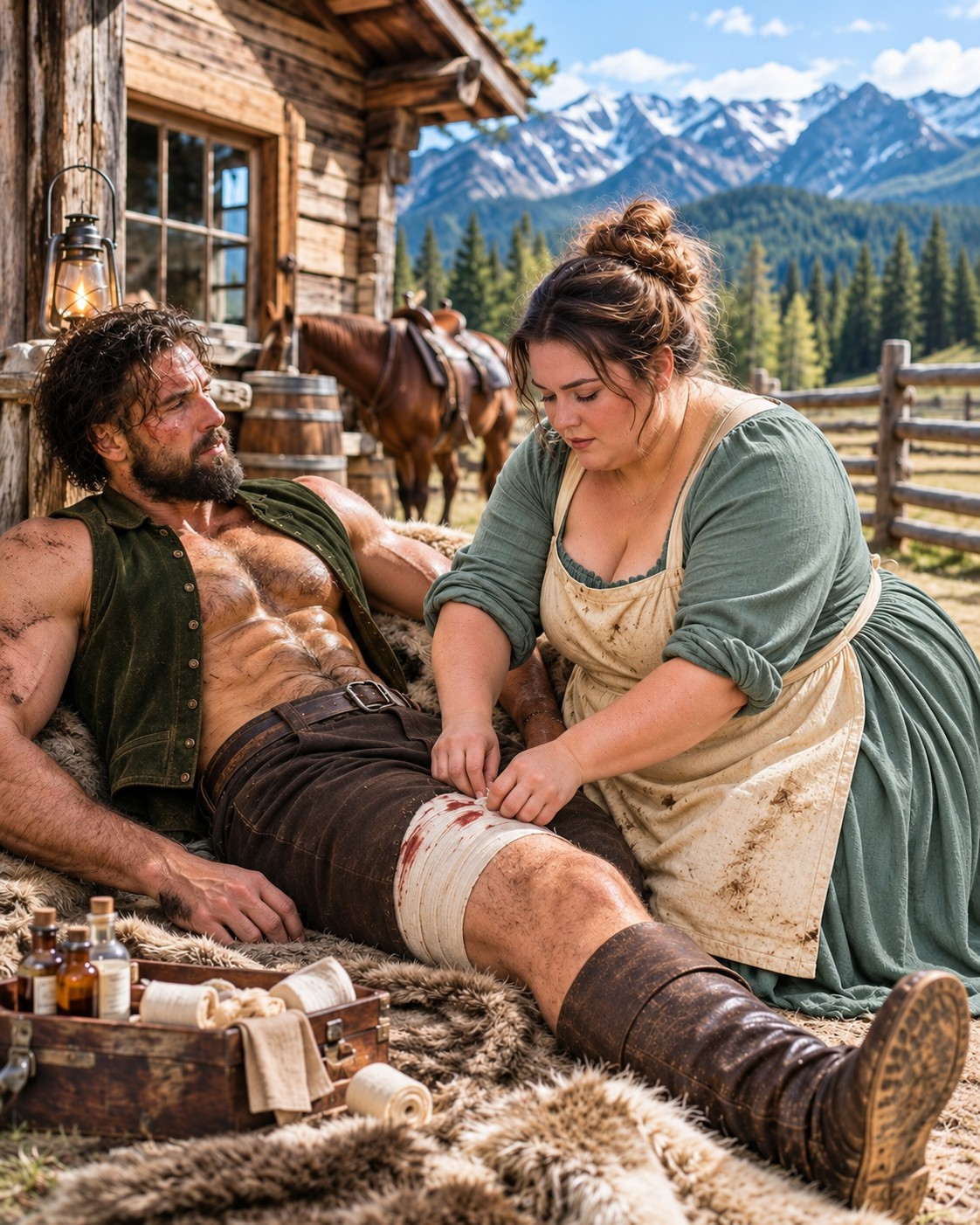
A wounded man collapsed into my arms outside a locked cabin door.
"Don't let them find me!"
When Temperance Hollis caught him, she recognized the blood-soaked trousers of her husband, Bryce Teller.
But something was missing from his leather coat.
A small brass key he had always carried.
And someone was riding toward the cabin.
I was thirty-four years old when I discovered that marrying a stranger could be less frightening than spending another year allowing other people to decide what kind of woman I was allowed to become.
At the time, I did not know that my decision would eventually place me between a wounded husband, a mysterious stranger, and a secret buried beneath the mountains of British Columbia.
I only knew that I needed a different life.
For four years, I had lived in Ashcraftoft, a small timber town where everyone seemed to know everyone else's business. Women were expected to marry respectable men, raise children, keep quiet, and never question decisions made by their husbands.
I had failed at nearly every expectation.
I was outspoken. I was independent. I had a strong appetite and a stronger opinion about how a household should be managed.
And because I was not the delicate, narrow-waisted woman some men preferred, I had learned to recognize the particular silence that followed my entrance into a room.
People rarely insulted me directly.
They simply made certain I understood I wasn't their first choice.
So when I found the marriage advertisement in the Ashcraftoft post office, I read it twice.
"Seeking a wife. Must manage a remote household through a Caribou winter. Must be capable and without complaint. No sentimentality required."
The advertisement was signed by Bryce Teller.
There was no promise of romance.
No description of a handsome husband.
No mention of wealth or comfort.
Just a man looking for someone who could cook, maintain a household, and survive the wilderness.
I found his honesty strangely refreshing.
Mrs. Dunford, the postmaster's wife, watched me remove the notice from the board.
"Temperance, please tell me you aren't considering that."
I folded the paper carefully.
"Why shouldn't I?"
"Because that man lives three miles beyond the last proper road. He barely visits town. His first wife couldn't tolerate the isolation."
"Perhaps she wanted something different."
"Perhaps she knew something about him."
I looked at the advertisement again.
"Then I suppose I'll have to find out."
Mrs. Dunford lowered her voice.
"You're making a terrible mistake."
I smiled faintly.
"No. I'm making my own decision."
Three days later, I boarded a northbound stagecoach.
I carried three changes of clothes, two wool blankets, a little money, and my grandmother's old cedar medicine chest.
That chest was the most valuable thing I owned.
My grandmother had spent forty years helping women deliver children, treating injured laborers, and caring for families who could not afford a physician.
She had taught me to clean wounds, recognize infection, prepare medicines, and remain steady when another person's life depended on my hands.
I had learned more from her than I could ever have learned from the women who spent their afternoons discussing respectable marriages.
Before she died, she had placed the cedar chest in my hands.
"People will underestimate you, Temperance," she had told me. "Don't waste your life trying to convince them otherwise. Learn something useful. Then let your actions speak."
I had carried those words ever since.
The stagecoach journey lasted most of the day.
The farther north we traveled, the fewer houses appeared along the road. Timber grew thicker, hills rose higher, and the settlements gradually disappeared behind us.
The driver, Burket, eventually pulled the horses to a stop beside a narrow mountain track.
"That's as far as I'm taking you."
I looked through the open door.
There was nothing ahead except trees and a muddy path.
"How far?"
"Three miles, maybe a little more. Cross the creek and take the left fork."
He glanced at my luggage.
"Still want to go?"
I tightened my grip on the medicine chest.
"I've come this far."
Burket shook his head.
"You're a stubborn woman."
"That's what I've been told."
He helped me unload my belongings before driving away.
I stood alone for several seconds, listening to the fading sound of the stagecoach.
Then I lifted my bags and started walking.
The journey was harder than I expected.
The path climbed through thick pine forest, crossed a narrow creek, and twisted between enormous rocks. My boots slipped several times, and the cedar chest became painfully heavy.
But I continued.
By late afternoon, I finally saw smoke rising above the trees.
Beyond a small clearing stood a lonely log cabin overlooking a broad mountain valley.
It was larger than I had imagined.
A small barn stood beside it, with a fenced paddock and several horses grazing nearby.
There was a woodpile stacked neatly against the cabin wall.
Everything suggested a man who knew how to survive.
Nothing suggested a man who knew how to welcome someone home.
I climbed the steps and knocked.
The door opened almost immediately.
A tall, broad-shouldered man stood in the doorway.
He had dark brown hair, a thick beard touched with gray, and steady brown eyes that seemed to examine everything without revealing much about himself.
He looked at my luggage.
Then his gaze settled on the cedar chest.
"What's that?"
"My grandmother's medicine chest."
"I asked for a wife who could cook."
"And I can cook."
I adjusted the strap across my shoulder.
"But the chest stays."
For a moment, he simply studied me.
Then he stepped aside.
"Come in."
That was how I met Bryce Teller.
The cabin was clean, but painfully bare.
There were no curtains at the windows, no photographs on the walls, and no decorative objects except a small folded handkerchief resting on the mantel.
It was yellowed with age.
Someone had folded it carefully into a perfect square.
I noticed it immediately.
But I didn't ask about it.
Bryce showed me the sleeping corner, separated from the main room by a heavy curtain.
"You'll sleep there. Meals are at six. I work during the day."
I placed my luggage beside the bed.
"What have you been eating?"
"Dried meat. Biscuits."
"For how long?"
He shrugged.
"A while."
I looked around the cabin.
There were sacks of flour, dried beans, and several baskets of root vegetables. A few pieces of venison hung in the storage area.
The supplies were sufficient.
The problem was that nobody had bothered turning them into proper meals.
I rolled up my sleeves.
"Then supper will be ready at six."
Bryce looked at me as though he wasn't certain whether I was serious.
I was.
I spent the next two hours organizing the kitchen, washing vegetables, checking the flour, and preparing venison stew with mushrooms and autumn turnips.
The cabin slowly filled with the smell of cooking.
When Bryce returned, he stopped in the doorway.
He looked at the table.
Then at the steaming bowl I placed before him.
He sat down without saying anything.
I watched him take the first spoonful.
Then another.
He ate quietly, but when I returned with more bread, I noticed that his expression had changed.
He looked almost uncomfortable.
"Something wrong?"
He shook his head.
"No."
He finished the bowl and accepted a second helping.
Finally, he put down his spoon.
"That's the first proper meal I've had since..."
His voice faded.
I glanced briefly toward the folded handkerchief on the mantel.
"Since some time," I finished gently.
He nodded.
I didn't press him.
Over the next two days, we developed a routine.
Bryce left early to inspect his timberland, check traps, and care for the horses.
I cleaned the cabin, organized supplies, prepared meals, and began making the place feel less like a temporary shelter.
He never complained about my cooking.
He never commented on my appearance.
He never questioned how much I ate.
More importantly, he never treated me as though I had come to the mountains simply to serve him.
When he returned from work, he carried wood inside without being asked.
If I needed something heavy moved, he did it.
When I mentioned that the kitchen window let in too much cold air, he repaired the frame the following morning.
His kindness was quiet.
It was not romantic, exactly.
But it was respectful.
And after years of being treated as though my opinions were inconveniences, respect felt like a gift.
On the second evening, I found him standing beside the mantel.
His fingers rested near the little yellowed handkerchief.
He noticed me watching.
"Was it your wife's?" I asked.
His expression changed.
For a moment, I thought he might refuse to answer.
"Yes."
I waited.
"She left a long time ago."
"I'm sorry."
He nodded and returned the handkerchief to its original position.
I understood that the conversation was over.
That night, I lay beneath the heavy wool blankets and listened to the wind moving through the pine trees.
I thought about the life I had left behind.
For the first time in years, I didn't feel as though I needed to apologize for taking up space.
I had a roof over my head.
Work that mattered.
A husband who treated me with consideration.
Perhaps this marriage would never become a grand love story.
Perhaps it didn't need to.
On the third evening, I prepared a simple dinner and placed two bowls on the table.
Bryce returned later than usual.
He seemed distracted.
When I asked whether everything was all right, he only said that he had work to finish on the eastern slope.
I noticed a small scrape on his right hand.
He washed it without explanation.
Then he ate dinner almost without speaking.
Before going to bed, he checked the front door twice.
I found that unusual.
But I said nothing.
At nine o'clock, I was folding a clean linen cloth when something struck the front door.
It wasn't a polite knock.
It sounded like a heavy object hitting the wood.
I hurried across the room and pulled the door open.
Bryce was standing outside.
His face was deathly pale.
His right trouser leg was soaked in blood from the knee downward.
For one terrible second, neither of us moved.
Then his knees buckled.
"Bryce!"
I caught him beneath his arms, but his weight nearly dragged me to the floor.
"Close the door," he whispered.
I managed to pull him inside and shut it.
He was breathing hard.
His fingers clutched my sleeve.
"Don't let anyone know I'm here."
I stared at the blood spreading across his trousers.
"You're bleeding badly."
He looked toward the dark window.
Then he tightened his grip around my wrist.
"Temperance, promise me."
Before I could answer, a distant horse whinnied beyond the trees.
Bryce's expression changed.
And when I followed his gaze toward the window, I saw the unmistakable shadow of a rider moving through the darkness...






Comments 0