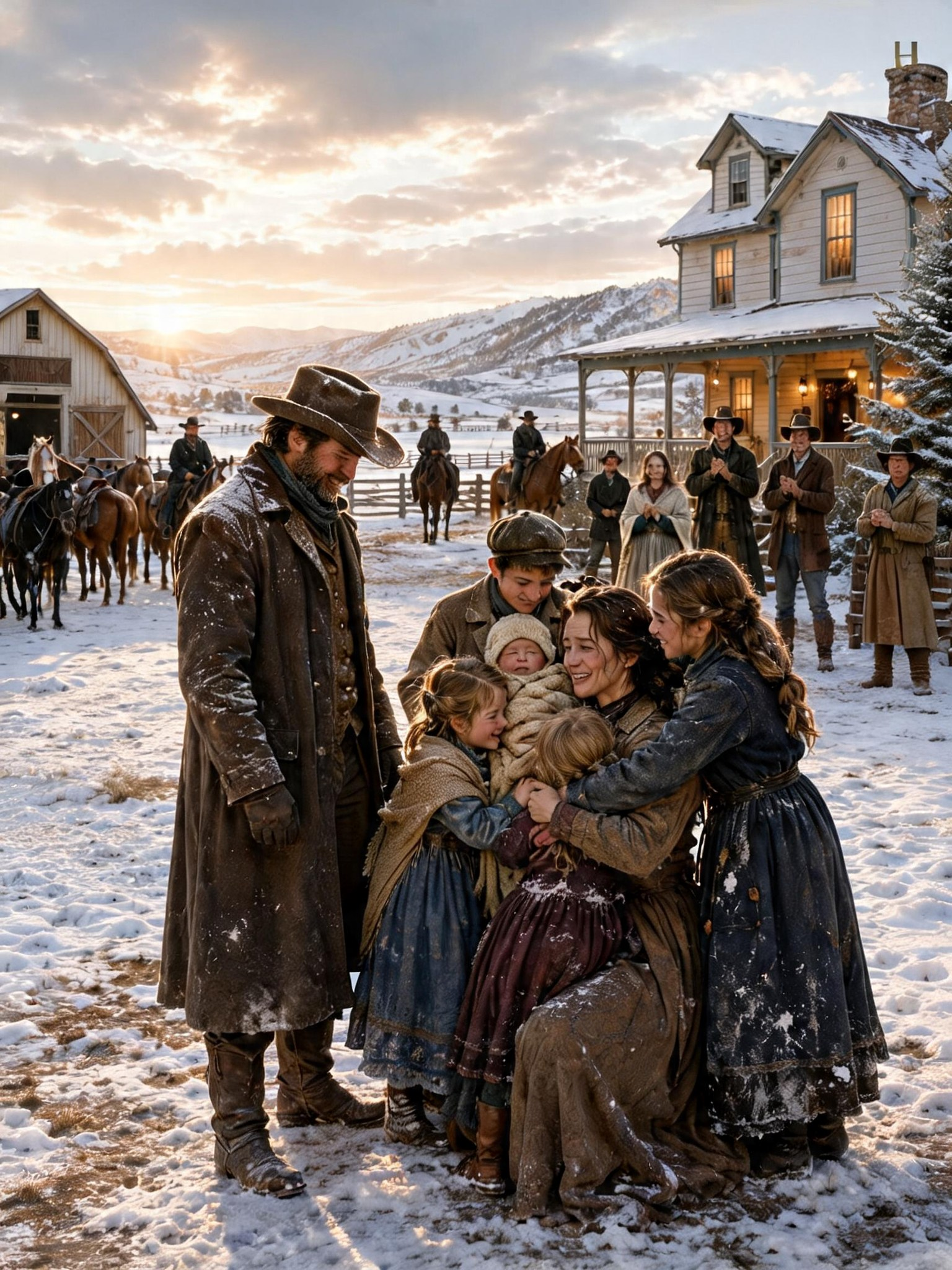
Mason Reed lifted the old rifle from above the fireplace.
"Nobody moves," he said.
The five children stared at him.
Ruthie pulled Nell closer against her chest. Ben immediately moved in front of his younger sisters, his small shoulders squared as though he could somehow protect them from whatever waited outside.
Mason noticed the boy's movement.
Ten years old.
Already standing like a man who expected trouble.
"Ben," Mason said quietly. "Take your sisters into the kitchen."
"I'm staying here."
"That's not what I asked you to do."
"I'm not leaving Ruthie."
For a moment, Mason studied him.
He remembered another child who used to argue with him about everything. Emily had once refused to go to bed until he promised to check beneath her bed for wolves.
He had searched every corner of her bedroom with a lantern, pretending to be frightened of the imaginary creatures.
She had laughed until she hiccupped.
The memory struck him unexpectedly.
He looked away.
"Then stay behind your sister. Both of you keep away from the windows."
Ben nodded.
Mason approached the front door.
The old wooden floor creaked beneath his boots.
He stopped beside the window and carefully moved the curtain aside.
Outside, the storm had weakened slightly, but the wind still pushed loose snow across the yard.
The barn stood approximately fifty yards from the farmhouse.
A lantern hung beside its entrance.
Its flame flickered.
Mason could see the fresh hoofprints leading toward the building.
There were no tracks leading back to the road.
Someone had ridden onto his property.
Someone had dismounted.
And someone was still out there.
He lowered the curtain.
"Stay inside," he said.
Then he opened the door.
Cold air rushed into the farmhouse.
The first thing Mason noticed was the silence.
The second was the smell.
Horse sweat.
Wet leather.
And something faintly metallic.
He stepped onto the porch with his rifle held low.
He had lived on this ranch long enough to understand the difference between ordinary winter noises and something that did not belong.
A loose shutter sounded different from a boot scraping against frozen wood.
A frightened horse sounded different from one that had been deliberately restrained.
The horses in the stable were restless.
Mason could hear them shifting their weight.
He walked down the porch steps.
Snow crunched beneath his boots.
The barn lantern flickered again.
"Who's there?" he called.
No answer.
Mason stopped.
He waited.
A gust of wind swept across the yard, carrying a cloud of powdery snow between him and the barn.
Then he heard it.
A horse snorted.
Not one of his.
Mason raised the rifle.
"Show yourself."
Something moved behind the barn.
He took two careful steps forward.
Then another.
His mind returned to Ben's words.
A man in a brown coat.
A black horse.
Someone who stood outside the Whitfield property and counted children.
Mason had spent five years avoiding other people's troubles.
He had refused invitations, ignored gossip, and stopped asking questions about anything that did not concern his livestock.
But five freezing children had walked onto his property.
One of them had nearly died in his arms.
Whatever had driven them through that storm was no longer somebody else's problem.
Mason reached the barn.
The large wooden door was partly open.
He pushed it with his boot.
Inside, the smell of hay and animals was thick.
His horses shifted nervously in their stalls.
A lantern hung from a wooden beam.
And beside the far wall stood a black horse.
Mason recognized the animal immediately.
It belonged to a man who had no business being on his ranch.
He approached slowly.
The horse wore a dark leather saddle.
Its reins had been tied to a wooden post.
There was fresh snow melting along its back.
The rider had been there recently.
Mason examined the saddle.
A small brass ornament had been attached near the stirrup.
It bore two initials.
C.W.
He frowned.
The initials meant nothing to him.
Then he noticed something beneath the saddle blanket.
A piece of folded paper.
Mason pulled it free.
It was damp around the edges.
Someone had written a number across the outside.
Five.
He unfolded the paper.
Inside was a crude list.
Five separate marks.
Five names.
Ruthie.
Ben.
Millie.
Grace.
Nell.
Mason stopped breathing for a moment.
The names were written in a neat, deliberate hand.
Below them was another sentence.
All five accounted for.
He stared at the paper.
The man had not simply followed the children.
He had known exactly who they were.
And he had been keeping track of them.
A sound came from behind him.
Mason spun around, raising the rifle.
Nothing.
Only the horses.
He waited several seconds before lowering the weapon.
Then he heard a faint creak from the loft.
Someone was above him.
Inside the farmhouse, Ruthie could not stop looking at the front door.
Mason had been gone for several minutes.
The fire crackled.
Nell slept against her chest, occasionally making small sounds.
Millie sat beside Grace beneath a thick blanket.
Ben stood near the kitchen doorway.
He had not eaten his broth.
He had not taken off his boots.
He kept staring toward the window.
"Ben," Ruthie whispered.
He turned.
"What?"
"Sit down."
"I don't want to."
"You're shaking."
"So are you."
Ruthie looked away.
He was right.
Her hands were trembling so badly that she had to adjust the baby's blanket twice.
She had spent the entire night telling herself that everything would be all right.
She had told Millie the snow would stop.
She had told Grace that Mama would find them.
She had told Ben that they would reach a house before Nell became too cold.
Every promise had been made because the children needed to hear it.
But Ruthie had no idea whether any of those promises would come true.
She looked down at Nell.
The baby was breathing.
That was enough for the moment.
"Do you think he's coming back?" Millie asked.
Ruthie forced herself to nod.
"Of course."
"He's got a gun."
"He's protecting the ranch."
"From the man?"
Ruthie looked at her.
Millie lowered her eyes.
The little girl had heard everything.
"Don't worry about that," Ruthie said.
Millie pulled the blanket closer.
"That man was at our house."
Ruthie's stomach tightened.
Ben turned sharply.
"Millie."
The seven-year-old looked frightened.
"What?"
"Don't talk about him."
"But he—"
"Ben," Ruthie interrupted.
Her brother looked at her.
She knew he was trying to protect Millie.
But there was something else in his expression.
Something he did not want her to know.
"Why are you telling her not to talk?" Ruthie asked.
Ben shook his head.
"Because she doesn't understand."
"Then explain it."
He looked toward the front door.
"I can't."
Ruthie stared at him.
Before she could say anything else, Grace spoke.
It was the first time she had said a word since entering the farmhouse.
"He's coming back."
Everyone turned toward her.
Grace was staring at the window.
"Who?" Ruthie asked.
The little girl did not answer.
She simply pulled the blanket over her knees and looked toward the door.
Mason climbed the ladder to the barn loft.
He moved slowly.
The old boards creaked beneath his boots.
The rifle remained in his hands.
At the top, he stopped.
The loft was empty.
Stacks of hay were arranged against the back wall.
A few old tools hung from wooden pegs.
Snow had blown through a crack in the roof, leaving a thin white line across the floor.
Mason examined the space.
Then he noticed the window.
It was open.
Not wide.
Just enough for someone to climb through.
Fresh scratches marked the wooden frame.
Someone had entered or exited through it.
Mason stepped closer.
On the windowsill lay a small object.
A child's ribbon.
Lavender.
He picked it up.
The fabric was worn and slightly frayed.
He turned it over.
There was a tiny embroidered letter on one end.
G.
Mason thought of Grace.
He looked down toward the farmhouse.
The little girl had worn a lavender scarf.
Could the ribbon belong to her?
He examined the loft again.
A few loose strands of pale hair were caught against a splintered board.
Mason's jaw tightened.
Someone had been inside the barn before the children arrived.
Possibly following them.
Possibly waiting for them.
He descended the ladder.
As he reached the ground, one of the horses suddenly pulled against its reins.
Mason turned.
The black horse was looking toward the open door.
Its ears were raised.
Outside, a shadow moved across the snow.
Mason rushed toward the entrance.
He reached the doorway just in time to see a figure disappearing beyond the fence.
Tall.
Wearing a brown coat.
The man turned his head.
For a brief second, Mason saw his face.
Then the figure vanished behind the trees.
Mason raised his rifle.
He could have fired.
But the distance was too great, and the storm made the shot uncertain.
He lowered the weapon.
The man had wanted him to see him.
That much was clear.
Mason looked down at the paper in his hand.
Five names.
Five children.
All accounted for.
His fingers tightened around the page.
"Not anymore," he muttered.
When Mason returned to the farmhouse, he found Ben standing near the door.
The boy had a fireplace poker in his hands.
Mason raised an eyebrow.
"Planning to fight someone with that?"
Ben did not smile.
"Where were you?"
"Checking the barn."
"Did you see him?"
Mason closed the door.
"Yes."
Ben's face went pale.
"Was he wearing a brown coat?"
Mason looked at him.
"How do you know that?"
Ben swallowed.
"Because that's what he always wears."
Ruthie stood up.
"Ben, what is going on?"
Her brother looked at Mason.
Then back at his sister.
"I told you. He's been watching us."
"Why?"
Ben shook his head.
"I don't know."
Mason took the folded paper from his coat pocket.
"Is this handwriting familiar?"
Ben stared at the page.
His expression changed immediately.
"Where did you find that?"
"Under the saddle blanket of the black horse."
Ben stepped closer.
His eyes moved over the names.
Then he stopped at the bottom.
All five accounted for.
He looked as though someone had struck him.
"That's his writing," he whispered.
Ruthie came forward.
"What does it mean?"
Ben did not answer.
Mason unfolded the paper completely.
"Tell me everything."
Ben looked at the floor.
For several seconds, the only sound in the room was the crackling fireplace.
Then he spoke.
"The first time I saw him, he was standing outside our fence."
"When?"
"Three weeks ago."
"What did he do?"
"He counted us."
Mason waited.
"Every morning, when we went outside, he stood by the road. Sometimes he was on his horse. Sometimes he was walking."
"Did he speak to your mother?"
Ben nodded.
"She told him to leave."
"Did he?"
"Not always."
Ruthie closed her eyes.
She remembered those mornings.
Her mother standing on the porch with her hands clenched.
Her mother telling the children to go inside.
Her mother looking over her shoulder whenever a horse passed the property.
At the time, Ruthie had thought it was because of a disagreement over money.
Now she was not so sure.
"Why didn't you tell me?" she asked Ben.
He looked at her.
"Because Mama told me not to."
Ruthie felt something twist inside her chest.
"She told you not to tell me?"
"She said I had to keep everyone together."
"And you thought you had to do that alone?"
Ben's eyes filled.
He quickly looked away.
"I was trying."
Ruthie reached for his hand.
"I know."
For the first time since the storm began, Ben allowed himself to look like a frightened child.
His shoulders dropped.
He leaned against her.
Mason watched them.
He understood something about grief.
It could make a person believe that needing someone was a weakness.
It could convince a child that crying was a luxury.
He had spent five years living that way.
And he was looking at two children who had learned the same lesson much too young.
"Listen," he said.
Both children looked at him.
"Whatever happened before you reached this ranch, you're safe here tonight."
Ben's expression remained uncertain.
"What about tomorrow?"
Mason looked toward the window.
The storm was still moving across the valley.
"Tomorrow, we'll find out who that man is."
A little later, Ruthie carried Nell into the kitchen.
The infant had begun stirring again.
Mason showed her how to prepare a small amount of warmed milk.
He watched carefully while she tested the temperature.
"Not too hot," he reminded her.
"I know."
"You've done this before?"
Ruthie nodded.
"Mama showed me."
Mason leaned against the counter.
"How old was Nell when your mother taught you?"
"Three months."
"That's very young to be caring for a baby."
Ruthie looked down.
"Someone had to help."
Mason did not argue.
He remembered how Clara used to hold Emily while preparing breakfast.
How she would sing softly when the little girl refused to sleep.
The farmhouse kitchen had once been full of ordinary sounds.
Now it was filled with unfamiliar children.
Yet he found himself listening for them.
The scrape of Ben's chair.
Millie's quiet coughing.
Grace moving near the hearth.
Nell's tiny breaths.
It was strange.
He had spent years believing that silence was what he needed.
But the silence had never brought him peace.
It had only given his memories more room.
"Did your mother ever say where she was going that morning?" he asked.
Ruthie shook her head.
"She said she had to settle something."
"With whom?"
"She wouldn't tell us."
"Did she leave anything behind?"
Ruthie hesitated.
"Her coat."
Mason looked at her.
"Her coat?"
"She went outside wearing her blue shawl. But her winter coat was still hanging by the door."
"Was she dressed warmly?"
"No."
Mason frowned.
The temperature had been falling for days.
No sensible woman would walk toward a frozen creek without a proper coat unless she had a reason.
"Did she take a horse?"
Ruthie shook her head.
"She walked."
"Did she take money?"
"I don't know."
"Did she leave a note?"
Ruthie stopped stirring the milk.
Then she looked at him.
"There's something."
Mason waited.
Ruthie lowered her voice.
"Mama told me that if she wasn't home by supper, I had to take the children to Aunt Margaret's."
"Did you?"
Ruthie nodded.
"We tried."
"What happened?"
Her expression changed.
"Her house was empty."
"Empty?"
"Nobody was there. The door was locked, and the windows were covered."
Mason considered that.
"Did your mother tell you where your aunt might be?"
"No."
"Did you see anyone?"
Ruthie looked toward the hallway.
"Yes."
Mason's attention sharpened.
"Who?"
"The man with the brown coat."
She swallowed.
"He was standing across the road."
Mason straightened.
"What did he do?"
"He looked at us."
"Did he approach?"
"No."
"Then what?"
Ruthie's voice became very quiet.
"He counted us again."
Mason felt the folded paper in his pocket.
He thought of the horse in the barn.
The ribbon in the loft.
The footprints outside.
Something was happening in the valley.
Something that had started long before the children arrived at his ranch.
And their mother had known enough to be frightened.
By evening, the snow had begun falling more heavily.
Mason brought additional firewood inside.
He checked the windows and secured the back door.
Then he made a simple supper.
Bread.
Potatoes.
Warm broth.
The children ate quietly.
Millie fell asleep halfway through her meal.
Grace sat with her hands wrapped around a cup of water.
Ben ate only after Mason placed a second piece of bread on his plate.
Ruthie watched everything.
She was not accustomed to receiving food without being asked to earn it.
When Mason noticed her staring at the bread, he placed another piece beside her bowl.
"There's more in the kitchen."
She looked at him.
"Why are you doing this?"
Mason paused.
"Doing what?"
"Helping us."
He considered the question.
He could have given her an easy answer.
Because it was the right thing.
Because nobody should freeze.
Because her baby sister needed help.
But something about the girl's expression made him want to tell the truth.
"Because I know what it feels like to lose someone," he said.
Ruthie lowered her eyes.
"Did you lose your family?"
Mason looked toward the empty chair beside the fireplace.
"Yes."
"Your wife?"
"And my daughter."
Ruthie was silent.
"I'm sorry."
Mason nodded.
He did not want sympathy.
He had spent five years avoiding it.
But the girl said something that caught him completely off guard.
"Then you know why I can't give up on Mama."
Mason looked at her.
For a moment, he had no answer.
He had assumed that the children were frightened because their mother was missing.
He had not fully understood that Ruthie still believed she could find her.
And perhaps she was right.
Perhaps their mother was alive somewhere in the valley.
Perhaps she was waiting for someone to come looking.
Mason glanced toward the window.
He remembered the man disappearing beyond the fence.
He remembered the five names.
And he remembered the little leather shoe.
"Tell me something," he said.
Ruthie looked up.
"Did you find both your mother's shoes?"
She shook her head.
"Only one."
"Where was the other?"
"We don't know."
Mason nodded slowly.
Then Ruthie added something.
"It was strange."
"What was?"
"The shoe we found was beside the creek. But Mama's footprints went the other way."
Mason stopped moving.
"What do you mean?"
Ruthie leaned closer.
"We followed the tracks. They went toward the trees."
"And?"
She swallowed.
"They stopped."
"Stopped?"
"There were no more footprints after the big rocks."
Mason looked at Ben.
The boy nodded.
"I saw it too."
"Could the snow have covered them?"
"No," Ben replied. "We checked."
Mason stared at the fireplace.
Someone had been at the creek.
Someone had left a shoe.
And someone had made sure the children would find it.
He stood.
"Where exactly was the shoe?"
Ruthie pointed toward the western side of the valley.
"Near the old crossing."
Mason knew the place.
It was an isolated stretch of water where the creek narrowed between two rocky banks.
A rider could approach from the northern trail without being seen from the main road.
Mason looked at the children.
"Tomorrow, if the weather allows, I'll go there."
Ruthie immediately stood.
"I'm coming."
"No."
"But—"
"You've had enough for one day."
"I need to find my mother."
"I understand."
"No, you don't!"
Her voice cracked.
Everyone became silent.
Ruthie looked at him with tears in her eyes.
"You don't understand. She's all we have."
Mason absorbed the words.
Then he lowered his voice.
"I lost my wife and daughter. I know what it means to wake up and find the people you love aren't there."
Ruthie's anger softened.
"But you still have to eat," he continued. "You still have to sleep. And you still have to keep breathing."
She looked down.
Mason placed another log on the fire.
"I'll look for her."
Later that night, Mason prepared the small guest room for Ruthie and the baby.
He brought fresh blankets from a cupboard.
The room had not been used in years.
It was across the hall from the locked bedroom where Emily's belongings remained.
Mason stood outside that door for a long time.
His hand rested on the brass handle.
He could still picture his daughter running through the hallway.
He could still hear her asking him to read the same story twice.
He had not entered her room since the funeral.
Tonight, he almost did.
But then Nell made a small sound from the guest room.
Mason turned.
Ruthie was struggling to settle the infant.
"Does she need something?" he asked.
"She's cold again."
He approached.
He checked the blankets and helped Ruthie adjust them.
"Keep her close. We'll keep the room warm."
Ruthie nodded.
Mason started toward the doorway.
"Mister Reed?"
He stopped.
"Yes?"
"Thank you for not leaving us outside."
Mason looked at her.
He wanted to say that she did not need to thank him.
Instead, he simply nodded.
"Get some sleep."
He closed the door gently.
For several minutes, he stood in the hallway.
Then he heard something.
A faint scratching sound.
It came from the front door.
Mason froze.
The sound came again.
Three slow scratches.
He moved toward the living room.
He picked up the rifle.
The children were asleep.
He approached the front window and looked through a narrow opening in the curtain.
Nobody stood on the porch.
But something had been left on the top step.
A small envelope.
Mason opened the door just far enough to retrieve it.
He brought it inside.
There was no name on the outside.
Only a single sentence written in dark ink.
You should have let those children freeze.
Mason read it twice.
Then he turned the envelope over.
Something small slipped onto the floor.
A photograph.
It showed five children standing outside a wooden house.
Ruthie.
Ben.
Millie.
Grace.
And baby Nell.
The picture had been taken before the storm.
On the back was another message.
Now that you have all five, you can tell me where their mother hid it.
Mason's blood ran cold.
He looked toward the guest room.
Then toward the locked bedroom at the end of the hallway.
And suddenly, someone knocked on the back door.
Not once.
Not twice.
But three times.
Mason raised his rifle.
A woman's voice came through the darkness.
"Mason Reed?"
He recognized it immediately.
It belonged to someone he had not heard from in nearly five years.
Then the woman spoke four words that made him lower his weapon.
"Clara is still alive."
And behind her, someone else was standing in the snow.






Comments 0