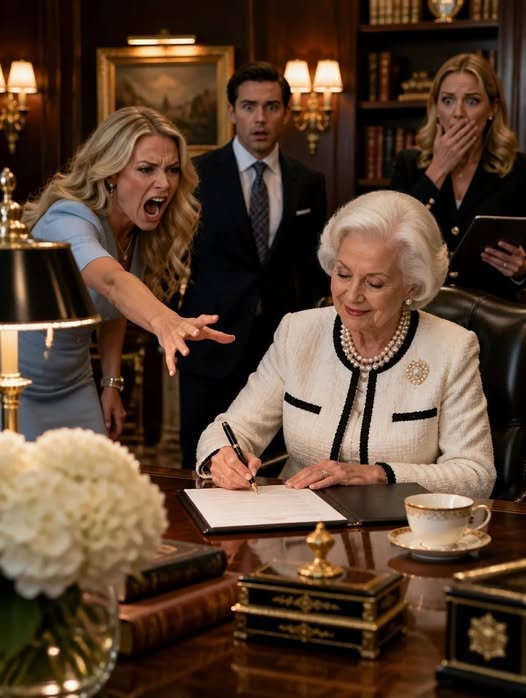
"Don't open that door, Margaret!"
The warning came from the telephone in my hand.
At the same moment, the stranger standing on my porch knocked again.
"Mrs. Kelley, I'm Daniel Mercer. I need to speak with you about your husband's estate."
I looked at the phone.
The man I had been speaking with for nearly an hour was still connected.
Then I looked at the front door.
Two men.
One name.
And somewhere between them was a secret my husband had carried to his grave.
I pressed the phone closer to my ear.
"Mr. Mercer," I whispered, "who is standing outside my house?"
"I don't know," he answered. "But I am sitting in my office, and I haven't left this building all morning."
My fingers tightened around the receiver.
The stranger knocked a third time.
"Mrs. Kelley? I know you're inside."
Evelyn stood beside the fireplace, holding her cane with both hands.
Her face had lost nearly all its color.
The little recording device remained inside Thomas's metal box.
Its red light blinked steadily.
I could still hear my husband's voice in my mind.
The woman we buried was not Evelyn Hartley.
For eleven years, I had believed I knew what happened at that funeral.
Now I wasn't certain I knew anything.
"Margaret," the real Daniel said, "move away from the door."
I took one step backward.
"Should I call the police?"
"Yes. Tell them someone has entered your property claiming to be your attorney, and you have reason to believe he's misrepresenting himself."
I looked toward the front window.
The stranger stood beneath the porch light.
He was perhaps sixty years old, with neatly combed gray hair, a charcoal suit, and polished black shoes.
He carried a black leather briefcase.
He looked respectable.
That was what frightened me.
Nothing about him suggested danger.
He looked like the kind of man Thomas would have invited into our dining room to discuss retirement accounts over coffee.
I had spent most of my life trusting people who looked respectable.
I was beginning to understand how little that meant.
"Mrs. Kelley," the stranger called, "this is an urgent legal matter."
I didn't answer.
Instead, I moved into the kitchen and dialed the police department from the landline.
The dispatcher listened while I explained the situation.
I told her that a man was outside claiming to be an attorney, that the actual attorney was speaking with me by phone, and that I was an elderly woman at home with another elderly guest.
She asked whether the stranger had threatened us.
"Not directly," I said.
"Has he attempted to enter?"
"Not yet."
"Keep the doors locked. An officer will be sent to check the situation."
I thanked her.
Then I returned to the living room.
The stranger was still there.
He had stopped knocking.
Now he was speaking into his own phone.
I couldn't hear the conversation.
But I noticed something.
He kept looking toward the driveway.
As though he were waiting for someone.
Evelyn moved closer.
"Margaret, I think I've seen that man before."
I turned.
"Where?"
She narrowed her eyes.
"I'm not certain."
"Take your time."
She leaned against the back of the armchair.
"I remember someone who looked like him visiting the retirement community in Arizona."
My heart began beating faster.
"When?"
"Last spring, perhaps. Or early summer."
"Did he speak to you?"
She shook her head.
"No. But he spoke to the administrator."
I looked toward the porch.
The stranger turned slightly, revealing his profile.
Evelyn inhaled sharply.
"Oh, dear God."
"What?"
She stared at him.
"That's him."
"Who?"
"The man who asked whether I still had family in Ohio."
I felt cold.
Evelyn had lived in Arizona for years.
She had told me that someone eventually contacted her through the retirement community.
Genevieve claimed there had been a misunderstanding about Evelyn's death.
Now a stranger had apparently been asking questions about her months earlier.
"Did he give you his name?" I asked.
Evelyn shook her head.
"The administrator told me he represented a family legal office."
"Did he say which one?"
"I don't remember."
I looked at the telephone.
"Daniel, did your firm send anyone to Arizona looking for Evelyn Hartley?"
"No."
"Are you certain?"
"Absolutely."
I told him what Evelyn remembered.
He was silent for several seconds.
Then he asked, "Mrs. Hartley, did the man request any documents?"
Evelyn looked toward the phone.
"Yes."
My stomach tightened.
"What documents?" Daniel asked.
"Copies of my identification. My old marriage certificate. Some records from when I moved."
I stared at her.
"Did you give them to him?"
She looked ashamed.
"The administrator said it was part of an estate inquiry."
I sat down slowly.
I remembered Clara's words.
The questionable authorization contained identification details associated with Evelyn's name.
Now I knew one possible way those details might have been obtained.
Daniel spoke carefully.
"Mrs. Hartley, please don't blame yourself. We need to establish exactly what was requested and who received it."
Evelyn nodded.
But her hands were trembling.
Outside, the stranger began walking toward his car.
For a moment, I thought he was leaving.
Then he stopped beside the driver's door.
He looked toward my house.
And smiled.
Not a friendly smile.
A small, knowing smile.
As though he understood something I didn't.
Then he got into the sedan.
The engine started.
The car pulled away.
I watched until it disappeared around the corner.
Only then did I realize I had been holding my breath.
The police officer arrived fourteen minutes later.
His name was Officer James Porter.
He was a broad-shouldered man in his early forties, with a calm manner and a notebook that looked as though it had survived several years in his uniform pocket.
I explained what had happened.
I showed him the photograph I had taken of the stranger through the window.
I also showed him the messages from Benjamin and Genevieve.
Officer Porter listened without interrupting.
When I finished, he asked, "Mrs. Kelley, do you believe this man intended to harm you?"
I considered the question.
"I don't know."
"Has anyone threatened you over these documents?"
"Not in so many words."
He nodded.
"Then let's focus on what we can establish."
I liked that.
Facts.
Not assumptions.
He recorded the stranger's description and the vehicle's approximate make and color.
I hadn't seen the license plate clearly.
That annoyed me.
Thomas had always been good at remembering license plates.
He could glance at a car once and recall the numbers hours later.
I had never understood how he did it.
Officer Porter asked whether I had security cameras.
"No," I admitted.
"Would you consider installing one?"
"Yes."
He looked toward the kitchen.
"Does anyone else have a key?"
"My son."
"Anyone else?"
"Possibly my daughter-in-law."
I felt embarrassed saying it.
I had allowed people to enter my home without knowing exactly who possessed a key.
Officer Porter didn't judge me.
He simply wrote it down.
"I recommend changing the locks today."
"I already intended to."
"Good."
Before leaving, he gave me a case number and explained how to contact the department if the stranger returned.
Then he looked at the folder on my table.
"Mrs. Kelley, financial disputes within families can become complicated. Keep copies of everything, and don't let anyone pressure you into signing documents."
I nodded.
"Thank you, Officer."
He smiled kindly.
"Take care of yourself."
After he left, I locked the door.
Then I checked it twice.
I had never been a nervous woman.
But I was beginning to feel like a stranger in my own house.
At 12:47, Eleanor arrived.
I had called her while the officer was still taking notes.
She came carrying a paper bag from the little bakery near her house.
Inside were two chicken sandwiches and a slice of lemon cake.
"I brought lunch," she announced. "And before you argue, you're going to eat it."
I almost cried.
Not because of the food.
Because she had come without asking what I could do for her.
She simply came.
I hugged her.
She held me for a moment longer than usual.
Then she stepped back and studied my face.
"Margaret, you look exhausted."
"I feel exhausted."
"Good. That means you're still human."
I laughed.
It was the first genuine laugh I'd had since Benjamin's message.
Eleanor noticed Evelyn sitting near the fireplace.
Her smile disappeared.
For several seconds, she simply stared.
Then she whispered, "Evelyn?"
Evelyn rose slowly.
"Hello, Eleanor."
Eleanor dropped the bakery bag.
The sandwiches slid across the floor.
"Oh, my Lord."
I caught her arm.
"Sit down."
She didn't.
Instead, she walked toward Evelyn.
She touched her shoulder.
Then her cheek.
As though checking whether she was real.
"But we buried you," Eleanor whispered.
Evelyn's eyes filled.
"I know."
Eleanor looked at me.
"Margaret, what in heaven's name is happening?"
I sighed.
"That's what we're trying to find out."
We spent the next hour talking.
Eleanor listened as Evelyn described her years in Arizona.
She listened as I explained the suspicious authorization and Thomas's letter.
She examined the photograph of Thomas and Evelyn in the hospital.
Then she sat very still.
"Margaret," she said, "I remember that funeral."
"So do I."
"No. I mean I remember something strange about it."
I looked up.
"What?"
She frowned.
"The service was arranged very quickly."
I thought back.
Evelyn's funeral had taken place only a few days after we were told she died.
I remembered thinking that the family must have wanted privacy.
Eleanor continued.
"There was no viewing."
"That's true."
"And the coffin stayed closed."
I nodded.
"The minister said Evelyn had requested it."
Evelyn looked startled.
"I never requested anything of the kind."
Eleanor's expression changed.
"Well, somebody did."
We sat quietly.
Then Eleanor asked a question I had somehow avoided.
"Margaret, who told you Evelyn had died?"
I opened my mouth.
Then stopped.
I tried to remember.
Eleven years was a long time.
I remembered Thomas answering a telephone call.
I remembered him becoming pale.
I remembered him sitting at the kitchen table with his head in his hands.
I remembered asking what was wrong.
And I remembered him saying Evelyn had died.
But who had called?
I closed my eyes.
There had been a man.
A formal voice.
Someone who said he was handling arrangements.
I opened my eyes.
"Robert Hensley."
Eleanor leaned forward.
"Are you sure?"
"I think so."
Evelyn's hand tightened around her cup.
I remembered Robert arriving at our house later that evening.
He brought papers.
He told Thomas the family had requested a private service.
He explained that arrangements were already being handled.
Thomas was devastated.
He didn't question much.
Neither did I.
We trusted Robert.
He had been associated with Thomas's business affairs for years.
I looked at Eleanor.
"Robert arranged the funeral."
She stared at me.
"Then he must know whose coffin it was."
The room went silent.
At 2:15, a locksmith arrived.
Eleanor had insisted on calling one immediately.
His name was Peter, and he was a cheerful young man who explained every step as he worked.
He replaced the front and back door locks.
He installed a reinforced strike plate on the kitchen entrance.
And he showed me how to use the new deadbolts.
When he handed me the keys, I felt an unexpected sense of relief.
They were ordinary pieces of metal.
But they represented something I had almost forgotten.
Control.
I could decide who entered my home.
I could decide who received my money.
I could decide which questions deserved answers.
Those were not unreasonable privileges.
They were ordinary rights.
Rights I had surrendered so gradually that I hadn't noticed they were gone.
After Peter left, Eleanor helped me clean up the broken teacup.
I knelt carefully beside the rug.
She stopped me.
"Margaret, let me do that."
"I can manage."
"I know you can. I'm offering."
I looked at her.
Then I sat back.
"All right."
She smiled.
"See? That wasn't so difficult."
I watched her gather the porcelain pieces.
The cup had been one of my favorites.
Thomas bought it during a trip to England.
For years, I saved it for special occasions.
That morning, I had finally decided to use it.
Now it was broken.
I felt a small pang of sadness.
Then Eleanor held up the largest piece.
"Well," she said, "at least it went out doing something important."
I laughed again.
"What?"
"It was there when you finally stopped paying for Benjamin's entire life."
I shook my head.
"Eleanor."
"What? It's true."
We laughed together.
And for a few minutes, the house felt almost normal.
At 3:06, Daniel Mercer called again.
He had spoken with the bank's security department.
He had also reviewed the limited estate records available in his office.
"Mrs. Kelley," he said, "I think we should meet tomorrow morning."
"Why not today?"
"Because I want to have the relevant files assembled before you arrive."
I looked at Thomas's briefcase.
"What about the recording?"
"Have you listened to all of it?"
"No."
"Good."
I frowned.
"Why good?"
"Because we need to preserve the original recording and establish whether it has been altered."
I looked at the small device.
The red light had stopped blinking.
It now lay silent inside the metal box.
"Daniel, I heard Thomas's voice."
"I understand."
"He said the woman we buried wasn't Evelyn."
"I know."
"Then who was she?"
He hesitated.
"That's one of the questions we're investigating."
I felt frustrated.
Everyone seemed to know pieces of the story.
No one seemed willing to tell me the whole thing.
"Mr. Mercer," I said, "I'm seventy-seven years old. I don't have unlimited time to spend waiting for people to decide what I deserve to know."
His voice softened.
"You're right."
I waited.
Then he said, "There is something I can tell you now."
I sat straighter.
"What?"
"Harold Bennett believed the funeral was connected to a false identity record."
I looked at Evelyn.
She was sitting beside Eleanor, listening quietly.
"A false identity?"
"Yes. He found evidence that someone had used Evelyn Hartley's personal information in financial transactions after her reported death."
I felt cold.
"Who?"
"We don't know yet."
"Was Genevieve involved?"
"We don't have enough evidence to say."
I appreciated his caution.
But I was beginning to hate uncertainty.
Daniel continued.
"There's another issue. The disputed authorization involving your account may be connected to the same identity records."
I looked at the folder.
"Meaning?"
"Meaning someone may have used old identification documents to create the appearance of legitimate authority."
I closed my eyes.
Genevieve's name.
Evelyn's identification.
My questionable signature.
The business account.
The trust.
Every piece seemed to belong to the same puzzle.
But I still couldn't see the picture.
"Daniel," I asked, "who was the man on my porch?"
"I've reviewed the photograph you sent."
"And?"
"I don't recognize him."
I felt disappointed.
"However," he continued, "one of our staff members noticed something unusual."
"What?"
"The identification badge clipped inside his jacket."
I frowned.
"I didn't see a badge."
"It's barely visible in the photograph."
I looked at the image on my phone.
Daniel was right.
A small corner of a plastic card showed near the man's lapel.
"What does it say?"
"We can't read the name, but the logo appears to belong to a private records management company."
I stared.
"What company?"
"Westbridge Document Services."
I repeated the name.
It meant nothing to me.
Daniel continued.
"That company handled archival storage for several legal and financial offices years ago."
"Including Harold Bennett's?"
"Yes."
My heart began pounding.
"Then the stranger might have access to Thomas's records."
"Possibly."
I looked toward the briefcase.
"And he came here pretending to be you."
"Yes."
"Why?"
Daniel paused.
"That's what concerns me."
At 4:20, Evelyn asked to speak with me privately.
Eleanor was in the kitchen preparing tea.
We sat in the living room, facing each other.
Evelyn held the little brass key in her lap.
"Margaret," she said, "there's something I haven't told you."
My stomach tightened.
I was becoming accustomed to that sentence.
Still, I nodded.
"Go ahead."
She looked down.
"When Thomas visited me in Arizona, he wasn't alone."
I stared.
"Who was with him?"
"A woman."
I felt a sharp pain.
"A woman?"
Evelyn nodded.
"She was younger than us. Perhaps in her forties."
I tried to picture it.
Thomas traveling to Arizona.
Meeting Evelyn.
Bringing another woman.
And never telling me.
"Did he introduce her?"
"Yes."
"What was her name?"
Evelyn closed her eyes.
"I've been trying to remember all day."
I waited.
"She had dark hair. Very straight. She wore a blue coat."
"Was she a lawyer?"
"I don't know."
"Did she work with Thomas?"
"Possibly."
Evelyn looked troubled.
"She didn't speak much. Mostly she took notes."
I leaned forward.
"Notes about what?"
"The trust. The funeral. The identity records."
My heart began beating faster.
"Did Thomas say why she was there?"
Evelyn nodded.
"He said she was helping him understand something that had happened years earlier."
I waited.
Then Evelyn whispered, "Margaret, Thomas was frightened."
I stared.
Thomas had never been a fearful man.
He worried, certainly.
He worried about bills when we were young.
He worried about Benjamin's choices.
He worried about my health.
But he rarely allowed fear to control him.
"What frightened him?"
Evelyn looked toward the window.
"He said someone had been using the family's records to move money."
I nodded.
"That matches what Daniel found."
"Yes."
"But there was something else."
I felt cold.
"What?"
Evelyn swallowed.
"He said the person responsible knew details about your life that only someone close to you should know."
I sat back.
My mind went immediately to Benjamin.
Then Genevieve.
Then Robert.
But Thomas's warning had been written years earlier.
I needed to understand the timeline.
"Did he name anyone?"
Evelyn shook her head.
"No."
"Why not?"
"He said he needed proof."
I looked at Thomas's photograph.
That sounded like him.
Facts first.
Opinions later.
Evelyn reached for my hand.
"Margaret, I think he was trying to protect you."
Tears filled my eyes.
"I know."
"And I think he was afraid that telling you too soon would put you in danger."
I looked at her.
"Do you believe someone hurt Thomas?"
She hesitated.
"I don't know."
I waited.
Then she said, "But I remember something about the woman who accompanied him."
My heart quickened.
"What?"
"She carried a small silver camera."
I frowned.
"A camera?"
"Yes. She photographed some documents."
"Did she photograph Thomas?"
"I think so."
Evelyn looked toward the briefcase.
"Margaret, the picture Robert showed you may have been taken by her."
I stared at the photograph.
Thomas sitting in the hospital chair.
Evelyn beside him.
The date on the back.
The five handwritten words.
Thomas knew who she was.
I turned it over.
The handwriting didn't look like Thomas's.
It was smaller.
Sharper.
More angular.
I hadn't noticed before.
I looked at Evelyn.
"Do you think the woman wrote this?"
"Perhaps."
I studied the picture.
Then I noticed something in the background.
A reflection.
The photograph had been taken near a window.
In the glass behind Thomas, a faint figure appeared.
A woman.
Dark hair.
Blue coat.
She was holding a camera.
I brought the photograph closer to the lamp.
My eyes weren't what they used to be.
I found my magnifying glass in the desk drawer.
Then I examined the reflection.
The woman's face was partly obscured.
But I could see enough to notice something.
She wore a necklace.
A small gold pendant shaped like a leaf.
I froze.
I had seen that pendant before.
Not recently.
Years earlier.
At Thomas's funeral.
A woman had approached me after the service.
She said she worked with Harold Bennett.
She offered condolences.
I remembered the pendant because it was unusual.
A delicate gold leaf hanging from a thin chain.
I had admired it.
The woman thanked me.
Then she asked whether Thomas had left any personal notebooks.
I told her I wasn't sure.
She gave me a business card.
I placed it in my handbag.
And forgot about it.
Until now.
I stood abruptly.
Evelyn looked startled.
"Margaret?"
"I think I know who she was."
I hurried toward the desk.
My knees protested, but I ignored them.
I opened the bottom drawer.
Inside was an old wooden box filled with cards, receipts, and keepsakes from Thomas's funeral.
I hadn't opened it in years.
I lifted the lid.
There were sympathy cards.
A dried rose.
A church program.
A photograph of Thomas smiling beside Lily when she was a baby.
And beneath them, a small stack of business cards.
I searched through them.
One from the funeral home.
One from a florist.
One from an insurance representative.
Then I found it.
A cream-colored card with dark blue lettering.
I read the name.
Serena Walsh.
Underneath it were the words:
Estate Records Consultant.
My heart began pounding.
Serena.
I remembered that name.
Not because we were close.
Because she had called me several times after Thomas died.
She said she was helping organize old records.
She asked about bank accounts, insurance policies, and family contacts.
I had answered her questions.
I had trusted her.
Then, after a few months, the calls stopped.
I never thought about her again.
I looked at the telephone.
Daniel had mentioned a records company.
Westbridge Document Services.
I turned the business card over.
There, printed in small letters, was the company name.
Westbridge Document Services.
I felt the room tilt.
The woman in the photograph.
The stranger on my porch.
The company connected to Harold's archives.
All of them might be linked.
I called Daniel immediately.
He answered on the second ring.
"Mrs. Kelley?"
"Daniel, I found a name."
"What name?"
"Serena Walsh."
Silence.
Then he asked, "Where did you hear that name?"
"She approached me at Thomas's funeral. She said she worked with Harold Bennett."
Daniel didn't answer.
I looked at the card.
"She worked for Westbridge Document Services."
Another silence.
Then Daniel spoke slowly.
"Mrs. Kelley, I need you to tell me exactly what that card says."
I read it aloud.
When I finished, he exhaled.
"That's very important."
"Why?"
"Because Serena Walsh was involved in the archival transfer of Harold's estate files."
My heart pounded.
"Does she still work there?"
"No."
"Where is she?"
Daniel hesitated.
"We've been trying to locate her."
I stared at the card.
"Why?"
"Because several files disappeared during the transfer."
I felt cold.
"Thomas's files?"
"Some of them."
I looked at the briefcase.
"Daniel, what happened to Serena?"
He paused.
Then said, "According to the information we have, she left the company suddenly about four years ago."
"Did she resign?"
"We don't know."
I frowned.
"What do you mean?"
"Her employment records show a departure, but the circumstances are unclear."
I looked toward Evelyn.
She was watching me anxiously.
Daniel continued.
"Mrs. Kelley, there's something else."
I gripped the phone.
"What?"
"Serena Walsh was listed as a witness on one of the original Hartley trust documents."
My heart seemed to stop.
"Which document?"
"The one establishing the transfer of authority after Evelyn Hartley's reported death."
I stared at the business card.
The woman who had photographed Thomas.
The woman who asked about his notebooks.
The woman who handled estate records.
She had also witnessed a document connected to Evelyn's supposed death.
I felt a terrible certainty forming.
Someone had been moving through our family's records for years.
Collecting information.
Changing documents.
Controlling who knew what.
And I had been too busy paying Benjamin's bills to notice.
"Daniel," I whispered, "I think Serena knew what happened."
"I think she may have known part of it."
"Then we need to find her."
"Yes."
I looked at the photograph again.
The reflection.
The pendant.
The handwritten words.
Thomas knew who she was.
I wondered whether those words referred to Evelyn.
Or Serena.
Or someone else entirely.
Then my phone vibrated.
An unfamiliar number.
A text message.
I opened it.
There was no greeting.
No explanation.
Only a photograph.
It showed Thomas's hospital room.
The same room from the picture in my hand.
But this image had been taken from a different angle.
Thomas was lying in bed.
A woman stood beside him.
Her face was turned toward the camera.
I recognized the gold leaf necklace.
Serena Walsh.
But she wasn't alone.
Another person stood near the foot of the bed.
A person whose face was partly hidden by the open door.
I enlarged the image.
My hands began trembling.
The person was holding a folder.
A thick folder with a familiar label.
BENJAMIN.
I stared at the screen.
Then another message arrived.
"Your husband discovered the truth before he died. Ask Benjamin what happened in Room 214."
I looked at the photograph.
Room 214.
Thomas's hospital room.
I remembered that number.
I had walked through that doorway every day during his final illness.
I had sat beside his bed.
Held his hand.
Read to him.
And promised that I would take care of our family.
Now someone was telling me that something happened in that room.
Something Benjamin knew.
Something Thomas discovered.
I called the unfamiliar number.
It rang once.
Then disconnected.
I tried again.
Nothing.
I looked at Daniel's name on the other phone.
"Daniel, someone just sent me a photograph."
"What photograph?"
"Thomas in the hospital."
"Who sent it?"
"I don't know."
"Can you forward it to me?"
"Yes."
I sent both images.
Then I waited.
Daniel was silent for nearly a minute.
When he finally spoke, his voice was different.
"Mrs. Kelley, I need you to look carefully at the second photograph."
I opened it.
"All right."
"Do you see the folder?"
"Yes."
"Look at the hand holding it."
I enlarged the image.
The hand belonged to the person standing near the door.
There was a ring on one finger.
A gold ring with a dark rectangular stone.
I recognized it.
Benjamin had worn that ring for years.
Thomas gave it to him when he graduated from college.
My heart began pounding.
"That's Benjamin," I whispered.
Daniel didn't answer.
I stared at the photograph.
Then I noticed something else.
The person holding the folder wasn't facing Thomas.
He was facing Serena.
And Serena appeared to be reaching toward the folder.
I enlarged the image again.
The details were blurry.
But I could see the edge of a paper protruding from the folder.
A document.
At the bottom was a signature.
My signature.
I felt sick.
"Daniel," I whispered, "I think they were handling documents in Thomas's hospital room."
"That's possible."
"Why?"
"We need to establish what happened."
I closed my eyes.
I remembered that day.
The day before Thomas died.
Benjamin had visited in the afternoon.
He told me to go home and rest.
He promised to stay with his father.
I had been exhausted.
I hadn't slept properly in days.
Thomas was weak, but he was conscious.
I kissed his forehead.
I told him I loved him.
Then I left.
Benjamin stayed.
I remembered calling the hospital that evening.
A nurse told me Thomas was resting.
The next morning, he was barely responsive.
He died shortly after noon.
For five years, I had believed his final decline was simply part of his illness.
Perhaps it was.
But now I knew that during those final hours, Benjamin had been in his room with Serena Walsh.
And they had been handling documents.
I opened my eyes.
Evelyn was watching me.
"Margaret?"
I looked at her.
"I need to know what happened in Room 214."
She nodded slowly.
"Then we'll find out."
I looked at Thomas's photograph.
His familiar smile.
His silver hair.
The man who had loved me for more than half a century.
I felt tears slide down my cheeks.
"I'm sorry, Thomas," I whispered.
Eleanor came into the room.
She looked at my face.
"What happened?"
I showed her the photograph.
She studied it carefully.
Then her expression changed.
"Margaret," she said, "I remember something about that day."
I turned.
"What?"
"The day before Thomas died."
I gripped the edge of the table.
"What do you remember?"
Eleanor hesitated.
"Benjamin called me."
My heart tightened.
"Why?"
"He asked whether you were home."
I stared.
"What did you tell him?"
"I said you had gone to the pharmacy."
I felt cold.
Eleanor continued.
"He sounded relieved."
I swallowed.
"Did he say why he wanted to know?"
She shook her head.
"No. But he asked something else."
"What?"
"He wanted to know whether Thomas had ever given you a small metal box."
I looked toward the open box on the dining table.
My hands went numb.
Eleanor followed my gaze.
Then she whispered, "Margaret, that's the box he was asking about."
I stared at her.
"Are you certain?"
"Yes."
I looked down at Thomas's letter.
Then at the recording device.
Then at the photograph from Room 214.
Benjamin had known about the box.
He had asked Eleanor whether I possessed it.
And now, five years later, Robert had brought it into my home.
I felt the pieces shifting again.
But before I could speak, the landline rang.
I answered.
"Hello?"
A woman's voice spoke.
Low.
Careful.
"Mrs. Kelley?"
"Yes."
"My name is Serena Walsh."
I froze.
Eleanor stared at me.
Evelyn slowly rose from her chair.
I gripped the receiver.
"Serena?"
"Please don't hang up."
I could hear traffic behind her.
A car horn.
Footsteps.
She sounded as though she were calling from a public place.
"Where are you?" I asked.
"That isn't important right now."
"It is to me."
She hesitated.
Then said, "Mrs. Kelley, I know what happened in your husband's hospital room."
My heart began pounding.
"Then tell me."
"I can't explain everything over the phone."
"Why not?"
"Because someone has been looking for me."
I closed my eyes.
"Who?"
She didn't answer.
Instead, she said, "Thomas left something for you. Something Benjamin never found."
I looked toward the metal box.
"What?"
"A recording."
"I have a recording."
"No," Serena whispered. "Not that one."
I stopped breathing.
"There's another?"
"Yes."
"Where?"
She hesitated.
Then said, "Before Thomas died, he asked me to hide it somewhere only you would think to look."
I gripped the phone.
"Where?"
Serena's voice trembled.
"Mrs. Kelley, do you remember the music box he gave you on your fortieth wedding anniversary?"
I looked toward the bedroom.
The music box sat on my dresser.
A small wooden box with a painted rose on the lid.
Thomas had given it to me during a weekend trip to Vermont.
I hadn't opened it in months.
"Yes," I whispered.
"Go get it."
I looked at Eleanor.
She nodded.
I walked toward the bedroom, carrying the phone.
My heart pounded with every step.
I opened the dresser drawer.
The music box was there.
I lifted it carefully.
The familiar melody began playing when I opened the lid.
I felt tears fill my eyes.
Thomas used to wind it for me on our anniversary.
I touched the velvet lining.
"Serena, I don't see anything."
"Remove the lining."
I hesitated.
Then I slipped my fingernail beneath the edge.
The velvet lifted.
Underneath was a thin wooden panel.
I pressed it.
Something clicked.
A hidden compartment opened.
Inside lay a small memory card wrapped in tissue paper.
And a folded note.
I recognized Thomas's handwriting.
I unfolded it.
There were only seven words.
Margaret, forgive me for waiting so long.
My throat tightened.
"Serena," I whispered, "I found it."
Her breath caught.
"Good."
"What is on it?"
She didn't answer immediately.
Then she said, "The truth about the night your husband died."
I stood frozen.
Outside, a car door slammed.
Serena's voice changed.
"Oh, no."
"What?"
"They found me."
I heard footsteps.
Fast.
Then a man's voice in the background.
"Serena! Stop!"
She gasped.
"Mrs. Kelley, listen carefully."
"Serena?"
"Do not let Benjamin see that recording."
The line crackled.
Then she whispered one final sentence.
"Because Thomas didn't die believing his son had betrayed him."
I gripped the phone.
"What does that mean?"
A sharp sound interrupted her.
The telephone fell.
I heard someone struggling to breathe.
Then a man's voice spoke close to the receiver.
"Serena, give me the phone."
I stood motionless.
The line went silent.
Then another voice came through.
A voice I recognized.
"Mom?"
My blood turned cold.
It was Benjamin.
And he said:
"Whatever Serena told you, don't believe her. Because if you play that recording, you'll find out what Dad really did to protect you."
Then the call ended.






Comments 0