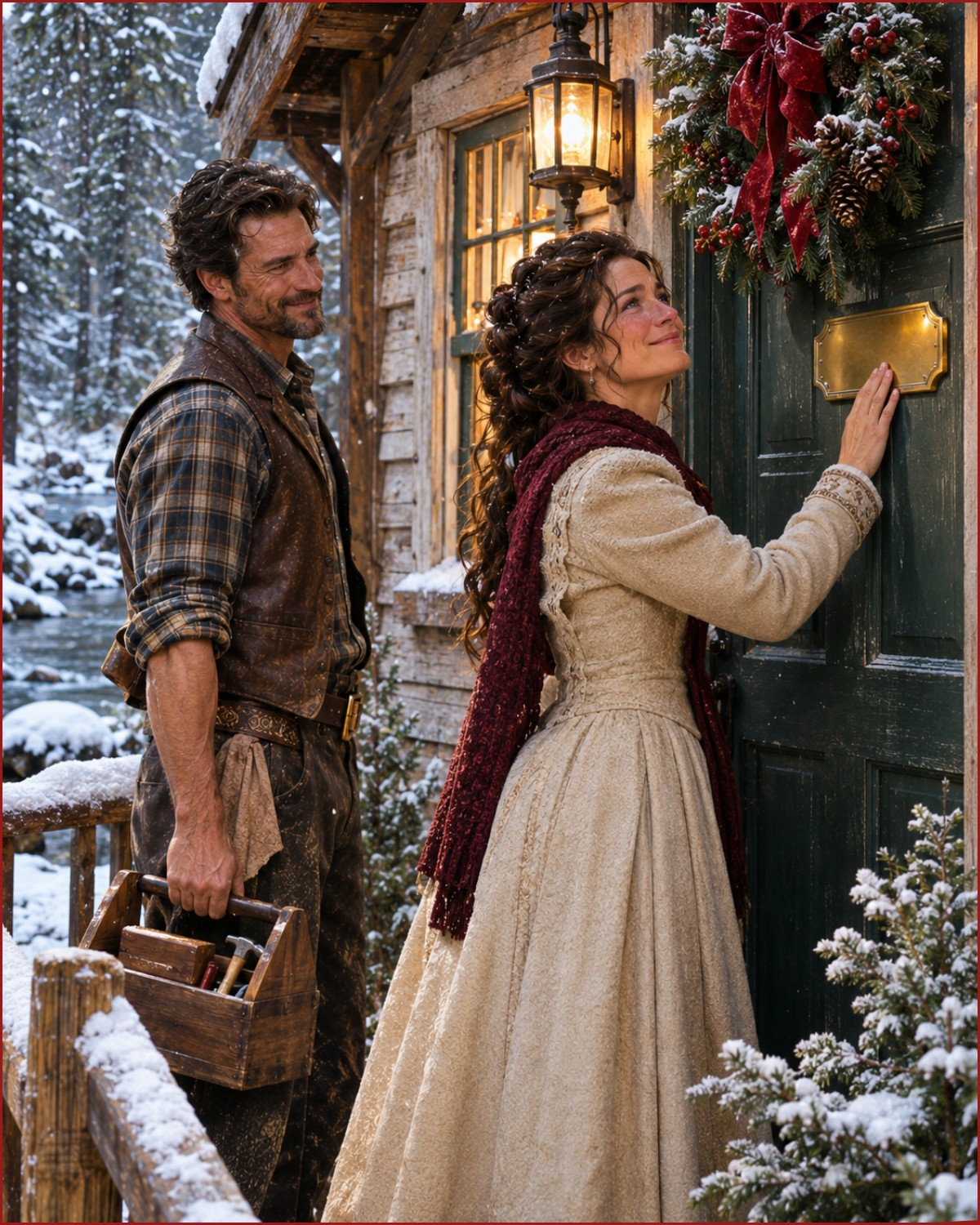
The front door swung open.
Nathaniel stepped in front of me.
"Don't come any closer."
A tall man stood in the doorway, his dark coat covered with melting snow. He held a black walking stick in one hand and wore a weathered leather hat pulled low over his forehead.
He didn't look surprised to see us.
In fact, he looked as though he had expected to find us exactly where we were.
His eyes moved from Nathaniel to the open journal on the floor.
Then they settled on the letter in my hands.
"Eleven years, Nathaniel," he said quietly. "And you still haven't learned when to leave the past alone."
Nathaniel's jaw tightened.
"Thomas Whitmore."
The stranger removed his hat.
I had never seen him before, but there was something unsettling about the familiarity with which Nathaniel spoke his name.
"You're supposed to be dead," Nathaniel said.
Thomas gave a faint smile.
"That's what everyone was told."
I felt my fingers tighten around Rebecca's letter.
The man looked at me.
"And who might you be?"
"Eliza Monroe."
His expression changed.
Only slightly.
But I noticed.
"Ah," he said. "The schoolteacher."
I frowned.
"Do I know you?"
"No. But I've heard about you."
He stepped inside and closed the door behind him.
Nathaniel moved forward.
"I didn't invite you in."
Thomas glanced at the wooden box on the table.
"You've found it, then."
Neither of us answered.
His gaze returned to the journal.
"Give me that."
Nathaniel stepped between him and the desk.
"No."
Thomas sighed.
"Don't make this difficult."
"You've been making things difficult for eleven years."
The older man looked at him for several seconds.
Then he slowly removed his gloves.
"You don't understand what you're holding."
"I understand that Rebecca wrote your name."
At the mention of Rebecca, something passed across Thomas's face.
It wasn't grief.
It was irritation.
"That girl never knew when to keep her mouth shut."
Nathaniel lunged forward.
I caught his arm.
"Nathaniel."
He stopped.
His breathing was heavy.
Thomas watched us with an expression that made my stomach tighten.
"You're still protecting people, I see," he said.
Nathaniel lowered his voice.
"Tell me what happened that night."
Thomas looked toward the windows.
Outside, the snow had become heavier.
"Eleven years ago, you should have listened when I told you to stay away from the church."
Nathaniel stared at him.
"What did you do?"
Thomas didn't answer.
Instead, he looked at me again.
"Miss Monroe, I suggest you go home."
I stood straighter.
"This is my schoolhouse."
"Not anymore."
His words were quiet.
But there was something unmistakable beneath them.
A threat.
I looked at Nathaniel.
He was watching Thomas with an expression I couldn't understand.
Then Thomas reached into his coat.
Nathaniel immediately stiffened.
"Don't."
The older man withdrew a folded piece of paper.
He placed it on the nearest desk.
"Consider this a warning."
Nathaniel didn't move.
Thomas adjusted his coat.
"You have until tomorrow morning to return what belongs to me."
Then he opened the door.
Before leaving, he turned one last time.
"And Nathaniel?"
"What?"
"Some people are better off staying buried."
The door closed.
For several seconds, neither of us spoke.
I could hear the wind pressing against the windows.
Then Nathaniel crossed the room and locked the door.
He checked the latch twice.
I looked at the paper Thomas had left behind.
It was a notice.
A formal document bearing the name of a law office in Denver.
At the bottom was a signature.
Thomas Whitmore.
I read the first paragraph.
Then I looked up.
"Nathaniel, what does this mean?"
He took the paper from me.
His face had become pale.
"It means he's claiming ownership of the schoolhouse."
I stared at him.
"How can he do that?"
"I don't know yet."
"But this building has belonged to the town for decades."
"That's what everyone believes."
I looked at the document again.
There was a date.
December 19.
Eleven years earlier.
And beneath it, a handwritten note.
The original deed remains valid until the missing signature is recovered.
I felt a chill.
"What missing signature?"
Nathaniel took a deep breath.
"Rebecca's."
We remained inside the schoolhouse for another hour.
Nathaniel gathered the journal, the letter, and the wooden box.
I placed the old floorboard back into position.
Neither of us wanted to leave anything behind.
But the question of Thomas Whitmore remained.
"Why did everyone believe he was dead?" I asked.
Nathaniel sat at the teacher's desk.
"Because his brother identified the body."
"Whose body?"
"Thomas's."
I stared at him.
"Then who was buried?"
He rubbed his forehead.
"An unidentified man found near the eastern road. The body had been badly damaged in a fire. Thomas's brother claimed it was him."
"Was there an official investigation?"
"Of course."
"And nobody questioned it?"
"People did. But Thomas's brother had documents. There was a funeral. A grave. The matter was closed."
I looked toward the window.
"Then why did he disappear?"
Nathaniel shook his head.
"I don't know."
He opened Rebecca's journal again.
"Maybe Margaret knew."
I sat beside him.
"Let's read the rest."
He turned the pages slowly.
Some entries described ordinary things.
A visit to the market.
A conversation with Margaret.
A new dress she had purchased for the wedding.
Then the writing changed.
The entries became shorter.
The handwriting more hurried.
One passage had been written so heavily that the pen had almost torn through the paper.
Nathaniel read it aloud.
"December 17.
Thomas came to the schoolhouse again. He asked Margaret about the old records. She refused to answer him. I heard them arguing in the library. When I entered, they stopped speaking."
He turned the page.
"December 18.
I saw the key in Margaret's desk. She says it opens a room beneath the old church. I asked her why she had kept it. She told me some things should never have been found."
He stopped.
I leaned closer.
"A room beneath the church?"
Nathaniel nodded.
"There's an old cellar beneath the original building."
"Does anyone use it?"
"Not anymore."
"Why?"
He looked toward the journal.
"Because the entrance was sealed."
I felt my heart beating faster.
"Why would anyone seal it?"
"I don't know."
He continued reading.
The next entry was dated December 19.
Margaret says the papers must remain hidden. Thomas knows about the ledger now. He says the town will lose everything if the truth comes out. I asked him what he meant, but he refused to explain.
Nathaniel turned another page.
This one was nearly blank.
Only one sentence had been written.
If anything happens to me, tell Nathaniel that the key is not the only thing Margaret hid.
I looked at him.
"What does that mean?"
He stared at the words.
"I don't know."
"Could there be another letter?"
"Possibly."
"Or another key?"
Nathaniel closed the journal.
"Eliza, we need to be careful."
I folded my arms.
"That man walked into our schoolhouse and threatened us."
"I know."
"He claimed the building belonged to him."
"I know."
"And you're telling me we should simply go home?"
He looked at me.
"I'm telling you that Thomas Whitmore has already proved he's willing to lie about his own death."
I fell silent.
Nathaniel stood and walked toward the window.
"I won't let him put you in danger."
I looked at his back.
"You don't get to decide that for me."
He turned.
"Eliza—"
"No. You brought me into this because you trusted me enough to show me the letter. I won't pretend I didn't see it."
His expression softened.
For a moment, he seemed about to argue.
Then he nodded.
"All right."
I walked toward the desk.
"But we need to understand what Rebecca was trying to protect."
Nathaniel looked down at the journal.
"Someone's life."
I swallowed.
"And perhaps the truth about her death."
He didn't answer.
The following morning, Willow Bend looked almost deserted.
Snow covered the streets, and most families were preparing for Christmas.
Nathaniel accompanied me to the cottage before returning to his workshop.
I insisted that I could manage the walk from the schoolhouse.
He disagreed.
We compromised by traveling together until we reached the main road.
Before leaving, he handed me a small brass whistle.
I looked at it.
"What's this?"
"If you need help, use it."
"Nathaniel, I'm not a child."
"I know."
"Then why are you giving me a whistle?"
He looked uncomfortable.
"Because I can't be everywhere."
His answer was so sincere that I couldn't bring myself to tease him.
I slipped the whistle into my coat pocket.
He studied my face.
"Promise me you'll stay away from Thomas."
"I promise I won't seek him out."
"That's not quite the same thing."
"It is the best promise I can make."
He gave a reluctant nod.
Then he tipped his hat and walked toward his workshop.
I watched him disappear around the corner.
For a moment, I considered following him.
But I had lessons to prepare.
The children were expecting their Christmas pageant, and I refused to let the events of the previous night ruin their celebration.
Still, something had changed.
Every time I heard footsteps outside the classroom, I looked toward the door.
Every time a wagon passed the schoolhouse, I wondered whether Thomas was inside.
At eleven o'clock, Clara arrived carrying a small basket.
"Miss Monroe!"
I smiled.
"Good morning, sweetheart."
"My mother made you something."
She placed the basket on my desk.
Inside were two small loaves of bread wrapped in a clean cloth.
"That's very kind."
"Mama says you work too hard."
I laughed.
"Your mother may be right."
Clara looked toward the repaired stage.
"Is Mr. Brooks coming today?"
"I believe so."
"He promised to show us how to make wooden stars."
"Then I hope he remembers."
She smiled.
I watched her run toward her desk.
For a few minutes, the schoolhouse returned to normal.
Children practiced their songs.
Someone dropped a pencil.
Two little boys whispered about Christmas presents.
But I couldn't stop thinking about the journal.
The hidden cellar.
The missing signature.
And the woman who had disappeared after Rebecca died.
Margaret Whitmore.
I went to the library and searched through the oldest school records.
The files were arranged in wooden cabinets along the back wall.
Some had been damaged by water.
Others were missing their covers.
I found the records from eleven years earlier and began reading.
At first, there was nothing unusual.
Attendance lists.
Teacher evaluations.
Letters from parents.
Then I found a document dated December 19.
It was a transfer request.
Margaret Whitmore had officially resigned from her teaching position.
The reason was listed as family circumstances.
I turned the page.
A second document was attached.
It was a letter from the school board.
Mrs. Whitmore's final salary will be paid upon receipt of the signed property release.
I read it twice.
Property release?
Why would a teacher need to sign a property release when leaving her job?
I searched the file again.
A folded sheet slipped from the back.
It contained a list of names.
Nathaniel Brooks.
Rebecca Hale.
Margaret Whitmore.
Thomas Whitmore.
And one more.
A name I recognized.
Samuel Carter.
I sat down.
Samuel Carter had been the town's former sheriff.
He had died six years earlier.
I remembered the old newspaper articles.
He had been respected by almost everyone in Willow Bend.
He had served as sheriff for more than twenty years.
Why was his name on a document connected to Rebecca's disappearance?
I examined the page.
Beside Samuel's name was a handwritten note.
Witness to the original agreement.
My stomach tightened.
I searched the surrounding papers.
There was no explanation.
No second page.
No copy of the agreement.
Only the list.
Then I noticed something else.
A small pencil mark beside the name Samuel Carter.
Three words.
Ask his daughter.
I stared at the writing.
Samuel Carter had a daughter.
Her name was Grace.
She still lived in Willow Bend, in a small house near the church.
I had met her only a handful of times.
She was a quiet woman in her late fifties who rarely attended town gatherings.
I placed the document inside my coat.
I needed to speak with her.
But before I could close the cabinet, I heard a voice behind me.
"Miss Monroe?"
I turned.
The schoolhouse caretaker, Mr. Bennett, stood near the doorway.
"Yes?"
He looked uncomfortable.
"There's a gentleman asking for you."
My stomach tightened.
"Who?"
"He says his name is Thomas Whitmore."
I stared at him.
"Did you tell him I was here?"
Mr. Bennett shook his head.
"No, ma'am. He was already waiting outside when I arrived."
I looked toward the front windows.
A dark figure stood beneath the porch lantern.
Thomas.
He was holding something in his hand.
A small brown envelope.
Mr. Bennett lowered his voice.
"Miss Monroe, he says he has something that belonged to your father."
My heart stopped.
"My father?"
He nodded.
"He says you should come outside and collect it."
I felt the room tilt slightly.
My father had been dead for months.
And as far as I knew, he had never met Thomas Whitmore.
I looked toward the window again.
Thomas raised the envelope.
Then he pointed directly at me.
And mouthed four words.
Your father knew Rebecca.
I didn't go outside.
Instead, I asked Mr. Bennett to lock the front door.
He looked surprised but obeyed.
Thomas remained on the porch.
He didn't knock.
He simply stood there, holding the envelope.
I moved away from the window.
My hands were trembling.
My father knew Rebecca?
How was that possible?
He had lived in Willow Bend for most of his life, but I had never heard him mention her.
I remembered his final months.
The way he sometimes stared at the window without speaking.
The way he had become unusually anxious whenever someone mentioned the old church.
Once, I had asked him what was wrong.
He had simply said that some memories were better left alone.
At the time, I had assumed he was thinking about his illness.
Now I wasn't so sure.
I returned to the desk and picked up the document bearing Samuel Carter's name.
Perhaps the connection was more complicated than I had imagined.
Perhaps my father had known more about Rebecca's death than I had ever realized.
I needed to find Nathaniel.
Immediately.
I gathered my coat and the papers.
But before I could leave through the back entrance, I heard a loud knock.
Three strikes.
Then silence.
A man's voice followed.
"Eliza Monroe."
I froze.
It wasn't Thomas.
It was another voice.
Older.
Deeper.
And strangely familiar.
"Your father asked me to find you if Rebecca's name ever appeared again."
I stepped closer to the door.
"Who are you?"
There was a pause.
Then the man answered.
"Someone who was there the night she died."
He pushed a small photograph beneath the door.
I bent down and picked it up.
My father was standing beside Rebecca Hale.
And behind them, with one hand resting on my father's shoulder, was Thomas Whitmore.
But it was the date written on the back that made my blood run cold.
December 24.
The night my father had always told me he was home with me.
I looked up.
The stranger was still standing outside.
Then he spoke again.
"Miss Monroe, there's something else in that photograph."
I turned it over.
And beneath my father's name was a second signature.
One I had spent twelve years believing belonged to a dead man.
Nathaniel Brooks.






Comments 0