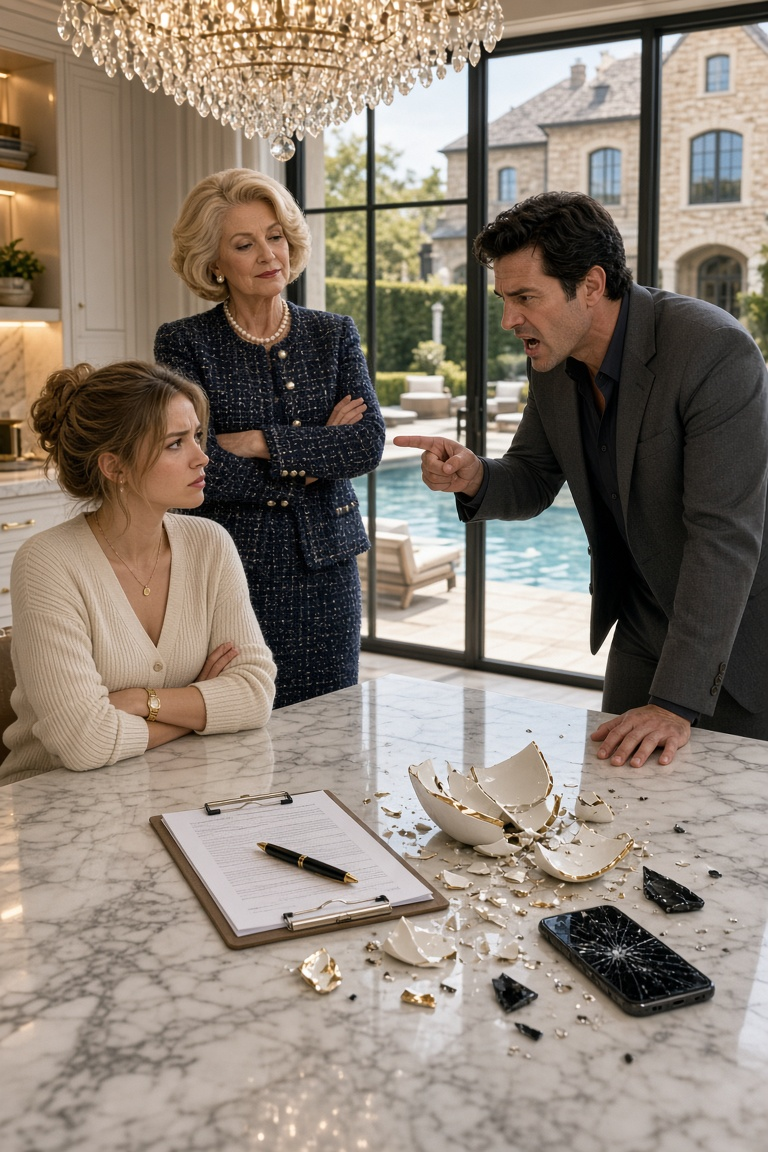
"David, you weren't supposed to let her find that."
Evelyn's voice was barely above a whisper.
But in the silence of our kitchen, every word sounded like a confession.
I stood beside the marble island, holding my phone.
On the screen was a document that appeared to show someone else as the owner of my house.
My house.
The mansion I had purchased six years earlier.
The home whose expenses I had quietly paid while David accepted congratulations for providing us with such a beautiful life.
And the woman standing in front of me had just admitted she knew something about the document.
I looked at Evelyn.
"What weren't I supposed to find?"
She froze.
David stepped forward.
"Rachel, calm down."
I turned toward him.
"Don't tell me to calm down."
He stopped.
I looked back at Evelyn.
"Answer me."
She straightened her shoulders.
"I don't know what you're talking about."
I held up my phone.
"Then why did you say that?"
Her eyes shifted toward David.
He looked away.
I felt something cold settle in my stomach.
For years, I had believed Evelyn was simply an overbearing mother-in-law.
A woman who enjoyed interfering.
A woman who believed her sons could do no wrong.
But now I was beginning to wonder how much of our marriage she had been quietly managing behind my back.
"Evelyn," I said, "whose name is on this document?"
She lifted her chin.
"I haven't seen it."
I turned the screen toward her.
She glanced at it.
Her expression changed.
Only for a second.
But I saw it.
Recognition.
Then she looked away.
"That doesn't concern you."
I stared at her.
"A document claiming ownership of my home doesn't concern me?"
David rubbed his forehead.
"Rachel, please."
I turned toward him.
"Did you know about this?"
He hesitated.
I felt my chest tighten.
"David."
He looked at me.
"I knew Mom had asked some questions."
"Questions?"
"About the house."
I stared at him.
"What kind of questions?"
He swallowed.
"About how ownership works."
I looked at Evelyn.
She folded her arms.
"There's nothing wrong with understanding legal arrangements."
"No," I said quietly. "There isn't."
For a moment, she looked relieved.
Then I continued.
"But there is something wrong with submitting a document that misrepresents who owns a property."
Her face reddened.
"You have no proof of that!"
I looked at the phone again.
The document had our address.
Our legal property description.
An estimated value.
And a name in the ownership section that wasn't mine.
I enlarged the image.
Evelyn Whitmore.
I looked up.
"Your name is on it."
She said nothing.
David closed his eyes.
And suddenly, the room felt much smaller.
I didn't shout.
I didn't throw the phone.
I didn't demand that Evelyn leave immediately.
Instead, I asked one question.
"Is this a recorded deed?"
Neither answered.
I looked at David.
"Is it?"
He shook his head.
"I don't know."
I turned toward Evelyn.
She hesitated.
Then said, "It's a document."
I stared at her.
"That wasn't my question."
She lifted her chin.
"Rachel, you wouldn't understand."
I almost laughed.
The woman who had spent years calling my business a hobby was now suggesting that I couldn't understand paperwork involving property I had purchased.
"Try me."
Evelyn looked toward David.
He remained silent.
Finally, she said, "Jason was trying to arrange financing. The lender needed information about family assets."
I felt my pulse quicken.
"Family assets?"
"Yes."
"And you listed yourself as the owner of my house?"
She frowned.
"It was a preliminary statement."
I stared at her.
"Did you tell the lender that you owned this property?"
She looked away.
David stepped forward.
"Mom, just answer her."
Evelyn turned sharply.
"Don't you start!"
He stopped.
For the first time, I saw the familiar family arrangement from the outside.
Evelyn gave orders.
David obeyed.
Jason benefited.
And I was expected to pay.
I looked at the document again.
"Was this ever recorded with the county?"
Evelyn said nothing.
I took out my phone and called Caroline.
She answered almost immediately.
"Rachel?"
"I'm looking at the document you sent."
"I know."
"Evelyn is here. Her name is listed as the owner."
Caroline paused.
"Rachel, listen carefully. The document attached to the lender's file is not the recorded deed."
I closed my eyes.
Relief rushed through me so suddenly that I had to grip the edge of the island.
"Are you sure?"
"Yes. I've already checked the available county records. The recorded title remains in your name."
I exhaled.
Across the kitchen, Evelyn looked irritated.
David stared at me.
Caroline continued.
"What you're looking at appears to be an ownership representation submitted as part of the financing package. It does not transfer title."
I opened my eyes.
"So Evelyn doesn't own the house?"
"Not based on that document. But we need to investigate why the representation was made and who submitted it."
I looked directly at my mother-in-law.
"Understood."
"And Rachel?"
"Yes?"
"Do not sign anything anyone puts in front of you tonight."
I glanced at David.
"I won't."
After the call ended, I placed the phone on the counter.
Then I looked at Evelyn.
"The recorded deed is still in my name."
Her expression tightened.
"That doesn't mean David has no rights."
"I didn't say that."
"Marriage is a partnership."
I held her gaze.
"That's what I've been trying to explain for eight years."
She looked away.
David sank into a chair.
He looked exhausted.
For several minutes, nobody spoke.
Then he said, "Mom, why did you put your name on that statement?"
Evelyn stared at him.
"Because someone had to protect this family."
I felt my stomach turn.
"Protect it from what?"
She looked at me.
"From uncertainty."
I waited.
"David has worked too hard to lose everything because of a technicality."
I stared at her.
"A technicality?"
She gestured toward the house.
"This home. This lifestyle. Everything he's built."
I looked around the kitchen.
The marble counters.
The expensive appliances.
The enormous windows.
The pool beyond the glass.
Then I looked back at her.
"Evelyn, do you know where the money for this house came from?"
She lifted her chin.
"David has a very successful career."
I nodded.
"Yes. He does."
She looked pleased.
I continued.
"But his salary didn't purchase this house."
Her smile disappeared.
David looked up.
"Rachel—"
I turned toward him.
"Do you want to tell her?"
He stared at me.
"Tell her what?"
"How we purchased the property."
He looked uncomfortable.
"Rachel, this isn't necessary."
I studied his face.
For years, he had allowed his mother to believe he was the sole provider.
He had accepted her praise.
Her admiration.
Her certainty that I was fortunate to be married to him.
And now, when the truth threatened to emerge, he wanted to avoid the conversation.
I looked back at Evelyn.
"The purchase funds came from arrangements involving my assets."
She laughed sharply.
"That's ridiculous."
I remained still.
"Is it?"
"David bought this house."
I looked at him.
"David?"
He stared at the table.
"Rachel contributed."
I felt something inside me break.
Not because he had lied.
Because even now, he couldn't say the truth plainly.
"Contributed?" I repeated.
He looked up.
"Rachel, please."
I shook my head.
"No."
I opened my laptop.
Found the closing statement.
Then turned the screen toward Evelyn.
"Here are the purchase records."
She looked at them.
Her expression changed.
I continued.
"Here are the funding documents."
She leaned closer.
"And here is the recorded deed."
Her eyes moved across the screen.
Then she looked at David.
"Is this true?"
He rubbed his forehead.
"Mom, it's complicated."
I stared at him.
"No, David. It isn't."
He looked at me.
I spoke quietly.
"You knew how the house was purchased."
He said nothing.
"You received the closing attorney's email."
His face reddened.
"You don't understand—"
"You replied to it."
Silence.
Evelyn turned toward him.
"David?"
He looked away.
And for the first time, I saw my mother-in-law's confidence begin to crack.
I remembered the day we moved into the mansion.
It had been a warm Saturday morning.
The moving trucks arrived before eight.
David stood in the driveway, directing workers and admiring the front entrance.
He looked like a man who had finally achieved something enormous.
I was happy for him.
Happy for us.
The house represented years of work.
Not just money.
Sacrifice.
Long nights.
Careful planning.
And the success of a business I had built from a small food blog into something much larger.
I remembered standing in the empty kitchen, looking at the sunlight falling across the marble.
David came up behind me.
He wrapped his arms around my waist.
"Can you believe this is ours?"
I smiled.
"No."
He kissed my cheek.
"We made it, babe."
I turned toward him.
"We did."
At the time, I believed he meant both of us.
Later that evening, Evelyn arrived with champagne.
She walked through the rooms, admiring everything.
Then she raised her glass.
"To my son," she announced, "who worked so hard to give his wife this beautiful home."
Everyone applauded.
I smiled.
David smiled.
And I said nothing.
I told myself it didn't matter.
We were married.
We were a team.
Who received credit wasn't important.
But the applause became a story.
The story became an assumption.
And eventually, the assumption became something David himself seemed to believe.
Now, six years later, I stood in the same kitchen watching him struggle to explain why his mother had submitted paperwork suggesting she owned the property.
I wondered how many other things I had ignored because I believed keeping the peace was more important than correcting a lie.
Evelyn sat down heavily.
She looked at the closing statement again.
Then at David.
"You told me you bought this house."
David rubbed his face.
"I said we bought it."
"No," she snapped. "You said you bought it."
He looked away.
I watched them.
For the first time, their anger wasn't directed at me.
It was directed at each other.
Evelyn pointed toward the laptop.
"Then why is her name on the deed?"
David sighed.
"Because that's how the purchase was structured."
She stared at him.
"Why?"
He looked at me.
I waited.
Finally, he said, "Rachel's assets were used."
Evelyn blinked.
"Her cooking business?"
I felt my jaw tighten.
David nodded.
"Yes."
She stared at him.
Then laughed.
A short, disbelieving sound.
"That little website?"
I looked at her.
"Evelyn, my business is much more than a website."
She waved a hand.
"I don't understand how selling recipes could pay for a mansion."
I closed the laptop.
"That's because you've never asked."
She looked offended.
"I've asked plenty of questions."
"No. You've made plenty of assumptions."
Her face reddened.
I continued.
"You've spent years telling people David provides everything. You've criticized my parents for needing help. You've used financial benefits connected to my business while dismissing the work that funded them."
She opened her mouth.
I held up a hand.
"And now you've submitted a document representing yourself as the owner of a property that isn't yours."
She stared at me.
For several seconds, nobody spoke.
Then Evelyn said quietly, "I was trying to protect my sons."
I looked at her.
"From me?"
She didn't answer.
I felt something cold settle in my chest.
That silence told me more than any argument could have.
The next morning, I met Caroline at her office.
Melissa joined us.
We sat around a conference table covered with documents.
Caroline had organized everything into separate folders.
Property ownership.
Business accounts.
Supplementary cards.
Jason's financing.
The disputed guarantee.
The questionable ownership representation.
I appreciated the structure.
It made the situation feel less like a family nightmare and more like a series of problems that could be investigated.
Caroline began with the house.
"The recorded deed names you," she said. "The lender's document does not change that."
I nodded.
"But we still need to assess any marital property claims under applicable law."
"Understood."
She continued.
"The bigger concern is that someone represented ownership inaccurately in connection with financing."
Melissa opened another folder.
"We've also identified several financial documents that appear to contain inconsistent information."
I looked at her.
"What kind?"
"Income figures. Account ownership details. Authorization records."
Caroline leaned forward.
"Rachel, I want you to understand that we're not assuming every inconsistency is intentional. Some could be clerical. Others may be more serious."
I nodded.
"What do we do?"
"We preserve evidence, dispute anything you didn't authorize, and communicate through the appropriate channels."
I looked at the documents.
"Can we stop the financial bleeding?"
Melissa nodded.
"We've already begun updating account permissions and payment arrangements where you're authorized to do so."
Caroline added, "And we need to keep your legitimate obligations current. We don't want anyone claiming you acted recklessly."
"Agreed."
Melissa turned a page.
"There's another issue."
I looked up.
"What?"
"David's personal spending."
I sighed.
"What about it?"
"His salary is substantial, but his recurring personal expenses are also high."
"How high?"
She showed me a summary.
Luxury vehicle payments.
Travel.
Clothing.
Entertainment.
Family assistance.
Various subscriptions.
And several payments that appeared connected to Jason.
I stared at the figures.
David had always talked about his salary as though it made him financially untouchable.
But the numbers told a different story.
He earned well.
He spent even better.
Melissa pointed to the final column.
"Without the household expenses you've been covering, his available cash flow is much smaller than he appears to believe."
I sat back.
"So he's going to feel the changes."
"Yes."
Caroline looked at me.
"Rachel, I want you prepared for that."
I nodded.
"Why?"
"Because people often react badly when financial assumptions collapse."
I thought about David's temper.
His broken phone.
The shattered porcelain.
The way he had grabbed my wrist at the front door.
"I understand."
By the following week, the bills began arriving more frequently.
David complained about everything.
The landscaping invoice.
The pool maintenance bill.
The vehicle services.
The insurance premium.
The premium subscriptions.
Each time, he acted as though someone had invented a new expense simply to punish him.
"Why is the pool service so expensive?" he demanded one evening.
I looked up from my laptop.
"Because you chose the premium maintenance package."
He frowned.
"Why didn't we use a cheaper company?"
"You said you wanted the best."
He stared at me.
Then looked away.
The next morning, he complained about the landscaping.
"These people charge more than some employees make in a week!"
I nodded.
"Yes."
"That's ridiculous!"
"You insisted on the full-service contract."
He rubbed his forehead.
"Well, we need to change it."
"Then change it."
He stared at me.
"You're not going to handle it?"
I looked at him.
"No."
He blinked.
For years, I had handled everything.
The scheduling.
The payments.
The repairs.
The vendor negotiations.
The paperwork.
David enjoyed the results.
Now he was discovering how much work had been hidden behind the phrase our beautiful home.
And he wasn't enjoying it.
One evening, I found him sitting alone in the kitchen.
A stack of bills lay in front of him.
He looked tired.
Older.
For once, he wasn't wearing a suit.
Just a white shirt with the sleeves rolled up.
I poured myself a glass of water.
He looked up.
"Rachel."
"Yes?"
"Can I ask you something?"
I nodded.
"Of course."
He hesitated.
"Why didn't you ever tell me how much you were paying?"
I looked at him.
"I did."
He shook his head.
"Not like this."
I sat opposite him.
"David, I handled the finances because you said you didn't want to deal with the details."
He looked down.
"I know."
"I told you when expenses increased."
He nodded slowly.
"I know."
"I asked you to review budgets."
He rubbed his forehead.
"I remember."
I waited.
Then he whispered, "I didn't think it was this much."
I studied his face.
For the first time, he seemed genuinely embarrassed.
Not angry.
Not defensive.
Embarrassed.
I wanted to comfort him.
The instinct was immediate.
Familiar.
Eight years of marriage had taught me to soften every difficult moment.
But I stopped myself.
He needed to experience the consequences of his own choices.
Not because I wanted him to suffer.
Because I couldn't keep protecting him from reality.
"David," I said quietly, "you told me I contributed nothing meaningful to this marriage."
He closed his eyes.
"I know."
"You said my work was insignificant."
He nodded.
"I know."
"You said my parents were useless."
His face tightened.
"I shouldn't have said that."
I looked at him.
"No. You shouldn't have."
He was quiet.
Then he whispered, "I'm sorry."
I stared at him.
It was the first apology he'd offered without immediately defending himself.
I wanted to believe it.
But one apology couldn't erase years of disrespect.
And it certainly couldn't explain the documents connected to Jason's financing.
I nodded.
"Thank you."
He looked up.
"Can we fix this?"
I took a breath.
"I don't know."
His expression changed.
I continued.
"Not until I understand everything that's happened."
He looked away.
And for the first time, he didn't argue.
That night, I received another email from Caroline.
The subject line read:
ADDITIONAL PROPERTY CORRESPONDENCE.
I opened it.
Attached were several messages between Evelyn and a financial consultant who had helped Jason prepare his financing package.
The messages were dated months earlier.
I read them carefully.
Evelyn had repeatedly asked whether the mansion could be presented as a family asset.
The consultant had requested documentation.
Evelyn had supplied information about the property.
Some of it was accurate.
Some of it was not.
Then I reached a message that made my stomach tighten.
Evelyn had written:
David has always told us the house is his. Rachel's name appears on some paperwork, but she's his wife, so it shouldn't matter.
I stared at the words.
For years, she had believed my ownership was a technicality.
Something that could be ignored.
Something that didn't count because I was married to her son.
I continued reading.
The consultant had replied:
We cannot treat the property as collateral without verifying ownership and obtaining valid authorization from the appropriate parties.
I exhaled.
At least someone had asked the right questions.
Then I saw Evelyn's response.
There must be a way to make this work. David cannot lose the opportunity because of Rachel's paperwork.
I closed my eyes.
My paperwork.
My house.
My business.
My assets.
Everything I had built had become an inconvenience to Evelyn because it didn't belong to her son.
I forwarded the email to Melissa.
Then I opened the final attachment.
It was a draft letter.
Addressed to the finance company.
The letter stated that the property was available to support Jason's financing.
At the bottom was a typed signature block.
Rachel Bennett.
I stared at it.
Then I noticed a handwritten note in the margin.
Need Rachel's approval before submission.
I felt a small measure of relief.
Someone had recognized that my permission was required.
But beneath that note was another.
Written in different handwriting.
David says approval already handled.
I stared at the words.
Then I heard footsteps outside my office.
David.
He knocked softly.
"Rachel?"
I didn't answer immediately.
He knocked again.
"Can we talk?"
I looked at the draft letter.
Then at the door.
"About what?"
He hesitated.
"Mom called me."
I felt my pulse quicken.
"What did she say?"
He was quiet.
Then he said, "She wants us all to sit down together."
I looked at the calendar.
Day twenty-three.
Seven days until the thirty-day mark.
I stared at the document again.
"Who is 'all'?"
David hesitated.
"Me. You. Mom. Jason."
I closed the laptop.
"Why?"
He took a breath.
"Because she says there's something you need to understand about the house."
I stood.
"What about the house?"
He didn't answer.
Then he said something that made my blood run cold.
"Rachel, Mom says she has a document that changes everything."
I stared at the door.
"What document?"
David was silent.
Then he whispered, "She says you signed it six years ago."
I looked down at the draft letter on my screen.
The false signature.
The ownership representation.
The financial guarantee.
And now another document.
I walked toward the door.
My hand closed around the handle.
Before I opened it, my phone vibrated.
A new message from Caroline appeared.
Rachel, do not agree to any meeting until you read what I just found in the original closing file.
Below the message was a photograph.
An old document.
Dated six years earlier.
The signature at the bottom looked like mine.
But beside it was a handwritten notation.
A date.
A reference number.
And a name.
I enlarged the image.
Then I stopped breathing.
Because the witness listed on the document was someone who had died three years before the document was supposedly signed.
I looked toward the office door.
David was still waiting outside.
And from downstairs, I heard Evelyn's voice.
"David! Tell Rachel to come down!"
I stared at the impossible date.
Then another message arrived from Caroline.
Rachel, I need you to look at the second page.
I opened it.
At the top were four words.
TRANSFER OF PROPERTY INTEREST.
And beneath them was a signature I recognized immediately.
Not mine.
Not David's.
Someone else's.
Someone who had been inside my house that very morning.
I leaned closer.
The name was—






Comments 0