The signature belonged to my son.
Seth Cooper.
For several seconds, I couldn't move.
I sat in my office with my phone in one hand and the printed appointment reminder in the other, staring at the blue signature beneath the words AUTHORIZED FAMILY REPRESENTATIVE.
I knew my son's handwriting.
I had watched him learn to write his name at our kitchen table when he was five years old. I had signed school permission slips beside that same handwriting when he was sixteen. I had seen it on birthday cards, university applications, and the first mortgage documents he had ever brought home.
The capital S always leaned slightly backward.
The final stroke of the t crossed farther to the right than it should.
And the C in Cooper was unusually narrow.
All three details were there.
But something else was wrong.
Beneath the signature, a box had been checked.
Relationship to Patient: Son
Below that was another statement.
I confirm that the patient has authorized me to participate in discussions regarding his medical care and financial decision-making capacity.
I read it twice.
Then a third time.
Wayne had never authorized Seth to make medical decisions for him.
He had never even discussed such an arrangement.
After his stroke, we had met with our family physician, Dr. Elaine Porter, to review his recovery and make sure his existing legal documents were current.
Wayne had been very clear.
He wanted me to remain his primary substitute decision-maker if he ever became incapable of making a particular decision himself.
He also wanted our daughter, Claire, to serve as the alternate.
Not Seth.
That decision hadn't been made because Wayne distrusted our son.
At least, not then.
Claire was simply more organized, lived closer to us, and had always been comfortable handling complicated paperwork.
Seth had agreed.
I remembered the conversation because he had made a joke about it.
"Good," he'd said. "Claire can deal with the boring stuff. I'll bring Dad the good coffee."
Now his signature appeared on a medical report claiming that his father might be unable to manage important financial decisions.
And the report was dated four days earlier.
The same afternoon Wayne and I had watched a documentary in our living room.
I enlarged the signature again.
There was a possibility it had been copied.
There was a possibility the entire document was fabricated.
But there was also a possibility I had been avoiding since the dinner party.
My son knew more than he was admitting.
I looked at the time.
12:43 a.m.
Wayne was asleep upstairs.
I wanted to wake him.
I wanted to place the report in front of him and ask whether he recognized anything about it.
But he had already endured enough humiliation for one evening.
And I refused to let Megan's cruelty steal his sleep as well.
Instead, I took screenshots of every page.
I saved the original attachment.
Then I printed a copy and placed it beside the other evidence.
My phone vibrated.
Another message from the unknown number.
YOU WERE WARNED.
I stared at it.
Then I typed a response.
Who is this?
I waited.
No answer.
A minute passed.
Then another.
Finally, a new message appeared.
ASK YOUR SON WHAT HE SIGNED.
I felt my stomach drop.
Whoever was sending these messages knew about the report.
They knew Seth's signature appeared on it.
And they knew I had discovered it.
But how?
Had Megan sent the document herself to frighten me?
Was someone at the clinic trying to warn me?
Or was another person involved?
I had no answers.
Only the growing certainty that my husband's medical information had become part of something deliberate.
I turned off my phone's sound.
Then I sat at my desk until nearly two in the morning, examining every document I had collected.
By the time I finally went upstairs, I had reached one decision.
I would not confront Seth.
Not yet.
Because if he had knowingly participated in whatever Megan was planning, confronting him would give them time to destroy evidence.
And if he hadn't, I needed to find out who had used his name.
Either way, the truth mattered more than my anger.
Wayne was already awake when I entered the kitchen the next morning.
He stood beside the counter, concentrating on pouring hot water into two mugs.
His right hand trembled slightly.
The kettle rested against the counter for support.
He looked up when he heard me.
"Morning, Jude."
"Morning."
He smiled.
"Tea's almost ready."
I crossed the room and kissed his cheek.
"You should have waited for me."
"And deprive myself of the satisfaction of making my wife breakfast?"
I looked at the two pieces of toast sitting on a plate.
One was darker than the other.
He followed my gaze.
"The toaster and I had a disagreement."
I laughed.
He grinned.
For a moment, I saw the man I had married forty-six years earlier.
The young history teacher who had proposed to me in a public park because he couldn't afford a fancy restaurant.
The man who had promised me a life filled with laughter, honesty, and enough adventure to keep us from becoming boring.
He had kept that promise.
Even when life became difficult.
Even after his stroke.
I sat beside him at the kitchen table.
"Wayne, I need to ask you something."
His smile faded slightly.
"About last night?"
"Not exactly."
I placed the printed medical report in front of him.
He adjusted his reading glasses.
For a moment, he said nothing.
Then his eyebrows drew together.
"What is this?"
"That's what I'm trying to find out."
He read the first paragraph.
Then the second.
His expression changed.
"Judy."
I waited.
"This says I attended an appointment in Oakville."
"I know."
"I didn't."
"I know that too."
He continued reading.
When he reached the paragraph describing alleged cognitive impairment, his face became very still.
I watched him carefully.
Not because I doubted his abilities.
Because I knew how much it would hurt him to see his intelligence questioned in writing.
Finally, he looked up.
"Who wrote this?"
"A doctor named Nathaniel Hawkins."
"I've never heard of him."
"Are you certain?"
"Absolutely."
He tapped the page with his left index finger.
"According to this, I couldn't correctly identify the current prime minister."
I nodded.
"Yes."
"Judy, I spent twenty minutes yesterday complaining about the federal government's latest budget announcement."
"I remember."
"And apparently I couldn't remember the date?"
"That's what it says."
He gave a short, humorless laugh.
"I may forget where I put my glasses, but I know what year it is."
He turned the page.
Then he saw Seth's signature.
The humor disappeared.
"Why is our son's name here?"
I took a breath.
"I don't know."
Wayne stared at the signature.
Then he looked at me.
"Did Seth arrange this?"
"I haven't asked him."
"Why not?"
"Because I wanted to speak with you first."
He sat back.
For a long moment, he studied the report.
Then he said something I hadn't expected.
"Do you remember the afternoon Seth came over while you were at the accountant's office?"
I frowned.
"Two weeks ago?"
"Yes."
"What about it?"
"He brought some paperwork."
My heart began beating faster.
"What kind of paperwork?"
"He said it had something to do with insurance."
"Insurance?"
Wayne nodded.
"He told me Megan's company was reviewing family coverage options. He wanted to know whether I'd be interested in some kind of supplementary medical plan."
I leaned forward.
"Did you sign anything?"
"No."
"Are you sure?"
He looked offended.
"Judy."
"I'm sorry. I just need to know."
He softened.
"No, sweetheart. I didn't sign anything."
"What happened to the paperwork?"
"I told him to leave it with me. He said it wasn't necessary."
"Did he take it back?"
"Yes."
I stared at him.
Wayne looked down at the report again.
"Do you think Seth had something to do with this?"
I wanted to say no.
I wanted to protect him from the possibility that his own son had betrayed him.
But I had spent too many years telling students that truth mattered to abandon that principle when it became uncomfortable.
"I think we need to find out."
Wayne was quiet.
Then he folded the report carefully.
"All right."
I reached for his hand.
"Rebecca is expecting us at nine."
He nodded.
"Then we'd better not be late."
Rebecca Sloan's office occupied the third floor of a brick building near downtown Hamilton.
She had never been interested in impressive offices.
Her waiting room contained comfortable chairs, a coffee machine that worked only when it felt like it, and a framed photograph of her golden retriever.
But Rebecca herself was one of the most capable attorneys I had ever met.
She was sixty-one, with short dark hair, sharp eyes, and a habit of asking questions that made dishonest people uncomfortable.
When we arrived, she came out personally to greet Wayne.
"How are you feeling?"
"Better than the people who wrote this report seem to think," he replied.
Rebecca smiled.
"Good. Come in."
We followed her into the conference room.
I placed the folder of evidence on the table.
Rebecca examined the appointment reminder first.
Then the credit application.
Then the medical report.
She read every page without speaking.
Finally, she looked at Wayne.
"Did you ever attend this clinic?"
"No."
"Did you authorize anyone to arrange an assessment on your behalf?"
"No."
"Did you consent to the release of your medical information to Dr. Hawkins?"
"Not that I'm aware of."
"Did you authorize Seth to participate in your medical or financial decision-making?"
Wayne shook his head.
"No."
Rebecca wrote something in her notebook.
"All right."
I leaned forward.
"What does this mean?"
"It means we have several serious questions to investigate. It does not yet establish who created the report, whether the clinic actually issued it, or whether any signatures were forged."
"Can we stop them from using it?"
"We can take immediate steps to challenge its authenticity and notify the appropriate parties that Wayne disputes the assessment."
She turned toward my husband.
"Wayne, I want to be absolutely clear about something. A stroke does not automatically mean a person lacks decision-making capacity. Neither does a tremor. Capacity is decision-specific and must be assessed properly."
Wayne nodded.
"I understand."
"And a report like this doesn't simply give Seth control over your money."
I felt some of the tension leave my shoulders.
Rebecca continued.
"Still, false medical information can cause real harm if someone submits it to financial institutions, insurers, or other organizations. We need to determine where this document has gone."
I placed the credit application beside her.
"And this?"
She examined it.
"Have you contacted the lender?"
"Not yet."
"We'll help Wayne report the suspected identity misuse. He should also contact the credit bureaus and request appropriate alerts."
Wayne nodded.
"I can do that."
Rebecca looked at me.
"Now, about the mansion."
I had been expecting that question.
I opened another folder.
Inside were the purchase agreement, the property ownership records, and the management documents.
Rebecca examined them.
"Long Realy still owns the property outright?"
"Yes."
"No mortgage?"
"No."
"No transfer agreement in favor of Seth or Megan?"
"None."
She nodded.
"Good."
Wayne looked at me.
"Why are we discussing the house?"
I hesitated.
Although Wayne knew about the purchase, we rarely spoke about it.
He had supported my decision to help Seth, even if he had never been entirely comfortable with the secrecy.
Rebecca answered before I could.
"Because Judy's ownership may become important if Megan is making financial representations about the property."
I frowned.
"What kind of representations?"
Rebecca opened a folder on her desk.
"This is why I wanted you here."
She removed a document.
It was a copy of a financing inquiry that had reached one of her professional contacts during a routine review of a commercial lending matter.
She placed it in front of me.
The heading read:
PROPERTY-BACKED BUSINESS FINANCING — PRELIMINARY REVIEW.
Applicant:
Megan Cooper Consulting Incorporated.
Proposed security:
Residential property outside Burlington, Ontario.
I recognized the address immediately.
The mansion.
My mansion.
I stared at the page.
"She can't use my house as collateral."
"Not without the proper legal authority," Rebecca said.
"She doesn't have it."
"I know."
"Then why is this document here?"
"Because someone has apparently been exploring financing options based on the claim that Megan or her household controls the property."
I felt anger rise.
"She doesn't control anything."
Rebecca raised a hand.
"I understand. But we need to determine exactly what was represented to the potential lender."
Wayne leaned forward.
"Does Seth know about this?"
Rebecca looked at him.
"I don't know."
I examined the document.
The proposed financing amount was enormous.
More than enough to cover the debts I had seen in the financial vault.
And then some.
"Rebecca," I said slowly, "could Megan actually believe the mansion belongs to Seth?"
"Possibly."
"Could she believe his company gave it to him?"
"Possibly."
"But Seth knows it was a corporate housing arrangement."
Rebecca looked at me.
"Judy, there's something you need to consider."
"What?"
"Your arrangement protected Seth from knowing who was helping him. But it may also have allowed Megan to make assumptions that were never corrected."
I sat back.
She was right.
I had been so determined to preserve my son's pride that I had created a situation where neither he nor his wife understood the true ownership.
Seth believed his employer had arranged a generous housing benefit.
Megan apparently believed that benefit meant something much closer to ownership.
And now she was treating my property as a financial resource.
I felt foolish.
Not because I had helped my son.
Because I had helped him without requiring responsibility in return.
Rebecca tapped the financing inquiry.
"There's another problem."
I looked up.
"What?"
"The application mentions a proposed family guarantee."
Wayne frowned.
"From whom?"
Rebecca turned the page.
A name appeared in a section labeled:
Additional Financial Support — Subject to Verification.
Wayne Cooper.
My husband stared at it.
Then he looked at me.
Neither of us spoke.
Rebecca continued.
"At this stage, it's only a preliminary document. We don't know whether Wayne's name was submitted with his permission, whether someone misrepresented his involvement, or whether this was merely an inquiry."
"He gave no permission," I said.
Rebecca looked toward Wayne.
"Is that correct?"
"Absolutely."
She wrote another note.
"Then we need to treat it as a possible attempt to misuse his identity."
I felt sick.
The pieces were beginning to connect.
The photographs of Wayne's prescriptions.
The false cognitive assessment.
The credit inquiries.
The financing application.
But the pattern still didn't make complete sense.
Why would someone try to establish that Wayne lacked capacity while also using his excellent credit history?
Wouldn't those two things work against each other?
I asked Rebecca.
She considered the question.
"Not necessarily, if different documents were intended for different purposes. But we shouldn't assume a single plan until we know who prepared them and why."
She was right.
I had spent too many years teaching students to distinguish evidence from speculation.
I needed to do the same now.
Rebecca gathered the documents.
"I recommend we begin with three things. First, Wayne should contact his physician and request assistance challenging the alleged assessment. Second, we'll preserve the evidence and investigate the financing inquiry through lawful channels. Third, we need to review the property arrangement and consider whether it should continue."
I looked down.
"You're saying I should take the mansion away from them."
"I'm saying you should stop assuming that providing an expensive benefit without accountability is helping your son."
Her words stung.
Because they were true.
Wayne reached for my hand.
"Jude."
I looked at him.
He gave me a gentle smile.
"We can survive having made a mistake."
I swallowed.
"I know."
"And Seth can survive learning that actions have consequences."
I stared at my husband.
There he was again.
The teacher.
The father.
The man who had spent his life believing people could learn from their mistakes.
Even now, he wasn't asking for revenge.
He was asking for honesty.
I squeezed his hand.
"You're right."
Rebecca closed the folder.
"There's one more thing."
I looked at her.
"What?"
"Until we know whether Megan is involved in fraudulent activity, don't tell her about Long Realy."
I frowned.
"Why?"
"Because the moment she learns the mansion isn't hers, she may react unpredictably. If she has already made financial representations about ownership, that information could create pressure to conceal or alter records."
I nodded slowly.
"So we keep quiet."
"For now."
Wayne sighed.
"I never liked secrets."
Neither had I.
Yet I had built one of the largest secrets in our family's life.
And now it was threatening to swallow us.
We left Rebecca's office shortly after eleven.
Wayne wanted to stop for lunch.
I suggested a small café near the waterfront.
It was the kind of place Megan would never enter voluntarily.
The tables were scratched.
The coffee mugs didn't match.
And the waitress called everyone "hon."
Wayne loved it.
He ordered soup and a sandwich.
I ordered tea.
For a while, we talked about ordinary things.
Our garden.
The neighbor's new dog.
Whether the tomatoes would survive another unusually cold night.
Then Wayne looked at me.
"Do you think Seth signed that report?"
I put down my cup.
"I don't know."
He nodded.
"I keep remembering him as a little boy."
I waited.
"He used to come into our bedroom after a nightmare. He'd climb into bed between us and hold my hand until he fell asleep."
I felt my throat tighten.
"I remember."
"He was such a good child."
"He was."
Wayne looked out the window.
"I don't understand what happened."
Neither did I.
But I was beginning to suspect that Seth's problems hadn't started with Megan.
They had started years earlier, when he discovered that someone would always rescue him.
A missed payment.
A bad investment.
A business decision he hadn't thought through.
There had always been a solution.
Usually me.
I had called it helping.
Perhaps I should have called it preventing him from growing up.
My phone rang.
Seth.
I stared at the screen.
Wayne noticed.
"Are you going to answer?"
I hesitated.
Then I accepted the call.
"Hello, Seth."
"Mom."
His voice sounded strained.
"Where are you?"
"Out with your father."
"Are you coming over today?"
"No."
A pause.
"Megan wants to talk."
"About what?"
"Last night."
I looked at Wayne.
He was watching me carefully.
"What about last night?"
Seth sighed.
"She feels like you embarrassed her in front of her guests."
I almost dropped the phone.
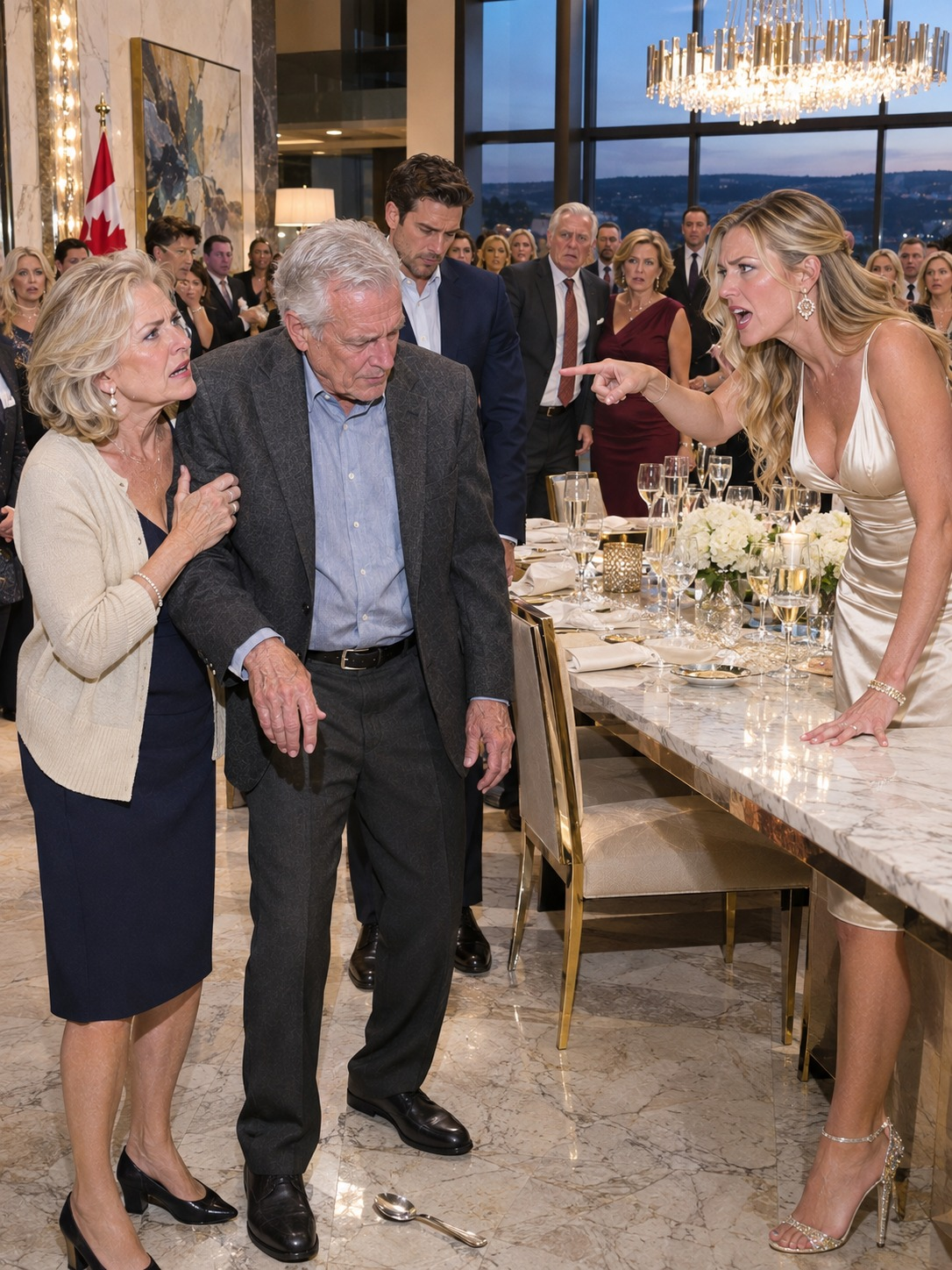
"Your wife screamed at your father because he dropped a spoon."
"I know."
"She ordered him to leave."
"I know."
"And now she's embarrassed?"
"Mom, please."
I closed my eyes.
"Does Megan understand that your father has a physical disability?"
"Of course."
"Then why does she keep treating it like a personal inconvenience?"
He didn't answer.
I waited.
Finally, he said, "She's under financial pressure."
My eyes opened.
"What kind of financial pressure?"
"Business stuff."
"Be specific."
"Mom, it's complicated."
"Then explain it slowly."
He gave an irritated breath.
"Why are you being like this?"
"Like what?"
"Interrogating me."
I looked at the man sitting across from me.
My husband was carefully lifting his soup spoon with his left hand.
His right hand rested on the table.
He had spent the previous evening being humiliated.
And our son was accusing me of asking too many questions.
"Seth," I said quietly, "your father and I have spent our lives helping you. The least you can do is speak to us honestly."
Another silence.
Then he said something that made my blood run cold.
"Mom, has Dad been having memory problems?"
I froze.
"What?"
"Memory problems."
"Why are you asking?"
"Just answer the question."
I stared at the phone.
"Your father had a stroke. His right hand trembles. His balance is affected. His memory is fine."
"Okay."
"Who told you otherwise?"
"No one."
"Seth."
"It's just something Megan mentioned."
I felt my heartbeat quicken.
"What did she mention?"
"She said Dad seemed confused at the party."
I looked at Wayne.
He was watching me.
He knew something was wrong.
"Seth, your father wasn't confused."
"All right."
"He was embarrassed."
"Mom—"
"Because your wife publicly humiliated him."
"Can we not do this again?"
I took a slow breath.
"Did you arrange a medical appointment for your father?"
Silence.
Complete silence.
I heard faint traffic noise on Seth's end.
Then a door closing.
"Why would you ask that?"
"Answer me."
"Mom, I have to go."
"Seth."
"I'll call you later."
The line went dead.
I lowered the phone.
Wayne looked at me.
"What did he say?"
I told him.
Every word.
When I finished, Wayne stared at his untouched sandwich.
Then he said quietly, "He knows something."
I nodded.
"I think so."
Wayne looked toward the window.
For the first time since his stroke, I saw something in his face that frightened me.
Not confusion.
Not weakness.
Resignation.
As though he had begun preparing himself for the possibility that his son had become someone he no longer recognized.
I reached across the table.
"Wayne."
He looked at me.
"Whatever happens, we're going to handle it together."
He nodded.
Then he picked up his spoon again.
His hand trembled.
But he didn't put it down.
That afternoon, I returned home and went straight to my office.
I opened the folder containing the mansion's records.
For years, the property had represented something good.
A second chance for Seth.
A way to help our son without humiliating him.
A quiet gift from parents who had more than they needed.
Now the mansion had become something else.
A symbol of entitlement.
A place where Megan believed she could humiliate the very people who had made her lifestyle possible.
I opened the original purchase agreement.
The amount I had paid still made me uncomfortable.
Not because I couldn't afford it.
Because I remembered how hard Wayne and I had worked to reach that point.
Every repaired kitchen.
Every late-night bookkeeping session.
Every weekend spent painting rental units while our friends went on vacation.
We had built our security slowly.
Carefully.
Honestly.
And I had placed a significant part of that security into a home occupied by people who apparently believed they deserved it simply because they wanted it.
I opened the property management agreement.
There were provisions governing occupancy, maintenance, and the use of the property.
There were also restrictions on representing ownership or offering the property as security.
I read those sections carefully.
Then I made a note to ask Rebecca about enforcing them.
I wasn't going to throw Seth and Megan out in a fit of anger.
That would be reckless.
There were legal procedures.
There was our granddaughter, Zoe.
And there was still the possibility that Seth had been manipulated into something he didn't fully understand.
But I was no longer willing to finance a fantasy.
My phone vibrated.
A message from Claire.
Mom, are you okay? Seth called me. He said there was some kind of fight last night.
I stared at the screen.
Our daughter was thirty-eight and worked as a physical therapist in Toronto.
She had been the one who helped Wayne find a rehabilitation program after his stroke.
She called him every Sunday.
She sent him articles about adaptive gardening tools.
And she had never once treated his physical limitations as an embarrassment.
I typed:
We're okay. But I need to talk to you about something important. Can you come tomorrow?
Her response arrived almost immediately.
Of course. Is Dad all right?
I hesitated.
Then wrote:
Physically, yes. There are some documents we need to discuss.
She called within seconds.
"Mom?"
I answered.
"Hi, sweetheart."
"What's going on?"
I sat down.
For the next twenty minutes, I told her everything.
The dinner.
The humiliation.
The medication photographs.
The medical report.
Seth's signature.
The credit applications.
The financing inquiry involving the mansion.
Claire listened.
Unlike Seth, she didn't interrupt.
When I finished, she said, "Mom, I want you to promise me something."
"What?"
"Don't let Dad start believing any of this is his fault."
My eyes filled with tears.
"I won't."
"And don't confront Megan alone."
"I won't."
"Good."
I heard her take a breath.
"There's something else."
I straightened.
"What?"
"Zoe called me last weekend."
My heart tightened.
"Our Zoe?"
"Yes."
"Why?"
"She was upset."
"About what?"
Claire hesitated.
"She said Megan told her Grandpa Wayne was getting sick in his head."
I closed my eyes.
Five years old.
Our granddaughter was five years old.
She loved helping Wayne plant flowers.
She loved listening to his stories.
She had never been afraid of his trembling hand.
And now someone was teaching her that her grandfather's disability meant he was mentally unwell.
"What else did Zoe say?"
Claire's voice softened.
"She asked me whether people who forget things have to go away forever."
I pressed my fingers against my forehead.
"Oh, Claire."
"I told her no. I explained that Grandpa's hand sometimes doesn't do what he wants, but his brain still works just fine."
"Thank you."
"Mom, why would Megan tell her something like that?"
I looked at the medical report on my desk.
"I don't know."
But I had a terrible suspicion.
If Megan wanted people to believe Wayne was losing his mental capacity, she might have been preparing that story for weeks.
Perhaps longer.
And children were often the easiest people to influence.
They repeated what adults told them.
Without understanding the consequences.
Claire continued.
"There's one more thing."
I held my breath.
"Go on."
"Zoe said a man came to the house to talk about Grandpa."
I sat upright.
"What man?"
"She didn't know his name."
"When?"
"Last week, I think."
"What did he look like?"
"She said he wore a gray coat and carried a black bag."
I stared at the wall.
"Did she say what he wanted?"
Claire paused.
"She said Megan told her he was helping the family make important decisions."
My stomach tightened.
"Did Zoe hear anything else?"
"Only that the man asked whether Grandpa still signed his own papers."
I closed my eyes.
There it was again.
The same pattern.
Wayne's capacity.
His signature.
His finances.
His independence.
Someone had been asking questions about all of them.
"Claire," I said, "I need you to write down exactly what Zoe told you."
"I will."
"And don't question her further right now. We don't want to frighten her or accidentally influence what she remembers."
"Okay."
"Please come tomorrow."
"I'll be there first thing."
After we hung up, I sat in silence.
Then I opened my notebook.
I wrote down everything Claire had told me.
The date.
The approximate time.
The words Zoe had used.
The description of the man.
I didn't know whether he was Dr. Hawkins.
I didn't know whether he had any connection to the clinic.
But I knew I needed to find out.
At six that evening, Wayne came into my office.
He was carrying a small wooden box.
I recognized it immediately.
It contained photographs from our early years together.
He placed it on my desk.
"Thought you might need something cheerful."
I smiled.
"What's this?"
"Evidence."
I laughed softly.
"Evidence of what?"
"That we had a pretty good life before everyone started acting ridiculous."
He opened the box.
Inside were photographs of our wedding.
Seth as a baby.
Claire learning to walk.
Family vacations.
Birthday parties.
Christmas mornings.
Wayne picked up a photograph of Seth at seven years old.
Our son was standing beside a bicycle.
His front tooth was missing.
His face was covered in dirt.
Wayne smiled sadly.
"He fell three times that day."
"I remember."
"Every time, he wanted to quit."
I nodded.
"You kept encouraging him."
Wayne studied the photograph.
"Eventually, he learned."
I looked at my husband.
"Wayne."
He raised his eyes.
"I don't know what Seth has done."
"Neither do I."
"But if he's involved in this..."
My voice broke.
Wayne reached for my hand.
"Then he'll have to face it."
I stared at him.
He continued.
"I love our son. I always will. But loving someone doesn't mean protecting them from every consequence."
I squeezed his hand.
"That's what I should have understood two years ago."
He shook his head.
"You were trying to help."
"I bought him a mansion."
"You bought a house because you thought he needed a fresh start."
"And look what happened."
Wayne smiled faintly.
"Jude, you can't buy someone good judgment."
I laughed through my tears.
"No, apparently not."
He leaned closer.
"But you can stop paying for their bad judgment."
I looked at him.
There was a firmness in his voice I hadn't heard since before the stroke.
He wasn't asking me to punish anyone.
He was reminding me that our lives still belonged to us.
Our money.
Our decisions.
Our future.
I nodded.
"You're right."
He smiled.
"Of course I am. I taught history."
I laughed again.
Then he closed the photograph box.
And for the first time all day, I felt something other than fear.
I felt determination.
At 8:17 that evening, Rebecca called.
"Judy, are you somewhere private?"
I glanced toward the living room.
Wayne was watching television.
"Yes."
"I've confirmed something about the financing inquiry."
My heart quickened.
"What?"
"The property address was submitted as part of a preliminary loan package."
"I know that."
"Yes, but there's an additional detail."
I gripped the phone.
"Tell me."
"The package included a document claiming that Seth and Megan had an ownership interest in the mansion."
I stared at the wall.
"That's impossible."
"Legally, the document does not establish ownership. But someone appears to have submitted it as supporting material."
"What kind of document?"
"A purported property interest declaration."
I felt cold.
"Who signed it?"
"That's what concerns me."
I waited.
Rebecca continued.
"The signature appears to be Seth's."
I closed my eyes.
Again.
My son.
His name.
His signature.
On another document connected to something he had no legal right to control.
"Could it be forged?"
"Possibly. We need to verify it."
I swallowed.
"Does Megan's name appear?"
"Yes."
"Where?"
"As the person who prepared the accompanying financial information."
I sat down.
Rebecca's voice remained steady.
"Judy, there's something else. I want you to understand that this is preliminary information, not proof of a completed transaction."
"All right."
"The financing package refers to a private lender."
"Who?"
"I'm still confirming the entity's details."
I rubbed my forehead.
"Rebecca, how much money were they trying to borrow?"
She paused.
Then told me.
The amount was almost enough to purchase a second mansion.
I felt physically sick.
"That's insane."
"It is a very large request."
"They couldn't possibly repay that."
"Based on the financial information you've described, repayment capacity would be a serious concern."
I stared at the papers on my desk.
"Why would anyone lend them that much?"
"That's one of the questions we need to answer."
I took a breath.
"What should I do?"
"Nothing impulsive. I've asked a colleague with experience in financial fraud to review the available information. Tomorrow, we'll discuss the next steps."
"All right."
"And Judy?"
"Yes?"
"Make sure the original ownership documents remain secure."
"They are."
"Good."
The call ended.
I sat for a long time.
Then I opened the property records again.
The mansion was still mine.
The title had not changed.
No legitimate transfer had occurred.
But someone had been using it to support financial claims.
And my husband's name had appeared in the same web of documents.
I thought about Megan's arrogance.
Her expensive gowns.
Her leased SUVs.
Her consulting business.
The parties.
The jewelry.
The endless need to impress people.
Perhaps she had been living far beyond her means for years.
Perhaps Seth had been helping her hide it.
Or perhaps he had been too frightened to admit how bad things had become.
Either way, they were now reaching toward assets that did not belong to them.
And Wayne had somehow become part of their calculations.
I looked at the photograph of our son on my desk.
The little boy with the missing tooth.
The boy who had once fallen off his bicycle three times and kept trying.
I wondered when he had stopped getting back up on his own.
And when he had started expecting someone else to carry him.
My phone vibrated.
A message from Megan.
Judy, I think we should put last night behind us. Seth says you're upset, but I don't want unnecessary drama. Come by tomorrow afternoon. We can talk like adults.
I stared at the message.
No apology.
No acknowledgment of Wayne.
No concern for his feelings.
Just an invitation to return to the mansion she believed she controlled.
I typed:
Wayne and I won't be coming tomorrow.
Her response arrived immediately.
That's disappointing. We need to discuss some important family arrangements.
I frowned.
What arrangements?
Three dots appeared.
Then disappeared.
Then appeared again.
Finally, she replied.
Seth will explain.
I put down the phone.
Something about that message disturbed me.
Not the words themselves.
The confidence behind them.
Megan seemed to believe that whatever she had planned was already moving forward.
As though she no longer needed my agreement.
Or Wayne's.
I opened my notebook and recorded the exchange.
Then I heard Wayne call from the living room.
"Jude?"
I stood.
"Coming."
When I entered, he was sitting in his favorite chair.
The television was muted.
He held his phone in his left hand.
His expression was troubled.
"What's wrong?" I asked.
He looked up.
"Seth sent me something."
My heart tightened.
"What?"
Wayne handed me the phone.
It was an email.
The subject line read:
FAMILY CARE PLANNING — URGENT REVIEW.
The message claimed that Wayne's recent medical evaluation had raised concerns about his ability to manage financial affairs independently.
It recommended a meeting with a medical professional and a financial adviser.
The meeting was scheduled for the following afternoon.
At the Burlington mansion.
I read the message twice.
Then I noticed the attachment.
A document titled:
CONSENT AND FAMILY REPRESENTATION AGREEMENT.
I opened it.
The first page contained Wayne's personal information.
The second described a proposed arrangement under which designated family members could assist with financial matters.
The third contained a signature line.
Wayne Cooper.
And beneath it:
Seth Cooper.
I looked at Wayne.
"Did you agree to any of this?"
He shook his head.
"No."
"Did Seth discuss it with you?"
"No."
I took a breath.
"Then we're not signing anything."
Wayne nodded.
"I know."
I scrolled to the bottom of the email.
There was a list of expected attendees.
Seth Cooper.
Megan Cooper.
Dr. Nathaniel Hawkins.
A financial consultant.
And one additional person.
The name was hidden behind an expandable section.
I tapped it.
The screen refreshed.
A new line appeared.
Independent Family Representative: Pending Confirmation.
I frowned.
Then another email arrived.
This one came from an address I didn't recognize.
The subject was simple.
YOU NEED TO SEE THIS BEFORE TOMORROW.
There was no message.
Only a photograph.
I opened it.
The image showed a desk covered with documents.
A black leather briefcase rested beside a laptop.
Several pages were spread across the surface.
At the top of one page, I could see Wayne's name.
At the bottom was the Long Realy company logo.
My breath caught.
Someone had obtained a document bearing my company's name.
A document I had never authorized.
I enlarged the photograph.
There was a handwritten note in the margin.
Confirm ownership before funds release.
I stared at those words.
Then I noticed something in the background.
A framed family photograph.
I recognized it.
I had given that photograph to Seth and Megan for their wedding anniversary.
It stood on a side table in the mansion's upstairs office.
The photograph had been taken inside their home.
Recently.
And whoever had sent it had been close enough to read the documents on the desk.
My phone vibrated again.
A second message appeared.
THEY THINK THE HOUSE IS THEIRS.
I swallowed.
Then another.
THEY DON'T KNOW WHAT'S IN THE ORIGINAL FILE.
I stared at the screen.
Before I could respond, the sender transmitted one final photograph.
This one showed a thick folder.
Its cover bore the name of my real estate company.
Long Realy.
Below it was the address of the Burlington mansion.
And beneath that, in bold capital letters, were four words:
BENEFICIAL OWNERSHIP — CONFIDENTIAL RECORD.
I froze.
That document should have been in Rebecca's secure office.
I had never given Seth or Megan a copy.
I had never even mentioned its existence.
Yet someone inside their mansion was holding it.
I enlarged the image.
At the edge of the photograph, a hand was visible.
A man's hand.
Wearing a distinctive silver watch.
I knew that watch.
I had bought it for someone fifteen years earlier.
For his university graduation.
My son.
Seth.
I stared at the image.
Then my phone rang.
Unknown number.
I answered without speaking.
For a moment, there was only breathing.
Then a man's voice whispered:
"Mrs. Cooper, your son just found out who really owns the mansion."
I stood completely still.
The voice continued.
"And he's not the person you need to be afraid of."
A door slammed somewhere behind him.
I heard hurried footsteps.
Then a woman's voice.
Sharp.
Furious.
Familiar.
"Who are you talking to?"
The man whispered one final sentence.
"She's coming for the original documents."
The call disconnected.
I stared at my phone.
Then a new photograph appeared.
It showed the mansion's upstairs office.
The door was open.
A woman stood in the doorway, holding a black folder.
I enlarged the image.
The woman's face was turned away.
But I recognized the emerald-green velvet sleeve.
Megan.
And she was holding a document that could expose everything.
I was about to call Rebecca when another message appeared.
JUDY, DON'T COME TO THE MANSION. SHE HAS ALREADY CALLED SOMEONE.
Then a final line appeared.
AND THE PERSON SHE CALLED WAS—






Comments 0