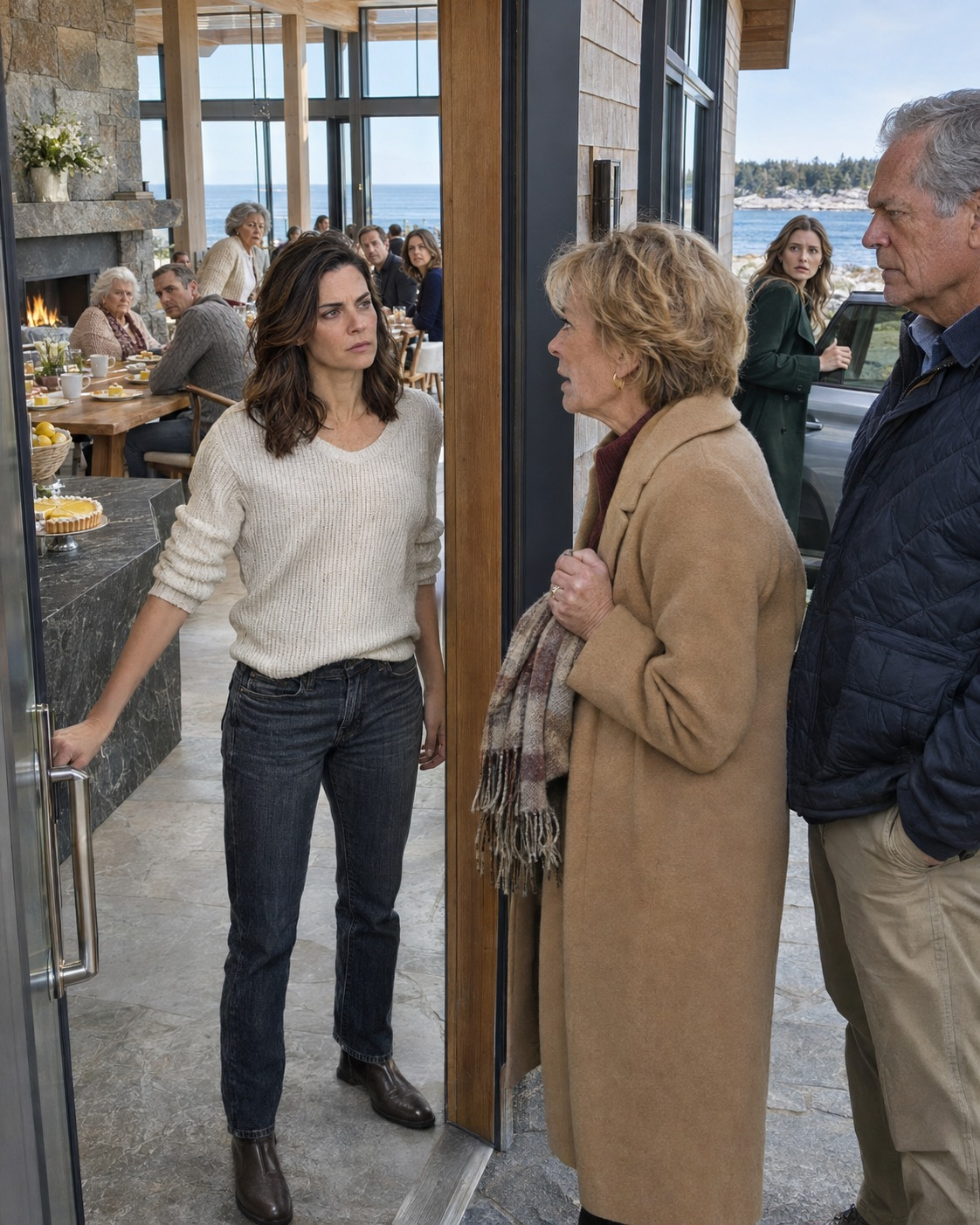
My grandmother was standing in the doorway when my mother’s message appeared on my phone.
"Your parents aren't coming?" Joyce asked quietly.
I looked down at the screen again.
The message was still there.
My mother had sent it at 8:17 that Thursday morning, two days before my housewarming celebration.
"Your dad and I are going to skip the housewarming. Jenna just moved too, and we want to keep things small. Hope you understand."
I was standing beside a six-thousand-pound slab of dark soapstone in the kitchen of a house I had spent three years designing and building.
Outside the enormous windows, the Atlantic Ocean stretched toward the horizon. Waves crashed against the black rocks far below the granite bluff. Morning sunlight moved across the natural cedar walls and illuminated the steel staircase leading to the upper floor.
Everything was exactly where I had imagined it.
The kitchen island had taken months to source. The oak flooring had been installed by a carpenter who had become more like family than a contractor. Every window had been positioned to capture a different view of the coastline.
The house was worth approximately six million dollars.
My parents thought I had bought a modest little property.
They had never asked enough questions to discover otherwise.
I read my mother's message three times.
Then I typed two words.
"That's okay."
I put my phone down.
For several seconds, I couldn't move.
It wasn't the cancellation itself that hurt.
It was how familiar it felt.
My name is Danielle Marshall. I was thirty-five years old, an architect, a business owner, and the founder of a design-build company called Second Form.
I had built homes for people who trusted me with their money, their dreams, and sometimes their most personal memories.
I had transformed abandoned buildings into beautiful places where people could begin again.
But somehow, I had spent most of my life trying to earn a place in a family that never seemed to notice when I was missing.
My younger sister, Jenna, had always been different.
Not because she was cruel.
She wasn't.
She was simply the person everyone naturally gathered around.
When Jenna celebrated a birthday, my parents decorated the backyard, ordered a custom cake, invited neighbors, and spent days preparing.
When I celebrated mine, Mom usually bought a grocery-store cake and promised that next year would be different.
Next year rarely arrived.
I learned early not to expect much.
At eleven, I won first place at the county science fair.
I had built a small wind-powered model car using scrap wood, a coat hanger, and an old ceiling-fan motor.
I remembered carrying that blue ribbon home.
I remembered how carefully I placed it on the kitchen counter.
I remembered standing there, waiting for my father to look at it.
He glanced at the ribbon.
"That's nice, kiddo. Just don't stay up so late doing this stuff."
Then he returned to the television.
Mom was more interested in telling me how well Jenna had performed at her dance recital.
"Your sister has such a natural stage presence," she said. "You should try something more social, Danielle."
I nodded.
I took my ribbon upstairs.
That night, I lay in bed staring at the ceiling fan, wondering why something that had made me so happy suddenly felt embarrassing.
I didn't know then that the feeling would follow me into adulthood.
Jenna's achievements became family celebrations.
Mine became brief conversations between other people's announcements.
When she made the cheerleading squad, Dad took everyone to her favorite Italian restaurant.
When I earned a place in a competitive engineering program, he asked whether I was certain I would fit in with all those math students.
Mom reminded me that Jenna needed help with her English assignment.
I helped her.
I always helped her.
I reviewed her essays, carried her boxes, fixed her computer, and drove her to appointments whenever my parents were busy.
I became the dependable daughter.
The one who didn't need attention.
The one who could be trusted to understand.
Eventually, everyone began treating my understanding as an unlimited resource.
My grandfather was the only person who seemed to notice.
He had owned a small carpentry workshop and spent most of his retirement repairing furniture for neighbors.
His workbench had been passed down to my parents after he died.
They eventually moved it into the garage, where it collected dust beneath old paint cans and forgotten boxes.
I loved that workbench.
At fourteen, I began spending afternoons there.
I read library books about woodworking and watched instructional videos whenever I could find a computer.
My first project was a small stool.
Its legs weren't perfectly even, and the plywood seat had a visible scratch.
But when I finished sanding the edges, I ran my hand over the wood and felt something wonderful.
I had made something.
Nobody had to approve of it.
Nobody had to compare it with Jenna's achievements.
It existed because I had imagined it and worked until it became real.
That stool remained in my bedroom for years.
It was the first thing I had ever built that made me believe I could create a life of my own.
At eighteen, I received a full scholarship to study architecture in California.
I placed the acceptance letter on the refrigerator beside one of Jenna's dance photographs.
My parents barely mentioned it.
At my going-away dinner, Dad told me not to get lost on the West Coast.
Mom asked whether I could help Jenna with her college applications before leaving.
I agreed.
Then I packed my belongings and moved across the country.
California was difficult.
Architecture school demanded everything from me.
I worked at a cabinet shop, swept sawdust, refinished old doors, and accepted small design jobs whenever I could find them.
Some nights, I slept only four hours.
Some mornings, I arrived at class with wood dust still trapped beneath my fingernails.
But for the first time, I was surrounded by people who wanted to hear what I thought.
My professors challenged my ideas.
My classmates questioned my drawings.
Clients asked me why I had chosen a particular material or positioned a window in a particular direction.
I loved it.
I discovered that architecture was more than constructing beautiful buildings.
It was about understanding how people felt inside the spaces they occupied.
I remembered my childhood dining room.
I remembered sitting at the edge of family gatherings while everyone turned toward Jenna.
I remembered being sent into the kitchen to help while the others continued talking.
Without realizing it, I began designing the opposite of those experiences.
Rooms where people could see one another.
Tables where nobody was pushed to the edge.
Windows that brought light into places that had once felt forgotten.
After graduation, I stayed in California.
I worked for an established architecture firm before eventually opening my own company.
I called it Second Form.
The name reflected something I believed deeply: discarded things could become valuable again, and a person was never required to remain the version of themselves that other people expected.
Our first projects were small.
An old barn became a neighborhood café.
A dark apartment became a bright home for a young couple.
A neglected storefront became a community art studio.
We used reclaimed wood whenever possible.
We restored rather than replaced.
We built slowly and carefully.
Then referrals began arriving.
One client recommended us to another.
A magazine featured one of our renovations.
A developer contacted us about a larger project.
My company grew.
My parents still described it as my little creative business.
Whenever Mom asked how work was going, I gave her a brief answer.
"Busy."
"That's good, honey," she would say. "Just make sure you have something stable."
I stopped explaining.
Three years before the housewarming, something changed.
Mom called to tell me Jenna and her husband had purchased their first house.
She sounded delighted.
"She's becoming so responsible," she said. "Your father is absolutely thrilled."
I congratulated Jenna.
I genuinely meant it.
But after the call ended, I sat alone in my office and looked at the blueprints spread across my desk.
Every single project belonged to someone else.
I had spent years creating places where strangers could feel safe, welcome, and understood.
Yet I had never built a home for myself.
That evening, I began searching for property in Maine.
A few weeks later, I found it.
A granite bluff overlooking the Atlantic in Port Clyde.
There was an old fishing shack on the property, barely standing against the coastal wind.
The realtor apologized for the condition of the structure.
I barely heard her.
I could already see the house.
Glass walls.
Natural cedar.
Black steel.
Stone floors.
A long oak dining table running through the great room.
A kitchen designed for people to gather rather than simply prepare food.
I bought the property.
For three years, I worked alongside local builders, carpenters, masons, and engineers.
I checked materials after storms.
I reviewed measurements before installations.
I visited the property during freezing mornings and stayed late when the builders needed another set of hands.
I learned how unforgiving salt air could be.
I changed window specifications, adjusted drainage plans, and reconsidered details that other people might have ignored.
I wanted everything to last.
When the house was finally completed, I stood in the empty dining room for nearly an hour.
The sunlight moved across the oak floor.
The ocean was visible through every major window.
The kitchen island looked exactly as I had imagined.
And the dining table was long enough to seat fifteen people comfortably.
I had deliberately avoided creating a traditional head-of-the-table position.
I wanted every guest to feel equally important.
A few months before the housewarming, a producer from HGTV contacted me.
Someone had seen photographs of the construction online and recommended the property for a coastal design special.
They wanted to feature the house.
I agreed.
The episode would not air for several weeks.
I didn't tell my parents.
I didn't tell Jenna.
It wasn't a secret I had carefully planned to reveal.
I simply wanted to enjoy something without wondering how my family would compare it with someone else's life.
Then came my mother's message.
"Your dad and I are going to skip the housewarming."
I looked at it again.
I could have called her.
I could have asked whether she had misunderstood the date.
I could have reminded her that I had spent three years building the house.
I could have told her that this was important to me.
But I had done those things in different ways for thirty years.
I was tired.
Instead, I opened my contacts.
I called my cousin Luke, who had been excluded from family gatherings after an old disagreement nobody could properly explain anymore.
I called Aunt Peggy, who always seemed to spend holidays serving food in the kitchen while everyone else sat in the dining room.
I called Uncle Keith, the quietest person in our family.
I called Erica, my closest college friend, whose own parents had skipped her graduation.
And I called my grandmother Joyce.
Each person received the same invitation.
"Come have dinner with me."
I didn't tell them how much the house was worth.
I didn't mention television.
I didn't promise an elaborate celebration.
I simply invited them to share a meal.
By Thursday evening, my guest list was complete.
Fifteen people.
Fifteen comfortable chairs.
Fifteen identical place settings.
Fifteen invitations to belong.
I had no idea that the message my mother had sent that morning would eventually become the most important family message I had ever received.
Because on Friday afternoon, while I was arranging the final place cards, my phone rang.
The name on the screen made my hand stop.
It was my grandmother.
And she had something to tell me about my mother that I had never heard before.






Comments 0