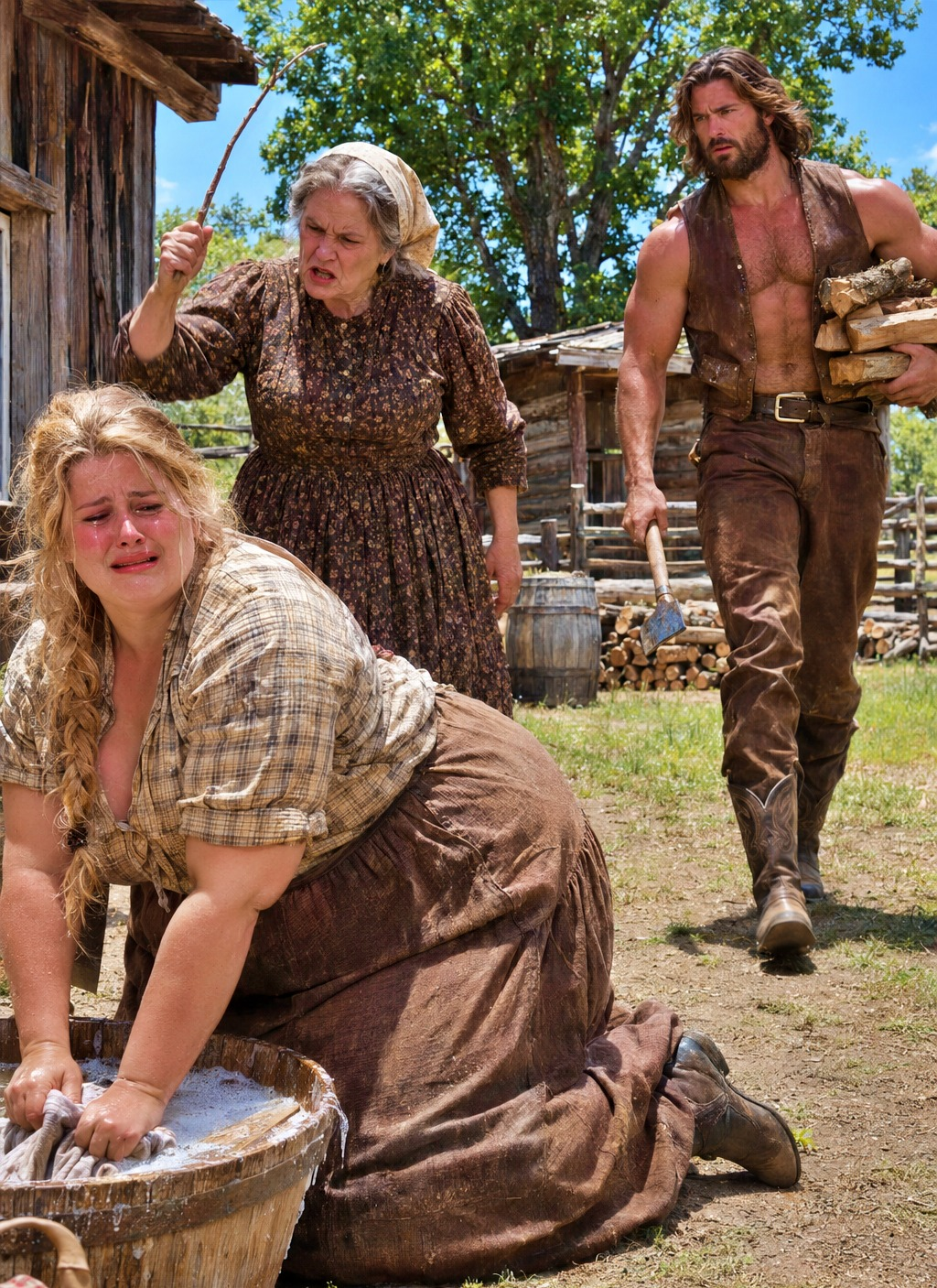
Josephine Merrick dropped to her knees beside the wooden washtub as her mother's switch cracked against her shoulder.
"Please, Mama. That's enough."
Adeline Merrick stepped closer, clutching a folded piece of paper in her other hand.
On the back of the paper, beneath a faded county seal, someone had written two words.
Josephine's inheritance.
Her mother had been hiding more than money.
Josephine did not see the writing.
Not yet.
All she saw was the shadow of the switch rising again.
She lowered her head and waited.
At twenty-three years old, Josephine had become exceptionally good at waiting for pain.
She knew how to recognize the warning signs: the tightening of her mother's lips, the sudden stillness before an outburst, the way Adeline's breathing changed when she was searching for someone to blame.
That morning, the offense had been breakfast.
"You let it burn!" Adeline shouted.
"The oats weren't burned, Mama."
The second blow landed across Josephine's upper arm.
"Don't contradict me!"
Josephine pressed her wet hands against the rim of the washtub.
Soap bubbles clung to her fingers.
The oats had not burned. She knew because she had stood over the stove for twenty minutes, stirring carefully while the first light appeared through the kitchen window.
But truth had never been particularly useful in the Merrick household.
Truth only mattered when Adeline was the one speaking it.
Josephine looked down at the gray water.
"Yes, Mama."
Adeline gave a satisfied grunt.
"Finish those clothes. Then scrub the kitchen floor. And don't think you're going to town until everything is done."
She turned toward the house, her dark dress brushing against the weeds.
Josephine remained kneeling until the kitchen door slammed.
Only then did she release the breath she had been holding.
Her shoulder throbbed.
Her back ached.
But the worst pain came from something that had happened several hours earlier.
At four that morning, Josephine had made a decision.
She was leaving.
And this time, nothing her mother said would change her mind.
For fourteen years, Josephine had lived inside a house where every sound carried a warning.
Her father, Samuel Merrick, had disappeared when she was nine.
Adeline told everyone he had abandoned them.
Sometimes she claimed he had run away with another woman. Other times she insisted he had been a drunk who squandered every dollar before vanishing into the mountains.
Josephine remembered a different man.
She remembered her father lifting her onto his shoulders so she could reach the first ripe apples in the orchard.
She remembered his hands smelling of leather and cedar.
And she remembered the last thing he said before leaving.
"You're stronger than you know, little bird."
For years, she had believed he would return.
At ten, she watched the road every Sunday.
At twelve, she stopped asking questions.
At fifteen, she stopped expecting anything.
By twenty-three, she had learned that hope could become a dangerous habit when placed in the wrong hands.
Her mother made certain of that.
Adeline controlled the money Josephine earned at the dry goods store.
She controlled the food, the clothing, the visitors, and the hours Josephine was permitted to spend outside.
When Josephine received a compliment, Adeline found a reason to punish her.
When a young man once offered to escort Josephine home after church, Adeline told him her daughter was simple-minded and unsuitable for marriage.
He never returned.
Afterward, Adeline said, "See? Nobody wants a girl who can't even manage her own household."
Josephine had been seventeen.
She remembered crying into her pillow that night.
She also remembered her mother opening the bedroom door and ordering her to stop making such a ridiculous noise.
That was the last time Josephine allowed herself to cry where anyone could hear.
The summer of 1883 had brought a relentless heat to Briarcliff, Colorado.
The small mountain town lay beneath a wide sky, surrounded by timber country, grazing land, and roads that turned to dust beneath wagon wheels.
Most people knew one another.
Unfortunately, knowing someone did not always mean helping them.
The neighbors knew Adeline had a temper.
They heard the shouting.
They saw Josephine's bruises.
But Adeline was a respectable widow in the eyes of the church, and Josephine was merely her quiet daughter.
People preferred explanations that required nothing from them.
"She fell."
"She bruises easily."
"Her mother has had a difficult life."
Josephine had heard every excuse.
She had even repeated some of them herself.
Only one person had ever looked at her injuries without pretending not to understand.
Nell Ashby.
Nell was married to the town telegraph operator and worked beside him at the post office.
She was a practical woman with gentle eyes and a habit of speaking plainly.
Three months earlier, Josephine had arrived at the post office wearing a scarf despite the heat.
Nell had noticed the swelling beneath her jaw.
She had not asked what happened.
Instead, she reached beneath the counter and handed Josephine a small bottle of arnica salve.
"For when something hurts," she said.
Josephine stared at the bottle.
Then at Nell.
Neither woman spoke for several seconds.
Finally, Josephine whispered, "Thank you."
Nell touched her hand.
"You don't have to stay where you're being hurt."
Those words had followed Josephine home.
They had followed her through the spring.
And now, on this terrible summer morning, they had become impossible to ignore.
By eight o'clock, the laundry was finished.
Josephine carried the heavy basket toward the clothesline, each step sending a dull ache through her shoulder.
Her mother sat on the porch, shelling peas into a bowl.
"You're moving slowly."
"I'm nearly finished."
"You always have an excuse."
Josephine hung a wet sheet over the line.
Adeline watched her.
"What's wrong with your face?"
"Nothing, Mama."
"You look like you're plotting something."
Josephine secured the sheet with wooden pins.
"No, Mama."
Adeline narrowed her eyes.
"Don't forget who feeds you."
Josephine looked toward the road.
Beyond the fence, a narrow dirt track curved between cottonwood trees before disappearing toward town.
She had walked that road hundreds of times.
To church.
To the store.
To fetch medicine.
To deliver things her mother demanded.
But she had never walked it without planning to return.
Until today.
"Josephine!"
She turned.
"Yes?"
"Did you hear me?"
"I'm sorry. What did you say?"
Adeline slammed the bowl onto the porch railing.
"I said you're an ungrateful girl."
Josephine looked at her mother.
For one brief moment, she considered telling the truth.
She considered saying that she had spent fourteen years trying to earn affection from a woman who treated love like a debt that could never be repaid.
She considered asking why nothing she did was ever enough.
Instead, she said, "I'll finish the kitchen floor."
Adeline smiled thinly.
"That's better."
Josephine entered the house.
She closed the door gently.
Then she walked straight to the kitchen drawer.
The money was hidden beneath a folded dishcloth.
Forty-seven cents.
Two dimes.
Four nickels.
Seven pennies.
Josephine counted them twice.
They represented almost six months of small sacrifices.
A penny saved when the shopkeeper mistakenly gave her extra change.
A nickel earned for mending a neighbor's apron.
A dime Nell had insisted she keep after helping with a shipment of mail.
Adeline believed every cent Josephine earned belonged to the household.
Josephine had learned to hide what little she could.
She placed the coins inside a small cloth pouch.
Then she reached farther into the drawer for her grandmother's Bible.
Her fingers brushed against something unfamiliar.
Paper.
Folded tightly.
She pulled it out.
It was an old document, yellowed at the edges.
A county seal had been stamped near the top.
Most of the writing was difficult to read, but she recognized one name immediately.
Margaret Whitcomb.
Her grandmother.
Josephine's pulse quickened.
Margaret had died when Josephine was eleven.
She had been the only person in the family who ever held Josephine without demanding something in return.
Her grandmother had taught her to read.
To bake bread.
To mend torn clothing.
And, most importantly, to keep her word.
"People can take many things from you," Margaret once told her. "But they cannot make you dishonest unless you help them."
Josephine unfolded the document.
At the bottom, in faded handwriting, she saw her own name.
Josephine Merrick.
Beneath it were the words:
To be held in trust until her twenty-first birthday.
Josephine stared.
Her twenty-first birthday had been two years ago.
She tried to read the remaining lines.
But footsteps sounded on the porch.
Her mother's footsteps.
Josephine folded the paper quickly.
The kitchen door opened.
Adeline stood in the doorway.
"What are you doing?"
Josephine turned, keeping the document hidden against her skirt.
"Putting things away."
Adeline looked at the open drawer.
Then at Josephine's hand.
Her expression changed.
"What's that?"
"Nothing."
"Show me."
Josephine hesitated.
It was a small hesitation.
Barely a second.
But Adeline noticed.
"Give it here!"
She crossed the kitchen and snatched the paper from Josephine's fingers.
For a moment, neither woman moved.
Adeline looked down.
Her face lost its color.
"Where did you find this?"
"In the drawer."
"You had no business touching it."
"It has my name on it."
Adeline's eyes snapped upward.
"That doesn't make it yours!"
Josephine felt something cold settle in her stomach.
"Why does it say twenty-one?"
Adeline crushed the paper in her fist.
"Because it's an old document that means nothing."
"But Grandma Margaret—"
"Your grandmother was a foolish woman!"
Josephine flinched.
Adeline stepped closer.
"She filled your head with nonsense. Always telling you that you deserved better. Always interfering in my household."
Josephine had never heard her mother speak about Margaret with such open hatred.
"What did she leave me?"
Adeline's face hardened.
"Nothing."
"Then why—"
"Enough!"
The slap came so quickly Josephine barely saw it.
Her head turned.
A sharp ringing filled her left ear.
Adeline stood breathing heavily, the crumpled document still in her hand.
"You will never mention this again."
Josephine touched her cheek.
Something inside her became very still.
She looked at her mother.
For the first time, she did not apologize.
Adeline seemed to notice.
"Do you understand me?"
Josephine lowered her hand.
"Yes."
Her voice was steady.
Adeline watched her suspiciously.
Then she turned toward the stove.
"Get back to work."
Josephine obeyed.
But she had made another decision.
She would not leave the house without her grandmother's Bible.
And one day, when she was safe, she would find out what that document meant.
At half past nine, Adeline announced she was going to visit Mrs. Pritchard.
"Have supper ready when I return."
"Yes, Mama."
"And don't waste the good flour."
"No, Mama."
Adeline took her bonnet from the peg.
She stopped at the door.
"Sometimes I wonder what would become of you without me."
Josephine stood beside the stove.
She had heard that question all her life.
Usually, she answered with gratitude.
Today, she said nothing.
Adeline waited.
Then she shook her head and left.
Josephine listened to the footsteps fade down the road.
She waited another full minute.
Then she moved.
Fast.
She took her small traveling bag from beneath the bed.
Inside went one spare dress, a clean blouse, two pairs of stockings, a blanket, and her grandmother's Bible.
She wrapped the forty-seven cents in cloth and tucked it into the lining of her skirt.
Then she found a pencil.
On a scrap of paper, she wrote:
I have gone.
Do not look for me.
She read the words twice.
Her hand trembled.
Not because she was uncertain.
Because, after fourteen years, she was finally doing something her mother had forbidden.
She placed the note beneath the salt shaker.
Then she looked around the kitchen.
The stove where she had cooked thousands of meals.
The table where she had eaten in silence.
The narrow stairs she had climbed each night, listening for the sound of anger behind her.
She expected to feel sorrow.
Instead, she felt exhausted.
There was nothing left in that house she wanted to carry.
Except the Bible.
And herself.
Josephine stepped onto the porch.
The sunlight was bright enough to make her squint.
A breeze moved through the cottonwood leaves.
Somewhere beyond the fence, a meadowlark sang.
She walked down the steps.
At the gate, she stopped.
For one terrible moment, she imagined her mother returning.
She imagined Adeline's face twisting with fury.
The shouting.
The accusations.
The threats.
She imagined being dragged back into the kitchen and punished for daring to leave.
Her hand tightened around the bag.
Then she remembered Nell's words.
You don't have to stay where you're being hurt.
Josephine opened the gate.
And walked through.
She did not look back.
The road into Briarcliff seemed longer than usual.
Josephine kept her head down when wagons passed.
She avoided familiar faces.
Every time she heard hoofbeats, her heart jumped.
But nobody stopped her.
At the edge of town, she passed the feed store.
A faded notice hung beside the entrance.
She had read it two weeks earlier.
HELP WANTED.
COOKING, HOUSEKEEPING, GENERAL RANCH WORK.
BOARD AND FAIR WAGES.
SUTTER RIDGE RANCH.
NORTH MOUNTAIN ROAD.
The notice had since been marked through with pencil.
Josephine knew the position might already be filled.
She knew she had no promise of employment.
She knew nine miles of mountain road separated her from the ranch.
But she also knew she could not return home.
She crossed the street toward the post office.
Nell Ashby was sorting letters behind the counter.
When she saw Josephine, she smiled.
Then her smile faded.
"Josephine?"
Josephine stepped inside.
"I need to tell you something."
Nell glanced toward the door.
"What happened?"
"I'm leaving today."
Nell became very still.
"Leaving Briarcliff?"
"Yes."
"Where will you go?"
"North. There's a ranch. Sutter Ridge."
Nell looked at the small bag in Josephine's hand.
Then at the bruise on her cheek.
"Does your mother know?"
"No."
Nell closed the ledger.
For several seconds, she said nothing.
Then she walked to the back room.
Josephine heard a drawer open.
When Nell returned, she carried a folded cloth.
"Take this."
Inside were several coins and a small pocketknife.
Josephine shook her head.
"Nell, I can't."
"You can."
"I don't know when I could repay you."
"You won't owe me anything."
Josephine's eyes filled.
Nell pressed the bundle into her hand.
"Someday, when you meet someone who needs help, you do the same."
Josephine nodded.
Nell came around the counter and embraced her.
Josephine stood stiffly at first.
Then she slowly returned the embrace.
It had been so long since anyone held her without anger that she nearly forgot how.
"Listen carefully," Nell whispered. "Don't take the main street out. Go behind the livery. Follow the north road."
Josephine pulled back.
"Why?"
Nell glanced toward the front window.
"Because your mother came here yesterday."
Josephine froze.
"What?"
"She asked whether I'd been helping you save money."
A cold sensation traveled down Josephine's spine.
"What did you tell her?"
"That I didn't know what she meant."
Josephine swallowed.
Nell lowered her voice.
"She also asked whether I'd seen you looking at the Sutter Ridge notice."
Josephine stared at her.
"How could she know?"
"I don't know."
Outside, a wagon rolled past.
The post office clock ticked.
Nell gripped Josephine's hand.
"Go now."
Josephine turned toward the door.
But before she could reach it, she heard a familiar voice outside.
A woman's voice.
Sharp.
Angry.
Calling her name.
"Josephine Merrick!"
Josephine stopped breathing.
Nell hurried to the window.
Her face went pale.
"Josephine," she whispered, "don't turn around."
But Josephine had already seen the shadow moving across the frosted glass.
The door handle began to turn.
And her mother's voice came from the other side.
"I know you're in there."






Comments 0