Sarah placed the document on the conference table.
She didn't sit down.
She didn't offer an explanation.
She simply turned the first page toward me and pointed to a name printed beneath the production company's logo.
LORELEI WARD — FAMILY PARTICIPATION CONSULTANT.
For several seconds, I couldn't make sense of the words.
My mother had never worked in television.
She had never produced a film, managed a production team, or even shown an interest in anything beyond Delaney's social media business.
Yet there she was.
Listed as a paid consultant on a commercial reality series.
I looked at Sarah.
"How long has she been involved?"
"According to this document, approximately five months before the wedding."
Beckett leaned forward.
"What's a family participation consultant?"
Sarah turned another page.
"It's a position created to coordinate access to family members, arrange filming opportunities, and help the production team obtain cooperation from participants."
"Participants?" I repeated.
She nodded.
"That's the terminology they're using."
I looked down again.
My mother's name appeared beside a financial arrangement.
Fifteen percent of the production budget.
I read the figure twice.
"Fifteen percent?"
Sarah pulled out a calculator.
"The production advance was three hundred and fifty thousand dollars. If your mother's compensation was calculated against that amount, her share would be fifty-two thousand five hundred dollars."
Beckett stood up.
"Fifty-two thousand dollars?"
"Potentially more," Sarah replied. "The agreement may cover additional production payments. We need the complete financial records before establishing the total."
I stared at the document.
My mother had accepted money to arrange access to her own family.
I thought about the wedding.
The cameras.
The seating arrangements.
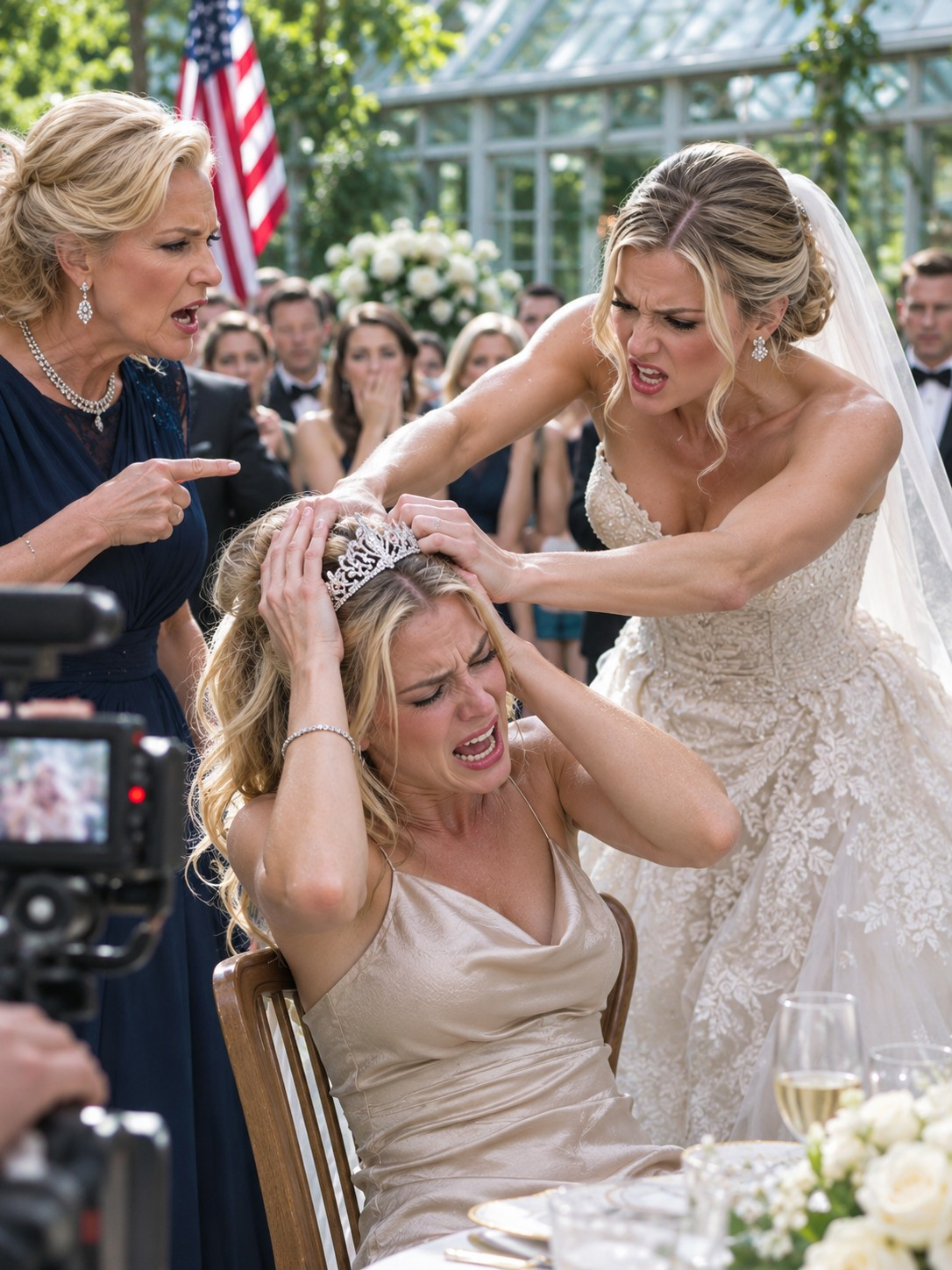
The way she had checked the recording light while I was bleeding.
Suddenly, several things that had seemed strange became painfully clear.
"Was she responsible for assigning my seat?"
Sarah examined another page.
"According to the production schedule, yes."
I leaned closer.
There was a seating diagram.
My name appeared beside a small camera symbol.
Delaney's position was marked in the center of the reception area.
Lorelei's chair was positioned close enough to reach me without entering the camera's primary frame.
I felt sick.
"Why would they need a diagram?"
Sarah turned the page.
"Because the production team wanted to capture the confrontation from several angles."
Beckett pointed at the screen.
"There's a note here."
I followed his finger.
The note read:
Older sister seated near the floral wall. Primary camera captures initial reaction. Secondary camera records maternal intervention.
Maternal intervention.
I read the phrase again.
"That's what Mom did."
Sarah nodded.
"The document appears to anticipate her involvement."
I remembered the moment.
The blood.
The guests.
My mother's hand on Delaney's shoulder.
The red recording light.
I had assumed Lorelei was simply indifferent.
But the production outline suggested something worse.
She had been assigned a role.
I turned another page.
There was a section titled FAMILY DYNAMICS.
Under my name, the description was almost identical to the wording in the promotional presentation.
Emotionally guarded. Resistant to reconciliation. Financially independent. Unwilling to acknowledge Delaney's achievements.
I let out a breath.
"Financially independent?"
Sarah looked up.
"What's wrong?"
"They make it sound like a personality disorder."
Beckett gave a short, bitter laugh.
"Apparently paying your own mortgage is threatening."
I continued reading.
Another sentence appeared beneath the description.
Subject should be encouraged to attend major family events. Avoid advance disclosure of production objectives.
I stopped.
"Subject?"
Sarah reached for the document.
"That terminology is important."
I looked at her.
"Why?"
"Because it suggests the production company wasn't treating you as a willing participant in a family documentary. They were treating you as someone whose reactions could be managed."
Beckett's face darkened.
"Could be managed?"
Sarah nodded.
"Or manipulated."
I looked at the page again.
There was a column labeled EXPECTED EMOTIONAL RESPONSE.
Beneath it were three entries.
Initial discomfort.
Public confrontation.
Emotional escalation.
The final line read:
Delaney's response should remain sympathetic. Lorelei should redirect attention toward the bride.
I pushed the document away.
"They planned this."
Sarah didn't disagree.
"At least, they planned a confrontation."
"That isn't the same thing?"
"Not necessarily. We still need to establish who knew about the barbed wire, who prepared the tiara, and whether the production company was aware of the intended physical injury."
Beckett looked furious.
"Does that matter? My sister was injured, and my daughter was filmed without permission."
"It matters legally," Sarah replied. "We need evidence that distinguishes what each person knew and what each person did."
I understood her point.
But I also understood something else.
My family had been discussing my behavior for months.
They had written a character description.
They had created a filming schedule.
They had arranged cameras.
They had even anticipated how my mother would respond when I became upset.
And none of them had thought to ask whether I wanted to be involved.
I had been turned into a storyline before I knew there was a show.
Sarah closed the folder.
"I want both of you to understand something. We are not going to rush into public accusations. We are going to preserve the evidence, establish the financial arrangements, and protect Juniper."
Beckett nodded.
"What happens next?"
"We obtain the original production documents and investigate the authorization for Juniper's footage."
She turned toward me.
"And we need to understand the complete scope of the agreement your mother offered you."
I remembered the settlement.
The seventy-five thousand dollars.
The medical expenses.
The lost income.
The nondisclosure clauses.
"She wanted me to sign away my right to discuss recordings involving minors."
Sarah nodded.
"Which is particularly concerning now."
I looked at the document again.
"Do you think she knew about Juniper's footage?"
"I think the evidence suggests she had access to the production arrangements. Whether she personally reviewed or approved every recording is something we still need to establish."
Beckett rubbed his forehead.
"She told me Juniper's college fund was secure."
I turned toward him.
"What do you mean?"
"Mom said Delaney had arranged something. She told me there was a family investment connected to the show."
"What kind of investment?"
"I don't know. She said there would be money for Juniper when she turned eighteen."
Sarah immediately made a note.
"Do you have anything in writing?"
"Maybe. Mom sent me a message about it a few months ago."
He opened his phone.
After scrolling through several conversations, he found it.
He handed the screen to Sarah.
The message came from Lorelei.
Delaney is doing something wonderful for Juniper's future. Please don't interfere with the arrangements. Everything is being handled.
Beckett stared at it.
"She made it sound like a college fund."
Sarah examined the date.
"When did you receive this?"
"Four months ago."
"Do you remember signing anything around that time?"
"No."
"Did you provide any personal information for Juniper?"
Beckett thought for a moment.
"Mom asked me for her date of birth, school information, and a copy of her birth certificate. She said it was needed for an educational account."
I looked at him.
"Did you send it?"
"Yes."
Sarah stopped writing.
"Do you still have that conversation?"
"I think so."
"Preserve it."
Beckett looked at me.
"I thought she was helping."
I didn't know what to say.
I remembered my mother telling me that Delaney was generous.
That she was trying to build something meaningful.
That the entire family would benefit from her success.
Apparently, the family had been benefiting in ways we hadn't understood.
That afternoon, Sarah arranged for a secure document exchange with the streaming network.
We received a preliminary production package.
It included the original presentation, financial schedules, filming plans, and several internal communications.
Sarah printed the pages.
We spent nearly two hours reviewing them.
The more I read, the less I recognized my own family.
There were photographs from birthdays, holiday dinners, and family vacations.
Some were public photographs from Delaney's social media accounts.
Others appeared to have been taken privately.
One showed Beckett helping Juniper with homework.
Another showed Lorelei standing beside a Christmas tree.
A third showed me at my apartment door.
I stared at that photograph.
It had been taken from the hallway.
I was carrying grocery bags.
My hair was tied back, and I was wearing an old sweater.
"Where did this come from?"
Sarah examined the page.
"It's listed as reference material."
"Who took it?"
"The document doesn't say."
I looked at the photograph again.
I hadn't known anyone was taking pictures of me.
There was something deeply unsettling about seeing an ordinary moment from my life presented as material for a production team.
Beneath the photograph was a note.
Subject maintains independent residence and limited family contact. Potential for narrative conflict around perceived exclusion.
I felt my stomach tighten.
They had taken the fact that I lived independently and turned it into evidence that I was difficult.
Beckett turned another page.
"Look at this."
It was a list of possible episode themes.
Family reconciliation.
Sibling jealousy.
The perfect bride.
The difficult daughter.
The grieving teenager.
I stopped at the last one.
"Grieving teenager?"
Sarah took the page.
"That's likely referring to Juniper."
There was a handwritten annotation beside the phrase.
Strong emotional material. Handle carefully. Family consent required.
Beckett slammed his hand against the table.
"She's not material!"
Sarah waited until he had finished.
"I agree. But we need to be careful about how we approach this."
He looked away.
I understood his anger.
He had spent three years trying to help his daughter rebuild her life after losing her mother.
Now he was discovering that someone had been documenting her worst moments and treating them as valuable entertainment.
I turned to another page.
There was a financial schedule.
Delaney's company had received the three-hundred-and-fifty-thousand-dollar production advance.
The payment was divided into several installments.
The first had been released after the initial concept presentation.
The second followed confirmation of the participating family members.
The third was connected to delivery of the first approved episode materials.
My mother's compensation appeared in a separate section.
Fifteen percent of the production budget.
The agreement described her responsibilities as coordinating family participation, supporting production access, and facilitating scheduled events.
I looked at Sarah.
"She was paid to make sure we showed up."
"That's what the agreement indicates."
"And to make sure we cooperated."
Sarah nodded.
I leaned back.
For the first time, I understood why Lorelei had been so determined to have me attend the wedding.
She hadn't wanted a family photograph.
She had needed me in a specific chair.
At a specific time.
In front of a specific camera.
I thought about the cream silk dress.
The family portrait.
The request not to wear anything dramatic.
I had believed my mother wanted the photographs to look beautiful.
Perhaps she wanted them to look predictable.
My phone vibrated.
A message from Maren.
Delaney's maid of honor.
I hadn't spoken to her since the reception.
Her message was short.
Can we talk privately? I need to tell you something about the wedding.
I stared at the screen.
Sarah noticed.
"Who is it?"
"Maren."
"Do you know what she wants?"
"Not yet."
I typed a reply.
What is this about?
She answered immediately.
I was part of the production team. I didn't understand everything until I saw what happened to you.
I showed Sarah.
She leaned forward.
"Ask whether she's willing to speak with us through counsel."
I typed the message.
Maren's response came a minute later.
Yes. But there's something you need to know first.
Another message appeared.
The tiara wasn't supposed to be part of the original wedding presentation.
I read it twice.
My hands became cold.
I showed Beckett.
He stood up.
"What does that mean?"
I didn't answer.
Another message arrived.
I saw someone working on it before the reception.
I stared at the screen.
Sarah immediately asked me to preserve the entire conversation.
Then she contacted Maren through the number provided.
For several minutes, nothing happened.
I walked toward the window.
Outside, Manhattan continued moving as if my family hadn't just become strangers to me.
Cars moved through the intersection.
People crossed the street carrying coffee.
A delivery truck stopped beside a loading area.
Ordinary life.
I envied it.
My phone vibrated again.
Maren had sent a photograph.
It showed a dressing room at the conservatory.
Several garment bags hung from a clothing rack.
A small table stood beside a mirror.
On the table was a silver object wrapped in white tissue paper.
The tiara.
I enlarged the photograph.
There was a handwritten note beside it.
Only three words were visible.
FOR SLOANE — DELANEY.
My throat tightened.
Sarah came to stand beside me.
"Is that the original tiara?"
"I think so."
She examined the photograph.
"Can you ask Maren when this was taken?"
I typed the question.
Maren replied.
Before the guests arrived.
Then another message appeared.
And Sloane, there's something else.
I stopped breathing for a moment.
The next message contained a photograph of a printed production checklist.
At the bottom was a signature.
I recognized the handwriting immediately.
It belonged to my mother.
And beside her signature was a handwritten instruction:
MAKE SURE SLOANE WEARS THE TIARA.
I looked at Sarah.
She had gone completely still.
Then Maren sent one final message.
I have the original checklist. But you need to see who gave it to me.
A moment later, my phone began ringing.
The caller's name appeared on the screen.
LORELEI WARD.






Comments 0