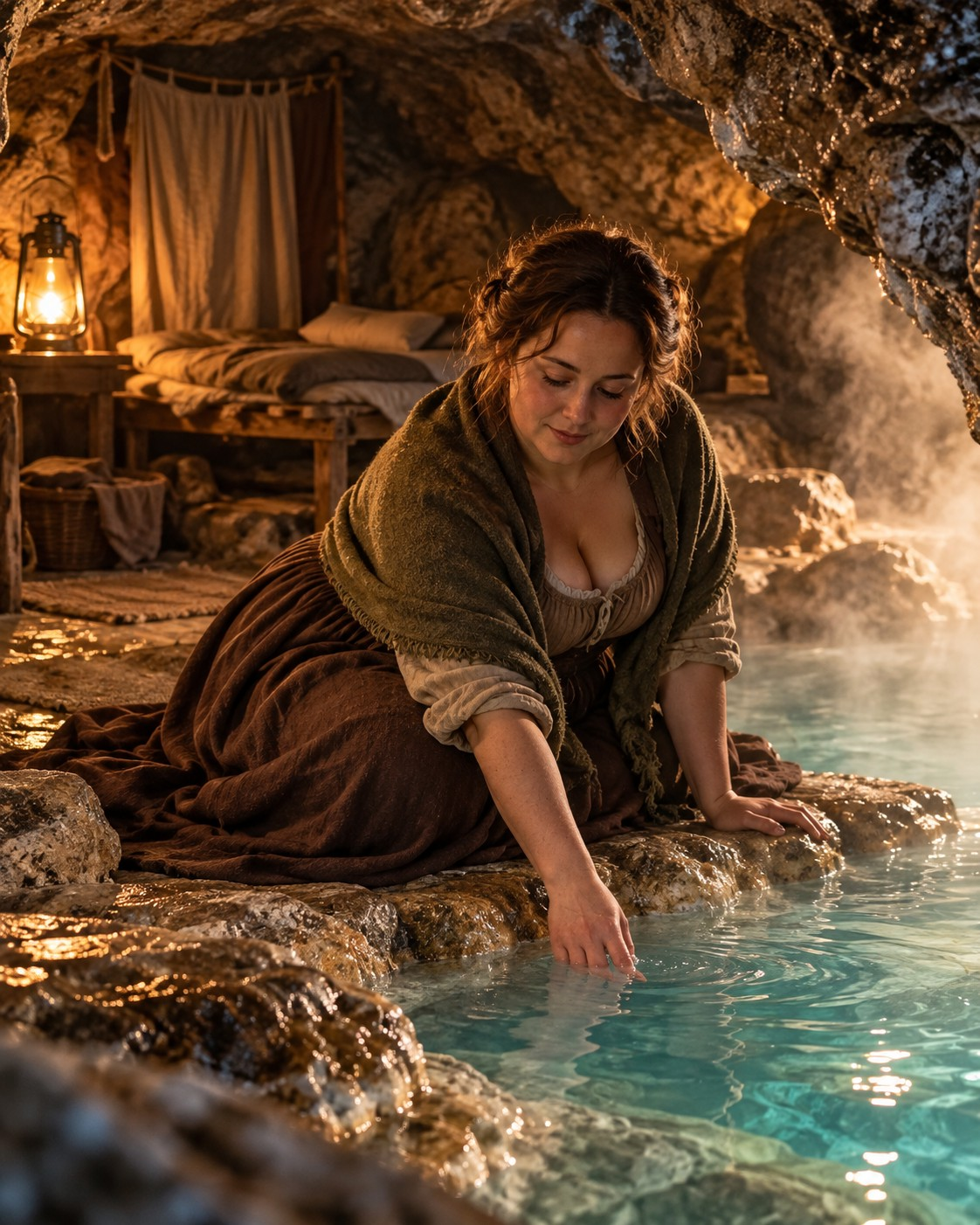
I didn't move.
The voice came from somewhere beyond the granite slab.
"Did you hear me?"
I tightened my fingers around the lantern.
"Who are you?"
A brief silence followed.
"Someone who knows that opening."
I looked toward the narrow crack.
The man was standing outside.
I could see the outline of his boots beneath the brush.
"Are you lost?" I asked.
He gave a short laugh.
"No. Are you?"
I didn't answer.
He stepped closer.
The lantern revealed part of his coat, a pair of worn leather gloves, and a long wooden walking stick.
He was older than I had expected.
Perhaps sixty.
His beard was grey, and his face looked weathered by years of mountain wind.
He glanced at the little shelter I had built.
Then he looked at the kettle beside the opening.
"How long have you been here?"
"Since yesterday."
"Where's your fire?"
"I don't have one."
He looked at me as though I had said something ridiculous.
"Then how are you staying warm?"
I pointed toward the rock.
His expression changed.
Only slightly.
But I noticed.
He looked at the narrow opening, then at the ground beneath it.
"You felt it."
It wasn't a question.
"Yes."
He lowered his walking stick.
"How much?"
"I don't know. Enough to feel it through my fingers."
He studied me.
Then he crouched beside the opening and placed his gloved hand near the crack.
For several seconds, neither of us spoke.
Finally, he stood.
"What's your name?"
"Mara."
He nodded.
"Caleb."
I waited for him to explain.
He didn't.
Instead, he examined the shelter again.
"You built that?"
"Yes."
"With what?"
"Branches and rope."
He shook his head.
"It won't last through a heavy snowfall."
"I know."
"And if the entrance gets blocked, you'll be trapped."
I looked at the opening.
"I know that too."
He seemed surprised.
For a moment, I thought he might offer advice.
Instead, he picked up one of my branches and examined it.
"You're trying to live here?"
"I have nowhere else."
He looked at my wet coat.
Then at the empty matchbox beside the lantern.
"How many matches?"
"None."
His eyes narrowed.
"How many did you use?"
"Nine."
He looked toward the mountains.
"All in one night?"
I nodded.
He exhaled slowly.
"Then you learned the expensive lesson quickly."
I felt my cheeks grow warm.
"I know I made mistakes."
"Everyone does."
He placed the branch back on the ground.
"But this mountain doesn't forgive all of them."
I didn't appreciate the warning.
Not because it was wrong.
Because I had heard enough warnings from people who had roofs over their heads.
Hale had warned me about winter.
The hotel owner had warned me about late deliveries.
The bank had warned me about payments.
Everyone had been very generous with warnings.
Nobody had offered a solution.
I stood.
"If you know something about this place, tell me."
Caleb looked at me for a long moment.
Then he stepped toward the opening.
"There's an old mineral seam beneath this ridge. Water moves through the rock. Some of it comes from deep underground."
"Hot springs?"
"Not exactly."
He pointed toward the narrow crack.
"Warm water can heat the surrounding stone. Air moves through the fractures. Depending on the season and the pressure, it comes out through openings like this."
I looked at the ground.
"So the warmth is natural?"
"Yes."
"Will it last?"
"That depends."
"On what?"
"How deep the passage goes. How the air circulates. Whether the snow blocks the opening. Whether you understand what you're doing before you start changing things."
I studied his face.
"You've been here before."
He nodded.
"A long time ago."
"Why didn't you stay?"
He looked toward the forest.
"Because I had somewhere else to go."
That answer told me almost nothing.
I glanced at his boots.
They were the same kind that had left the tracks beside the entrance.
"Those footprints were yours."
Caleb looked down.
"Probably."
"You were here yesterday?"
"I came through the ridge."
"Why?"
He hesitated.
Then he pointed toward the rock formation.
"Checking an old boundary marker."
I wasn't convinced.
But I didn't press him.
Instead, I asked the question that mattered.
"Could someone live here?"
He looked at my shelter.
"Not like that."
I felt my stomach tighten.
"Could someone build something that would?"
Caleb didn't answer immediately.
He walked around the granite slab and examined the hillside.
Then he crouched near the strip of frostless ground.
He scraped away some loose soil.
Beneath it was dark, damp earth.
He touched the ground.
"Interesting."
"What?"
"The warmth isn't coming from only one place."
He moved his hand toward the opening.
"Air is escaping here, but the ground is also holding heat."
He stood.
"There's more to this ridge than I remembered."
I watched him.
"Can you show me?"
Caleb shook his head.
"I can show you what to avoid."
It wasn't the answer I wanted.
But it was more than Hale had ever given me.
He examined the overhang again.
"First, you need to keep snow away from the entrance. Second, you need to stop the wind from entering your sleeping area. Third, you need insulation."
"I have one blanket."
"Then you'll need more."
"I have eleven dollars and forty cents."
He looked at me.
For the first time, his expression softened.
"That's not much."
"No."
He reached into his coat and removed a small piece of folded paper.
It was an old map.
He opened it against the granite.
Several ridges were marked in pencil.
A narrow blue line crossed the upper portion.
"What is that?"
"An old survey."
He pointed toward the rock formation.
"This ridge was examined decades ago. The surveyors were looking for mineral deposits."
"Did they find any?"
"Some."
"Did they find this opening?"
Caleb folded the map.
"I don't know."
I stared at him.
He seemed to notice my frustration.
"Listen, Mara. Warm air doesn't mean a safe home. A cave can hold dangerous gases. Water can flood a passage. The temperature can change. You need to test everything carefully."
I nodded.
That was the first thing he had said that sounded like genuine advice.
He glanced toward the forest.
"I have to go."
"Will you come back?"
He paused.
"Maybe."
Then he began walking downhill.
I watched him disappear between the trees.
Before he vanished completely, he turned.
"One more thing."
I waited.
"Don't close that opening."
"Why?"
"Because you don't know what keeps the air moving."
Then he was gone.
I stood beneath the granite overhang for a long time.
The wind had begun to rise again.
I looked at the opening.
Then at the little shelter I had built.
Caleb was right.
I knew almost nothing about the place.
But I had something I hadn't possessed the day before.
A direction.
I spent the following morning examining the ridge.
I marked the areas where the frost had melted.
I watched the movement of the air near the cracks.
I placed small pieces of cloth at different points and observed which ones moved.
I also looked for signs of water.
There were several.
Tiny mineral deposits had formed along the lower rocks.
The ground remained damp even where the surrounding earth was frozen.
And the elk tracks continued along the same narrow strip.
They were using the area regularly.
That mattered.
Animals didn't need maps or scientific explanations.
They simply followed places that offered the best chance of survival.
I began to understand that the ridge was not one warm opening.
It was a system.
A natural network of stone, water, and moving air.
I still didn't know enough to build a proper shelter.
But I could begin with the basics.
I reinforced the frame with thicker branches.
I collected dry grass from beneath the sheltered rocks.
I used the remaining strips of cloth to cover gaps where the wind entered.
Then I moved my sleeping area farther from the opening, leaving enough space for the airflow to continue.
I didn't want to block something I didn't understand.
That afternoon, I found another narrow passage on the opposite side of the granite slab.
It was partially concealed beneath a fallen tree.
The air there was cooler.
I placed a strip of cloth near it.
It moved inward.
I returned to the first opening.
The cloth moved outward.
I stared at the two points.
Air was entering through one place and leaving through another.
The mountain was breathing.
I remembered Caleb's warning.
Don't close that opening.
Now I understood why.
If I blocked the wrong passage, I could stop the movement that made the warm air possible.
I sat beside the rock and began drawing a rough diagram in the dirt.
Two openings.
One flow.
A sheltered area between them.
I drew arrows.
Then I added the direction of the wind.
It wasn't a perfect diagram.
But it was the first time I had ever tried to understand a place instead of simply surviving in it.
As evening approached, I returned to the shelter.
I had managed to make it slightly more secure.
The blanket was still damp, but I had found a dry patch of grass to place beneath it.
I ate the last of my oats.
Then I checked the lantern.
There was only a little oil left.
I would have to find another solution soon.
I was considering whether I could trade some sewing work for supplies when I noticed something near the entrance.
A small piece of paper.
It had been placed beneath a flat stone.
I picked it up.
The paper was old and folded several times.
There was writing on the front.
My fingers tightened.
It was not Caleb's handwriting.
The message contained only one sentence:
IF YOU FOUND THE WARM AIR, YOU ARE NOT THE FIRST.
I turned the paper over.
There was a date.
October 17, 1938.
And beneath it, written in darker ink, were five words that made my stomach turn.
ASK HALE WHAT HE KNOWS.






Comments 0