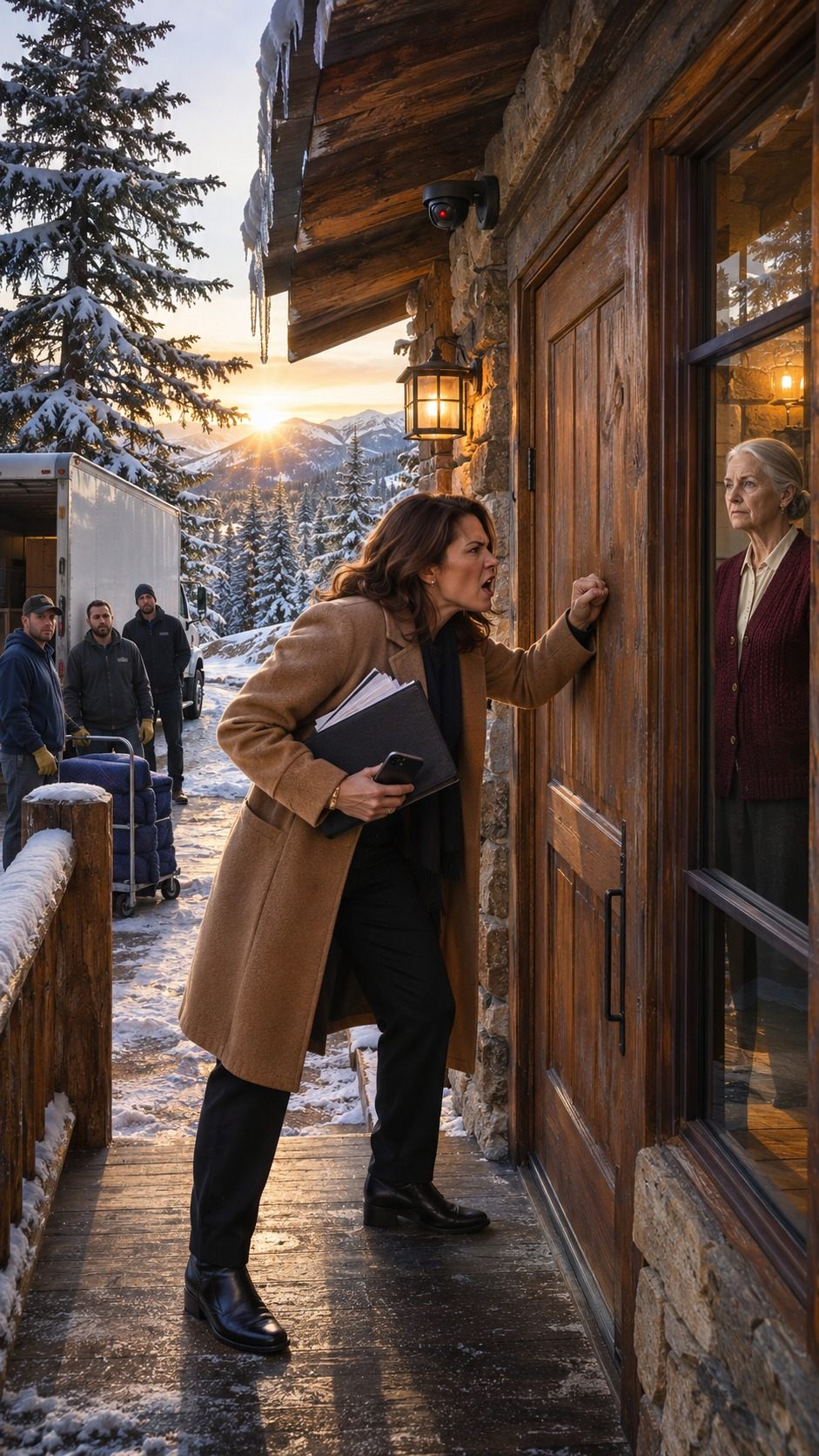
"Open this door! This property belongs to me now!"
Melissa slammed her fist against my front door while my security guard, Mike, watched a moving truck parked beside the porch.
In her hand was a thick black folder.
A small yellow sticker on its corner carried three words:
TRANSFER AUTHORIZATION — APPROVED.
I knew immediately that something was wrong.
Because I had never authorized a transfer.
And Melissa had just made the biggest mistake of her life.
Twenty-three minutes earlier, my telephone had rung at exactly five in the morning.
Nobody called me at that hour unless something was seriously wrong.
I was seventy-two years old, and after four decades of marriage, raising a son, burying my husband, and surviving enough family disappointments to fill several lifetimes, I had learned to trust that instinct.
I reached across my bedside table and answered.
"Hello?"
"Mrs. Harland?"
It was Mike Dawson, my security guard.
Mike had worked for my late husband for nearly fifteen years. He was a dependable man in his late fifties, with a quiet voice and the kind of patience that came from dealing with difficult people without losing his temper.
But that morning, something in his voice sounded different.
"Mike? What's happened?"
"I'm sorry to wake you, ma'am. There's a situation at the front gate."
I sat upright.
"What kind of situation?"
He hesitated.
"Your daughter-in-law is here."
I looked at the clock.
5:00 a.m.
"Melissa?"
"Yes, ma'am."
"At five in the morning?"
"She's brought a moving truck."
For several seconds, I said nothing.
Outside my bedroom window, the Colorado mountains were still wrapped in darkness. The first suggestion of sunrise was beginning to appear behind the snow-covered pines.
A moving truck.
At five in the morning.
My daughter-in-law had never been particularly considerate, but even for Melissa, this was extraordinary.
"Is my son with her?" I asked.
"No, ma'am."
"Then what exactly is she doing here?"
Mike lowered his voice.
"She says the property belongs to her now."
I slowly pushed the blankets away.
"Excuse me?"
"She says she has documents proving ownership. She's demanding access to the cabin. She brought three movers, and she's telling them they're supposed to empty the house."
I turned toward the window.
The mountains were beginning to glow with pale gold light.
For a moment, I simply watched the sunrise.
Then I smiled.
Not because anything was funny.
Because Melissa had chosen the worst possible morning to make her move.
"Let her through," I said.
Mike went silent.
"Mrs. Harland, are you sure?"
"Absolutely."
"Ma'am, she's being extremely aggressive."
"I understand."
"She claims you're no longer legally entitled to occupy the property."
"Does she?"
"Yes."
I reached for the robe hanging beside my bed.
"Mike, I want you to do something for me."
"Anything, ma'am."
"Have her sign the visitor log."
There was another pause.
"The visitor log?"
"Yes. Her full name. Arrival time. Vehicle information. Everything."
"Understood."
"And Mike?"
"Yes?"
"Don't argue with her."
I could almost hear him frowning.
"May I ask why?"
"Because I want her to feel completely comfortable telling us exactly what she intends to do."
I ended the call.
Then I sat on the edge of my bed for a moment, listening to the silence.
My name is Eleanor Harland.
I was seventy-two years old that winter, and I had lived in that mountain cabin for twenty-eight years.
My husband, Robert, had built it when our son, Daniel, was still a teenager.
Robert used to say he wanted a place where the world couldn't reach us.
He had spent most of his working life building a successful construction company. He understood contracts, property, money, and the complicated ways people behaved when they believed something valuable was within their reach.
But the cabin was different.
It was never meant to be an investment.
It was our home.
Robert had chosen every piece of timber himself. He had argued with the architect about the size of the windows. He had insisted that the front porch face east so we could watch the sun rise over the mountains.
And when the builders finished, he had stood beside me in the empty living room and said something I never forgot.
"Ellie, whatever happens to the rest of the world, this place will always be yours."
He had kept that promise.
Even after his death.
Especially after his death.
I walked into my dressing room and selected a cream cashmere turtleneck, charcoal trousers, and my favorite emerald-green wool coat.
Robert had given me that coat for our last wedding anniversary.
I still remembered him laughing when I told him it was too expensive.
"Then promise me you'll wear it when you need to feel important," he'd said.
I put it on.
Then I brushed my short silver hair, fastened my pearl earrings, and went downstairs.
The cabin was quiet.
The heating system hummed beneath the floors.
A lantern glowed beside the front entrance.
Beyond the tall windows, the snow-covered forest stretched toward the mountains.
Everything looked exactly as it had the night before.
That was the strange thing about betrayal.
The world rarely changed its appearance to warn you.
Sometimes the sun rose beautifully on the very morning someone planned to destroy your life.
I entered the small security room beside the hallway.
Six monitors illuminated the desk.
Robert had installed the original security system years earlier, but after his death, I had upgraded it.
The cameras covered the driveway, front gate, porch, side entrance, garage, and main hallway.
The recordings were automatically backed up to a secure system outside the property.
That last detail mattered.
More than Melissa knew.
I switched on the monitor displaying the front gate.
There she was.
My daughter-in-law.
Melissa Harland.
Forty-eight years old, platinum-blonde hair, expensive midnight-blue wool coat, cream leather boots, and the unmistakable posture of a woman who believed everyone around her existed to follow instructions.
She stood beside a large white moving truck.
Three men waited nearby.
One of them held a clipboard.
Another leaned against the truck, looking uncomfortable.
The third was checking the straps on a moving dolly.
Melissa was speaking rapidly into her phone.
Even without sound, I recognized the expression on her face.
Impatience.
Entitlement.
That familiar little tightening around her mouth whenever the world refused to move quickly enough.
I turned up the audio.
"—I don't care what she says," Melissa snapped. "We have the paperwork. Just do your jobs."
One of the movers shifted his weight.
"Ma'am, we're supposed to confirm that the person inside knows we're coming."
Melissa turned on him.
"She's elderly. She's confused. That's why we're here."
I felt something cold settle in my chest.
Not fear.
Recognition.
For months, Melissa had been using those words.
Elderly.
Confused.
Forgetful.
She said them casually, often with a sympathetic smile.
At family dinners, she would correct things I hadn't said incorrectly.
When I mentioned an appointment, she would ask whether I was sure I remembered the date.
Once, when I couldn't immediately find my reading glasses, she had laughed and told Daniel that perhaps I shouldn't be living alone anymore.
Daniel had looked embarrassed.
I had said nothing.
People often mistake silence for agreement.
Melissa certainly had.
I watched her approach Mike at the gate.
He held out the visitor log.
She looked offended.
"Seriously?"
"Standard procedure, ma'am."
"I'm family."
"Yes, ma'am."
"I own this property."
"Then I'm sure you won't mind signing."
Melissa snatched the pen.
I leaned toward the screen.
She wrote her name.
Melissa Harland.
Then the date.
Then the time.
5:07 a.m.
Mike checked the entry.
"Thank you."
Melissa thrust the clipboard back at him.
"Now open the gate."
Mike stepped aside.
The iron gates slowly swung inward.
And the moving truck began its journey up my driveway.
I watched it disappear between the trees.
Then I poured myself a cup of tea.
I had met Melissa eleven years earlier.
Daniel brought her to dinner on a Sunday evening in September.
She was charming then.
Beautiful, articulate, ambitious.
She asked Robert intelligent questions about his business. She complimented the cabin. She offered to help me clear the table.
When Daniel stepped outside to take a phone call, she looked around the living room and said, "This place must be worth a fortune."
I remember laughing.
"Probably. But we've never thought of selling it."
She smiled.
"Of course not."
At the time, I thought nothing of it.
Looking back, I wondered whether that had been the first moment she began calculating.
Daniel was our only child.
He was a good boy growing up, gentle and thoughtful, but he had always struggled with confrontation.
Robert was decisive.
I was patient.
Daniel somehow inherited my patience without his father's ability to recognize when patience had become surrender.
He loved Melissa.
And because he loved her, he made excuses.
When she criticized his career, he said she wanted him to succeed.
When she complained that we didn't give them enough financial help, he said she was worried about their future.
When she began suggesting that I move into a retirement community after Robert died, he said she was only concerned about my safety.
I wanted to believe him.
For a while, I did.
But concern has a different sound from calculation.
And Melissa's concern always seemed to end with someone else gaining access to my property.
Three months before that morning, she had invited me to lunch.
We met at a restaurant in Denver.
She arrived carrying a folder.
That should have warned me.
"Eleanor," she began, "Daniel and I have been talking."
I set down my water glass.
"About?"
"Your future."
"My future?"
She gave me a gentle smile.
"We're worried about you living so far away from everyone."
"I'm quite happy where I am."
"Of course. But happiness and safety aren't always the same thing."
I waited.
She opened the folder.
Inside were brochures for luxury senior living communities.
Beautiful buildings.
Private dining rooms.
Indoor swimming pools.
Organized activities.
Everything designed to make surrendering your independence look like an upgrade.
"I've found a wonderful place," she said. "They have immediate availability."
"How thoughtful."
She leaned forward.
"And if we handle the cabin properly, the transition could be financially very comfortable."
I looked at her.
"Handle the cabin?"
"Well, it doesn't make sense to leave such a valuable property sitting empty."
"It wouldn't be empty. I live there."
She laughed softly.
"You know what I mean."
I did.
That was precisely the problem.
I closed the brochure.
"Melissa, I'm not moving."
Her smile held for another second.
Then it changed.
Just slightly.
"Eleanor, eventually we all have to accept reality."
"Indeed."
"And Daniel agrees that something needs to be done."
I studied her.
"Does he?"
"Absolutely."
"Then perhaps Daniel should speak to me himself."
She closed the folder.
Our lunch ended shortly afterward.
Two days later, Daniel called.
He sounded uncomfortable.
"Mom, Melissa said you got upset."
"Did she?"
"She was only trying to help."
"Daniel, did you ask your wife to find me a retirement home?"
Silence.
"Not exactly."
"What does that mean?"
"We talked about options."
"Did you agree that I should sell the cabin?"
Another silence.
"Mom, nobody's trying to take your house."
I remember looking out the window at the mountains.
"Then nobody should have a problem with me keeping it."
He sighed.
"You're making this harder than it needs to be."
That sentence stayed with me.
Because I had heard it before.
Not from Robert.
From people who wanted something I wasn't willing to give them.
At 5:24 a.m., the moving truck appeared on the driveway camera.
It crawled slowly through the snow.
Its tires crunched over the gravel.
The sunrise had grown brighter, painting the pine branches gold.
Melissa climbed out before the driver had fully shut off the engine.
She immediately began giving instructions.
"You two, start with the furniture inside. The other one can clear the shed."
One mover looked toward the cabin.
"Are you sure the owner knows we're coming?"
Melissa waved the folder.
"I've already explained this."
"Yes, ma'am, but—"
"Do you want to get paid?"
He fell silent.
I watched Melissa point toward my porch.
Then the side entrance.
Then the garage.
She was dividing my home into pieces.
Furniture.
Tools.
Boxes.
Possessions.
As though twenty-eight years of living could be reduced to a moving inventory.
One mover approached the porch steps.
He stopped when he saw the security camera.
"Ma'am," he said, "is there someone inside?"
Melissa gave an impatient laugh.
"Of course there's someone inside."
"Then shouldn't we speak to her first?"
Melissa's voice sharpened.
"She's elderly, confused, and completely alone."
My fingers tightened around the teacup.
There it was again.
The story she had been telling about me.
Only this time, she had brought an audience.
Melissa stepped onto the porch.
"By noon, she'll be gone."
The words came through the speaker clearly.
I looked at the recording indicator.
A small red light blinked.
Everything was being preserved.
Every word.
Every gesture.
Every person who had witnessed it.
I placed the teacup on the desk.
Then I reached for the telephone.
Mike answered immediately.
"Mrs. Harland?"
"Is everything all right at the gate?"
"Yes, ma'am. I'm coming up toward the driveway now."
"Good."
"Do you want me to stop them?"
"Not yet."
"She's already on your porch."
"I can see her."
He hesitated.
"Mrs. Harland, with respect, I don't like this."
"Neither do I."
"Then why are we letting her continue?"
I looked at Melissa pounding on the door.
"Because she's telling us things she would never admit if she knew someone was listening."
Mike said nothing.
"Just stay close," I added.
"Of course."
I ended the call.
Outside, Melissa struck the door again.
"Open this door!"
The sound echoed through the hallway.
I remained seated.
"Don't pretend you can't hear me!"
Another blow.
"I have the legal right to enter!"
I looked at the monitor.
The three movers stood together near the truck.
None of them looked comfortable.
The tallest man stepped forward.
"Ma'am, maybe we should wait until someone answers."
Melissa turned toward him.
"Do you understand how much money I'm paying your company?"
"Yes, but—"
"Then stop wasting my time."
He stepped back.
I felt a strange sadness.
Not for myself.
For Daniel.
My son had married a woman who seemed to believe that volume was authority and money was permission.
And somehow, over the years, he had allowed her to convince him that keeping the peace meant letting her have her way.
I wondered where he was that morning.
Whether he knew.
Whether he had approved.
Whether he was lying in bed while his wife tried to remove his mother from her home.
That thought hurt more than Melissa's threats.
I stood.
My knees were a little stiff, as they often were on cold mornings, but I walked steadily toward the entrance.
I passed the framed photograph of Robert hanging beside the staircase.
He was standing on the porch the summer we finished building the cabin.
One arm around me.
The other holding a hammer.
We were laughing.
I stopped for a moment.
"You were right about one thing, darling," I whispered.
The house remained silent.
"People show you who they are when they think you're powerless."
I continued down the hallway.
Melissa was still shouting when I reached the door.
"This is ridiculous!"
I heard her footsteps moving across the porch.
"You cannot hide in there forever!"
I placed my hand on the lock.
For one moment, I considered how different things might have been.
If Melissa had come with kindness.
If she had asked whether I needed help.
If she had treated me as a person rather than an obstacle.
I might have welcomed her inside.
I might have made breakfast.
We might have sat together watching the sunrise.
Instead, she had arrived with a moving truck.
And a plan.
I turned the lock.
Click.
Outside, the shouting stopped.
The silence was immediate.
I opened the door slowly.
Melissa stood directly in front of me.
Her fist was still raised.
Behind her, the movers watched.
Mike stood near the driveway.
The cold mountain air brushed against my face.
Melissa stared at me.
For the first time that morning, she seemed unsure what to say.
I looked directly into her eyes.
"Good morning, Melissa."
She lowered her fist.
"Eleanor."
"You're up early."
Her expression hardened.
"We need to talk."
"So I gathered."
She lifted the folder.
"I have documents."
"How interesting."
"Legal documents."
"Then I imagine they're very important."
She frowned.
I could see she had expected something different.
Perhaps tears.
Perhaps confusion.
Perhaps an elderly woman trembling in the doorway, begging for more time.
Instead, I stood quietly with my hands relaxed at my sides.
Melissa took a breath.
"You need to understand something. This property no longer belongs to you."
I tilted my head slightly.
"Doesn't it?"
"No."
"That's quite a serious statement."
"It's the truth."
I glanced toward the security camera above the porch.
Then back at her.
"You arrived at exactly the right time."
Melissa's eyes narrowed.
"What does that mean?"
I didn't answer.
Instead, I looked at the folder in her hand.
The yellow sticker was visible.
TRANSFER AUTHORIZATION — APPROVED.
And beneath those words was a small printed date.
I recognized it.
It was the date of an appointment I had attended in Denver three weeks earlier.
An appointment Melissa knew nothing about.
I felt my heartbeat settle into a slow, steady rhythm.
"May I see your documents?" I asked.
Melissa hesitated.
Then she smiled.
It wasn't a pleasant smile.
It was the smile of someone who believed she had finally won.
"Of course."
She opened the folder.
Inside was a stack of papers secured with a silver clip.
She pulled out the first page and held it toward me.
"Everything is perfectly legal."
I took the document.
At the top, in bold letters, were the words:
PROPERTY TRANSFER AGREEMENT.
Below them was my full legal name.
Eleanor Margaret Harland.
And at the bottom of the page—
my signature.
I stared at it.
Not because I was confused.
Not because I had forgotten signing something.
But because I recognized the handwriting.
Someone had copied my signature.
And they had made one tiny mistake.
A mistake only Robert and I would have recognized.
I looked up at Melissa.
She was watching my face closely.
"Well?" she demanded.
I carefully folded the corner of the document back into place.
Then I asked a question.
"Melissa, who prepared this agreement?"
Her smile disappeared.
"Why?"
"Because I'd very much like to meet them."
She opened her mouth.
Before she could answer, a phone began ringing inside her coat.
She glanced at the screen.
Her face changed.
Only for a second.
But I saw it.
She quickly turned the phone away.
Too late.
I had already read the name.
Daniel Harland.
My son.
Melissa rejected the call.
Then she looked back at me.
"We don't have time for games, Eleanor."
I held the document between two fingers.
"No," I said quietly. "I don't suppose we do."
Behind her, one of the movers cleared his throat.
"Ma'am?"
Melissa turned angrily.
"What now?"
The man pointed toward the driveway.
A second vehicle was coming through the gate.
A black SUV.
Melissa frowned.
"Who is that?"
I looked past her.
The vehicle moved slowly toward the cabin.
Its headlights swept across the snow.
Then it stopped behind the moving truck.
The driver's door opened.
A man stepped out carrying a leather briefcase.
Melissa went completely still.
Because she recognized him.
And when he looked toward the porch, he spoke a name that made her grip the folder so tightly the papers bent.
"Melissa."
He closed the car door.
Then he looked directly at me.
"Mrs. Harland, we need to talk about the signature on that document."
Melissa took a step backward.
The man opened his briefcase.
And removed a second copy of the agreement.
This one had a red stamp across the front.
FRAUD INVESTIGATION — EVIDENCE COPY.
He looked at Melissa.
Then he said five words.
"Your husband told me everything."
Melissa's phone began ringing again.
This time, she didn't dare answer.
Because the man standing beside the SUV was the one person she had never expected to see at my cabin that morning.
And he had brought something far more dangerous than a moving truck.






Comments 0