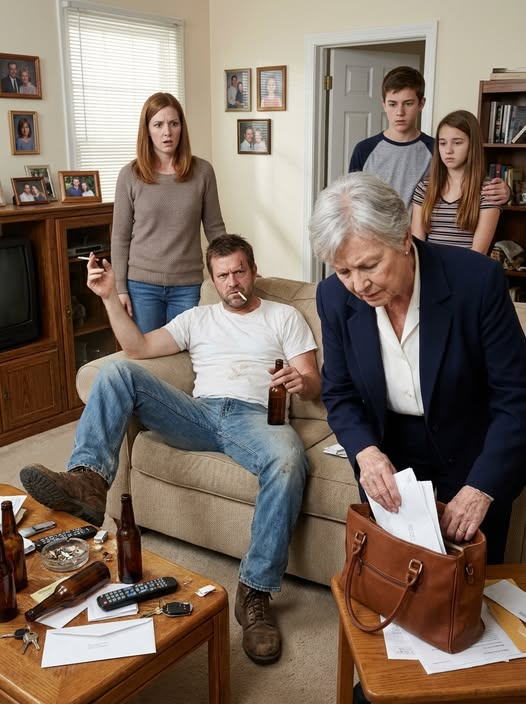
A beer bottle slipped from Tyson's hand as he stood up from the sofa.
"Did you hear me, Joanne? I said this is MY house!"
My son-in-law had just shouted those words in front of three of his friends.
Then he pointed toward the front door.
"If you don't like it, there's the door!"
I stood beside the coffee table and looked at the floor.
My daughter, Shelby, was sitting less than six feet away, holding her phone.
She didn't say a word.
Neither did his friends.
For a moment, I could hear nothing except the music coming from the television speakers and the faint buzzing of the refrigerator in the kitchen.
I was sixty-two years old.
I had raised a daughter, buried a husband, survived forty years of exhausting work, and paid for every inch of the house where I was now being told I didn't belong.
Yet there I stood, being treated like an unwanted guest.
"Come on, Tyson," one of his friends muttered.
Tyson ignored him.
He took another drink of beer and rested his feet on the wooden coffee table.
That table.
I recognized every scratch on its surface. I had bought it almost a year earlier after saving a little money from several sewing orders. I had paid for it in installments because I didn't want to touch the money I kept for property taxes.
Now Tyson was using it as a footrest.
I looked at his shoes, then at the beer bottle in his hand.
"Would you mind lowering the music?" I asked again.
My voice was quiet.
"My head is hurting."
He laughed.
Not a nervous laugh.
Not the laugh of someone who thought I was joking.
It was the kind of laugh people use when they believe they have finally been given permission to humiliate someone.
"You're always complaining," he said. "You complain about the music, the bathroom, the kitchen, my friends. What exactly do you want from us?"
I didn't answer.
He leaned forward.
"Maybe you should find somewhere else to live."
Shelby finally moved.
I thought she might look at him.
Instead, she adjusted the position of her phone.
That small movement hurt more than anything Tyson had said.
I turned toward her.
"Sweetheart?"
She kept her eyes down.
"Mom, please. Don't start."
Don't start.
I had heard those two words so many times over the previous four years that they had almost become part of the furniture.
Don't start when Tyson left his belongings in my sewing room.
Don't start when his friends arrived without warning.
Don't start when he occupied the bathroom for an hour.
Don't start when he discussed tearing down walls in a house that he had never purchased.
Don't start when he called my home ours.
And now, apparently, don't start when he told me to leave it.
Tyson leaned back and smiled.
"See? Even Shelby knows you're making a big deal out of nothing."
One of his friends looked uncomfortable.
The other two exchanged glances.
I could tell they weren't entirely sure what to do.
But none of them defended me.
I took a slow breath.
Then I turned away.
I didn't cry in front of them.
I didn't argue.
I didn't remind Tyson that the property taxes were paid from my account.
I didn't explain that the mortgage had been my responsibility long before he entered our lives.
I simply walked toward the kitchen.
Behind me, Tyson raised his beer.
"That's better! Maybe we can finally enjoy ourselves!"
Someone laughed.
The music grew louder.
I reached the kitchen counter and switched off the pot of beans.
The food had been cooking for hours.
I had planned to serve dinner before the evening became what it had become.
But I no longer felt hungry.
I walked down the hallway toward my bedroom.
My hands were shaking slightly.
Not because I was afraid of Tyson.
At least, that was what I told myself.
I was shaking because something inside me had finally reached its limit.
When I closed my bedroom door, the music became muffled.
I sat on the edge of my bed.
For several minutes, I stared at my hands.
They were not beautiful hands.
The skin was rough.
My fingers were slightly crooked.
There were tiny marks left by needles and years of handling fabric.
I remembered the nights I had spent at my sewing machine.
The school uniforms.
The quinceañera dresses.
The wedding gowns.
The trousers I had shortened for people who never bothered to learn my name.
I remembered working until two in the morning because Shelby needed new shoes for school.
I remembered skipping meals to make sure the electricity bill was paid.
I remembered my husband's funeral and the terrible silence of the first night after everyone had gone home.
I had survived all of it.
And somehow, after everything, I had allowed a man who had lived under my roof for four years to convince me that I was the problem.
I covered my face.
This time, I cried.
Quietly.
Not because I wanted Tyson to feel guilty.
Not because I expected Shelby to come running into the room.
I cried because I had begun to feel like a stranger in the only place I had ever truly called home.
After a while, I wiped my face and stood up.
I opened the bottom drawer of my dresser.
Inside was an old notebook with a faded blue cover.
I carried it to the bed and opened it.
For years, I had written down payments, expenses, sewing orders, and money I had lent to Shelby.
I had never considered those loans something I needed to collect.
She was my daughter.
When she needed help, I helped her.
That was what mothers did.
But that evening, something changed.
I found the first entry.
Five thousand dollars.
Then another.
Eight thousand.
Then two thousand five hundred.
Twelve thousand.
Six thousand.
I kept turning the pages.
There were more entries.
Much more.
Some had dates.
Others had short descriptions.
Car repairs.
Medical expenses.
A business emergency.
A temporary cash problem.
Tyson's unexpected bills.
Shelby's rent payment before they moved into my house.
Every time, I had believed they were going to recover financially.
Every time, I had told myself that helping them was temporary.
By the time I finished adding everything together, my stomach tightened.
One hundred fifty-three thousand dollars.
I read the number again.
Then I checked the calculations.
One hundred fifty-three thousand.
That money represented years of sewing work.
It represented hundreds of evenings when I could barely keep my eyes open.
It represented the customers who called me at the last minute and the dresses I finished with aching fingers.
I closed the notebook.
For the first time, I asked myself a question I had avoided for years.
What had happened to all that money?
The next morning, I woke before sunrise.
I made coffee and sat at the kitchen table.
The house was quiet.
Tyson had left several empty beer bottles in the living room.
A blanket was lying on the floor.
The television was still on.
I picked up the bottles and placed them in the recycling bin.
Then I returned to my notebook.
I began writing down every payment again.
I wanted dates.
Amounts.
Reasons.
Anything I could remember.
Around nine, Shelby entered the kitchen.
Her hair was messy, and she was wearing the same clothes from the previous evening.
"Morning, Mom."
"Good morning."
She opened the refrigerator.
"Is there any coffee?"
I pointed toward the machine.
She poured herself a cup.
For a few seconds, neither of us spoke.
Then she said, "You shouldn't have embarrassed Tyson last night."
I looked up.
"Excuse me?"
She sighed.
"He had friends over. You know how he gets when people are around."
I stared at her.
"How does he get, Shelby?"
She looked away.
"You know what I mean."
"No, sweetheart. I don't."
She placed her cup on the counter.
"He was just having a good time. You could have waited until they left."
I slowly closed my notebook.
"He told me to leave my own house."
Shelby rubbed her forehead.
"Mom, please. We live here too."
I looked at her for a long moment.
Then I asked the question that had been sitting inside me since the previous evening.
"Do you know whose name is on the deed?"
She frowned.
"What?"
"The property deed. Do you know whose name is on it?"
She looked confused.
"Yours, obviously."
"Then why does your husband keep calling this his house?"
Shelby didn't answer.
She picked up her coffee and walked out of the kitchen.
I watched her disappear down the hallway.
I had hoped she would say something.
Anything.
Instead, she left me alone with the notebook.
That afternoon, I made a decision.
I would no longer rely on memories.
I would find every document connected to my house, every payment, every financial arrangement, and every piece of information I had ignored because I wanted to keep my family together.
I took an old folder from the filing cabinet in my bedroom.
Inside were property tax statements, mortgage records, insurance papers, and several documents from years earlier.
I organized everything on my bed.
Then I noticed something unusual.
A letter from a local financial institution had been placed between two old tax statements.
It was addressed to me.
The date was several months earlier.
I opened it.
The letter referred to a request for information concerning the property.
I read it twice.
I had never made that request.
I checked the signature.
It wasn't mine.
My heart began beating faster.
I immediately called the institution using the telephone number printed on the letter.
After several transfers, a representative explained that someone had made an inquiry involving my property.
For privacy reasons, she couldn't provide all the details over the phone.
But she suggested that I visit in person with identification and the original property documents.
I thanked her and ended the call.
For several minutes, I sat completely still.
Then I looked toward the hallway.
Tyson's voice came from the living room.
He was laughing with someone on the phone.
I heard him say:
"Don't worry. There's plenty of room back here. I'll show you everything when you come."
I stood up.
He didn't know I was listening.
I quietly returned the papers to the folder.
Then I took out my notebook and wrote down the date.
That evening, I went to bed early.
I didn't tell Shelby about the letter.
I didn't confront Tyson.
I didn't even mention the strange signature.
Instead, I began looking for someone who could explain what was happening without being influenced by my family.
The following Monday, I contacted a local attorney who handled property and financial matters.
I brought the documents.
I brought the notebook.
And I brought the letter with the unfamiliar signature.
He listened carefully while I explained everything.
He didn't interrupt.
When I finished, he asked me one question.
"Mrs. Miller, has anyone ever told you that your house might be involved in a transaction you never authorized?"
I shook my head.
He examined the letter again.
Then he opened another folder.
His expression became serious.
"I think we need to investigate this before you speak to your son-in-law."
I leaned forward.
"Why?"
He placed a sheet of paper on his desk.
And when I saw the date written at the top, I recognized it immediately.
It was the date Tyson had first started asking questions about my property.
But the next page contained something even more disturbing.
My attorney turned it toward me.
"Mrs. Miller," he said quietly, "I need you to tell me whether you recognize this man's name."
I looked down.
It was Tyson's full legal name.
And beneath it was a signature that looked remarkably similar to mine.
I felt the room grow cold.
Because I had never signed that document.
And suddenly, the argument about the house seemed much more serious than I had ever imagined.
That was the first day I realized Tyson might not simply believe the house belonged to him.
He might have been trying to make it happen.






Comments 0