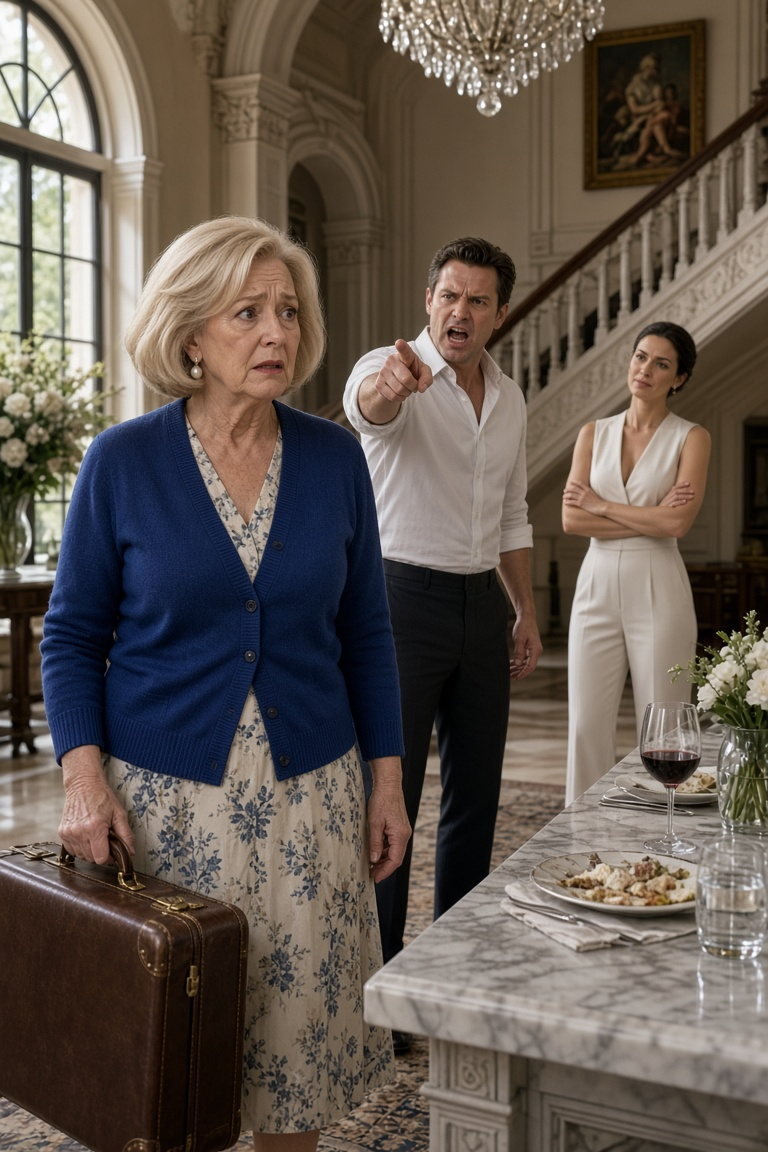
My son shoved my suitcase toward the front door and shouted:
"You're not welcome here anymore, Mom!"
When Henry Carlisle arrived, he carried a sealed envelope bearing my late husband's handwriting.
Three words were written beneath the address:
"For Catherine. Always."
My son suddenly stopped smiling.
I had never imagined that the most humiliating evening of my life would begin with a conversation in the kitchen.
I had spent the entire afternoon preparing dinner. My back hurt from standing for hours, and my fingers were still wrinkled from washing dishes. A pot of roasted chicken sat on the stove, vegetables were cooling beside the sink, and the dining table had been carefully arranged for the family.
I had even made the children's favorite dessert.
Peter loved apple pie.
Alice preferred chocolate cake.
I had prepared both because I knew they would be disappointed if I brought only one.
At sixty-eight, I was no longer as quick as I had been when my children were young. My knees sometimes ached, and I needed reading glasses to follow recipes. But I could still cook, clean, drive, shop, and take care of myself.
I had never considered those ordinary abilities something worth celebrating.
They were simply part of being a mother.
Apparently, my son no longer saw it that way.
"Mom, we need to talk."
David stood near the kitchen island, scrolling through his phone.
He was forty-two years old, tall, athletic, and accustomed to getting what he wanted. His dark hair was carefully styled, and his expensive clothes always seemed perfectly arranged.
He had inherited his father's strong jaw.
Unfortunately, he had not inherited Albert's patience.
I wiped my hands on a kitchen towel.
"Of course. Is something wrong?"
David finally looked up.
"Actually, yes. Something needs to change around here."
I glanced toward the dining room.
"Is it about dinner? I can prepare something different if you prefer."
He sighed.
"No, Mom. It's not about dinner."
Emily appeared behind him.
My daughter-in-law was wearing an expensive cream-colored outfit and holding a glass of sparkling water. She leaned against the counter with the expression of someone who had already heard the conversation and knew exactly how it would end.
I looked between them.
"All right. What is it?"
David put his phone down.
"We've been discussing the living arrangements."
I waited.
Emily took a small sip of water.
David continued.
"You're not getting any younger, Mom. And the children need more room."
I stared at him.
"What does that mean?"
He shifted his weight.
"It means we've found a very nice senior living facility nearby. It has excellent services, activities, and medical support."
For a moment, I thought I had misunderstood him.
A senior living facility?
I was sixty-eight, not eighty-eight.
"David, I'm perfectly capable of looking after myself."
"That's not the point."
"Then what is the point?"
Emily placed her glass on the counter.
"Catherine, please don't make this difficult. We're only thinking about what's best for everyone."
I turned toward her.
"What's best for everyone?"
"Yes."
I looked at the kitchen, then toward the staircase.
My bedroom was upstairs.
It had been my room for three years.
I had decorated it with photographs, a small reading chair, and the bedside table Albert and I had purchased during our first anniversary trip.
Suddenly, something occurred to me.
"Is this really about my age, Emily?"
She frowned.
"What?"
"Or is it because you want my bedroom?"
Her expression changed.
I continued.
"I remember hearing you discussing plans for turning it into another dressing room."
Emily's mouth tightened.
"That's a completely different conversation."
"Is it?"
David interrupted.
"Mom, this isn't about a bedroom."
"Then tell me what it is about."
He looked uncomfortable for a second.
Then his expression hardened.
"We need our space. This is our house, and we need to make decisions about how we use it."
Our house.
Those two words stayed with me.
I looked at my son.
"Your house?"
David crossed his arms.
"Yes, Mom. My house."
I felt something tighten inside my chest.
Three years earlier, those same words would have sounded impossible.
Because I remembered exactly how that house had become possible.
I remembered the money.
I remembered the promises.
And I remembered the day I sold the condominium where Albert and I had spent the final years of our marriage.
But David didn't seem interested in remembering any of that.
He looked at me with impatience.
"You have two choices, Mom. Move into a senior living facility or find somewhere else to stay."
The kitchen became completely silent.
Even the refrigerator seemed unusually loud.
I studied my son's face.
I waited for him to smile.
I waited for him to explain that this was some kind of misunderstanding.
He did neither.
Emily folded her arms.
"There's no reason to make a scene, Catherine."
I slowly turned toward her.
"A scene?"
"Yes. David has a family to think about. Peter and Alice need their own space. We can't keep arranging everything around you."
I almost laughed.
Not because anything was funny.
Because I suddenly understood how thoroughly they had rewritten the history of the last three years.
I had prepared their breakfasts.
I had washed their clothes.
I had cleaned their bathrooms.
I had collected the children from school, helped with homework, cooked dinner, and stayed awake when either child was sick.
When David and Emily wanted an evening together, I had watched the children.
When they traveled, I had kept the household running.
And now I was being told that the household needed to be arranged around someone other than me.
I looked at David.
"Is this what you really want?"
He nodded.
"Yes."
"You're asking your own mother to leave?"
"Don't make it emotional."
I felt the words land harder than I expected.
Don't make it emotional.
As though being abandoned by my own child were an inconvenience he wanted me to avoid discussing.
I took a slow breath.
"All right."
David blinked.
"What?"
"I'll leave."
For the first time, he seemed genuinely surprised.
Emily straightened.
"Well, I'm glad we can handle this like adults."
I didn't answer.
I simply folded the kitchen towel and placed it beside the sink.
Then I walked upstairs.
Each step seemed heavier than the one before.
When I entered my bedroom, I closed the door and stood still.
The room looked exactly as it had that morning.
A neatly made bed.
A small vase of white flowers.
My reading glasses on the bedside table.
And Albert's photograph.
I approached the photograph.
My husband was smiling in it.
His silver hair was slightly untidy, and his eyes held the warmth that had made me feel safe for more than forty years.
I picked up the frame.
"Albert," I whispered.
My voice trembled slightly.
"I think I've made a terrible mistake."
Three years earlier, I had believed that moving into David's house would give me something meaningful after Albert's death.
I had imagined family dinners, grandchildren running through the hallways, and the comfort of knowing that I would never be alone.
Instead, I had slowly become someone who was expected to make herself useful.
I placed Albert's photograph on the bed.
Then I opened my suitcase.
I packed several changes of clothes.
My medication.
My personal documents.
A small jewelry box.
The framed photographs of Peter and Alice.
And a few letters Albert had written during our marriage.
I left most of the household belongings untouched.
I had no desire to argue over furniture or decorations.
I only wanted the things that belonged to me.
As I packed, I remembered the day David had first asked me for help.
It had been three years earlier, shortly after Albert's funeral.
My husband had passed away after more than four decades of marriage.
Losing him had left an emptiness I could barely describe.
For months, I moved through the days without knowing what to do with myself.
Our condominium felt too quiet.
His chair remained beside the window.
His coffee mug was still in the kitchen cupboard.
I could not bring myself to move any of his things.
Then David visited me.
He brought flowers and sat beside me on the sofa.
"Mom, I know things have been difficult."
I nodded.
He took my hand.
"But I have an opportunity."
He explained that his first retail store was doing reasonably well.
He wanted to open a second location.
The opportunity was substantial, but he needed additional capital.
"$240,000," he told me.
I remember looking at him in disbelief.
That was an enormous amount of money.
It represented a substantial portion of the savings Albert and I had accumulated through decades of careful planning.
"David, that's a lot of money."
"I know."
"What happens if the business doesn't succeed?"
He smiled reassuringly.
"Mom, this could change everything for us."
Then he made another suggestion.
"Why don't you sell your condominium and move in with us? You'll be closer to Peter and Alice. We can look after one another."
I had hesitated.
But he had made it sound so reasonable.
He promised I would always have a place in the family.
He told me that I would never need to worry about being alone.
I wanted to believe him.
So I sold my condominium.
I gave David the money.
And I moved into his house.
At the time, I believed I was investing in my family's future.
I had no idea how expensive that decision would become.
A soft knock interrupted my thoughts.
"Grandma?"
I turned.
Alice stood in the doorway.
She was twelve, with her dark hair pulled into a loose ponytail.
Her eyes moved toward the suitcase.
"Are you going somewhere?"
I smiled gently.
"Just for a little while, sweetheart."
"Where?"
I hesitated.
"Somewhere I can settle in."
She stepped closer.
"Are you coming back?"
That question nearly broke me.
I crouched slightly so I could look into her eyes.
"I don't know yet."
Alice looked toward the hallway.
"Did Daddy make you leave?"
I didn't answer immediately.
Children often understand more than adults realize.
"Sweetheart, grown-ups sometimes make decisions that hurt each other."
"But you didn't do anything."
I reached for her hand.
"No. I didn't."
Her eyes filled with tears.
I wanted to tell her everything.
I wanted to explain the money, the promises, the years of work, and the way her parents had gradually stopped seeing me as family.
But she was only twelve.
She didn't deserve to carry the weight of those things.
I kissed her forehead.
"Be a good girl, Alice."
She hugged me.
I held her for several seconds longer than usual.
Then she whispered something that made my heart ache.
"Grandma, I don't want your room to become a closet."
I closed my eyes.
So she had heard about it too.
I gently released her.
"Go downstairs, sweetheart. I'll be there in a minute."
She nodded reluctantly.
When she left, I placed Albert's photograph carefully inside the suitcase.
Then I zipped it closed.
I looked around the bedroom one final time.
Three years of memories were packed into a single piece of luggage.
I took the suitcase downstairs.
David and Emily were sitting together in the living room.
A television played quietly in the background.
Neither looked particularly upset.
In fact, they seemed relieved.
David glanced at my suitcase.
"Mom, I hope you understand we're doing this for everyone's benefit."
I looked at him.
"I understand more than you realize."
Emily gave me a small smile.
"I'm glad we can handle this like adults."
I didn't respond.
I walked toward the entrance hall.
My suitcase wheels made a quiet sound against the polished marble.
I stopped beside the front door and reached for the handle.
Then I heard David speak behind me.
"Mom."
I turned.
He looked almost uncomfortable.
"Where are you going to stay?"
I studied him.
For three years, I had helped make his life easier.
I had given him money.
I had given him a home.
I had given him my time.
Yet he had not even asked whether I had somewhere safe to sleep.
"I'll be fine, David."
He nodded.
"Good."
I turned back toward the door.
And then the doorbell rang.
David frowned.
"Are you expecting someone?"
I placed my suitcase beside the entrance.
"As a matter of fact, I am."
He looked at me suspiciously.
"Who?"
Before I could answer, the doorbell rang again.
David walked toward the entrance.
He opened the door.
And the expression on his face changed.
A sleek black luxury sedan was parked in the driveway.
Standing beside it was a distinguished older gentleman in an immaculate forest-green suit.
His silver-white hair was neatly combed.
He held a thick cream-colored envelope in one hand.
David stared at him.
"Mr. Carlisle?"
The gentleman nodded.
"Good evening, David."
Then he looked past my son.
His expression softened.
"Catherine."
I smiled for the first time that evening.
"Hello, Henry."
He glanced at my suitcase.
Then he looked directly into my eyes.
"Are you ready?"
I nodded.
"Yes, Henry. I am."
David slowly turned toward me.
"Mom, what's going on?"
Henry stepped inside.
He closed the door behind him.
Then he looked at my son with an expression I had not seen in years.
It was the expression he used whenever an important business discussion was about to begin.
And in his hand was an envelope that had been waiting for this exact evening.
Henry glanced at David.
"Before your mother leaves, I believe there's something you need to understand."
David's face tightened.
"What are you talking about?"
Henry placed one hand on the sealed envelope.
Then he said:
"Your father and I had a conversation before he passed away."
And suddenly, my son stopped moving.






Comments 0