A county clerk slammed a yellowed property deed onto the courthouse desk.
"One dollar! That's all you're willing to pay for twenty-four acres of mountain land?"
Gideon Rusk placed a silver coin beside the document.
Then he signed his name.
The cabin was his.
Nobody in the room congratulated him.
In fact, several men laughed.
Gideon did not look at them.
He had learned long ago that a man who spent his life answering every insult eventually had no time left to live his own life.
At thirty-eight, he had already seen enough cruelty to understand that silence could be more powerful than anger.
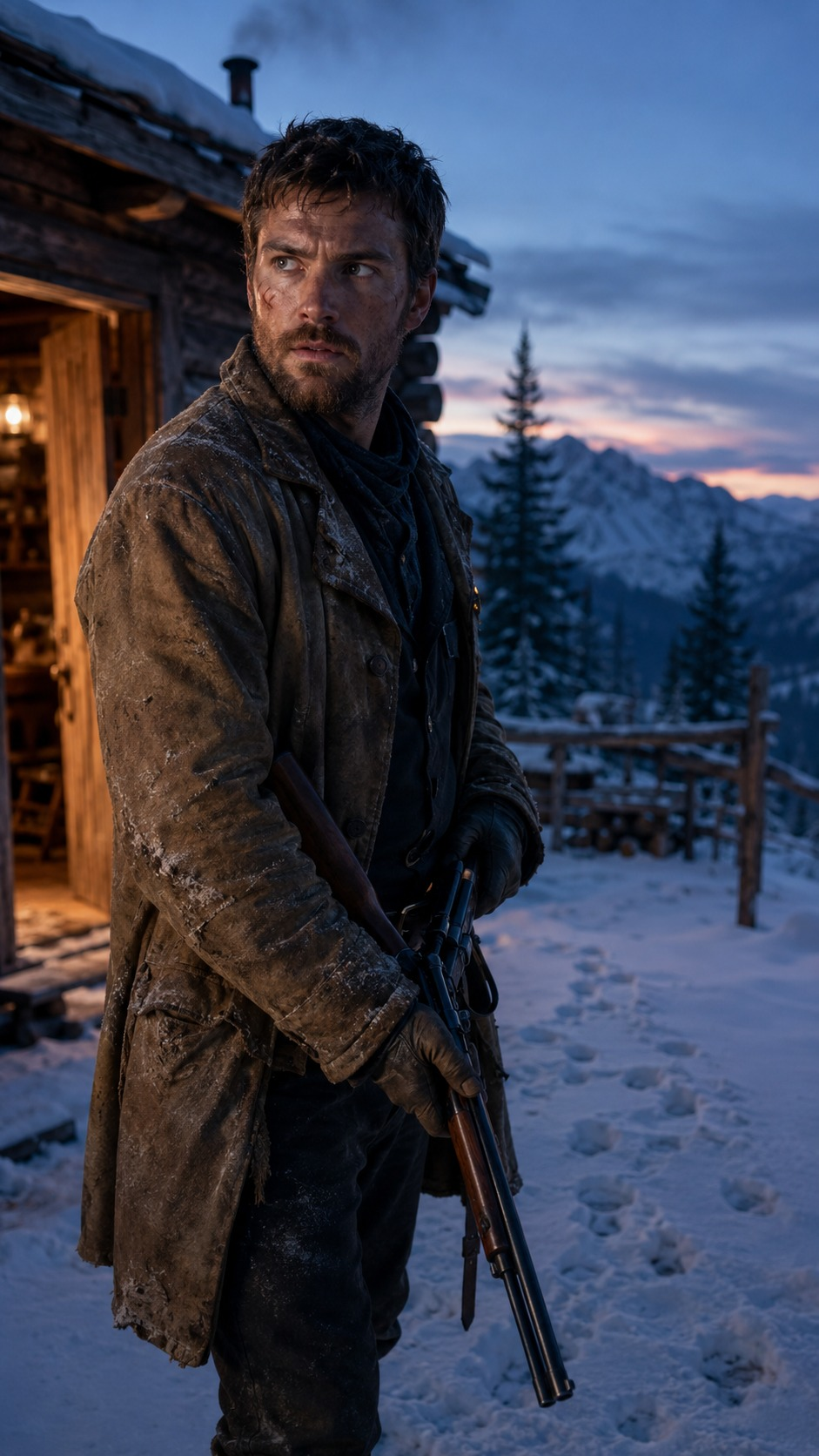
He was tall and lean, with broad shoulders shaped by years of carrying traps, rifles, and supplies through the wilderness. His dark auburn hair was tied loosely behind his head, and a thick reddish-brown beard covered most of his weather-beaten face. A pale scar ran along his left cheek, disappearing beneath the beard.
His gray-green eyes missed very little.
He wore a dark forest-green wool coat, a faded charcoal shirt, a brown leather vest, and black trousers tucked into worn boots.
Nothing about him suggested wealth.
Nothing suggested that he had ever belonged to a respectable family.
That was precisely how he preferred it.
"Lot thirty-seven," the clerk announced, looking at the paper. "One cabin and twenty-four acres on Deadfall Ridge. Seized for unpaid county taxes four years ago. The structure is reportedly damaged."
A rancher in the front row chuckled.
"Damaged? That place is practically a grave."
Another man leaned toward his neighbor.
"Didn't a woman freeze up there?"
"Different story," someone answered. "I heard the owner went mad. Started talking to people who weren't there."
A third voice came from the back.
"Nobody stays on Deadfall Ridge through winter. Nobody sensible, anyway."
Gideon studied the property map.
He noticed something the other men apparently considered unimportant.
A narrow stream crossed the northern section of the land. There was a natural spring near the cabin, and the surrounding slopes were thick with timber.
The location was isolated, certainly.
But isolation was not necessarily a disadvantage.
For a man who had spent most of his life sleeping beneath trees and moving whenever trouble approached, a permanent roof was worth more than a prosperous neighbor.
He raised his eyes.
"One dollar."
The laughter stopped.
The clerk looked over his spectacles.
"Did you say one dollar?"
"I did."
"The opening bid is five."
"Then I suppose nobody wants it for five."
A few men exchanged amused looks.
The rancher in the front row leaned back.
"Let him have it. Maybe the mountain will eat him before Christmas."
Gideon did not turn around.
The clerk examined the room one final time.
"Any other bids?"
Silence.
The wooden gavel struck.
"Sold to Mr. Gideon Rusk for one dollar."
The sound echoed through the courthouse.
Gideon signed the deed.
His handwriting was firm and unusually neat for a man who had spent so many years away from desks and books.
He placed the coin on the clerk's table and folded the deed into the inside pocket of his coat.
For the first time in many years, he owned something that could not simply be packed onto a horse.
He owned land.
A cabin.
A place where he could remain.
That thought followed him outside.
Unfortunately, so did the whispers.
"Half-breed."
"Blood man."
"Mountain savage."
Gideon heard every word.
He kept walking.
He had been called worse by men who had done considerably less with their lives.
The general store stood near the courthouse square.
Its windows displayed sacks of flour, iron tools, blankets, lanterns, and various supplies for ranchers preparing for winter.
Gideon entered and placed a list on the counter.
"Flour. Salt. Coffee. Cartridges. Nails. Lamp oil. An iron stove grate."
The merchant looked at him.
Then at the deed protruding slightly from his coat.
"Bought yourself some property?"
"Yes."
"Where?"
"Deadfall Ridge."
The merchant stopped counting coins.
His expression changed.
"You're joking."
Gideon waited.
The man glanced toward the windows, as though someone outside might be listening.
"You bought that cabin?"
"I bought the land and the cabin standing on it."
"With your own money?"
"Would you prefer I borrowed yours?"
The merchant ignored the remark.
"Listen carefully. You don't know what you're getting into."
Gideon leaned one forearm against the counter.
"Then tell me."
The merchant lowered his voice.
"That place has been empty for years. People have gone up there and come back with stories they couldn't explain. Some said they heard footsteps in the cellar. Others claimed the chimney smoked when nobody was living inside."
"Perhaps someone was living inside."
"Nobody was."
The answer came too quickly.
Gideon studied the man's face.
"How do you know?"
The merchant swallowed.
"Because the previous owner made certain nobody went near it."
"Who was the previous owner?"
The man looked away.
"That's not important."
Gideon gathered his supplies.
The merchant reached beneath the counter and pulled out a small package of cartridges.
"One more thing."
Gideon stopped.
The man's voice dropped almost to a whisper.
"If you find the cellar door, don't open it."
For several seconds, neither man spoke.
Then Gideon took the cartridges.
"That's an unusual warning for a man selling nails and flour."
"I mean it."
"So do I."
Gideon placed the money on the counter and walked outside.
He had no intention of allowing a frightened shopkeeper to decide what he could do with his own property.
Still, the warning remained in his thoughts.
He left Alder Creek before dusk.
His horse was a sturdy dark bay named Mercer, an animal that had carried him through enough difficult country to earn his trust.
The supplies were packed carefully into two saddlebags.
The rifle rested across Gideon's lap.
Behind him, the settlement slowly disappeared into the fading light.
Ahead lay the mountain trail.
The first day was difficult.
Snow had begun falling before noon, and the narrow path became increasingly slippery as the temperature dropped.
Gideon stopped twice to check Mercer's hooves and once to examine a broken branch near the trail.
Someone had passed through recently.
The branch was not old enough to have been weathered by the storm.
He crouched beside it.
There were no clear tracks.
Only a shallow impression in the snow.
He examined the surrounding trees before continuing.
The mountains had taught him that danger rarely announced itself.
By nightfall, he found shelter beneath a rocky overhang.
He built a small fire, warmed coffee, and ate a piece of dried meat.
He slept lightly.
The second day was worse.
Wind swept across the ridge, pushing snow into his face and making the trail nearly impossible to follow.
Mercer stumbled once, but Gideon steadied the animal before it could fall.
"Easy, boy."
He patted its neck.
"We're almost there."
He did not know whether that was true.
But a man needed something to say to his horse when the world around him seemed determined to bury them both.
Late that afternoon, the wind finally weakened.
Gideon reached a clearing between two enormous pines.
And there it stood.
The cabin.
It leaned slightly to the left beneath a heavy layer of snow. Its roof appeared damaged, and several boards had separated along the western wall.
The chimney was cracked.
The windows were covered with old wooden shutters.
It looked exactly like the kind of place people abandoned when they had nowhere else to go.
Gideon dismounted.
He examined the structure from a distance.
Something felt wrong.
Not dangerous, exactly.
Just wrong.
The snow around the cabin was uneven.
He moved closer.
Then he noticed the chimney.
A thin trail of smoke rose from it.
Gideon stopped.
He stared at the roof.
The smoke continued curling into the cold evening air.
He had seen no other rider on the trail.
No other cabin.
No settlement for miles.
He slowly reached for his rifle.
Someone was inside.
Gideon approached on foot, leading Mercer behind him.
Near the porch, he found a set of footprints.
Small ones.
They crossed the snow from the front steps toward the side of the building.
He crouched to inspect them.
They were recent.
The edges remained sharp, untouched by drifting snow.
He followed them with his eyes.
They ended near the porch.
There was only one entrance.
Gideon raised his rifle.
He listened.
At first, there was nothing.
Then came the faint sound of wood cracking in a fireplace.
He climbed the steps.
The porch boards groaned beneath his boots.
He stood beside the door for several seconds.
A faint amber light showed through a narrow gap between the boards.
Someone had lit a lamp.
He pushed the door.
It opened.
Warm air touched his face.
The cabin was not abandoned.
A fire burned in the stone fireplace.
An oil lamp stood on a wooden table.
A chair had been pulled close to the hearth.
And sitting in that chair was a woman.
She looked to be in her mid-thirties.
Her long chestnut-brown hair was braided loosely over one shoulder. Her pale face appeared exhausted, and dark circles rested beneath her deep blue eyes.
She wore a faded burgundy dress over an old cream-colored blouse.
Her clothes were worn but clean.
Her hands rested together in her lap.
She looked at Gideon.
Not with surprise.
Not with suspicion.
With recognition.
Gideon remained at the doorway.
His rifle was still raised.
"Who are you?"
The woman slowly stood.
For a moment, she seemed unable to speak.
Then her eyes filled with tears.
"You finally came."
Gideon tightened his grip.
"I asked you a question."
She looked at his face.
At the scar.
At his eyes.
Then she whispered something that made him feel as though the room had suddenly become smaller.
"I knew you'd come back."
Gideon stared at her.
"Back?"
She nodded.
He lowered the rifle slightly but did not put it away.
"I have never been here before."
The woman seemed to struggle with the answer.
"Not here," she said.
"Then where?"
She opened her mouth.
But instead of answering, she turned toward the wooden table.
There was something lying beside the oil lamp.
A small rectangular object.
Old.
Yellowed.
Partially covered by a folded piece of cloth.
The woman reached for it.
Gideon took one step forward.
"Don't touch anything."
She stopped.
Her fingers hovered above the object.
Then she looked at him again.
"There's something you need to see."
"What?"
She slowly uncovered it.
A photograph.
Gideon could see the faded edges from where he stood.
The paper was old enough to have developed several cracks.
He took another step.
The woman carefully placed it on the table.
"I have waited a very long time to show you this."
Gideon stared at the photograph.
At first, he did not understand what he was seeing.
Then his eyes settled on the small boy standing in the center.
The boy wore a dark coat and held the hand of a tall man.
Gideon's breathing stopped.
He recognized the child's face.
His own.
He was perhaps six or seven years old.
But it was the man beside him who made his fingers go cold.
The older man's face was unmistakable.
The same broad forehead.
The same sharp eyes.
The same slight bend in the nose.
His father.
The man Gideon had believed dead for twenty-three years.
He looked at the woman.
"Where did you get this?"
She did not answer.
Gideon leaned closer.
His eyes searched the photograph for some explanation.
A date.
A name.
Anything.
Then he noticed something written in faded ink on the back.
Three words.
DEADFALL. NEVER FORGET.
Before he could turn the photograph over again, a tremendous impact came from beneath the wooden floor.
THUD.
The oil lamp trembled.
Dust fell from the ceiling.
Gideon immediately raised his rifle.
The woman stepped backward.
Her face lost what little color it had.
A second impact shook the floor.
THUD.
Gideon looked down.
At the heavy cellar door.
The same door the merchant had warned him about.
The woman stared at him.
Her lips began to tremble.
Then she whispered:
"Please, Gideon. Whatever you do..."
Another sound came from beneath their feet.
This time, it was not an impact.
It sounded like someone slowly dragging something heavy across the cellar floor.
And then, from the darkness below, a man's voice spoke Gideon's childhood nickname.
Write Chapters Two Through Fifteen Align the hook with Chapter One






Comments 0