"Take that wedding contract away from my breakfast!" Princess Liliana shouted, pushing a silver tray across the table.
Queen Margarite entered the morning room carrying a sealed royal decree.
A tiny black mark stained the wax beneath the English crown.
The marriage had already been approved.
Liliana had never agreed to it.
And I knew, before the first pancake hit the floor, that someone in Rosalind had made a terrible mistake.
My name is Agnes Whitmore. For twenty-two years, I served the women of the royal house of Bowmont. I had dressed queens for coronations, held their hands through childbirth, hidden their tears behind embroidered handkerchiefs, and learned that the most dangerous words in a palace were rarely spoken loudly.
But that morning, Princess Liliana Rosamond Bowmont had apparently decided that twenty-eight years of royal etiquette were quite enough.
"Mother," she said, lifting another forkful of pancakes, "I have considered your proposal carefully."
Queen Margarite stood at the end of the breakfast table, her expression as stiff as the pearls around her neck.
"And?"
"I have decided to marry my breakfast."
The queen closed her eyes.
Liliana continued.
"It has never disappointed me. It never interrupts. It doesn't ask whether my waist is suitable for diplomatic negotiations. And unlike the English prince, it comes with maple syrup."
I turned toward the window to conceal my smile.
Unfortunately, Aunt Theodora was not nearly so disciplined.
"Must you make a spectacle of yourself?" she demanded.
Liliana looked down at her plate.
"Well, someone has to. Elena has been making one since five this morning, and frankly, I'm impressed she hasn't fainted."
Across the table, Lady Elena Bowmont stiffened.
Elena was Liliana's cousin, twenty-six years old, impossibly slender, and possessed of the sort of beauty that made portrait painters forget to charge for their work.
Her dark hair had been arranged into an elaborate braided crown. Her pale lavender gown was fitted so tightly that I doubted she could breathe deeply without requesting permission from her seamstress.
She had been awake since dawn.
Liliana had been awake for approximately eleven minutes.
And yet, as I watched them, I knew which young woman had already won the room.
"At least I understand the importance of today," Elena said.
"Of course you do," Liliana replied. "You've been practicing your curtsy for three weeks. At this point, I expect the furniture to bow back."
"Enough," Queen Margarite said.
Her voice was quiet.
That made it worse.
The room fell silent.
Even Liliana lowered her fork.
"Prince Charles of England will arrive at noon," the queen continued. "He is thirty-two years old, educated, respected, and next in line to inherit considerable responsibilities. His family has honored Rosalind by proposing this union."
"His family has honored Rosalind by proposing a transaction," Liliana corrected.
"A marriage."
"A transaction with flowers."
"Liliana."
"Mother."
"Please."
That final word changed the room.
The queen was not a woman who begged.
I had seen her negotiate with foreign ministers, dismiss powerful dukes, and sit beside her dying husband without allowing a single tear to fall until the doors were closed.
But she was begging now.
Liliana noticed.
For one brief moment, the mischief disappeared from her face.
"Mother," she said gently, "I know you believe this is important."
"It is more than important."
"Then tell me why."
The queen looked toward the tall windows.
Outside, December snow covered the palace gardens in white.
Beyond the gardens rose the mountains that had protected Rosalind for centuries.
A beautiful country.
A small country.
And, though very few people outside the royal council knew it, a country in serious financial trouble.
"Some things are larger than personal happiness," Queen Margarite said.
Liliana placed her fork down.
"Then perhaps the people arranging them should be the ones sacrificing theirs."
Elena inhaled sharply.
Aunt Theodora reached for her fan.
I looked at the queen.
Her face had gone pale.
"Your father understood duty," she whispered.
That was an unfortunate choice of words.
King Frederick had been dead for six years.
Liliana had adored him.
He had been the only person in the palace who never made her feel that her body was a political inconvenience.
He had called her his little lioness, even after she grew taller, older, and considerably more capable of defending herself.
He had taught her to ride.
He had taught her to read financial reports.
He had taught her that a crown was not a prize.
It was a promise.
And he had once told her something I had never forgotten.
Never marry a man who needs you to become smaller so he can feel important.
Liliana remembered it too.
I saw it in her eyes.
"Father also understood that a woman could say no," she replied.
The queen looked away.
Aunt Theodora cleared her throat.
"Perhaps," she said, "we should discuss the practical realities."
"Oh, good," Liliana replied. "My favorite kind of threat."
"Liliana!" Elena snapped.
"What? I'm listening."
Theodora folded her hands.
"Prince Charles has been offered introductions to some of the most accomplished young women in Europe. Women who understand their responsibilities. Women who take care of their appearances."
There it was.
The familiar blade, polished and presented as concern.
Liliana looked at her aunt.
"Are you suggesting I don't take care of my appearance?"
"I am suggesting that a princess should make an effort."
"I made an effort to get out of bed."
"Your gowns have required alterations three times this year."
"Because I enjoy dinner."
"Your cousin has never needed—"
"Then perhaps my cousin should marry him."
Silence.
Elena's eyes widened.
Theodora stopped breathing.
Even Queen Margarite seemed momentarily unable to speak.
Liliana leaned back in her chair.
"Honestly, it would solve everyone's problems. Elena wants a prince. The prince presumably wants a princess. I want another pancake. Everybody wins."
Elena's cheeks flushed.
"You think this is funny?"
"No," Liliana said.
The humor vanished.
"I think it's humiliating."
The room grew still.
Liliana stood.
Her emerald morning gown settled around her full figure, the soft velvet catching the winter light.
She was not a small woman.
She had broad hips, a generous waist, full cheeks, and a presence that made even large rooms seem less empty.
I had watched palace dressmakers quietly complain about the amount of fabric her gowns required.
I had watched visiting noblewomen glance at her plate before looking at her face.
And I had watched Liliana pretend none of it mattered.
But I knew better.
"Every time a prince visits," she said, "you talk about me as though I'm a problem to be solved."
"Liliana," the queen whispered.
"You tell me to stand straighter. Eat less. Laugh more quietly. Wear darker colors. Smile without showing my teeth. You tell me men appreciate grace, but apparently grace has a dress size."
Elena lowered her eyes.
Liliana looked at her mother.
"And now you want me to marry a man who hasn't even met me."
"He has seen your portrait."
"Which portrait?"
The queen said nothing.
Liliana laughed once.
Not happily.
"The one from three years ago?"
Still no answer.
"The one where the painter made my waist six inches smaller?"
"Liliana, please."
"Did you send him that portrait?"
The queen's silence was answer enough.
I felt something tighten in my chest.
I remembered that painting.
The court artist had worked for six weeks.
When it was finished, the princess had stared at it for a long time before saying, very quietly, "She's lovely. Who is she?"
I had wanted to take the canvas down myself.
Now Liliana pushed back her chair.
"Tell Prince Charles he can marry the painting."
She turned toward the door.
"Where are you going?" the queen demanded.
"To find a room where nobody is discussing my measurements."
"You will return for the reception."
Liliana stopped.
Then she turned.
"No, Mother."
The queen stared.
"No?"
"I will meet him. I will be polite. I will thank him for traveling here. And then I will tell him the truth."
"What truth?"
"That I am not marrying him."
Aunt Theodora rose so abruptly that her chair scraped the floor.
"You cannot embarrass the royal family like this!"
Liliana looked at her.
"Watch me."
Then she walked out.
I followed her.
I had been following Liliana since she was six years old and had escaped a state dinner by hiding beneath a dessert trolley.
Some habits were difficult to break.
She marched down the corridor, her velvet slippers making almost no sound against the polished stone.
"Agnes?"
"Yes, Your Highness?"
"Do you think I'm unreasonable?"
I considered lying.
It would have been easier.
It usually was.
"Sometimes," I said.
She stopped.
Then laughed.
"Thank you."
"But not today."
Her smile faded.
We continued walking.
At the end of the corridor, she stopped beside a window overlooking the eastern gardens.
Below us, servants were clearing snow from the paths.
Florists carried enormous arrangements of winter roses toward the grand entrance.
The royal carriage had been brought out of storage.
Its ivory panels and gilded wheels shone beneath a dusting of fresh snow.
Everything was being prepared for a celebration.
A celebration the bride had not agreed to attend.
"I don't hate marriage," Liliana said.
"I know."
"I don't even hate the idea of love."
"I know that too."
She pressed her fingertips against the cold glass.
"I just want someone to look at me and see me."
I said nothing.
"Not a treaty. Not a crown. Not an embarrassing daughter who needs to be grateful that somebody finally offered."
Her voice grew smaller.
"Just me."
I touched her shoulder.
For a moment, she leaned toward my hand the way she had when she was a little girl.
Then she straightened.
"Well," she announced, "that's enough emotional honesty for one morning. It's terrible for the complexion."
I smiled.
She looked at me.
"Do you think the kitchens have more pancakes?"
"Almost certainly."
"Then I have important diplomatic business."
And she disappeared down the servants' staircase.
I watched her go.
Then I turned toward the queen's private office.
Because there was something about that royal decree I could not forget.
The black mark beneath the wax seal.
It was not part of the English royal insignia.
It was a small crescent.
And I had seen it before.
Twenty-two years earlier.
On the night a young woman vanished from Rosalind Palace.
Her name had been Catherine Vale.
She had worked in the royal archives.
She had been intelligent, quiet, and trusted by King Frederick.
Then one winter morning, she was gone.
The official explanation had been simple.
She had stolen confidential documents and fled the country.
But I remembered the blood on the library carpet.
I remembered the queen crying behind a locked door.
And I remembered Catherine pressing a folded piece of paper into my hand only hours before she disappeared.
If anything happens to me, Agnes, remember the crescent.
I had kept that paper for twenty-two years.
I had never told anyone.
And now the same mark had appeared on a marriage decree involving Princess Liliana.
I hurried toward the queen's office.
The corridor outside was empty.
Or so I thought.
As I approached the door, I heard voices.
Queen Margarite.
Aunt Theodora.
And a man.
Lord Sebastian Harrow.
The royal chancellor.
A tall, silver-haired gentleman who had served the crown for nearly thirty years.
He was the sort of man who never raised his voice because other people were always frightened enough to listen.
I stopped beside the door.
"I told you she would refuse," Theodora said.
"Then you should have prepared her more carefully," Harrow replied.
"She is impossible."
"She is the heir."
"Not yet," Harrow said.
Something in his voice made my blood run cold.
The queen spoke.
"Sebastian, we agreed there would be no coercion."
"Your Majesty, we agreed that Rosalind would survive."
"At what cost?"
"At whatever cost is necessary."
A chair moved.
Then Harrow continued.
"The English agreement must be signed before the winter council convenes. Without it, our creditors will demand immediate repayment."
"Charles is not responsible for our debts," the queen said.
"Neither is your daughter. Yet here we are."
I pressed myself against the wall.
Theodora lowered her voice.
"And if Liliana continues refusing?"
There was a pause.
Then Harrow answered.
"The succession council has procedures for determining whether an heir is fit to rule."
The queen gasped.
"You would not dare."
"I would prefer not to."
"You cannot declare my daughter unfit because she refuses a marriage!"
"Not for that reason alone."
Silence.
Then the chancellor spoke again.
"Her behavior has been documented for years. Her public outbursts. Her disregard for protocol. Her refusal to cooperate with advisers."
"She's spirited," the queen said.
"She's vulnerable."
I felt sick.
He was not talking about a wedding anymore.
He was talking about removing Liliana from the line of succession.
Theodora spoke.
"And Elena?"
"Would be a suitable alternative."
I closed my eyes.
There it was.
The true reason Elena had been dressed for the prince since dawn.
The true reason Theodora had been so eager to criticize Liliana.
The true reason a marriage contract had arrived already sealed.
They were not simply trying to find Liliana a husband.
They were preparing to replace her.
I stepped backward.
My heel touched something.
A silver tray.
It stood on a small table beside the door.
The tray shifted.
A spoon fell.
The sound rang through the corridor.
Inside the office, the conversation stopped.
"Who's there?" Harrow demanded.
I moved quickly.
By the time the door opened, I was standing beside a portrait, pretending to adjust a vase of white roses.
Lord Harrow looked at me.
His expression did not change.
"Mrs. Whitmore."
"Your Lordship."
"What are you doing?"
"Checking the flowers."
"Outside the queen's office?"
"Her Majesty prefers fresh arrangements."
He looked at the vase.
Then at me.
"How long have you been here?"
"Only a moment."
His eyes narrowed.
I had known Sebastian Harrow for more than two decades.
I had watched him smile at ambassadors, comfort widows, and congratulate young officers whose careers he had quietly destroyed.
He was dangerous because he understood patience.
And because he remembered everything.
"Mrs. Whitmore," he said softly, "loyalty is a rare quality."
"Yes, Your Lordship."
"It should never be confused with curiosity."
He closed the door.
I stood motionless.
Only when his footsteps faded did I allow myself to breathe.
At eleven forty-five, the bells began ringing.
Prince Charles had arrived.
The entire palace seemed to move at once.
Footmen hurried through corridors.
Servants opened the great doors.
Musicians gathered in the reception gallery.
Elena appeared wearing a pale silver gown and a diamond necklace borrowed from the queen.
She looked magnificent.
She knew it.
Aunt Theodora nearly wept with satisfaction.
Liliana, meanwhile, was missing.
Naturally.
I found her in the old library.
She was sitting cross-legged in a window seat, reading a book about the history of Rosalind's northern villages.
A plate of pastries rested beside her.
"Your Highness."
"Agnes."
"The prince has arrived."
"How unfortunate for him."
"Your mother is waiting."
"She's very good at that."
I folded my arms.
Liliana looked up.
"Oh, don't give me that face."
"What face?"
"The one that says you raised me better."
"I did."
She sighed.
Then closed her book.
"Fine."
She stood and smoothed her gown.
It was deep emerald velvet, with silver embroidery at the cuffs and a neckline that framed her shoulders beautifully.
Her auburn hair had been arranged into a low braided crown.
She wore pearl earrings and a small silver pendant that had belonged to her father.
She looked every inch a princess.
Not because she resembled Elena.
Because she did not.
"Do I look acceptable?" she asked.
I adjusted a loose curl beside her cheek.
"You look like yourself."
Her expression softened.
"That's the nicest thing anyone has said to me today."
We walked toward the reception gallery.
As we approached, I heard voices.
Elena's laughter.
Theodora's delighted chatter.
And a man's voice.
Low.
Calm.
Warm.
Prince Charles.
I had expected him to sound arrogant.
Many princes did.
They were raised among people who agreed with them before they finished speaking.
But Charles sounded different.
He was asking Elena about Rosalind's winter schools.
Not her gown.
Not her jewels.
The schools.
I glanced at Liliana.
She had noticed too.
"Well," she murmured, "at least he can form a complete sentence."
I almost laughed.
We entered.
Prince Charles stood beside the fireplace.
He was taller than I expected, with dark blond hair, blue-gray eyes, and a midnight-blue military uniform embroidered with silver.
He turned as we approached.
His gaze found Liliana.
And stopped.
I had spent twenty-two years watching men look at royal women.
I knew the difference between admiration, calculation, desire, and polite disappointment.
What I saw in Charles's face was none of those things.
It was surprise.
Genuine surprise.
As though someone had opened a door and revealed a room he had not known existed.
Liliana noticed.
Her shoulders stiffened.
Queen Margarite stepped forward.
"Your Royal Highness, may I present my daughter, Princess Liliana Rosamond Bowmont."
Charles bowed.
"Your Highness."
Liliana curtsied.
"Your Royal Highness."
A perfectly correct introduction.
A perfectly correct silence.
Then Charles smiled.
"I've heard a great deal about you."
Liliana raised an eyebrow.
"Then I should probably apologize in advance."
His smile widened.
Elena looked confused.
Theodora looked alarmed.
The queen looked as though she might faint.
Charles laughed.
Not politely.
Genuinely.
And Liliana seemed almost offended by how much she liked the sound.
"I was told you enjoy history," he said.
"Depends who's telling it."
"How so?"
"History is usually written by people who want you to believe they were right."
Charles considered that.
"An excellent point."
"Thank you."
"I was also told you enjoy riding."
"I do."
"Perhaps we might ride together tomorrow."
"Perhaps."
The queen brightened.
Theodora nearly smiled.
Then Liliana continued.
"But before anyone starts ordering wedding flowers, there's something you should know."
I closed my eyes.
Here it came.
Prince Charles looked at her.
"Of course."
Liliana drew a breath.
"I don't intend to marry you."
The room went silent.
Elena stared.
Theodora made a small choking noise.
Queen Margarite whispered her daughter's name.
But Charles did not look angry.
He did not look embarrassed.
He simply studied Liliana for a moment.
Then he said, "I see."
Liliana blinked.
"That's all?"
"What would you prefer I say?"
"Most men would be offended."
"Most men haven't been fortunate enough to receive such an honest introduction."
Liliana stared at him.
I stared at him too.
Charles glanced toward the queen.
"Your Majesty, perhaps the princess and I might speak privately later. I would hate for our first meeting to become a public negotiation."
It was gracious.
It was intelligent.
And it was the first time I had seen a man protect Liliana's dignity without being asked.
But Lord Harrow, standing near the far doorway, did not look pleased.
He watched the prince.
Then Liliana.
Then the queen.
And I saw something move behind his eyes.
Calculation.
The reception continued.
Tea was served.
Elena attempted to reclaim Charles's attention.
Theodora discussed royal bloodlines.
Liliana answered questions with unexpected seriousness.
And Charles kept looking toward her.
Not constantly.
Not rudely.
But enough that I noticed.
Enough that Elena noticed.
And enough that Lord Harrow eventually left the room.
That evening, snow began falling more heavily.
The palace prepared a formal dinner.
Liliana refused to attend until she had spent an hour alone.
I found her near the carriage courtyard shortly before dusk.
She stood beneath the covered archway, looking toward the snow-covered gardens.
"Agnes," she said, "do you think people can surprise you?"
"Occasionally."
"Even princes?"
"Especially princes, I imagine."
She smiled faintly.
Then looked toward the royal carriage.
"He's not what I expected."
"No?"
"No."
She paused.
"That's irritating."
I laughed.
She took my hand.
"Will you help me with my cloak?"
"Of course."
I fastened the silver clasp beneath her chin.
She stepped toward the courtyard.
Then stopped.
"Agnes?"
"Yes?"
"If I refused the crown, would you think less of me?"
The question struck me harder than I expected.
"Why would you refuse it?"
She looked toward the mountains.
"Because everyone seems to believe it gives them the right to own me."
I wanted to tell her what I had overheard.
I wanted to warn her about Harrow.
About Theodora.
About Elena.
But twenty-two years of palace service had taught me that accusations without evidence could destroy the person they were meant to protect.
So I said only, "Your father wanted you to be happy."
Liliana swallowed.
"I miss him."
"I know."
She looked down.
Then whispered, "Sometimes I think he was the only person who ever believed I could be queen."
I touched her cheek.
"He wasn't."
She looked at me.
For a moment, she seemed very young.
Then she hugged me.
And walked into the snow.
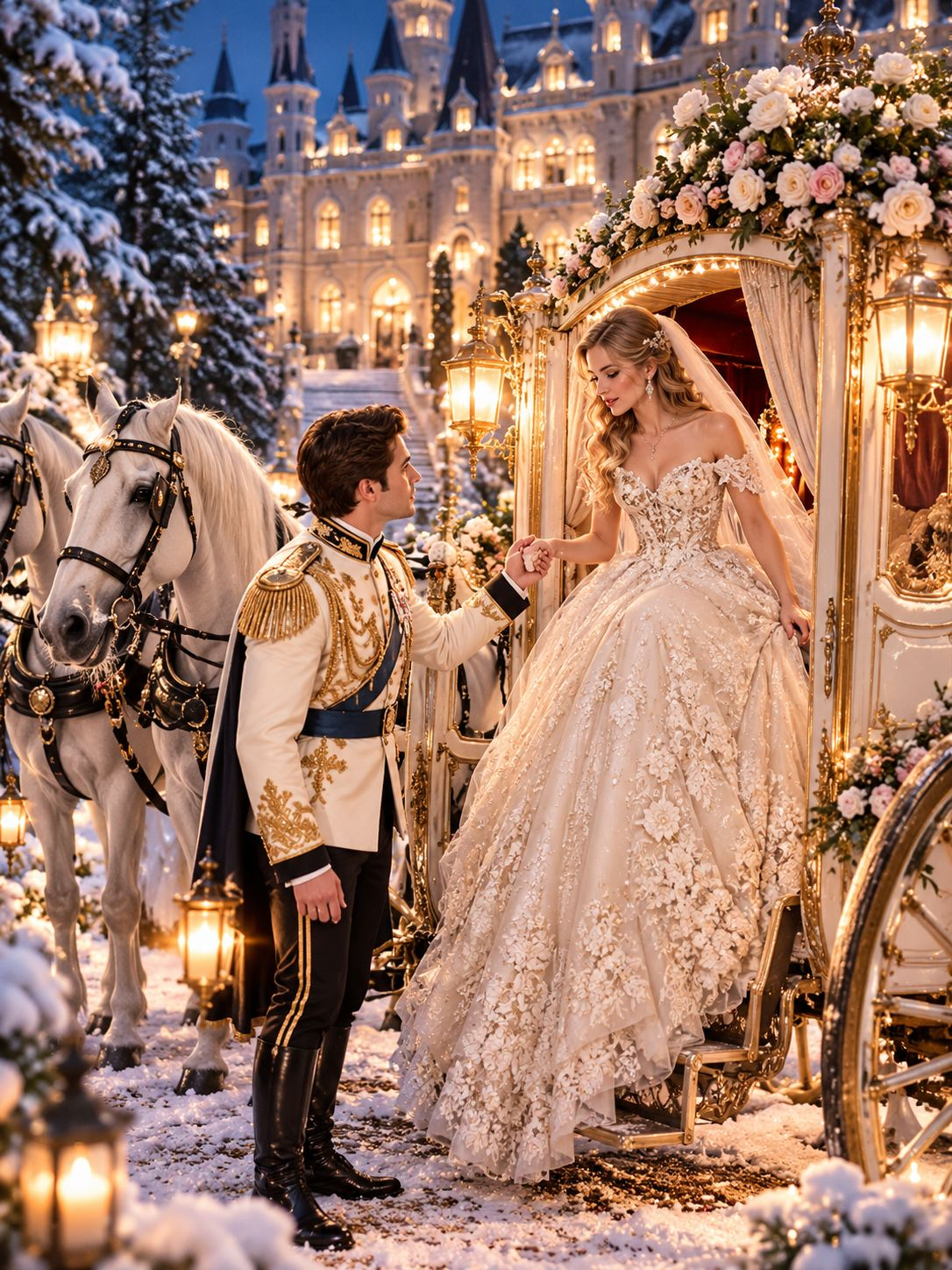
I watched her cross the courtyard toward the waiting carriage.
The lanterns glowed gold.
The white horses stood quietly.
And beside the carriage, a tall figure in a dark navy cape stepped forward.
Prince Charles.
He offered his hand.
Liliana hesitated.
Then placed her fingers in his.
I saw him help her down from the carriage step, where she had paused to adjust her heavy gown.
They spoke quietly.
I could not hear the words.
But I saw Liliana's expression change.
Her guarded face softened.
And when Charles smiled, she looked away as though she had suddenly forgotten how to be suspicious.
I felt an unexpected warmth in my chest.
Perhaps, I thought, this would not become the disaster everyone feared.
Perhaps the prince was different.
Perhaps Liliana would finally be allowed to choose.
Then someone spoke behind me.
"Mrs. Whitmore."
I turned.
Lord Harrow stood beneath the archway.
His silver hair was immaculate.
His expression was calm.
And in his gloved hand he held a folded document.
"Her Highness appears to be enjoying herself," he said.
"Yes, Your Lordship."
"How fortunate."
He looked toward the carriage.
Then back at me.
"Tell me, Agnes. Do you remember Catherine Vale?"
My heart stopped.
Twenty-two years.
No one had spoken that name to me in twenty-two years.
I kept my face still.
"Of course, Your Lordship. She worked in the archives."
"Indeed."
He unfolded the document.
It was old.
Yellowed at the edges.
A small black crescent had been stamped beside the royal seal.
Harrow watched me carefully.
"An extraordinary thing happened this morning," he said.
"What was that?"
"Someone entered the sealed archives."
I said nothing.
"Someone opened Catherine's file."
The wind moved through the archway.
Snow gathered along the stone steps.
Beyond us, Liliana laughed softly at something Prince Charles had said.
Harrow lowered his voice.
"And someone removed a document that has been hidden for twenty-two years."
I looked at the paper in his hand.
My fingers went cold.
He stepped closer.
"Do you know what was written on that document, Agnes?"
"No, Your Lordship."
He smiled.
"Then perhaps you should read it."
He placed the folded paper in my hand.
I looked down.
The first line was written in King Frederick's handwriting.
The second contained Princess Liliana's full name.
And beneath it was a date.
The date of her birth.
I unfolded the final section.
There was another name written below hers.
A name I had never expected to see again.
Before I could read the final sentence, the palace bells began ringing.
Not the evening bells.
The emergency bells.
A guard came running through the archway.
"Lord Chancellor!"
Harrow turned sharply.
"What is it?"
The guard was breathless.
"Someone has entered the queen's private chambers."
"Who?"
"We don't know, sir."
The guard swallowed.
"But the door was locked from the inside."
Harrow's face changed.
For the first time in twenty-two years, I saw genuine fear in his eyes.
Then the guard said something that made the folded paper slip from my fingers.
"There's a woman inside, my lord. She says her name is Catherine Vale."






Comments 0