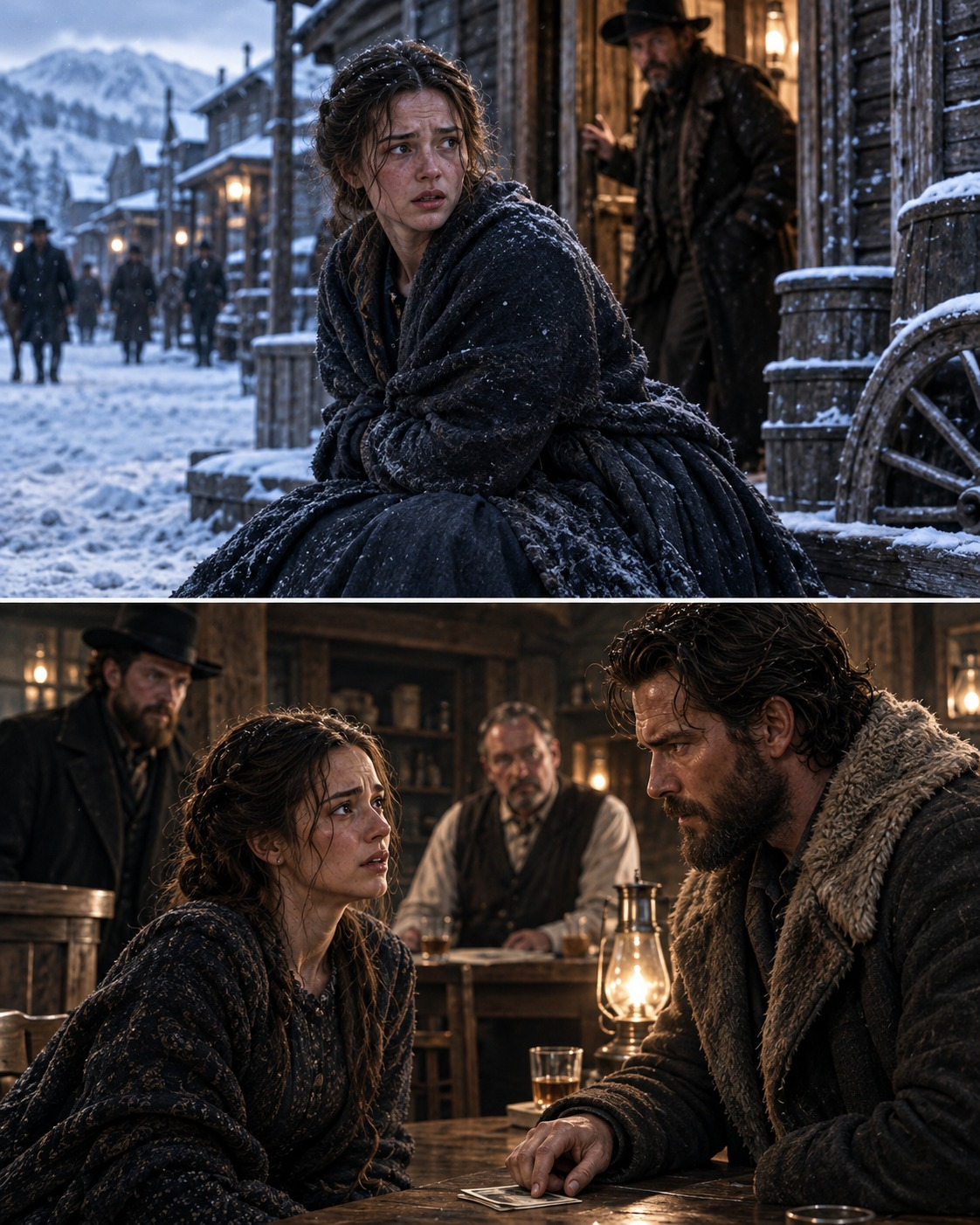
Kora Dunn stumbled backward as a bucket crashed against her feet.
"Get out! And don't come back without my money!"
Silas Omali stood in the saloon doorway, holding a folded debt note.
Four hundred dollars was written across its face.
But beneath the number was a small red seal.
Kora had seen that seal before.
And it had nothing to do with money.
The dirty water reached her shoes before she could move.
It spilled from the overturned mop bucket, spread across the frozen boards, and soaked into the hem of her wool skirt. For a moment, Kora watched it happen as though she were standing outside her own body, observing the final humiliation of a woman who had already lost everything worth losing.
Silas Omali took the damp cigar from his mouth.
"Did you hear me, girl?"
Kora raised her eyes.
"I'm not deaf, Mr. Omali."
"Then why are you standing there?"
"Because you haven't paid me for the last six days."
Omali gave a short laugh.
Behind him, the Redbend saloon glowed with the warmth of oil lamps and a coal-burning stove. Men sat around tables with whiskey glasses in their hands. Somewhere near the back, a piano was being played badly.
Not one of them came to the door.
"Paid you?" Omali repeated. "You ought to be thanking me for letting you work off what that worthless husband of yours owed."
"My husband wasn't worthless."
"Your husband was a dead fool who left you four hundred dollars in debt."
Kora's fingers tightened around the handle of her empty bucket.
"He was a good man."
"Good men pay their bills."
She said nothing.
Omali leaned closer.
"Your debt was due at noon. You scrubbing floors for scraps isn't even enough to cover the interest."
"It was three hundred and sixty dollars last month."
"Interest."
"You told me the interest was suspended while I worked."
"Did I?"
"You know you did."
His expression changed.
It was a small change, hardly noticeable to anyone who did not know him. His smile disappeared, and his eyes grew flat.
"Careful, Mrs. Dunn."
Kora looked at the folded paper in his hand.
Four hundred dollars.
She had never seen the original loan agreement.
Her husband, Daniel, had been dead for nearly five months, and every time she asked to examine the document, Omali found another reason to refuse.
First, he said it was locked in his office.
Then he claimed his clerk had taken it to the county seat.
After that, he simply told her that respectable widows did not question businessmen about their accounts.
But Kora had learned something during those five months.
A man who told the truth rarely needed so many explanations.
"May I see the note?" she asked.
Omali stared at her.
"What?"
"The original note. With Daniel's signature."
"Are you accusing me of dishonesty?"
"I'm asking to see what I'm supposed to repay."
He stepped forward.
Kora held her ground, though her stomach tightened.
"You think because your husband knew how to scratch his name on a piece of paper, that makes you qualified to argue business with me?"
"No, sir."
"Then take yourself off my porch."
He pushed the door inward.
Kora caught one last glimpse of the paper before he folded it.
There was a red seal near the bottom.
A circle surrounding three narrow lines.
She recognized the design immediately.
Daniel had received a letter bearing that same mark shortly before he died.
He had burned the envelope in their stove.
At the time, Kora had thought little of it.
Now she wondered why.
"Mr. Omali—"
The door slammed.
A bolt scraped into place.
Kora stood motionless.
Then she heard laughter from inside.
Not loud laughter.
Not even particularly cruel laughter.
Just the ordinary sound of men continuing their evening while a woman froze on the other side of the door.
Somehow, that was worse.
She picked up the empty bucket.
The handle had split.
She left it where it lay.
Redbend's main street stretched ahead of her, nearly deserted beneath the falling snow.
It was December of 1887, and winter had arrived early in the mountain territory.
The stagecoach had stopped running regularly.
The freight wagons came only when the roads allowed.
Every morning, another family woke to find its water barrel frozen solid.
Kora had spent the previous winter beside Daniel, in a little rented house with a crooked chimney and a kitchen window that rattled whenever the wind came down from the mountains.
They had been poor.
But they had laughed.
That seemed impossible to remember now.
She pulled her shawl around her shoulders and started walking.
Her shoes made a wet sound against the snow.
The leather had cracked near the toes. She had tried repairing the openings with thread and candle wax, but the water always found a way inside.
She passed the general store.
Through the window, she could see Mrs. Bell arranging jars on a shelf.
The storekeeper's wife looked up.
For one brief moment, their eyes met.
Kora almost raised her hand.
Mrs. Bell reached for the curtain.
The window went dark.
Kora kept walking.
She had stopped expecting charity weeks ago.
Still, the small rejection hurt more than she wanted to admit.
At the corner of the street stood the assayer's office.
It was a narrow wooden building with a stone foundation and a chimney that released a thin line of smoke into the winter sky.
The office belonged to Mr. Finch, an elderly man who weighed ore, certified claims, and kept records for the miners who came down from the mountains.
Daniel had visited the office several times before his death.
Kora remembered that now.
He had always returned quieter than when he left.
Once, she had asked what troubled him.
"Numbers," he had answered.
She had laughed.
"Since when do numbers frighten you?"
"They don't frighten me."
"Then what does?"
He had kissed her forehead.
"Men who change them."
She had forgotten that conversation until this moment.
Kora reached the wall of the assayer's office and stopped.
Her legs felt strangely heavy.
She had eaten nothing since the previous morning except half a biscuit given to her by the saloon cook.
Her hands were numb.
The cold had begun to creep through her clothing, past the skin, into places she could not describe.
She lowered herself against the wall.
Just for a moment, she thought.
Just until the dizziness passes.
Her knees folded beneath her.
She sank into the snow.
At first, she tried to stand again.
Her legs refused.
She pulled her knees toward her chest and tucked her hands beneath her arms.
The wind drove loose snow against her face.
She closed her eyes.
Daniel had once told her that falling asleep in extreme cold was dangerous.
She remembered him saying it while they sat beside their stove.
"Promise me something, Kora."
"What?"
"If you ever get caught outside in a storm, you keep moving."
"What if I can't?"
"You find a reason."
She had smiled then.
"And what reason would that be?"
He had taken her hand.
"Whatever you love most."
Now, sitting alone against the wooden wall, Kora searched for something she loved enough to make herself stand.
Daniel was gone.
Their little house was gone.
The silver locket he had given her on their first anniversary had been sold to buy flour.
Even her wedding ring was gone.
She had surrendered it to Omali two months earlier.
He had valued it at three dollars.
Three dollars.
Kora let out a breath that trembled.
"I tried, Daniel," she whispered.
The words disappeared into the wind.
She lowered her head.
A pair of heavy boots stopped in front of her.
"You're about to lose a few toes."
The voice was deep and rough.
Kora opened her eyes.
A large man stood over her.
He wore a heavy green wool coat with a dark fur collar, and his broad shoulders seemed almost too large for the narrow space between the buildings.
Snow clung to his hat.
His beard was streaked with gray.
His eyes were pale blue.
He looked like a man who had spent most of his life outdoors and had never expected the world to be gentle.
Kora stared at him.
"I don't have anything."
The man said nothing.
"If you came to rob me," she continued, "you're too late."
His gaze moved over her soaked skirt and damaged shoes.
"Can you stand?"
"I was standing a little while ago."
"That wasn't my question."
Kora tried to push herself upright.
Her knees buckled.
The man caught her by the arm.
She flinched.
His grip immediately loosened.
"I'm not going to hurt you," he said.
"That's what men usually say before they do."
He looked at her for a long moment.
Then he nodded once.
"Fair enough."
He offered his hand again.
This time, he waited.
Kora studied him.
He did not look impatient.
He did not smile.
He simply held out his hand as if she had the right to decide whether to take it.
At last, she placed her frozen fingers in his palm.
He pulled her to her feet.
The movement sent a sharp pain through her legs.
She gasped.
"Easy," he said.
"I'm all right."
"No, you're not."
He looked toward the assayer's office.
"There's a stove inside."
"Mr. Finch won't want me dripping water on his floor."
"I'll speak to Finch."
"Do you know him?"
"Yes."
The man guided her toward the door.
Kora tried to walk without leaning on him.
She managed three steps before her knees weakened again.
He steadied her without comment.
Inside, the office smelled of coal smoke, leather, and damp paper.
Mr. Finch sat behind a counter, examining a small piece of ore through a magnifying lens.
He looked up.
"Good Lord."
The stranger removed his hat.
"She needs the stove."
Finch immediately rose.
"Of course. Bring her over."
Kora felt the heat before she reached the iron stove.
It struck her face with such force that she nearly cried out.
Her skin tingled.
Then it burned.
She sat in the wooden chair Finch pulled forward.
"Don't put your feet too close," the old man warned. "Let them warm slowly."
Kora nodded.
Her teeth began chattering.
The stranger stood beside the counter.
"What's your name?" he asked.
"Kora Dunn."
Something moved behind his eyes.
It was gone almost immediately.
"Dunn?"
"Yes."
"Daniel Dunn's widow?"
Kora looked up sharply.
"You knew my husband?"
"I knew of him."
"How?"
The man did not answer at once.
Instead, he reached inside his coat and removed a small leather pouch.
He placed it on the counter.
Gold coins shifted inside.
Kora stared at it.
The sound was unmistakable.
She had heard gold coins before, but never so many together.
The stranger turned toward Finch.
"Do you have writing paper?"
"Certainly."
"Ink?"
"Of course."
"Good."
He looked at Kora.
"I heard Omali shouting about four hundred dollars."
Her stomach tightened.
"Then you heard enough."
"I heard he claims your husband left a debt."
"He did."
"Have you seen the original note?"
Kora hesitated.
"No."
The man's expression darkened.
"Interesting."
"Why?"
He did not answer.
Instead, he opened the pouch.
Several gold coins rolled across the counter.
Finch stared.
Kora forgot the pain in her feet.
The stranger spoke quietly.
"Write a debt note, Finch. Four hundred dollars. Payable to Silas Omali."
The old man blinked.
"Mr. Miller, are you certain?"
Miller.
Kora recognized the name.
Everyone in Redbend knew of Harlon Miller.
He owned a silver claim high in the mountains, a timber mill, and several hundred acres of land that eastern investors had been trying to acquire for years.
Some said he was rich.
Others said he was nearly bankrupt.
A few claimed he had killed a man in a dispute over a mining claim.
Nobody seemed to know the truth.
But everyone agreed on one thing.
Harlon Miller was not a man to be crossed.
Kora looked at the gold.
Then at him.
"Why?"
Harlon turned.
"Why what?"
"Why would you pay my debt?"
"Because I can."
"That isn't an answer."
"It is the only one I've given."
Kora slowly stood.
Her feet protested.
She ignored them.
"I know what men expect when they pay a widow's debts."
Finch looked down at his desk.
Harlon remained still.
Kora's voice shook.
"I won't do that for you."
He watched her.
"I'd rather go back outside."
A muscle moved in his jaw.
Kora lifted her chin.
"I mean it."
For several seconds, nobody spoke.
The stove cracked softly.
Snow tapped against the window.
Then Harlon said, "Good."
Kora blinked.
He continued.
"I need a wife, not a piece of property."
The words seemed to settle over the room.
Finch removed his spectacles.
Kora stared.
"A wife?"
"Yes."
"You don't even know me."
"I know enough to make an offer."
"An offer?"
"A legal marriage. You keep your name on your personal papers. You keep any wages you earn. You keep whatever property belongs to you."
Kora said nothing.
"My land is being challenged by an eastern company," Harlon continued. "If I die this winter without a lawful heir or surviving wife, they'll have an easier time taking it."
"Then find someone who wants to marry you."
"I'm trying."
The answer was so plain that Kora almost laughed.
But she saw no humor in his face.
"You want a housekeeper."
"I need someone who won't run when the mountain pass closes."
"And what happens when spring comes?"
"If you want to leave, you leave."
"Just like that?"
"Just like that."
Kora searched his face.
There was no warmth in it.
No charm.
No attempt to flatter her.
He looked like a man negotiating the purchase of timber.
And somehow, that made him easier to believe.
"Why me?" she asked.
Harlon glanced toward the window.
"Because you were freezing in the street, and you still refused to be bought."
Kora swallowed.
"That's not a reason to marry someone."
"It's a reason to trust that they understand the difference between a bargain and ownership."
Finch cleared his throat.
"Mr. Miller, such an arrangement would need careful documentation."
"Then document it."
Harlon pushed the gold toward him.
"Start with Omali's debt."
Kora sat slowly.
Her mind struggled to keep pace.
That morning, she had awakened with no money, no food, and no hope of surviving another month.
Now a wealthy stranger was offering her a home and a legal marriage.
There had to be a catch.
There was always a catch.
"What aren't you telling me?" she asked.
Harlon looked directly at her.
"Plenty."
The answer chilled her more than the snow had.
"But nothing that changes the terms I've offered."
Before Kora could respond, the office door opened.
Silas Omali stepped inside.
His cigar was still between his fingers.
He stopped when he saw her.
Then his gaze moved to Harlon.
Then to the gold.
A smile spread across his face.
"Well, well."
Kora stiffened.
Omali removed his hat.
"Looks like someone finally put a price on you."
Finch rose from his chair.
"Mr. Omali—"
"Stay out of it, Finch."
Harlon turned slowly.
"Careful."
Omali laughed.
"What's that supposed to mean?"
"It means you should think before speaking again."
The smile faded slightly.
Omali glanced at the pouch.
"Is that my money?"
"Four hundred dollars."
"Then I suppose the widow has found herself a generous friend."
"She has found someone willing to settle a debt."
Omali held out his hand.
"I'll take it."
Harlon did not move.
"Not until I see the original note."
The room went quiet.
Omali's fingers curled.
"What?"
"The document Daniel Dunn signed."
"I don't carry my business papers around for strangers."
"Then you'll get paid when you produce it."
Omali's face reddened.
"Are you calling me a liar?"
"I'm asking for a document."
"You have no authority to question my accounts."
Harlon leaned one hand against the counter.
"I have four hundred dollars you want."
Omali looked at the gold.
For the first time, Kora saw him hesitate.
It was a small hesitation.
But she recognized it.
She had spent five months watching this man frighten people into silence.
Now someone had spoken to him without fear.
And Omali did not know what to do.
Finch carefully placed a blank sheet on the counter.
"I can prepare a receipt pending examination of the original note."
"Do it," Harlon said.
Omali stared at Kora.
"You think this changes anything?"
She did not answer.
"You still owe me."
Harlon slid the pouch forward.
"Not once this is properly settled."
Omali's jaw tightened.
Kora watched him.
She wanted to say something.
Something cruel.
Something that would make him feel a fraction of the humiliation he had given her.
But she remembered Daniel's voice.
Never let a cruel man decide what kind of person you become.
So she remained silent.
Finch wrote the receipt.
Harlon placed a second paper beside it.
Kora leaned forward.
"What is that?"
"A preliminary marriage agreement."
She stared at the page.
Harlon continued.
"You'll have time to read it. Finch will explain every clause. Nothing is signed unless you agree."
Kora studied him.
"You're serious."
"Yes."
"About marrying me?"
"Yes."
"Today?"
"If you're willing."
Kora looked toward the window.
Snow was falling harder.
Outside, Redbend waited for her.
The saloon was closed to her.
The general store would not extend credit.
Her rented room had been taken away that morning.
She had nowhere to sleep.
But she would not marry merely because she was frightened.
She turned back.
"I have conditions."
Finch stopped writing.
Omali gave a mocking snort.
Harlon nodded.
"Let's hear them."
"My own room."
"Agreed."
"My own money."
"Agreed."
"No man tells me when I can leave a room."
"Agreed."
"If I want to leave in spring, you won't stop me."
"Agreed."
Kora hesitated.
"And you won't put your hands on me unless I allow it."
Harlon's expression did not change.
"Agreed."
Omali laughed.
"Listen to her. Bargaining like a queen."
Harlon looked at him.
"You're still here?"
Omali fell silent.
Kora lowered her eyes to the paper.
For the first time in months, she felt something unfamiliar.
Not happiness.
Not safety.
Possibility.
She reached for the agreement.
Finch turned it toward her.
The paper was thick and cream-colored.
The handwriting was neat.
At the bottom, beside the space reserved for the official signature, was a small seal.
A circle.
Three narrow lines.
Kora stopped breathing.
She leaned closer.
The design was unmistakable.
It was the same mark she had glimpsed on Omali's debt note.
The same mark Daniel had received in the final weeks of his life.
She remembered the night he had burned the envelope.
He had been standing beside their stove.
His face had looked pale.
When she asked what the letter said, he had answered, "Nothing you need to worry about."
But later that night, she had awakened to find him sitting at the kitchen table.
He was holding a needle.
Her old wool skirt lay across his knees.
At the time, she thought he was repairing a tear.
Now she remembered that he had quickly folded the garment when he noticed her watching.
Kora touched the hem of her skirt beneath the counter.
There was a small ridge in the lining.
She had always assumed it was a badly sewn seam.
Her heart began to pound.
Harlon noticed.
"Mrs. Dunn?"
She looked up.
"Where did you get this paper?"
"From Finch."
"No."
Her voice was barely audible.
"I mean the seal."
Finch frowned.
"What seal?"
Kora pointed.
Harlon looked down.
For the first time since entering the office, his composure seemed to falter.
Only slightly.
But enough.
Omali stepped forward.
"What are you talking about?"
Kora kept her finger on the page.
"This mark."
Finch adjusted his spectacles.
"That's the seal used on certain claim documents."
"Which claims?"
The old man hesitated.
Harlon answered before he could.
"Mining claims."
Kora looked at him.
"Daniel received a letter with that seal before he died."
Omali's cigar stopped halfway to his mouth.
Harlon went completely still.
Kora noticed both reactions.
And suddenly, the room felt much smaller.
"Did you know my husband?" she asked Harlon.
He did not answer immediately.
"You said you knew of him."
"That's right."
"Did you ever meet him?"
Harlon looked toward Finch.
The old man lowered his gaze.
Kora felt cold despite the stove.
"Mr. Miller."
Harlon turned back.
"Yes," he said.
"I met Daniel."
The words struck her harder than she expected.
"When?"
"Before he died."
"How long before?"
Harlon's eyes moved briefly toward Omali.
"That isn't a conversation we should have in front of everyone."
Omali stepped closer.
"Now hold on—"
Harlon turned toward him.
"Get out."
Omali stared.
"You can't order me out of a public office."
"No," Finch said quietly. "But I can."
The old man straightened.
"Mr. Omali, I believe your business here is finished."
Omali looked from one face to another.
His expression had changed.
The smug certainty was gone.
In its place was something Kora had never seen before.
Concern.
He pointed at her.
"That woman doesn't know what she's getting herself into."
Kora lifted her chin.
"Neither do you, apparently."
Omali's eyes narrowed.
For a moment, she thought he might strike her.
Instead, he stepped backward.
"Be careful, Mrs. Dunn."
His voice was low.
"Some debts don't disappear just because a rich man pays them."
He turned and walked out.
The door slammed behind him.
Kora listened to his boots fade along the porch.
Then she faced Harlon.
"Tell me about Daniel."
Harlon looked at the paper.
"First, we need to settle your immediate situation."
"My husband is dead."
"I know."
"And you knew him."
"Yes."
"Then my situation can wait."
Harlon studied her.
For several seconds, neither spoke.
At last, he said, "Daniel came to me about a claim."
"What claim?"
"A silver claim."
"Yours?"
Harlon hesitated.
"Partly."
Kora felt her fingers grow cold.
"Daniel never told me he was involved in mining."
"He wasn't a miner."
"Then why would he come to you?"
Harlon looked toward the door.
"Because he found something."
"What?"
The big man slowly removed his gloves.
"Something that made certain people nervous."
Kora stared.
"Did it get him killed?"
Finch dropped his pen.
The small sound made everyone turn.
The old man bent to retrieve it.
His hands were shaking.
Kora saw.
Harlon saw it too.
"Finch," he said quietly.
The old man straightened.
"I think Mrs. Dunn ought to hear the truth."
Harlon's jaw tightened.
"Not here."
"She's already involved."
"Not here," Harlon repeated.
Kora rose.
"Stop speaking as though I'm not standing in front of you."
Both men looked at her.
She placed her hands on the counter.
"I buried my husband. I watched them lower him into the ground. I sold everything we owned to pay a debt nobody would let me examine."
Her voice remained steady.
"And now you're telling me he found something dangerous."
Harlon said nothing.
Kora looked directly into his eyes.
"If you know why Daniel died, you will tell me."
For a long moment, Harlon did not move.
Then he reached into his coat.
Kora stiffened.
He withdrew a folded piece of paper.
It was old.
The edges were worn.
A dark stain marked one corner.
He placed it on the counter.
Kora recognized the handwriting immediately.
Daniel's.
Her hand flew to her mouth.
"Where did you get that?"
Harlon did not answer.
She reached for the paper.
He placed two fingers over it.
"Before you read this, there's something you need to understand."
Kora stared at him.
"What?"
Harlon's voice dropped.
"Your husband didn't come to me because he wanted money."
He lifted his fingers.
Kora unfolded the page.
Only one sentence was visible at the top.
If anything happens to me, don't let Kora—
A sudden knock struck the office door.
Finch went pale.
Harlon turned sharply.
A second knock followed.
Then a third.
Slow.
Evenly spaced.
From the other side of the door, a man's voice called:
"Mr. Miller. We know the widow is in there."
Kora looked down at the unfinished sentence.
The door handle began to turn.
Someone had come for Daniel's letter.






Comments 0