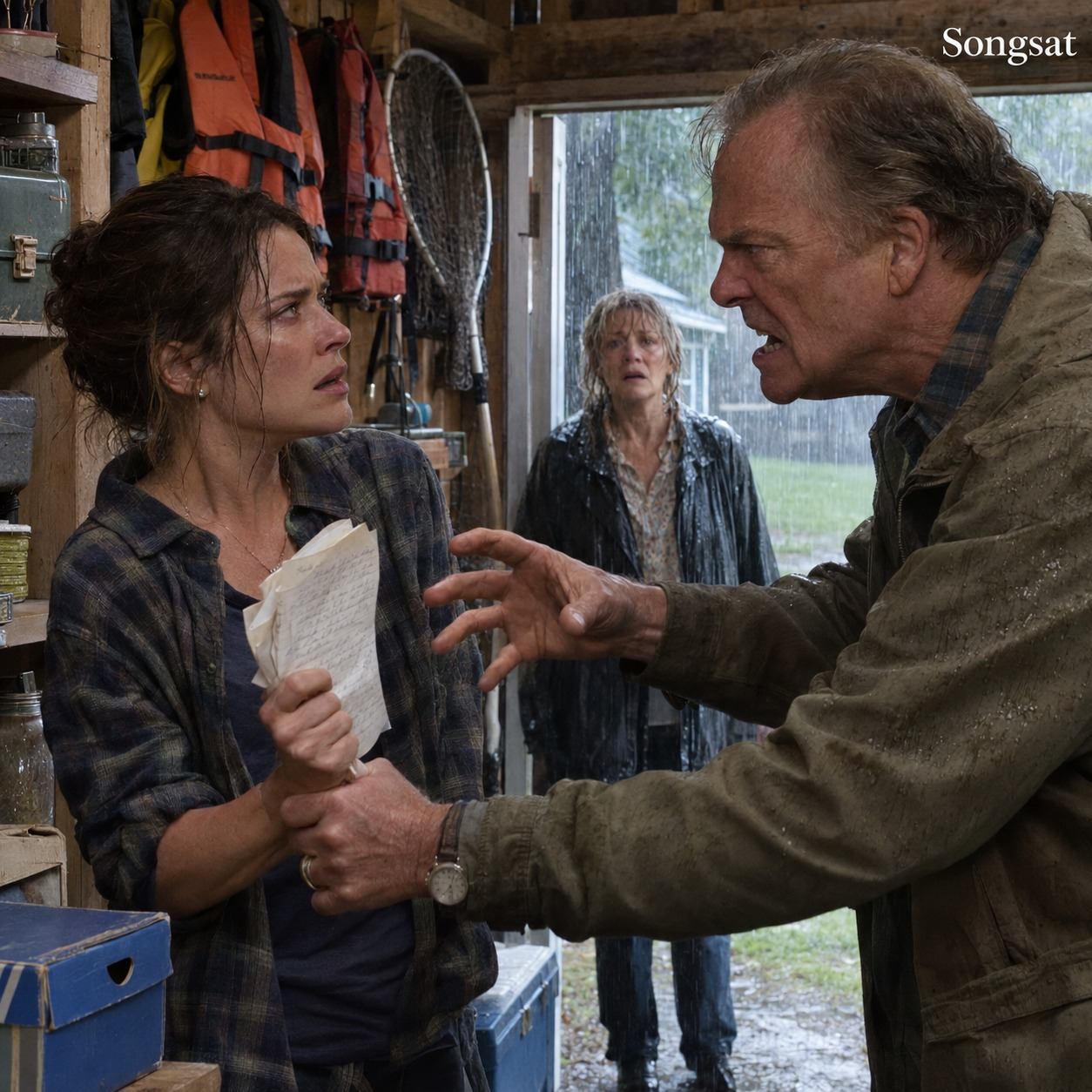
I grabbed the ringing phone beside my husband's hospital bed and whispered, "Dad, please tell me you're calling about Owen."
My father, Gene Matson, answered with a question that made my fingers go numb.
"So, is your husband dying or not?"
On the bedside table sat Owen's wedding ring in a clear plastic hospital bag.
A nurse had written three words across the label.
Removed on arrival.
My father wasn't asking whether Owen would survive.
He wanted to know whether Owen would ever speak again.
For several seconds, I couldn't make a sound.
The ventilator beside my husband's bed continued its steady rhythm. A green line moved across the monitor above his head. Every few seconds, a number changed, and I found myself staring at it as though watching closely enough might keep him alive.
"Ava?"
My father's voice came through the phone.
"Are you listening to me?"
I looked at Owen.
His dark hair was still damp beneath the edge of a hospital blanket. There was a small bruise near his temple. A tube disappeared between his lips, secured with white tape.
Twenty-four hours earlier, those lips had kissed my forehead while I complained about forgetting sunscreen.
Now a machine was doing the breathing for him.
"He's critical," I finally said.
"That doesn't answer my question."
I closed my eyes.
"Dad, I don't know if he's going to die."
He exhaled sharply.
Not the sound of a frightened grandfather.
Not the sound of a father worried about his daughter's marriage.
It sounded like irritation.
"Well, somebody must know something."
"The doctors are trying to stabilize him."
"Has he woken up?"
"No."
"Has he talked?"
I stared at the phone.
"What?"
"Before they put him on that machine. Did he say anything?"
I felt something cold settle beneath my ribs.
My father had always been good at making questions sound ordinary.
He could ask where I'd been, who I'd spoken to, or why I'd taken a different road home, and somehow make it seem as though he was only looking out for me.
But this was different.
"Dad, why are you asking that?"
"Because I'm concerned."
"About Owen?"
"About this whole mess."
He paused.
Then he said the words I would remember for the rest of my life.
"I need to know if this is finally over."
I looked at the clock.
11:42 p.m.
I remember the exact time because I was staring at it when I realized my father hadn't asked about Eli.
My nine-year-old son had nearly drowned that afternoon.
My husband had nearly died saving him.
And the man who had been with Eli when he fell into Kettle Lake hadn't asked whether either of them was okay.
"Dad," I said carefully, "Eli is safe."
"I know that."
"He's scared. He keeps asking when Owen is coming home."
"Kids get scared. They get over it."
I gripped the phone harder.
"He's nine."
"And you're thirty-eight, Ava. I need you to stop falling apart every time something goes wrong."
There it was.
The familiar tone.
The one that could turn me from a grown woman with a husband, a mortgage, and a child into the ten-year-old girl who had once stood barefoot on a dock, begging someone to tell her where her little brother had gone.
I swallowed.
"I'm not falling apart."
"Then answer the question."
"I already did."
He was silent for a moment.
Then his voice softened.
"Sweetheart, you know I'm only trying to protect this family."
Those words should have comforted me.
For most of my life, they had.
Instead, I looked at the man lying motionless in front of me and wondered why my father sounded more frightened of what Owen might say than of whether he would survive.
"I have to go," I whispered.
"Ava, wait."
I pulled the phone away.
His voice became louder.
"Listen to me. Don't let anyone put ideas in your head about what happened on that lake."
My thumb hovered above the red button.
"What ideas?"
"Just don't start blaming people."
"Who would I blame?"
"Ava—"
I ended the call.
For a long time, I stood perfectly still.
The phone remained in my hand.
I could hear footsteps outside the room, the distant squeak of a cart, and the low mechanical hum of equipment.
I had spent the entire day feeling as though my life were balanced on a narrow ledge.
Now I felt the ledge beginning to crack.
"Mrs. Bennett?"
I turned.
The night nurse stood near the foot of Owen's bed.
Her name was Carla.
She was in her early fifties, with short brown hair streaked with gray and a calm, practical manner that had kept me from completely losing control earlier that evening.
She had been checking Owen's chart when my father called.
I hadn't realized she was still there.
"I'm sorry," I said automatically. "I didn't mean to disturb anyone."
Carla looked at me for a moment.
"You don't need to apologize."
I tried to smile.
It didn't work.
"Family," I said weakly.
She glanced at the phone in my hand.
Then at Owen.
"Would you like some water?"
"No, thank you."
"Have you eaten?"
I shook my head.
She didn't lecture me.
She simply moved a chair closer to the bed.
"Sit down for a minute."
I obeyed.
That was another habit I'd developed early.
When someone spoke firmly enough, I usually did what they asked.
Carla checked Owen's monitor, adjusted something near the IV pole, and then turned back toward me.
"Your husband is receiving very close attention," she said. "The team is doing everything it can."
I nodded.
"I know."
But knowing didn't help.
I wanted Owen to open his eyes.
I wanted him to complain about the hospital coffee.
I wanted him to ask where Eli was and then insist on seeing him, even if it meant arguing with three nurses and a doctor.
Owen had always been like that.
Stubborn about the things that mattered.
Eight years and eight months sober, and still the first person to admit when he was wrong.
He never pretended to be perfect.
That was one of the things I loved most about him.
My father had never understood it.
To Gene Matson, a man who had once struggled with alcohol would always be a drunk.
It didn't matter how many meetings Owen attended.
It didn't matter how many years passed.
It didn't matter that he had built a successful contracting business, coached Eli's Little League team, and never missed a school concert.
My father remembered the man Owen had been before I met him.
And he never let anyone forget it.
"He was sober," I said suddenly.
Carla looked up.
"Excuse me?"
"Owen. My husband. He was sober when he went into the lake."
My voice sounded strange.
Defensive.
As though I were already standing in a courtroom.
Carla pulled the chair beside mine closer.
"Why would you need to tell me that?"
I stared at my hands.
"Because my father says he was drinking."
"Your father was there?"
"Yes."
She waited.
I wished she would interrupt.
I wished she would tell me to stop talking.
Instead, she gave me the kind of silence that made it possible to say things I'd been trying not to think about.
"My dad took Eli fishing," I explained. "He has a pontoon boat. They were supposed to stay near the dock."
I rubbed my forehead.
"Eli knows the rules. Owen taught him. Life jacket on whenever he's near the water. No exceptions."
Carla nodded.
"That sounds sensible."
"My father promised he'd make sure Eli wore it."
"What happened?"
"I don't know exactly."
The admission hurt.
I'd been repeating my father's version of the accident all evening, but when Carla asked me what had happened, I realized I hadn't actually witnessed any of it.
I'd been shopping with my mother.
We were buying groceries for the holiday weekend.
My phone had rung while I stood in the cereal aisle.
It was a neighbor.
She was screaming.
Something about the lake.
Something about Eli.
I remembered abandoning the shopping cart.
I remembered my mother running behind me through the parking lot.
I remembered driving too fast and praying so hard that the words stopped making sense.
Then the hospital.
Two ambulances.
Eli shivering beneath a silver emergency blanket.
Owen being rushed past me with an oxygen mask covering his face.
His skin had looked almost blue.
My father had been standing near the emergency department doors.
His T-shirt was soaked.
His face was pale.
He'd grabbed my shoulders before I could reach my son.
"Owen had been drinking," he'd said.
Not Eli is alive.
Not I'm sorry.
Not There was an accident.
Owen had been drinking.
Those were the first words my father chose to tell me.
And because he was my father, because he was Gene Matson, because everyone in our town trusted him when something went wrong, I'd allowed those words to settle inside me.
Even while I knew they couldn't be true.
"Mrs. Bennett?"
Carla's voice brought me back.
I blinked.
"I'm sorry."
"You don't need to keep saying that."
I looked at her.
Something in her expression made my throat tighten.
She wasn't pitying me.
She was paying attention.
That was somehow worse.
"My father is a volunteer firefighter," I said. "He has been for more than thirty years. He knows what to do in emergencies."
"That must have been reassuring when you were growing up."
I almost laughed.
Reassuring.
There were so many words I could have used to describe growing up with Gene Matson.
Safe wasn't always one of them.
But the town loved him.
He had pulled people from burning cars.
He'd organized fundraisers after storms.
He had once spent sixteen hours helping search for a missing teenager.
At the annual Fourth of July parade, people waved when his truck passed.
Children climbed onto his shoulders.
Neighbors called him a hero.
And every summer, when our family gathered at Kettle Lake, he told the same stories about courage, responsibility, and how a real Matson never panicked.
I believed him.
For years, I believed everything he said.
Especially about Danny.
My little brother had drowned in that same lake in 1998.
He was eight.
I was ten.
I had gone inside to get popsicles.
By the time I returned, he was gone.
Even now, twenty-eight years later, I couldn't think about that afternoon without remembering the sticky orange wrappers in my hands.
I'd dropped them when I saw the empty dock.
People had searched until dark.
My father had been one of them.
I remembered him coming out of the water, exhausted and shaking.
I remembered my mother screaming when someone finally found Danny.
And I remembered the words my father said afterward.
"We never blamed you, sweetheart."
He said them at the funeral.
He said them on Danny's birthday.
He said them whenever I cried.
Sometimes he said them when I hadn't mentioned Danny at all.
I used to think he was trying to comfort me.
But comfort had a strange way of turning into a reminder.
We never blamed you.
Which meant there had been something to blame me for.
And for twenty-eight years, I had accepted that.
Carla touched my arm lightly.
"You're a long way from home right now, aren't you?"
I nodded.
"We came for the Fourth of July."
"Was your husband happy to come?"
I looked toward Owen.
"He wanted Eli to know the lake. He thought maybe this summer would be different."
"Different how?"
I hesitated.
"Owen and my dad never got along."
Carla waited.
"My father didn't trust him because of his drinking history."
"How long has your husband been sober?"
"Eight years and eight months."
I said it immediately.
I knew the number.
I always knew.
Not because I was waiting for Owen to fail.
Because I knew how much work every one of those days represented.
Carla's expression softened.
"That's a long time."
"Yes."
I reached for Owen's hand.
His fingers were warm.
I held them carefully, avoiding the tape securing a line.
"He wouldn't drink and then go swimming. He wouldn't risk Eli's life."
My voice cracked.
"He just wouldn't."
Carla didn't contradict me.
She didn't offer false reassurance.
She simply said, "Then don't let someone else's certainty replace what you know about your husband."
I looked at her.
It was such a simple sentence.
But I couldn't remember the last time anyone had said something like that to me.
My phone vibrated.
A message from Dad.
You need to call me back.
A second message appeared almost immediately.
This is serious, Ava.
I turned the screen facedown.
Carla glanced toward the door.
"Your son is resting in the pediatric observation area," she said. "Someone from the team checked on him earlier."
"He's been asking for Owen."
"I know."
"He thinks it's his fault."
My eyes filled.
I pressed my lips together until the feeling passed.
"He keeps saying he should have held onto his fishing rod."
Carla became very still.
"His fishing rod?"
"Yes."
She studied me.
"Did your father tell you how Eli fell into the water?"
I nodded.
"He said Eli jumped in after Owen."
Carla didn't answer.
Something about her silence made me look up.
"Why?"
She glanced at the chart in her hand.
Then at the hallway.
"Mrs. Bennett, has anyone from the sheriff's department spoken with you?"
"Not really. A deputy asked a few questions earlier, but I wasn't there when the accident happened."
"Did you tell him what your father said?"
"Yes."
She lowered her eyes.
I felt my stomach tighten.
"Carla?"
She took a breath.
"I need you to understand something. When a child is involved in an incident like this, we take certain statements very seriously."
"What statements?"
She didn't answer immediately.
Instead, she moved closer to the bed and checked Owen's monitor again.
I watched her hands.
They were steady.
Professional.
But her face had changed.
"Is Eli okay?" I asked.
"He's physically stable."
"Then what is it?"
Carla turned toward me.
"Did your son tell you anything about what happened on the boat?"
I tried to remember.
Eli had been terrified.
He'd cried when I held him.
He'd asked whether Daddy was going to die.
He'd said he was sorry.
Over and over.
I'm sorry, Mommy.
I'm sorry.
I'd assumed he was apologizing for falling into the water.
Now I wasn't sure.
"He said he lost his fishing rod," I whispered.
Carla nodded slowly.
"And?"
"And he said Grandpa got mad."
The words came back so suddenly that I could almost hear Eli's voice.
Grandpa got mad.
At the time, I'd barely registered them.
I'd been too frightened about Owen.
Too overwhelmed by doctors and paperwork.
Too desperate to keep my son from seeing me cry.
Carla placed her chart on the counter.
"Mrs. Bennett, I'd like to speak with you somewhere private."
I stood so quickly that my chair scraped the floor.
"What's wrong?"
"Nothing new has happened to your husband."
"Then why do we need to go somewhere?"
She looked toward Owen.
"Because I don't think this conversation should happen beside his bed."
My heartbeat accelerated.
I glanced at the monitor.
Then at the door.
"Is it about Eli?"
Carla hesitated.
That hesitation frightened me more than anything she could have said.
"Please," I whispered. "Just tell me."
She reached into the pocket of her scrubs.
For a moment, I thought she was going to show me another medical report.
Instead, she withdrew a folded sheet of paper.
There was handwriting on it.
Not a printed form.
Not a discharge instruction.
Handwriting.
Carla held it carefully between two fingers.
"While you were speaking with the doctor earlier, Eli said something to me."
I stared at the paper.
"What did he say?"
"He wasn't being questioned. He started talking on his own. I wrote down his words as accurately as I could."
My mouth went dry.
"About the accident?"
"Yes."
"Did he say something bad?"
Carla looked at me for a long moment.
Then she said, "There's something your father doesn't know."
The words seemed to change the air around us.
I looked back at Owen.
He hadn't moved.
The ventilator continued its rhythm.
For the first time that night, I wondered whether my husband had gone into the water knowing something my father desperately wanted hidden.
Carla stepped into the hallway.
I followed her.
She stopped beside an empty consultation room and reached for the door.
"Before I show you this," she said quietly, "I need you to understand that your son may have been carrying something he was afraid to tell you."
I felt my knees weaken.
"Afraid of what?"
Carla unfolded the paper.
Her eyes moved to the first line.
Then she looked at me.
"Mrs. Bennett, your son didn't say he jumped into the lake after his father."
I stared at her.
She turned the page toward me.
At the top, beneath Eli's name, she had written four words in quotation marks.
I leaned closer.
And the first thing I saw was...






Comments 0