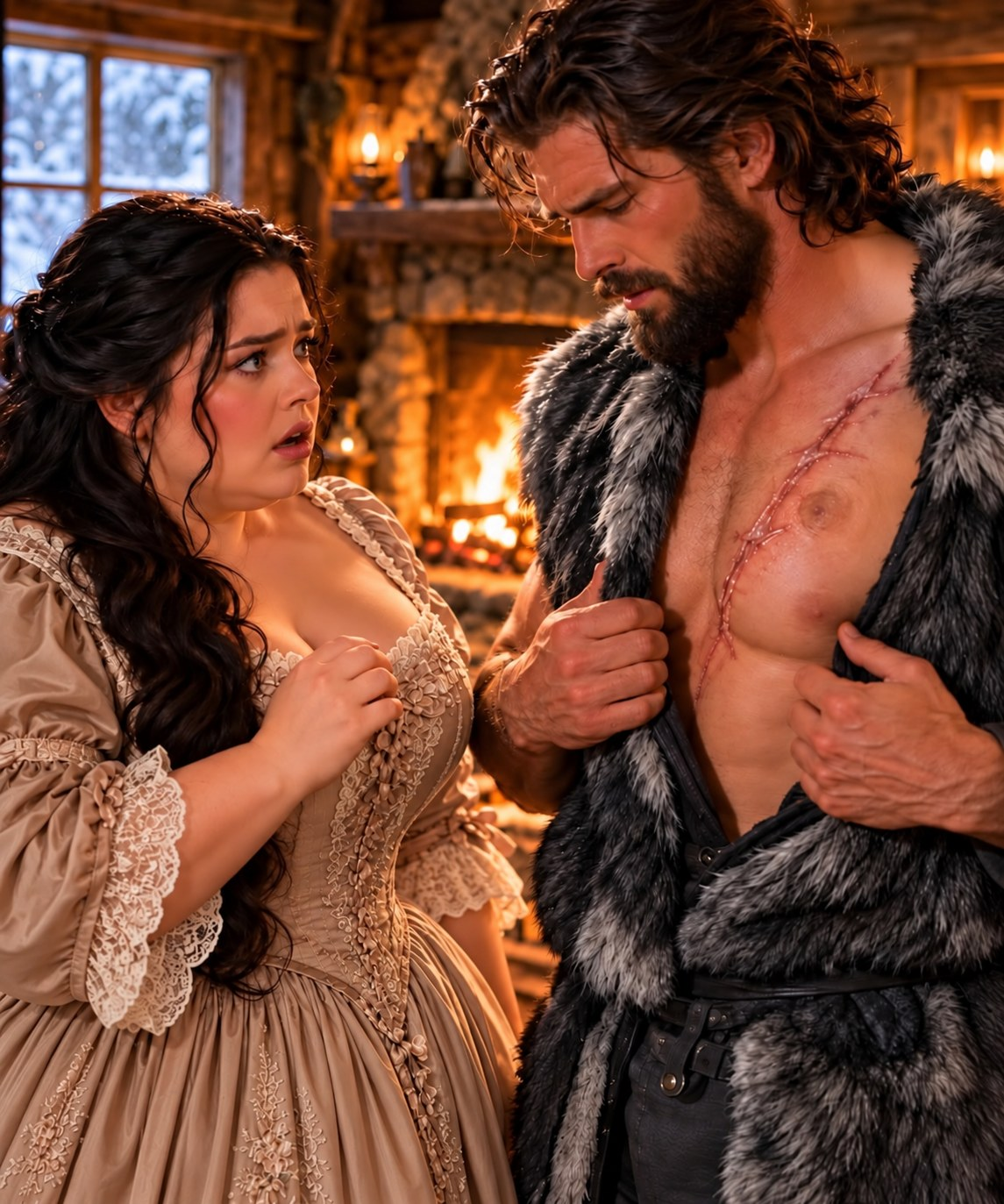
"Your father knew you would marry?"
Caleb looked down at the small wooden box in his hands.
"He hoped I would."
Eleanor studied him, uncertain whether she had heard correctly.
"Why would your father leave instructions for your wedding night?"
Caleb ran his thumb along the edge of the box. Its dark wood was scratched and worn, and a small brass lock held the lid shut.
"He believed there would come a day when I wouldn't be alone anymore."
"And he thought that day would change something?"
Caleb nodded slowly.
"He said the person who chose to stay with me deserved to know the truth."
Eleanor glanced toward his chest.
The scar remained hidden beneath his waistcoat, but she couldn't forget what she had witnessed. The strange movement had been small, almost imperceptible, yet unmistakably real.
"Then open it," she said.
Caleb hesitated.
"My father told me not to open this until I had a wife."
"Well, you have one now."
He gave her a brief, nervous smile.
"That's what worries me."
Eleanor pulled a chair closer to the fireplace and sat down. Her heavy burgundy wedding skirt settled around her feet.
"Caleb, I didn't travel all this way to marry a man who refuses to tell me anything."
He looked at her.
There was something unexpectedly firm in her voice.
For years, Eleanor had been taught to make herself smaller. Henry had disliked women who questioned him, and she had learned that silence often prevented an argument.
But she had made a promise to herself after his death.
She would never again spend her life being afraid to ask a question.
Caleb seemed to recognize that determination.
He placed the wooden box on the table between them.
"I need to explain something first."
Eleanor folded her hands.
"I'm listening."
Caleb took a long breath.
"When I was thirteen, my father and I lived in a cabin farther up the mountain. It was smaller than this one, and the roof leaked whenever the snow began melting."
He paused.
"My father was a quiet man. He didn't have many friends, and he rarely spoke about the years before I was born."
"Why not?"
"He said some memories were better left buried."
Eleanor frowned.
"That sounds like something a man says when he's hiding something."
Caleb almost smiled.
"Perhaps."
He looked into the fire.
"One night, I woke up because I heard my father shouting outside. I went to the door and saw him standing in the snow with a lantern. He was staring toward the trees."
"What did he see?"
"He never told me."
Caleb's fingers tightened around the edge of the table.
"I remember asking him whether someone was there. He told me to get inside. Then he locked the door."
Eleanor leaned forward.
"And afterward?"
"He sat beside my bed until morning. He kept checking my forehead, my hands, and my breathing."
"Was that when you became sick?"
Caleb nodded.
"I woke up the next morning with a fever. My chest hurt so badly that I couldn't sit upright."
He touched the front of his waistcoat.
"By evening, my father had discovered the first mark."
Eleanor felt a chill travel down her spine.
"What kind of mark?"
"A thin red line beneath my skin. It started near my ribs and slowly moved toward my shoulder."
She stared at him.
"Moved?"
"That's what he told me."
Caleb swallowed.
"By the following morning, it had become a wound."
Eleanor looked toward the box.
"And your father treated it?"
"He tried everything he knew. Hot compresses, herbs, medicine from the trading post. Nothing helped."
"What happened next?"
Caleb lowered his voice.
"He took me to a doctor."
Eleanor waited.
"He examined me for nearly an hour. Then he asked my father to step outside."
"Why?"
"I don't know exactly what they discussed. But when my father returned, his face had changed."
Caleb looked directly at Eleanor.
"He packed our belongings that same afternoon."
Eleanor blinked.
"He took you away?"
"Into the mountains. Farther from the settlements."
"Because of your scar?"
"Because of what the doctor told him."
"What did the doctor say?"
Caleb shook his head.
"My father never repeated the conversation. He only said that I was safer where nobody could examine me."
Eleanor felt her uneasiness deepen.
She had expected an explanation involving an accident, an old injury, or perhaps some rare illness.
Instead, every answer seemed to lead to another question.
"Did your father ever take you back to the doctor?"
"No."
"Not once?"
"Not after that day."
Eleanor leaned back.
"That was nineteen years ago, Caleb. Surely there must have been another doctor."
"My father didn't trust them."
"Why?"
He looked at the box again.
"Because he believed the doctor had recognized something."
The room became quiet.
Outside, the wind pushed against the cabin walls.
Eleanor looked at her husband more carefully.
Despite his enormous frame, he seemed almost fragile when speaking about his childhood. His shoulders were slightly hunched, and his eyes had taken on the distant expression of someone remembering something painful.
"Did your father ever hurt you?" she asked.
Caleb immediately shook his head.
"Never."
"Did he make you hide the scar?"
"Yes."
"Did he explain why?"
"He said people would try to take me away if they saw it."
Eleanor's stomach tightened.
"Take you where?"
Caleb didn't answer.
Instead, he reached into his pocket and produced a small brass key.
He placed it beside the wooden box.
"My father gave me this three days before he died."
Eleanor watched him unlock it.
The brass mechanism clicked.
Caleb lifted the lid.
Inside lay several folded sheets of yellowed paper, a small silver pocket watch, and a faded photograph.
He removed the photograph first.
It showed a younger man standing beside a boy of approximately thirteen.
The older man had a thick beard and stern eyes. One hand rested protectively on the boy's shoulder.
Eleanor recognized Caleb immediately.
Even as a child, he had possessed the same broad face and deep-set eyes.
"Your father?" she asked.
"Yes."
"He looks serious."
"He rarely smiled."
Caleb turned the photograph over.
Something had been written on the back in faded black ink.
Eleanor leaned closer.
There were only seven words.
If he marries, give her the letter.
She looked up.
"Is that why you were waiting until you had a wife?"
Caleb nodded.
"My father told me that I must never give the letter to anyone who married me for money, land, or curiosity."
Eleanor felt a small sting at the implication.
"Did he think every woman would marry you for those reasons?"
"No. He thought I would never find anyone willing to marry me at all."
Caleb looked embarrassed.
"I suppose he knew me better than I knew myself."
Eleanor softened.
"Why did you believe you couldn't find someone?"
He glanced at his chest.
"Because I was different."
She considered him for a moment.
"Caleb, I've spent most of my adult life believing I wasn't good enough for anyone. I know what it feels like to expect rejection before someone has even spoken."
His expression changed.
"Your first husband?"
Eleanor nodded.
"Henry."
Caleb had heard a little about her previous marriage, but she had never described its worst moments.
"He used to tell me that nobody else would ever want me," she said. "He said I should be grateful he had married me."
Caleb's jaw tightened.
"That was cruel."
"It took me years to understand that."
She looked down at her hands.
"I thought marriage meant accepting whatever treatment your husband decided I deserved."
Caleb remained silent.
"That's why I answered your advertisement," she continued. "Your letter didn't mention how a woman should look. It didn't tell her to be obedient or grateful. You simply said you wanted someone to share your life."
"I meant it."
"I know."
For the first time that evening, Eleanor smiled faintly.
Caleb looked at her as if he had witnessed something extraordinary.
Then he carefully unfolded the first letter.
The paper was brittle around the edges. The handwriting was large and uneven, as though the person who had written it had been in a hurry.
Caleb read silently for several seconds.
His expression gradually changed.
"What does it say?" Eleanor asked.
He didn't answer.
Instead, he passed the paper to her.
Eleanor took it carefully.
The first lines were addressed to a woman whose name she didn't recognize.
To the woman who may one day become my son's wife,
If you are reading these words, then my boy has finally found someone willing to share the life I could never give him.
I hope you will understand that he is not a monster. He is not cursed, and he is not dangerous to those who treat him with kindness.
Eleanor stopped.
She read the passage again.
Not a monster.
Not cursed.
Those were unusual words for a father to write about his son.
She continued.
When Caleb was thirteen, something happened that changed our lives. I have spent nineteen years trying to understand it. I have failed.
There is something beneath the scar on his chest. It is not an ordinary wound. It has a rhythm of its own, and sometimes it responds to sounds that nobody else can hear.
Eleanor's fingers went cold.
She slowly raised her eyes toward Caleb.
He was staring at the fireplace.
"Did you know?" she whispered.
"I knew something moved."
"Your father wrote that it responds to sounds."
Caleb nodded.
"He used to say that."
Eleanor looked back at the letter.
For many years, I believed the thing beneath his skin was connected to the night he became ill. I thought it was slowly growing. But last winter, I discovered something that frightened me more than the scar itself.
The next sentence had been heavily underlined.
It was not responding to Caleb anymore.
Eleanor stopped breathing for a moment.
She looked at Caleb.
"What does that mean?"
His face had become pale.
"I don't know."
"Your father discovered something?"
"I told you he never explained everything."
She continued reading.
It was responding to something outside the cabin.
A gust of wind struck the windows.
Eleanor glanced toward the dark glass.
The storm seemed suddenly louder.
She looked down again.
If your husband ever tells you that he hears someone calling his name from beyond the tree line, do not let him go outside.
Eleanor felt her heartbeat quicken.
She looked at Caleb.
"Have you ever heard someone calling you?"
He didn't move.
For several seconds, he simply stared at the letter.
Then he nodded.
"Sometimes."
"When?"
"Usually during the winter."
"Why didn't you tell me?"
"Because I thought it was the wind."
Eleanor looked back at the paper.
The final paragraph was written in smaller letters.
There is one more thing you must know. I buried the truth beneath the old cabin, where the first mark appeared. If I am no longer alive when you read this, find the iron box beneath the western floorboard.
Do not open it unless you have heard three knocks.
Eleanor read the final sentence twice.
"Three knocks?"
Caleb nodded.
"That's what he wrote."
She lowered the letter.
"Why would someone need to knock before opening a box buried beneath a floor?"
"I don't know."
"Caleb, this makes no sense."
"I know."
He gathered the remaining papers and returned them to the wooden box.
But Eleanor noticed something.
There was another folded sheet beneath the photograph.
It was smaller than the others and sealed with dark red wax.
Caleb hadn't noticed it.
"There's something else."
He followed her gaze.
His expression changed immediately.
"I've never seen that before."
Eleanor carefully lifted the folded paper.
The wax seal bore a symbol: a circle crossed by three narrow lines.
She turned it over.
A name had been written across the front.
Eleanor Whitmore.
Her blood ran cold.
She stared at the writing.
"Caleb?"
He leaned closer.
The color drained from his face.
"That's impossible."
"Why?"
"Because my father died before I ever answered your advertisement."
Eleanor looked at the handwriting.
It was unmistakably addressed to her.
Not to Caleb's future wife.
Not to an unnamed bride.
To her.
She carefully broke the wax seal.
Inside was a single sentence.
If Eleanor has become your wife, then the mountain has already found us again.
Caleb abruptly stood.
His chair scraped against the floor.
"What?" Eleanor whispered.
He stared at the paper.
Then, from somewhere beneath the wooden floorboards, came a sound.
One knock.
Both of them froze.
A second knock followed.
Caleb slowly turned toward the western side of the cabin.
Eleanor gripped the letter.
Then came the third knock.
And beneath their feet, something began scratching at the wood.






Comments 0