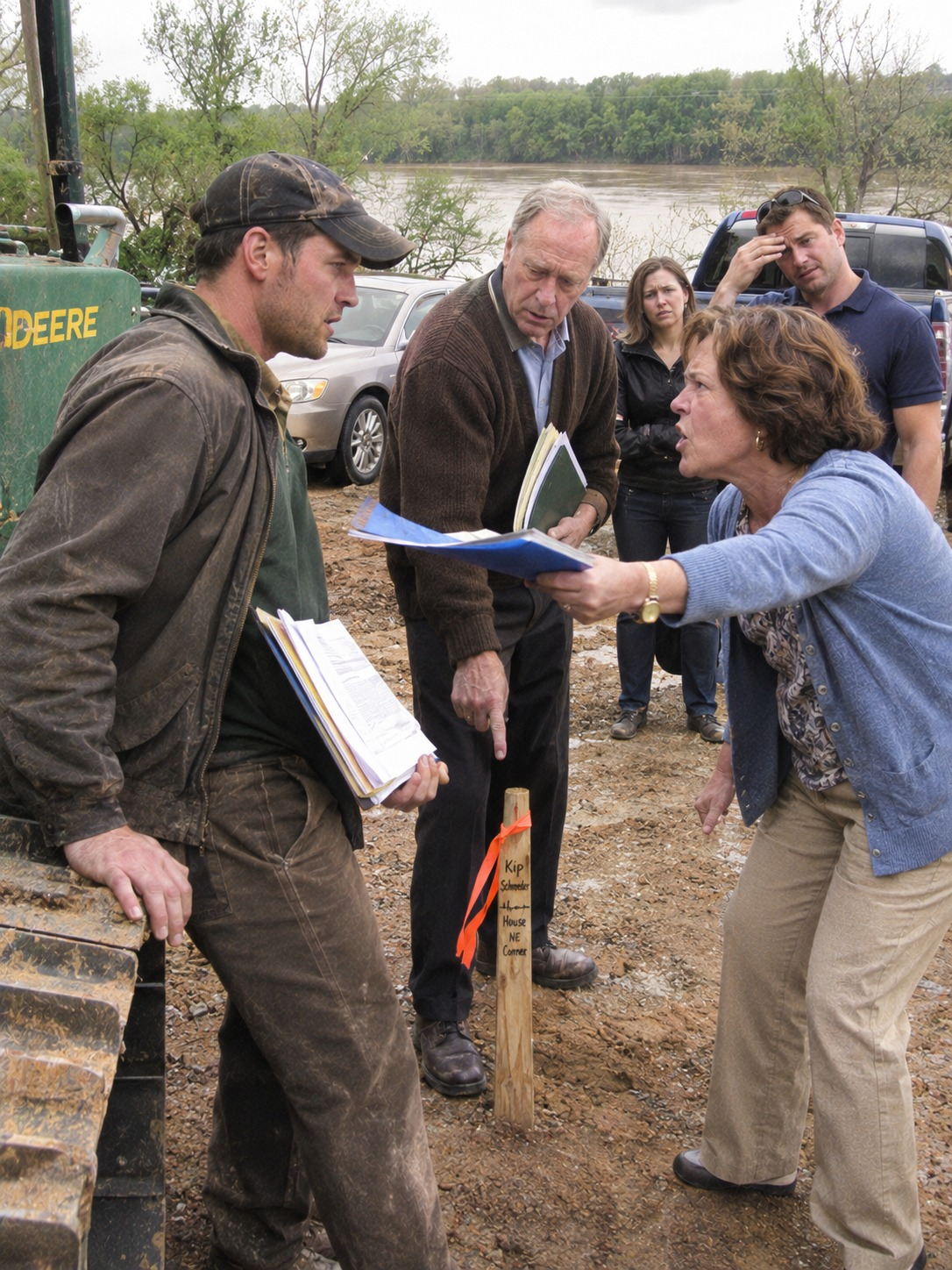
I stared at the document on my mother's coffee table.
My signature was at the bottom.
But I had never signed it.
For several seconds, nobody moved.
Then Lucas stepped closer.
"Mom, what is that?"
She straightened the pages.
"Your father made arrangements before he died. Kip agreed to transfer the property. Everything was settled."
I looked at her.
"Then why does the hospital have no record of me visiting that day?"
Her expression tightened.
"Records aren't always complete."
"Why was the notary's commission expired?"
She said nothing.
"And why does Dad's letter say he specifically refused to give Lucas my property?"
She slammed the document onto the table.
"Because your father changed his mind!"
The words came out louder than she intended.
I looked directly at her.
"Then show me the original authorization."
She hesitated.
It lasted only a second, but I saw it.
And so did Lucas.
"Mom," he said quietly. "Show us."
She turned toward him.
"You need to stay out of this."
"No. I think I've been in it the whole time."
Alyssa stood beside him.
"We all deserve the truth."
Mom looked around the room as if searching for someone who would support her.
Nobody moved.
I placed my phone on the table.
"Bernie has copies of everything. The bank records, the company registration, the contractor's estimate, and this document. He's also requested the original hospital records."
Mom's face changed.
"You went to an attorney?"
"Yes."
"You would take your own mother to court?"
"I didn't forge my own signature."
She looked away.
For the first time, I saw something beyond anger in her expression.
Fear.
I left without another argument.
The following morning, Bernie arranged a meeting with the bank's legal department. He had also contacted the appropriate authorities regarding the disputed signatures and financial transactions.
I brought Dad's letter, the photograph, and every document I had collected.
Lucas came with me.
He looked nervous.
Alyssa waited in the lobby.
We were shown into a conference room where Martin Keller, the former branch manager, was already seated.
He looked older than I remembered.
When he saw me, he stood.
"Kip."
"Martin."
Bernie introduced himself and explained the purpose of the meeting.
Martin sat down.
He looked uncomfortable.
"I understand there are questions about your father's account."
"More than questions," I said.
Bernie placed the September authorization on the table.
"Can you explain this transaction?"
Martin examined the document.
His face tightened.
"I remember the account."
"Do you remember authorizing the transfer?"
He nodded slowly.
"Your mother brought the paperwork to the hospital."
"Was my father present?"
"Yes."
"Was he capable of understanding the transaction?"
Martin hesitated.
"I believed he was."
"Did you explain that two hundred thousand dollars would leave his account?"
He looked down.
"I explained the transfer."
"To whom?"
"Your mother."
I leaned forward.
"Did you explain it to my father?"
He didn't answer immediately.
Bernie intervened.
"Mr. Keller, please be precise."
Martin rubbed his forehead.
"Your father was very tired. He asked us to make things easier for your mother. She told us the money was being placed in an account for family expenses."
"Did Dad specifically authorize the transfer to her personal account?"
"I can't say that he understood the destination account."
My hands tightened.
"Then why did you approve it?"
Martin looked at me.
"Your mother provided documents stating that she had authority to manage the funds."
"Did you verify that authority?"
He hesitated.
"Not as thoroughly as I should have."
Bernie placed another document on the table.
It was the transfer authorization carrying my supposed signature.
Martin stared at it.
"Where did you get this?"
"From the documents submitted by my mother."
He read the first page.
Then the second.
His face became pale.
"This wasn't part of the original transfer."
"What do you mean?" Bernie asked.
Martin pointed to the date.
"This document was brought to the branch several months later. I remember it because your mother wanted us to recognize the property contribution as part of the family development arrangement."
I stared at him.
"Did you accept it?"
"No. We didn't process a property transfer."
"Why?"
"Because the ownership documentation was incomplete."
I looked at Bernie.
He made a note.
Martin continued.
"I should have reported the discrepancy earlier. I didn't realize the signature was disputed."
I sat back.
It wasn't the answer I wanted.
But it was an answer.
Bernie requested that Martin preserve all remaining records and provide a formal statement through the appropriate process.
Martin agreed.
After the meeting, Lucas and I walked outside.
He stopped near the parking lot.
"I think I owe you an apology."
I looked at him.
"You've already said that."
"I know. But I didn't understand how far this went."
He stared at the pavement.
"Mom told me Dad wanted me to have the house. She said you'd eventually agree because you didn't need the money."
I said nothing.
"I believed her because I wanted to believe her."
I looked at my brother.
"Did you know about the $180,000 company transfer?"
"No."
"Did you receive any of that money?"
"No."
"Did you know Mom had created the company?"
"Not until you showed me."
He swallowed.
"I thought she was helping us."
I nodded.
"That's what she wanted you to think."
A week later, the investigation produced a much clearer picture.
The bank provided its original transaction records through the proper legal process.
The hospital supplied visitor records and the available documentation surrounding Dad's final days.
The county confirmed that no valid transfer of the river property had ever been recorded.
The disputed documents were submitted for examination.
The findings were damaging.
The supposed signature of mine on the property contribution agreement was not genuine.
The notary's commission had expired before the date shown on the acknowledgment.
The hospital's records did not support the claim that I had signed the agreement there.
The company had been created using the $180,000 transferred from my father's account after his death.
And the proposed contribution of my property had never been authorized by me.
The authorities continued examining the financial transactions and the documents connected to the estate.
Mom eventually stopped denying that she had arranged the paperwork.
Through her attorney, she agreed to cooperate with the investigation.
She claimed she had believed the money was hers to manage and that the property arrangement was intended to benefit the family.
But the records told a different story.
The estate accounting showed that the $200,000 transfer had been treated as a distribution to her.
The subsequent $180,000 contribution to Lammers Family Holdings had never been properly explained to the other beneficiaries.
The company records showed that Lucas had been listed as a minority member without receiving the full financial information he should have received.
The remaining company funds were frozen while the accounting was completed.
After reviewing the evidence, the estate representatives determined that Mom had not been entitled to treat the entire transfer as her personal property.
The disputed funds were recovered through the legal process, and the estate accounting was corrected.
The authorities also pursued the forged documents and the improper financial representations.
Mom eventually accepted responsibility for her part in the wrongdoing through a negotiated legal resolution.
She was required to repay the improperly retained funds, cover the associated costs, and accept restrictions on her ability to manage financial matters on behalf of other family members.
The legal consequences were serious.
But for me, the most important result was simpler.
My grandfather's deed remained valid.
The river lot was mine.
Bernie called me one Friday afternoon.
"Kip, I have the final confirmation."
I was standing beside my dozer in Dad's old machine shed.
"What confirmation?"
"The county has completed its review. The disputed filings have been rejected, and your ownership remains unchanged."
I looked toward the open shed doors.
Sunlight fell across the equipment.
"Thank you."
"You did the right thing by preserving the documents."
After we ended the call, I stood there for a while.
Dad's old flashlight was still hanging from a nail near the workbench.
I took it down.
The batteries were dead.
I replaced them and switched it on.
The beam illuminated the blade of the old crawler dozer.
I smiled faintly.
Dad had wanted me to keep that machine running.
I intended to.
The following month, Lucas and Alyssa visited the river property.
They arrived in his pickup.
Alyssa carried a paper bag from a bakery.
Lucas stepped out and looked toward the water.
"I've never really seen this place the way you see it," he said.
I stood beside the entrance.
"There's a lot to see."
We walked toward the elevated pad.
I showed them where the house would stand.
The porch would face the Mississippi.
The kitchen would sit toward the eastern side.
There would be a mudroom near the back entrance, with enough space to remove muddy boots without tracking dirt through the house.
Alyssa smiled.
"That sounds like a good idea."
"Paula insisted on it."
Lucas looked across the property.
"Mom told me this place was just a piece of wet ground."
I laughed quietly.
"It was."
He looked at me.
"Not anymore."
I shook my head.
"No. Not anymore."
He hesitated.
"Are we okay?"
I considered the question.
Our childhood hadn't been perfect.
Neither had our adult relationship.
There were things that couldn't be repaired with one apology.
But Lucas had finally stopped accepting promises without examining the facts.
And he'd stood beside me when the truth became uncomfortable.
"We're brothers," I said. "We can start there."
He nodded.
Alyssa handed me the bakery bag.
Inside were three cinnamon rolls.
I looked at her.
"How did you know?"
She smiled.
"Lucas told me about the mornings you and your dad used to spend together."
I looked toward the river.
For a moment, I could almost hear Dad laughing about his old truck and Grandpa complaining about the mosquitoes.
I took the bag.
"Thank you."
Several months later, Paula and I began building the house.
The work took longer than expected.
We had to finalize the floodplain requirements, confirm the drainage plan, and coordinate the foundation work.
But this time, every contract carried my signature.
Every payment was documented.
Every decision belonged to us.
I hired local contractors and paid them fairly.
I used my own equipment for the grading work.
When the foundation was finished, I stood on the elevated pad and watched the crew prepare the framing.
Paula came outside carrying two coffees.
She handed me one.
"Looks different now."
I looked at the wooden structure rising above the ground.
"Better than the drawing?"
She smiled.
"Much better."
The porch faced the Mississippi exactly as we'd planned.
The back entrance had enough room for muddy boots.
And beside the kitchen, there was a small shelf where Paula placed the first photograph we'd taken together.
We moved in the following spring.
Lucas and Alyssa visited on a Saturday afternoon.
They brought food, helped us unpack, and stayed long enough to watch the sunset.
Lucas stood on the porch with me.
"I've been thinking about Dad," he said.
"So have I."
"I wish he'd been here."
I nodded.
"Me too."
He looked toward the river.
"Do you think he'd like the house?"
I smiled.
"He'd probably complain about the driveway."
Lucas laughed.
Then he became serious.
"I've also been thinking about Grandpa."
"He'd like the porch."
"Definitely."
We stood together for a while.
The river moved slowly below us.
There were no speeches.
No arguments.
No documents spread across a table.
Just two brothers standing on a piece of ground that had once nearly divided them.
Mom and I didn't return to the relationship we'd had before.
She sent a letter several weeks after the legal proceedings ended.
It contained an apology.
Not a perfect apology.
There were explanations, regrets, and a few sentences that still tried to soften what she'd done.
But she acknowledged that the land was mine.
She acknowledged that she had used my name without permission.
And she acknowledged that she had allowed Lucas to believe something that wasn't true.
I accepted the letter.
I didn't pretend everything was fixed.
Forgiveness, I learned, didn't require giving someone another opportunity to take what wasn't theirs.
I could wish her well without handing her the keys to my life.
That was enough.
One Sunday morning, Paula and I walked down to the river.
The grass was still wet.
The water reflected the early sunlight.
I carried two cups of coffee.
She leaned against the porch railing.
"Six years," she said.
"Six years of payments."
"And all those loads of clay."
"More than I want to count."
She smiled.
I looked across the water.
Grandpa had sold me this land because he believed a man should pay for what he owned.
Dad had wanted his sons treated fairly.
Neither of them had wanted a family divided by money.
For a long time, I'd thought protecting what I'd earned meant fighting alone.
But I hadn't been alone.
Paula had stood beside me.
Lucas had eventually faced the truth.
Alyssa had refused to let a dishonest arrangement become the foundation of her marriage.
And Grandpa's simple receipt book had preserved something more valuable than a piece of property.
It had preserved the truth.
I took a sip of coffee.
The house was quiet behind us.
The porch faced the river.
The boots had their own place by the back door.
And for the first time, I didn't have to explain to anyone why I belonged there.
I looked at Paula.
"Home?"
She smiled.
"We're already home."






Comments 0