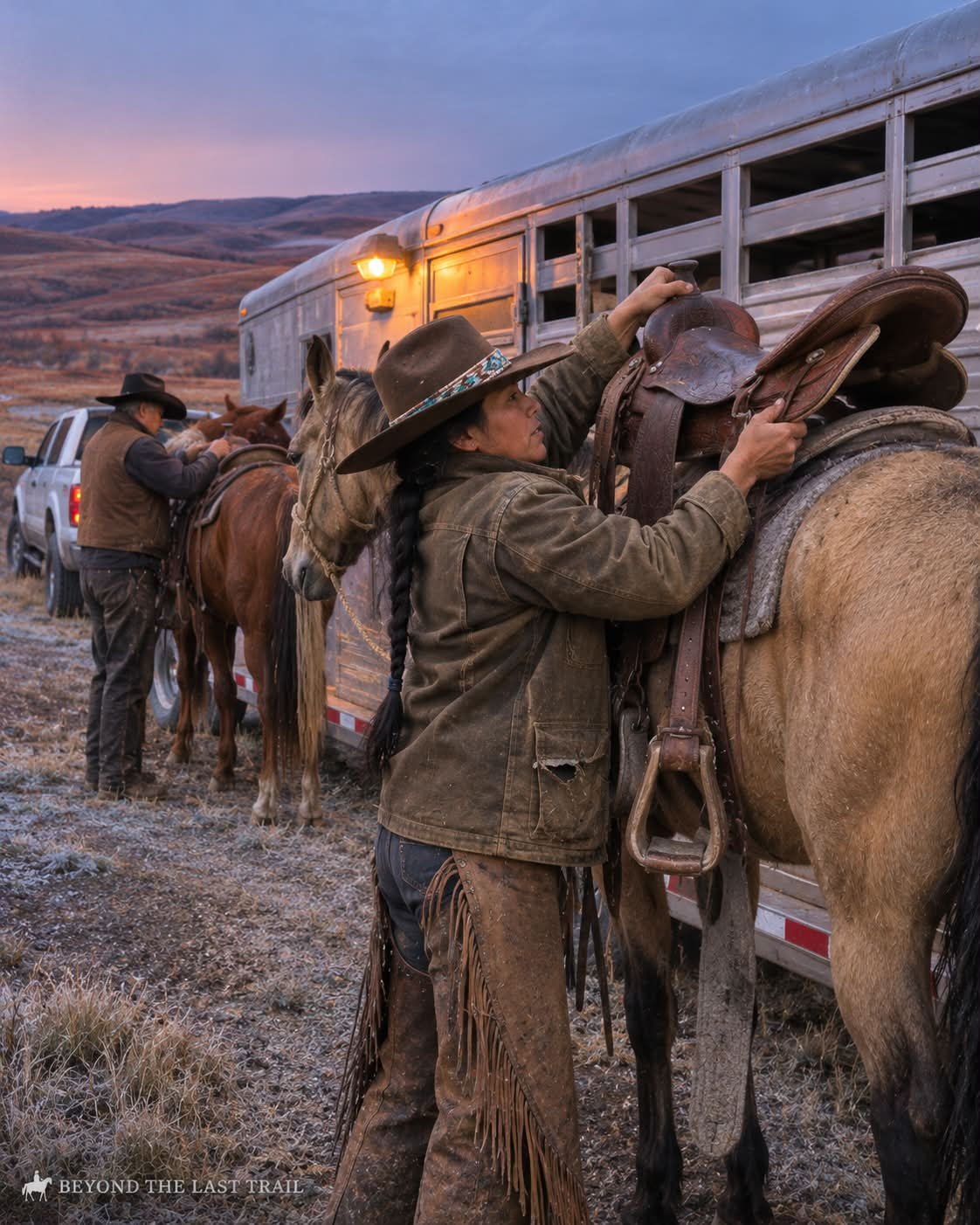
"Don't tighten that cinch!" Caleb shouted.
I froze with the leather strap in my hand.
Caleb Mercer, the most experienced ranch hand my father had ever trusted, stepped toward me holding an old brass cattle tag.
Three numbers had been scratched into its surface.
417.
I recognized them immediately.
They were the last numbers my father had written before he died.
And Caleb was holding proof that somebody had lied about his death.
For several seconds, neither of us moved.
My buckskin gelding, Copper, shifted his weight beside the silver livestock trailer, his ears turning toward Caleb's voice. The amber utility light above us hummed softly. Beyond the trailer, the rolling Wyoming hills were still dark, with only a thin pink line beginning to form along the eastern horizon.
It was 5:12 a.m.
We were supposed to be saddled and moving before first light.
Instead, I was staring at a piece of metal that should have been buried with my father.
"Where did you get that?" I asked.
Caleb didn't answer.
He was fifty-three, broad-shouldered, with silver-gray hair and a beard that always seemed to carry a little dust, even after he'd washed. He had worked for my father for twenty-six years. I had known him since I was a little girl learning to ride on a pony too stubborn to understand that children were supposed to be in charge.
I had seen Caleb furious.
I had seen him exhausted.
I had seen him hold a dying calf in his arms and cry without making a sound.
But I had never seen him afraid.
Until that morning.
"Ellie," he said quietly, "we need to talk before we ride out."
I glanced at the eastern horizon.
"We have nearly four hundred head scattered across the north range. If we don't get moving, we'll lose the cool hours."
"I know."
"Then whatever this is, it can wait."
"No." His voice hardened. "It can't."
I looked down at the tag again.
417.
The number meant nothing to anyone else.
To me, it meant the final page of my father's life.
Three months earlier, my father, Samuel Bennett, had been found dead at the bottom of a narrow ravine on the north side of our ranch.
The sheriff called it an accident.
A horse slipped on loose rock. My father fell. He struck his head.
Simple.
Tragic.
Finished.
Except the night before his death, Dad had sat at our kitchen table with an old ledger open in front of him.
He had been writing numbers, crossing out names, and making phone calls he refused to explain.
I remembered asking him whether something was wrong.
He had looked up at me with tired eyes.
"Nothing you need to worry about, sweetheart."
That was the last lie my father ever told me.
The next morning, he was dead.
And on the final page of his notebook, written so hard that the pen had nearly torn through the paper, were three numbers.
417.
I hadn't understood them.
Neither had the sheriff.
Now Caleb was standing beside our horse trailer with those exact numbers scratched into a cattle tag.
"Tell me where you found it," I said.
Caleb glanced toward the white pickup parked behind us.
Then he looked at the trailer.
"Inside your saddle."
I stared at him.
"What?"
"I was checking the tack before you came out. The underside of your saddle skirt had been cut and stitched back together. Somebody hid this inside."
My eyes moved toward the heavy Western saddle resting across Copper's back.
The saddle had belonged to my father.
Dark brown leather.
A worn silver concho near the horn.
A small repair on the right fender where Dad had caught it on a fence post years earlier.
He had ridden in it almost every day for fifteen years.
After his death, I couldn't bear to look at it.
For weeks, it had hung untouched in the tack room.
Then, two days before the fall gather, I decided to use it.
I told myself it was because the saddle fit Copper better than my newer one.
The truth was harder to admit.
I missed my father.
And carrying something that had belonged to him made the ranch feel a little less empty.
"Who would hide something in Dad's saddle?" I asked.
Caleb's jaw tightened.
"That's what worries me."
I took the tag from his hand.
It was heavier than I expected.
Old brass.
One corner bent.
A narrow scratch running across the back.
I turned it over.
There was a second marking beneath the numbers.
A small triangle.
Inside it, someone had stamped the letter B.
My breath caught.
Bennett.
Our family cattle brand was a simple B inside a triangle.
Dad designed it himself when he bought his first thirty acres.
Over the next thirty years, he built that small operation into the Bennett Creek Ranch.
Six thousand acres of leased and owned grazing land.
A working herd.
A modest house.
A reputation for keeping his word.
And debts that had nearly swallowed us after his death.
I ran my thumb over the marking.
"This is ours."
Caleb nodded.
"Looks that way."
"Then why hide it?"
"Because somebody didn't want it found."
I looked at him.
"You're not telling me everything."
He turned away.
That was answer enough.
"Caleb."
He stopped.
"Look at me."
For a moment, he seemed older than I remembered.
"Your father came to me two days before he died," he said.
The words landed heavily between us.
"He said he'd found something wrong with the herd records. Something that went back years."
"What kind of wrong?"
"He wouldn't say."
"Did he ask you to help?"
"Yes."
"And?"
Caleb swallowed.
"I told him he was making trouble where there didn't need to be any."
I felt something cold settle inside my chest.
"You didn't believe him."
"I thought he was mistaken."
"My father didn't make mistakes about cattle."
"I know that now."
I stared at him.
Caleb looked down at his boots.
"He wanted me to ride the north range with him. I said I'd go the following morning."
"The morning he died?"
He nodded.
"But I never got the chance."
A faint wind moved through the dry grass.
Behind Caleb, his chestnut gelding, Ranger, lowered his head and nudged the trailer.
I had spent three months believing my father's death was a terrible accident.
Three months trying to hold together a ranch that seemed to be collapsing from every direction.
The bank wanted payments.
Feed prices had risen.
Two longtime buyers had suddenly canceled their contracts.
And our neighboring rancher, Victor Harlan, had offered to purchase the Bennett Creek property at a price so low it felt insulting.
When I refused, he smiled and told me I would change my mind.
I hadn't.
Not yet.
But I was running out of options.
"Why didn't you tell me Dad came to you?" I asked.
Caleb looked toward the hills.
"Because I was ashamed."
"Of what?"
"Not listening."
I wanted to believe him.
For most of my life, Caleb had been the man who showed up when things went wrong.
When I was eleven and broke my wrist falling from a horse, he carried me back to the house.
When my mother died of cancer, he handled the livestock so Dad could stay beside her.
When Dad died, Caleb was the one who found me sitting alone in the barn and told me I didn't have to decide the future of the ranch that night.
He had earned my trust a hundred times over.
But trust didn't explain why he had kept something this important from me.
"Is there anything else?" I asked.
His eyes met mine.
For one terrible second, I thought he might finally tell me everything.
Instead, he said, "We need to get those cattle in."
I almost laughed.
"You just told me somebody hid evidence in my father's saddle, and now you want to go gather cattle?"
"That's exactly what I want."
"Why?"
"Because your father was looking for something on the north range when he died."
I glanced toward the distant ridgeline.
"And you think it's still there?"
"I think this tag was meant to lead us somewhere."
I looked at the numbers again.
417.
"Then we start with the herd."
Caleb nodded.
"That's what Sam would've done."
Hearing my father's name nearly broke me.
I turned back to Copper before Caleb could see my eyes.
I slipped the brass tag into the inside pocket of my burgundy jacket.
Then I reached beneath the saddle and finished threading the latigo through the cinch ring.
My hands were steady.
That surprised me.
Maybe grief had changed me more than I realized.
Three months earlier, I had cried every time I passed Dad's empty chair at the kitchen table.
Now I could hear that someone might have lied about his death, and my first instinct was to finish saddling my horse.
I wasn't sure whether that meant I was becoming stronger.
Or simply running out of tears.
Copper exhaled softly as I tightened the cinch.
I checked the saddle's position, straightened the blanket, and pulled the stirrup down.
Everything felt familiar.
Leather.
Dust.
Cold metal.
The weight of a morning's work.
My father had taught me that horses could sense when something was wrong.
"Don't carry your troubles into the saddle," he used to say. "Your horse already has enough to think about."
I rested my hand against Copper's neck.
"Easy, boy."
His ear turned toward me.
Caleb finished checking Ranger's tack.
The sky was beginning to lighten.
We had lost almost fifteen minutes.
I reached for Copper's reins.
"One more thing," I said.
Caleb looked up.
"If we're riding out there because of Dad, I want the truth. All of it."
He nodded slowly.
"You deserve that."
"Then no more secrets."
He hesitated.
It was barely noticeable.
But I noticed.
"Caleb?"
"No more secrets," he said.
I didn't believe him.
Not completely.
We mounted beside the trailer and started toward the north range.
The gravel crunched beneath the horses' hooves.
The pickup and trailer slowly disappeared behind us as we followed the narrow ranch road into the hills.
I had ridden this route hundreds of times.
Dad and I used to leave before dawn during gathering season, carrying coffee in dented thermoses and arguing about which pasture needed attention first.
He always claimed the north range was the most beautiful part of the property.
I preferred the creek bottoms.
He liked the hills.
"Out there," he once told me, "you can see trouble coming."
That morning, I wondered whether he had seen his own trouble approaching.
The first cattle appeared as the sky turned lavender.
A small group of black Angus cows stood near a shallow draw, their calves tucked close.
Copper pricked his ears.
I shifted my weight and guided him toward the herd.
Caleb rode wide to the west.
We worked without speaking, moving slowly enough to keep the cattle calm.
A good gather wasn't about speed.
It was about pressure.
Position.
Knowing when to move and when to wait.
Dad had spent years teaching me those things.
He used to say anyone could make cattle run.
It took patience to make them walk where you wanted.
By six-thirty, we had collected the first forty head.
By seven, the herd had grown to nearly a hundred.
The rising sun painted the dry hills gold.
For a little while, the work pushed everything else out of my mind.
I watched the cattle.
Read their movement.
Adjusted Copper's pace.
Called quietly to a stubborn calf that wanted to turn back.
Caleb worked the opposite flank, his chestnut gelding moving with the easy confidence of a horse that knew its job.
Then I noticed something strange.
Three cows near the rear of the group carried brands I didn't recognize.
I slowed Copper.
The animals were black Angus, like most of ours.
Healthy.
Well-fed.
But the marks on their left hips were unfamiliar.
A hooked line beneath a circle.
I stared at the nearest cow.
"Caleb!"
He turned.
I pointed.
"Those three. Where'd they come from?"
He rode closer.
His expression changed the moment he saw the brands.
"Hold the herd," he said.
He moved Ranger toward the cows, turning them slightly so he could examine their markings.
I waited.
"Well?" I called.
Caleb didn't answer immediately.
He circled the animals once.
Then he rode back toward me.
"They're not ours."
"I can see that."
"They belong to Harlan."
Victor Harlan.
The man who wanted our land.
I looked toward the cattle.
"How did his stock get onto our range?"
"Could've crossed a fence."
"Three mature cows? From the other side of the ridge?"
"It happens."
"Not with that fence."
Caleb said nothing.
I knew the north boundary.
It was one of the strongest stretches of fencing on the ranch.
Dad had rebuilt it himself five years earlier after a hard winter.
And Victor Harlan's cattle grazed miles away.
I studied the animals again.
One had a fresh yellow ear tag.
The others wore older red tags.
"Something's wrong," I said.
Caleb followed my gaze.
"Ellie, we need to keep moving."
"Wait."
I guided Copper closer to the yellow-tagged cow.
She turned her head.
The number on the tag was partly obscured by dirt.
I leaned forward.
The first digit was a four.
The second was a one.
My stomach tightened.
The third digit was a seven.
417.
I stopped breathing.
The same number.
On my father's notebook.
On the hidden brass tag.
And now on a cow wearing Victor Harlan's brand.
"Caleb."
He rode beside me.
I pointed at the animal.
He looked.
For a moment, all the color drained from his face.
"That's impossible," he whispered.
"Why?"
He didn't answer.
"Caleb, why is it impossible?"
His eyes moved from the cow to the distant ridgeline.
"Because that animal should've been sold two years ago."
I stared at him.
"What?"
"Your father kept a separate record of the breeding herd. That number belonged to a cow he raised from a calf."
"Then why is she wearing Harlan's brand?"
Caleb's jaw tightened.
"I don't know."
But he did.
I could see it.
He knew something.
And he was terrified of saying it.
I looked back at the cow.
Her brand was dark and cleanly healed.
Not recent.
Whatever had happened, it had happened long before Dad died.
A cold realization crept over me.
Maybe my father hadn't discovered a problem three months ago.
Maybe he had discovered something that had been happening for years.
And maybe the missing cattle, the debts, and Victor Harlan's sudden interest in our land were connected.
"How many?" I asked.
Caleb frowned.
"How many what?"
"How many cattle did Dad think were missing?"
He looked away.
"Caleb."
His voice dropped.
"More than you know."
I felt my chest tighten.
"Give me a number."
He took a breath.
"Your father suspected at least a hundred and eighty."
I stared at him.
A hundred and eighty head.
At current market prices, that represented hundreds of thousands of dollars.
Enough to explain why our operation had been struggling despite years of careful management.
Enough to explain why Dad had been working late over the ledgers.
Enough to explain why he had been afraid.
"Who knew?" I asked.
Caleb didn't answer.
"Who knew about the missing cattle?"
"Sam."
"And?"
"Me."
I waited.
Caleb looked toward the western hills.
"And somebody else."
Before I could demand a name, Ranger suddenly lifted his head.
His ears locked toward the ridge.
Copper did the same.
I followed their gaze.
A dark pickup truck was parked high above us on an old service road.
It hadn't been there earlier.
The truck was too far away for me to identify the driver.
But someone was standing beside it.
Watching us.
I raised a hand to shade my eyes.
"Who is that?"
Caleb turned sharply.
His expression changed.
"Ellie, move the herd."
"Why?"
"Now."
The figure beside the truck lifted something to his face.
Binoculars.
He was watching the cattle.
Watching us.
Then the truck's headlights flashed twice.
Caleb went completely still.
I looked at him.
"You know what that means."
He didn't answer.
"Caleb!"
He grabbed Ranger's reins tighter.
"We need to get off this ridge."
"Not until you tell me what's going on."
The truck's engine started.
A moment later, it began moving down the narrow service road.
Toward us.
Caleb stared at it.
Then he said something that made the morning feel suddenly colder.
"Your father saw that same truck the day before he died."
I looked back toward the approaching vehicle.
Its windshield caught the rising sun.
I couldn't see the driver.
But I could see something hanging from the rearview mirror.
A small silver horseshoe.
My father's lucky charm.
The one that had disappeared from his truck after his funeral.
I gripped Copper's reins.
"Caleb," I whispered, "that's Dad's horseshoe."
He turned toward me.
His face was pale.
"Ellie, don't go near that truck."
"Why?"
"Because the man driving it—"
The pickup stopped.
The driver's door began to open.
Caleb whispered a name.
And I realized the man stepping out was someone I had buried three months earlier.






Comments 0