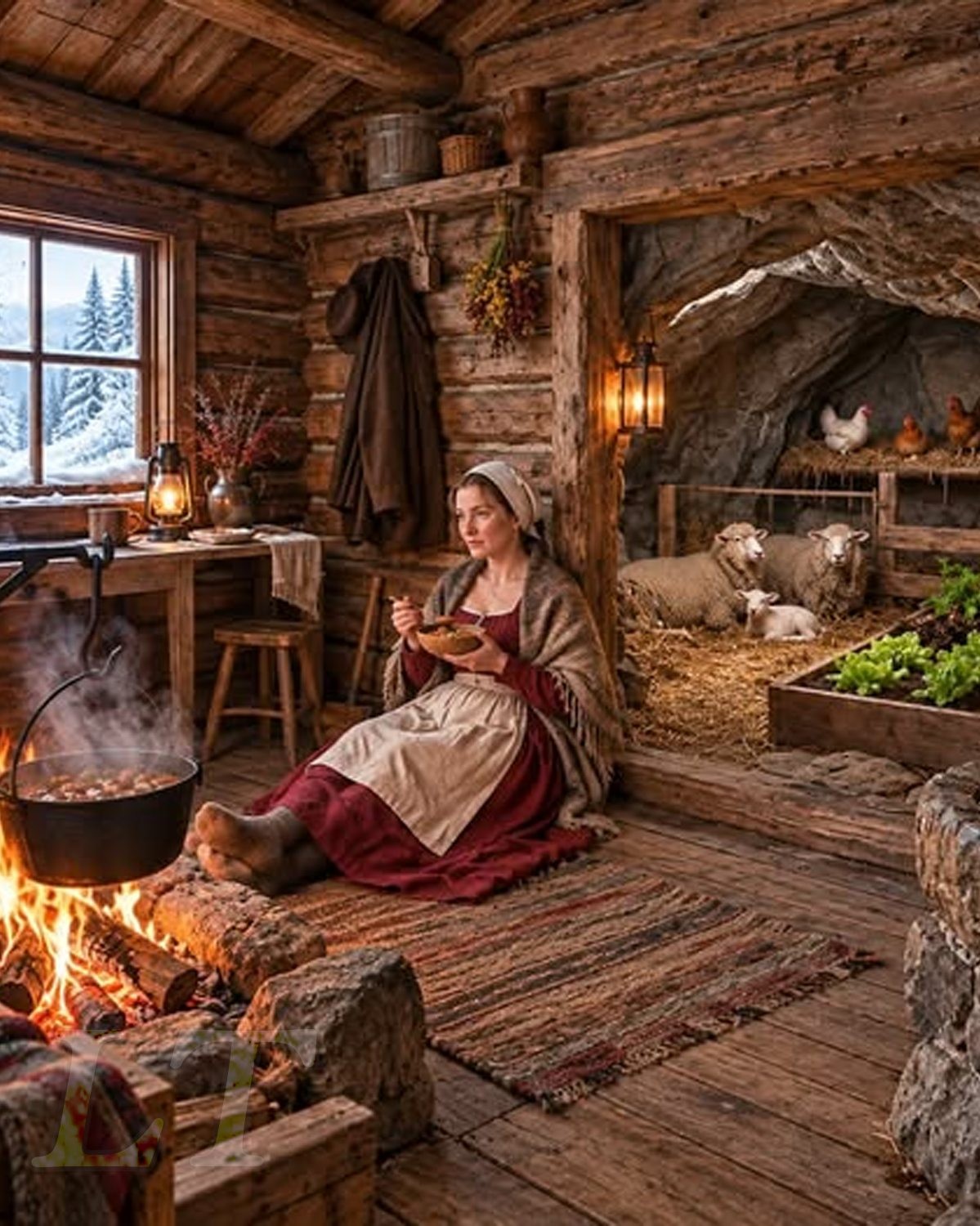
"Open this door, Eleanor! We need to talk about Grandmother's property!"
Charles's voice cut through the shelter.
Eleanor remained beside the stone wall, her fingers still hovering near the small iron ring.
For several seconds, she did not move.
Three knocks had sounded against the front door.
Then another.
"Ellie! I know you're in there!"
She glanced toward the wooden table.
Her grandmother's letter lay beside the fireplace, its lower fold still open.
The words NOT THE UPPER SPRING seemed darker than before.
Eleanor quickly folded the paper and slipped it into the pocket of her dress.
Then she looked toward the narrow stone opening.
The metal ring remained where she had found it.
She considered pulling it once more.
But the voice outside came again.
"Don't make me stand in this snow all afternoon!"
Eleanor took a breath and walked toward the entrance.
Before opening the door, she checked the wooden latch.
The shelter had no proper lock, only a thick iron bolt that slid across the inside of the frame.
She pulled it back.
The door opened with a long creak.
Charles stood on the wooden threshold.
His expensive dark wool coat was dusted with snow. His black leather gloves were spotless, and his polished boots looked entirely unsuitable for the muddy mountain path.
Behind him stood Thomas.
Unlike Charles, Thomas appeared irritated by the cold. His brown coat was unbuttoned, and his hat was pulled low over his forehead.
But he was not the only person standing outside.
A third man waited beside the wagon.
He was unfamiliar to Eleanor.
He looked to be in his late forties, with a narrow face, a gray mustache, and a dark felt hat. He wore a heavy coat and carried a leather document case.
Charles stepped forward without asking permission.
"Well, finally."
Eleanor moved aside just enough to prevent him from pushing past her.
"What are you doing here?"
Charles looked around the shelter.
His eyes passed over the fireplace, the wooden table, the animal enclosure, and the rough stone walls.
He gave a short laugh.
"Good heavens. You actually intend to live here?"
"That was my intention."
Thomas entered behind him.
He immediately noticed the sheep.
"Where did those animals come from?"
"They were here when I arrived."
"Grandmother never mentioned leaving animals on this property."
Eleanor looked at him.
"Perhaps you should have visited her more often."
Thomas's expression changed.
Charles turned sharply.
"Don't start."
"I haven't started anything."
The unfamiliar man remained outside.
Charles removed his gloves and approached the fireplace.
"Well, Ellie, we have a problem."
Eleanor closed the door.
"What problem?"
Charles glanced toward Thomas.
Thomas nodded.
"The inheritance."
Eleanor stared at them.
"The inheritance has already been settled."
"Not entirely," Charles replied.
"The lawyer read the will. We signed the documents. The property is mine."
Charles smiled.
It was the kind of smile Eleanor remembered from childhood.
The smile he used whenever he believed he had discovered a way to make someone feel foolish.
"You're very confident for someone who doesn't understand what she owns."
Eleanor folded her arms.
"Then explain it."
Charles looked toward the stone wall.
For a brief moment, his expression changed.
It was subtle.
A tightening around the eyes.
A slight hesitation.
Then it disappeared.
"First, let me introduce Mr. Gideon Mercer."
He gestured toward the stranger.
The man removed his hat.
"Good afternoon, Miss Whitcomb."
Eleanor nodded.
"Good afternoon."
"Mr. Mercer is an attorney specializing in property disputes," Charles explained. "He has been reviewing some documents concerning Grandmother's estate."
Eleanor looked at the leather case in his hand.
"What kind of documents?"
"Historical property records," Mercer answered.
His voice was quieter than Charles's.
"Your grandmother's mountain holdings may have been described incorrectly in the final deed."
Eleanor said nothing.
Charles stepped closer.
"The forty acres you inherited may not include everything within the mountain."
Eleanor's attention sharpened.
"What does that mean?"
"It means," Charles replied, "that the underground resources may belong to the estate as a whole rather than to the individual property holder."
Thomas nodded enthusiastically.
"Exactly. Water rights, mineral rights, underground passages. These things are complicated."
Eleanor looked from one brother to the other.
"Who told you there were underground resources?"
Neither answered immediately.
It was the first question that seemed to make them uncomfortable.
Mercer opened his document case.
"Miss Whitcomb, may I?"
He held up a folded sheet.
Eleanor did not take it.
"Where did you get that?"
"It is a copy of a historical survey."
Charles interrupted.
"There's no need to turn this into an interrogation. We're family."
Eleanor looked at him.
"Family members don't usually arrive unannounced with attorneys to discuss taking property that isn't theirs."
Thomas gave an impatient sigh.
"Nobody is trying to take anything."
"Then why are you here?"
Charles walked toward the window.
He examined the snow-covered mountainside as though the land already belonged to him.
"Because Grandmother made a mistake."
Eleanor felt her fingers tighten.
"A mistake?"
"She was old. She was sick. She wasn't thinking clearly about the value of the property."
The words struck harder than Charles probably intended.
Eleanor remembered Abigail's trembling hands.
She remembered the nights when her grandmother could barely lift a cup.
She also remembered the clarity in Abigail's eyes whenever she spoke about the mountain.
"She knew exactly what she was doing," Eleanor said.
Charles turned.
"How would you know?"
"Because I was there."
The shelter became quiet.
Thomas looked toward the fireplace.
For a moment, Eleanor thought he might say something.
Instead, he approached the table and picked up the wooden bowl she had used earlier.
"You're eating beans?"
Eleanor watched him.
"Put that down."
He shrugged and returned the bowl.
"Just making conversation."
Charles gestured toward the unfamiliar attorney.
"Mr. Mercer believes the property may contain a natural underground water source. If that's true, the original ownership agreements might be relevant."
Eleanor remembered the sound beneath the floor.
Her grandmother's words returned.
Go where the water sings beneath the stone.
She kept her face still.
"Why would that matter to you?"
Charles gave a short laugh.
"Because we're Whitcombs. This land belonged to our family long before you were born."
"It belongs to me now."
"Technically."
The word hung in the air.
Eleanor studied her brother.
"Did you know about the water?"
Charles did not answer.
Thomas looked away.
That was enough.
They knew something.
Perhaps not everything.
But enough to make a journey through the snow.
Eleanor walked toward the wooden table and placed both hands against its edge.
"I want to see the documents."
Mercer handed her the survey.
It was an old copy, yellowed around the edges.
A series of dark lines showed the mountainside, the valley, and several marked locations.
Eleanor recognized the general shape of Widow's Hollow.
Near the lower section of the drawing was a small circle.
A line passed through its center.
Her breath almost stopped.
It was the same symbol she had noticed on her grandmother's letter.
Beside it were two words.
NORTH CHAMBER.
Eleanor looked up.
"Where did you get this?"
Mercer studied her expression.
"It was discovered among several county records. The original survey dates back to 1868."
"Who made it?"
"An engineer named Samuel Whitcomb."
Eleanor stared at the name.
"Samuel?"
Charles answered before Mercer could.
"An ancestor. Your great-grandfather's brother."
Eleanor looked back at the paper.
"What was he surveying?"
Mercer hesitated.
"Water."
The word seemed to change the temperature of the room.
Charles stepped closer.
"Now you understand why we need to discuss this."
Eleanor lowered the survey.
"No. I understand that you came here knowing something was hidden beneath this mountain."
Charles's face hardened.
"Be careful with your accusations."
"Then answer my question."
"What question?"
"Why did Grandmother leave this property to me?"
Charles laughed bitterly.
"Because she always favored you."
Eleanor shook her head.
"That isn't an answer."
Thomas finally spoke.
"Grandmother was obsessed with this place."
Charles shot him a warning glance.
Thomas immediately stopped.
Eleanor noticed.
"What do you mean?"
Thomas rubbed his hands together.
"She used to come here when we were children. Sometimes she disappeared for days."
"She never told me that."
"Of course she didn't," Charles replied. "She told you whatever she wanted you to believe."
Eleanor looked toward the stone alcove.
Her grandmother had indeed spoken about the mountain.
But she had never described visiting it alone.
"Why did she stop coming?"
Neither brother answered.
Mercer closed his document case.
"Perhaps we should concentrate on the legal matter."
Charles nodded.
"Agreed."
He removed another paper from his coat.
It was a neatly written document.
"We've prepared a proposal."
Eleanor did not reach for it.
"What proposal?"
"We're offering to purchase your inheritance."
"All forty acres?"
"Yes."
"How much?"
Charles named a sum.
It was more money than Eleanor had ever possessed.
Enough to purchase a respectable cottage.
Enough to live comfortably for years.
Enough to stop worrying about food, fuel, and winter repairs.
For a moment, she understood why someone might accept.
Then she remembered her grandmother's letter.
Whatever you discover, do not let your brothers take it.
"No."
Charles blinked.
"What?"
"I said no."
He looked genuinely surprised.
Thomas stepped forward.
"Ellie, think about this. You don't have any experience managing land."
"I can learn."
"You're going to freeze up here."
"I have a fireplace."
"You have an abandoned shelter."
"I have forty acres."
Thomas shook his head.
"You're being stubborn."
Eleanor returned the proposal.
"I am not selling."
Charles took the paper without looking at it.
His jaw tightened.
"You're making a mistake."
"That seems to be a popular opinion today."
Mercer moved toward the entrance.
"Perhaps we should leave Miss Whitcomb to consider the offer."
Charles ignored him.
"There's something else."
Eleanor waited.
He pointed toward the rear of the shelter.
"What's behind that wall?"
The question was so sudden that Eleanor almost looked toward the metal ring.
She stopped herself.
"Stone."
Charles narrowed his eyes.
"Don't play games."
"I'm not."
Thomas moved toward the animal enclosure.
"There's an opening back here."
Eleanor stepped between him and the wall.
"Please don't disturb the animals."
Thomas looked annoyed.
"I just want to see."
"You've seen enough."
Charles approached.
For several seconds, he examined the stones.
Then his eyes moved toward the lower edge of the wall.
Eleanor watched him carefully.
He seemed to know where to look.
His gaze stopped near the hidden rectangular outline.
"Have you moved anything?" he asked.
"No."
"Have you examined the stonework?"
"I've been here less than a day."
"Did you find anything?"
Eleanor met his eyes.
"No."
It was the first lie she had told him that day.
Charles seemed unconvinced.
He crouched beside the wall.
His fingers moved across the stone surface.
Then he stopped.
There was a small metallic scraping sound.
He had found the ring.
Eleanor's stomach tightened.
Charles looked over his shoulder.
"What is this?"
"A metal ring."
"I can see that."
He pulled it.
The stone did not move.
He tried again.
A hollow sound came from beneath the floor.
Thomas immediately turned.
"What was that?"
Mercer stepped closer.
"Interesting."
Charles pulled the ring a third time.
Nothing happened.
Then he examined the surrounding stones.
"How long has this been here?"
Eleanor did not answer.
Charles stood.
He looked directly at her.
"You said you hadn't examined the wall."
"I hadn't."
He stared at her for another moment.
Then he turned toward Thomas.
"Get the lantern."
Thomas looked confused.
"Why?"
"Just get it."
Eleanor moved forward.
"You're not opening anything."
Charles laughed.
"Don't be ridiculous. This is a family property."
"It's my property."
"Which is precisely why we're trying to prevent you from making an expensive mistake."
He pointed toward the ring.
"That mechanism may connect to an old water system. If it has been neglected for years, opening it without proper knowledge could damage the entire structure."
Eleanor studied him.
"Then why are you trying to open it?"
Charles did not respond.
Mercer cleared his throat.
"Mr. Whitcomb, perhaps we should not interfere with the structure before its condition has been assessed."
Charles looked irritated.
"Fine."
He stepped away.
But Eleanor had noticed something.
When he pulled the ring, his eyes had not shown curiosity.
They had shown recognition.
He had expected to find it.
And perhaps he had expected it to open.
The visit continued for another twenty minutes.
Charles insisted that Eleanor reconsider the offer.
Thomas complained about the cold.
Mercer quietly examined the survey again.
Before leaving, the attorney approached Eleanor.
"Miss Whitcomb, may I ask you something privately?"
Charles turned.
"What is it?"
"Nothing concerning the purchase agreement. I simply wish to clarify a historical detail."
Charles looked displeased.
But he stepped outside with Thomas.
Mercer waited until the door closed.
Then he lowered his voice.
"Did your grandmother leave you any personal papers?"
Eleanor looked at him.
"Why?"
"Old maps. Letters. Diaries."
"She left me a letter."
Mercer's expression changed.
"What did it say?"
"Personal things."
He watched her carefully.
"Did she mention the North Chamber?"
Eleanor felt a chill that had nothing to do with the weather.
"No."
Mercer looked toward the door.
"Then perhaps you should examine the property records before making any decisions."
"Why?"
He hesitated.
"Because the North Chamber was never included in the original land surveys."
Eleanor frowned.
"What does that mean?"
"It means the chamber was deliberately omitted."
"By whom?"
Mercer looked down at the survey.
"That is what I have been trying to establish."
A gust of wind rattled the wooden window.
Eleanor glanced toward the entrance.
"Why are you helping my brothers?"
The attorney seemed uncomfortable.
"Because they hired me."
"Then why are you warning me?"
He closed his document case.
"Because I have seen what happens when people mistake ownership for permission."
Before Eleanor could ask what he meant, the front door opened.
Charles stepped inside.
"Ready, Mercer?"
The attorney put on his hat.
"Yes."
Charles gave Eleanor one final look.
"Think about our offer."
"I have."
"And?"
"My answer hasn't changed."
Charles pulled on his gloves.
"Then don't blame us when things become difficult."
He opened the door.
Thomas followed.
Mercer paused at the threshold.
For a brief moment, his eyes met Eleanor's.
He seemed about to say something.
Then Charles called his name.
The attorney left.
Eleanor watched the three men walk toward the wagon.
She waited until they had disappeared beyond the trees.
Then she locked the door.
The shelter seemed quieter than before.
The fire had burned low.
The animals shifted in their straw.
Eleanor returned to the table and unfolded the old survey.
She studied the symbol.
The circle.
The line.
North Chamber.
She placed her grandmother's letter beside it.
The two markings were identical.
There was something else, too.
The survey contained a series of tiny numbers along the edge.
Most were faded.
But one remained visible.
1891.
Eleanor frowned.
The survey was supposedly made in 1868.
Why had someone written a date twenty-three years later?
She turned the paper over.
There was a handwritten note on the back.
The ink had faded, but the words were still readable.
ABIGAIL KNOWS THE WAY.
Eleanor sat down.
Her grandmother had known about the chamber.
The attorney knew about it.
And Charles had recognized the hidden mechanism.
How many people had been involved?
She carefully folded the survey.
Then she went to the fireplace and added another log.
The flames rose.
She looked toward the stone wall.
The water was still running beneath the floor.
She could hear it more clearly now.
A steady trickling.
A faint echo.
A sound that seemed to come from somewhere deeper than the shelter itself.
Eleanor took a small oil lantern from the shelf.
She lit it.
Then she returned to the hidden ring.
This time, she examined the stonework without touching the mechanism.
The rectangular outline was clearer in the lantern light.
There were two narrow grooves along the sides.
Perhaps a panel had once fitted into the opening.
She lowered the lantern.
A small mark appeared near the bottom corner.
Three short scratches.
Then another.
Then a fourth.
They looked deliberate.
She leaned closer.
Four scratches.
A pause.
Two more.
Eleanor remembered something her grandmother had taught her years ago.
Abigail had once shown her how to mark a storage box so that its owner could recognize it without writing a name.
Four lines.
A space.
Two lines.
It was a simple family marking.
But why would it be carved into this stone?
She touched the scratches gently.
Then she heard a faint click.
The stone beneath her fingertips shifted.
Eleanor pulled her hand away.
The panel remained closed.
She looked toward the animals.
The sheep had settled again.
The lamb was lying against its mother's side.
For several seconds, nothing happened.
Then a tiny stream of water emerged from the lower crack.
It trickled across the stone floor.
Eleanor followed it with her eyes.
The water flowed toward the fireplace.
No.
Not toward the fireplace.
Toward a narrow depression in the floor that she had mistaken for an ordinary crack.
She moved the lantern closer.
The depression formed a curved line.
It ended beneath the wooden table.
Eleanor stood and moved the table aside.
Dust fell from its legs.
Underneath was a circular iron plate.
She crouched.
The plate had a small handle.
Unlike the ring in the wall, this one looked newer.
It had been polished recently.
Someone had touched it.
Perhaps her grandmother.
Perhaps someone else.
Eleanor reached for the handle.
But before she could pull it, she noticed a folded piece of cloth caught beneath one edge.
She carefully removed it.
It was a strip of faded blue fabric.
There was a small embroidered letter on it.
A.
Abigail.
Eleanor held the fabric in her palm.
Her grandmother had been here.
Recently.
Possibly during the final months of her life.
The realization made her chest tighten.
Had Abigail come to Widow's Hollow when she was already too weak to walk without assistance?
Had she hidden something here?
And why had she never brought Eleanor with her?
Eleanor returned the cloth to the table.
She looked at the iron plate again.
Then she heard another sound.
A soft knock.
Not from the front door.
From beneath the floor.
One knock.
A pause.
Two more.
Eleanor froze.
The sound came again.
Three knocks.
She slowly lowered the lantern.
The water continued flowing.
Her heart began to pound.
There was something beneath the shelter.
Something connected to the hidden passage.
She moved closer to the iron plate.
Then she noticed a small inscription around its edge.
The letters were almost invisible.
She wiped away the dust.
The words emerged slowly.
ONLY THE FIRST DAUGHTER MAY ENTER.
Eleanor stared at them.
She read the sentence twice.
Then she looked toward the letter in her pocket.
Her grandmother had not simply left her the property.
She had left her a key to something.
Something that had been kept hidden for generations.
And suddenly the brothers' visit made sense.
They had not come because they were worried about her surviving the winter.
They had come because they knew the mountain contained something valuable.
Something they could not access without her.
Eleanor stood.
She moved toward the fireplace and retrieved her grandmother's letter.
This time, she unfolded it completely.
She held it close to the lantern.
The paper was thin enough that the light passed through certain sections.
A faint line appeared beneath the original writing.
She turned the sheet slightly.
There were words hidden between the fibers.
Eleanor brought the letter closer.
A sentence slowly became visible.
IF CHARLES HAS COME BEFORE YOU FIND THE LOWER DOOR, DO NOT TRUST THE MAN WHO CARRIES THE MAP.
Her fingers went cold.
She read it again.
Then she looked toward the front entrance.
Charles had come.
And he had brought a man carrying a map.
Gideon Mercer.
But before Eleanor could decide what to do, something struck the wooden door.
Hard.
The entire frame shuddered.
She turned.
Another impact followed.
Then a voice came through the wood.
It was not Charles.
It was not Thomas.
It was a man's voice she had never heard before.
"Miss Whitcomb!"
Eleanor stepped away from the door.
The stranger spoke again.
"I know you've found the iron plate."
Her breath caught.
"Do not pull it!"
She stared at the handle.
Then the stranger delivered one final sentence.
"Because the last person who opened that door never came back out..."






Comments 0