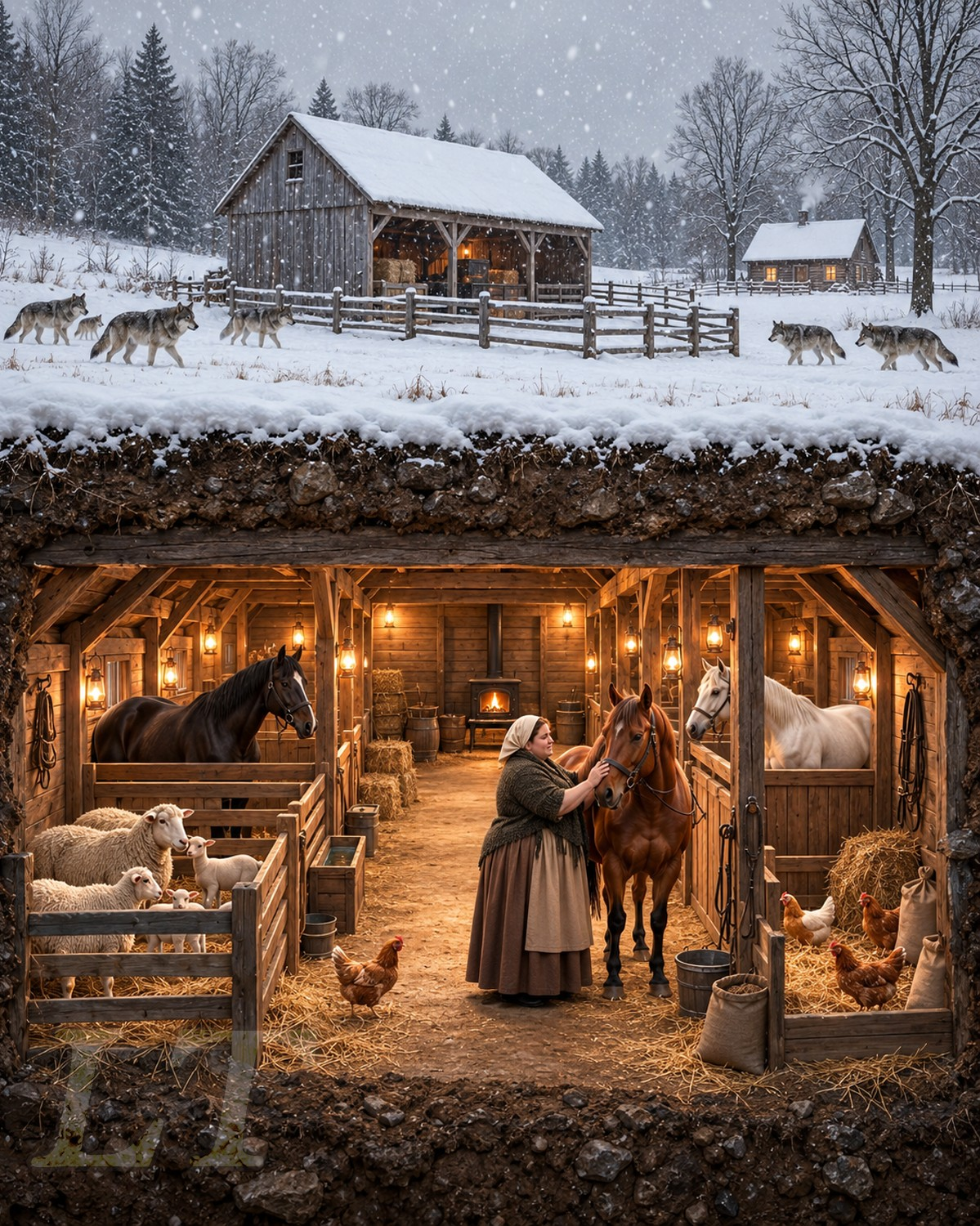
Nora Calloway stood beside the covered floorboards when Edgar Stanton knocked for the second time.
"Mrs. Calloway, I know you're inside."
She closed her eyes briefly.
The excavation beneath the cabin was still open. A lantern burned below the floor, and a pile of freshly removed clay sat behind the stove, hidden beneath an old canvas sheet. Her pickaxe rested against the wall. Several timber supports lay beside the kitchen table.
If Stanton entered, he would see enough to start asking questions.
She crossed the room, picked up a wooden cup, and placed it beside the washbasin. Then she opened the door.
Edgar stood on the porch with a tall, narrow-faced man carrying a leather measuring case. The newcomer wore a gray wool coat and a dark hat. His boots were clean despite the muddy track outside.
"Mrs. Calloway," Edgar said. "I hope we're not disturbing you."
"You've already disturbed me twice this week."
The surveyor looked down at his notebook.
Edgar ignored her remark.
"This is Mr. William Price. He's assisting the county with property inspections ahead of the winter regulations."
Price removed his hat.
"Good evening, ma'am."
Nora stepped aside reluctantly.
"What exactly are you inspecting?"
"Your property boundaries, the condition of the existing structures, and the suitability of your livestock arrangements," Edgar answered.
"My corral is outside."
"Indeed."
His eyes moved toward the interior.
"May we come in?"
Nora knew refusing would only make him more suspicious.
She opened the door wider.
"Of course."
The two men entered.
Edgar removed his gloves and looked around the cabin. His attention moved over the stove, the shelves, the old dining table, and finally the wooden floor.
Nora watched his eyes.
He was not looking at the furniture.
He was looking for something.
Price opened his measuring case.
"Would you mind showing us the original foundation plans?"
"There aren't any."
"Building permits?"
"My husband built the cabin himself."
Edgar smiled faintly.
"Which is precisely why the county needs to verify its structural condition."
Nora folded her arms.
"The cabin has stood for nine years. It hasn't moved an inch."
"That doesn't mean it meets current safety standards."
Price walked toward the northern wall.
Nora moved instinctively to intercept him.
"There's a storage chest there."
"I only need to examine the foundation."
"Then examine it from outside."
Price glanced at Edgar.
For a moment, nobody spoke.
Then Edgar approached the stove.
"Mrs. Calloway, I understand your concerns. But if your property is safe, you have nothing to hide."
Nora looked directly at him.
"That's an interesting thing to say to someone whose land you want to buy."
The surveyor stopped writing.
Edgar's smile disappeared.
"I've made a reasonable offer. You refused. That is your right. But the county's responsibility is to protect the animals."
"Then perhaps the county should help people build the structures it requires."
"Public funds are limited."
"Convenient."
Edgar stepped closer.
"Be careful, Nora."
It was the first time he had called her by her first name.
His voice remained quiet.
That made the warning more unsettling.
"An unnecessary confrontation could make this process considerably more difficult."
Nora did not move.
"Then I suggest you keep it simple."
Price cleared his throat.
"I think we should finish the exterior measurements."
Edgar held her gaze for another second.
Then he turned toward the door.
Outside, the surveyor measured the cabin's length and width.
Nora stood on the porch with her hands tucked into her jacket pockets.
Edgar walked toward the corral.
Hector approached the fence.
The buckskin gelding lowered his head, watching the men.
"Good-looking animal," Price remarked.
"His name is Hector."
"How old?"
"Nine."
Price wrote something down.
Edgar examined the empty section of ground beside the corral.
"Where do you intend to build the stable?"
"I haven't decided."
"Twenty-one days isn't much time."
"I know how to count."
Price looked uncomfortable.
Edgar crouched near the ground and examined a patch of disturbed soil beside the cabin.
Nora's stomach tightened.
She had carried the excavated earth away in small loads the previous afternoon, but the recent rain had softened the ground. A few marks from her wheelbarrow remained.
She stepped toward the area.
"That's where the drainage ditch used to run."
Edgar straightened.
"Was it?"
"My husband dug it years ago."
"Interesting."
He looked toward the northern pasture.
"That land would be worth considerably more if someone with the resources to develop it acquired it."
Nora stared at him.
"Are we discussing the stable or the pasture?"
"Both affect the future of this property."
"Then let me make something clear. I'm not selling."
Edgar adjusted his coat.
"People sometimes change their minds when winter arrives."
He mounted his horse.
Price followed him.
Before leaving, the surveyor turned toward Nora.
"Good luck with the construction, Mrs. Calloway."
There was something in his expression that she could not quite understand.
Concern.
Perhaps sympathy.
Or perhaps he knew something Edgar had not told her.
Nora watched them disappear down the track.
Only when they were gone did she return inside.
She immediately moved the canvas covering.
The floorboards were still in place.
The hidden opening remained concealed.
But she had learned something important.
Edgar was no longer satisfied with threatening her.
He was looking for evidence.
And she had to make sure he never found it.
That night, Nora did not sleep.
She sat beside the stove with her father's old mining journal open across her knees.
The leather cover had cracked with age. Several pages were stained with oil, and the edges smelled faintly of smoke.
Owen Vance had kept the journal for nearly twenty years.
It contained sketches of mine supports, ventilation shafts, stone arches, drainage channels, and measurements from tunnels he had worked in across the northern mountains.
Nora had inherited the book after his death.
For years, she had treated it as a family keepsake.
Now it might save her horses.
She turned to a drawing of a small underground storage chamber.
Her father had written beneath it:
Never ask the earth to carry more weight than its structure can safely distribute.
She traced the diagram with one finger.
The chamber beneath her cabin would need to support the weight of the cabin itself, several feet of soil, accumulated snow, and the movement of the horses inside.
A simple timber roof would not be enough.
The structure needed an arch.
Her father had explained that a properly constructed arch transferred pressure toward its supporting walls. Instead of allowing the ceiling to carry the entire load, the stonework distributed that force downward.
She remembered watching him demonstrate it with a few pieces of wood.
He had built a small model on their kitchen table.
"See this?" he had said, pressing a book against two curved supports.
Nora had nodded.
"Now imagine those supports are stone. The weight doesn't simply push down. It moves outward."
"Like the legs of a bridge?"
"Exactly."
He had smiled.
"You always were good at noticing things."
Nora turned another page.
There were drawings of ventilation systems.
One showed two separate air passages.
A lower intake.
An upper exhaust.
Another showed a chimney connection designed to maintain airflow through an enclosed space.
Her father had underlined a sentence.
Fresh air must have a path in, and stale air must have a path out. Never trust a room simply because it feels comfortable.
Nora stopped reading.
Three horses.
A closed underground chamber.
Warmth from the surrounding earth.
Without reliable ventilation, the shelter could become dangerous.
She took a pencil and began drawing.
The first version was too complicated.
The second placed the intake too close to the chimney.
The third had an exhaust channel that would not draw properly in certain wind conditions.
She rubbed the page clean.
Then she studied the original sketch again.
Her father had drawn something similar for a small mining storage room near Copper Ridge.
The intake was positioned away from the prevailing wind. The exhaust connected to a higher outlet, allowing the difference in pressure to help move air.
Nora copied the principle, adjusting the design for her cabin.
She would need to test the airflow carefully.
A candle flame could show whether air was moving in the expected direction, but she would also need to monitor the chamber for signs that ventilation was insufficient.
She wrote down everything.
Measurements.
Materials.
Possible risks.
Drainage.
Structural supports.
The more she studied, the more she understood how much work remained.
Her father had never promised that underground construction was easy.
He had only taught her that difficult work became possible when a person understood the forces involved.
Nora closed the journal.
Outside, the wind grew stronger.
She glanced at Ben's old coat hanging beside the door.
For a moment, she remembered the last winter they had spent together.
Ben had been repairing the corral fence when he found her struggling with a broken gate.
He had laughed when she insisted she could fix it herself.
"You're stubborn," he had told her.
"So are you."
"That's why we're still married."
She had thrown a handful of snow at him.
He had caught her around the waist, and they had laughed until their faces hurt from the cold.
The memory faded.
Nora returned to the journal.
"I haven't forgotten," she whispered.
Then she went back to work.
By the following morning, she had removed another section of earth.
The chamber was beginning to take shape.
She worked in short intervals, carefully checking the surrounding ground before removing more material.
The walls needed reinforcement before she could continue deeper.
She selected the limestone pieces she had collected from the edge of the northern pasture and arranged them near the opening.
Some were too irregular.
Others had cracks that made them unsuitable.
She rejected anything that looked questionable.
A collapsing ceiling would kill everything she was trying to save.
By midday, she had shaped the first section of the chamber's foundation.
She placed a timber support beneath the most vulnerable area and tested its stability.
Then she stopped.
A faint sound came from outside.
Hooves.
Nora covered the opening and stepped toward the window.
Thomas Hale was riding along the track.
He stopped near the corral and dismounted.
Nora opened the door.
"You're becoming a regular visitor."
Thomas smiled briefly.
"Only when the weather allows it."
He carried a heavy canvas bag.
"I brought the rest of those fasteners."
She accepted it.
"Thank you."
He glanced at her hands.
"You're working too hard."
"I don't have much choice."
Thomas looked toward the northern pasture.
"Stanton has been asking questions again."
Nora tightened her grip on the bag.
"What kind?"
"Whether anyone has seen you purchasing lumber. Whether you've hired workers. Whether you've spoken to the men at the sawmill."
"Did you tell him anything?"
"I told him the truth."
"Which is?"
"That I haven't seen you buying anything."
Nora studied him.
Thomas lowered his voice.
"He's been speaking with the county clerk about your land."
"What does that mean?"
"I don't know exactly. But I heard him mention a winter emergency acquisition."
Nora felt her chest tighten.
"Can they take my property?"
"Not simply because he wants it. But if they claim the animals are in danger and the property is noncompliant, he may try to make your life difficult."
Nora looked toward the cabin.
She wondered how long it would take before Stanton discovered what she was doing.
"Why are you helping me?" she asked.
Thomas seemed surprised.
Then he looked down at the bag.
"Because my father lost his forge to a man who wanted the land beneath it. The county called it a safety matter. My father called it theft."
He paused.
"I was sixteen. I couldn't do anything."
Nora said nothing.
Thomas looked at her again.
"I can help you now."
She nodded slowly.
"Thank you."
He did not ask what she was building.
Instead, he walked toward the porch and examined the weather.
"Snow will come within two days."
"That gives me less time."
"Then don't waste any."
He mounted his horse.
Nora watched him ride away.
For the first time since receiving the county order, she felt that she might not be entirely alone.
The next two nights were the hardest.
Nora worked until her shoulders burned.
She moved soil through the concealed opening in small containers and stored it beneath the cabin's farthest corner until she could remove it without attracting attention.
She built the chamber walls from fitted limestone.
Her father's sketches showed how to position the stones so the structure remained stable.
She used the iron fasteners Thomas had supplied to secure the timber supports.
Every piece had to fit.
Every measurement mattered.
On the fourth night, she completed the first curved section of the stone vault.
She stood beneath it, holding the lantern.
The ceiling looked different from anything she had ever built.
It was not beautiful.
It was not decorative.
But it was strong.
She pressed her palm against one of the limestone blocks.
"Please hold," she whispered.
She placed a temporary timber support beneath the center and carefully checked the joints.
Nothing shifted.
Nothing cracked.
For the first time, the underground chamber looked like a real structure rather than a hole in the earth.
She allowed herself a brief breath of relief.
Then she remembered the ventilation.
The horses would need fresh air constantly.
She moved toward the northern wall and examined the channel she had begun digging.
The opening would have to remain hidden from outside observers. It needed protection from snow, ice, and animals.
She also needed to ensure that water could not enter.
Her father had warned her about this more than once.
A ventilation passage could become a dangerous source of moisture if it was poorly positioned.
Nora returned to the journal.
A small drawing near the back caught her attention.
It showed a stone-lined air channel with a raised exterior opening and a protective wooden cover.
Beneath it, her father had written:
Never build an entrance that tells the weather where to go.
She almost smiled.
Even after all those years, his advice still sounded like him.
She copied the design.
Then she heard something outside.
A branch snapped.
Nora extinguished the lantern.
She waited.
Another sound followed.
A horse snorted.
Then silence.
She slowly approached the window.
A rider stood at the edge of the property.
The man was too far away to recognize.
He did not approach the cabin.
He simply watched.
Nora remained behind the curtain.
After several seconds, the rider turned and disappeared into the trees.
She waited another ten minutes before lighting the lantern again.
Her heart was beating faster.
Someone was watching the property.
And if it was one of Stanton's men, the deadline was no longer her only problem.
The following afternoon, Nora walked to the old stone ridge beyond the pasture.
She needed to inspect the ground where the ventilation intake would emerge.
The ridge was partially covered by brush and scattered pine trees. It sat far enough from the cabin that a passing rider would not immediately associate it with the building.
She carried a shovel and a small measuring rope.
The soil was frozen in places.
She worked carefully, checking the depth and direction of the passage.
Then she found something unexpected.
A narrow depression ran through the earth beneath the trees.
At first, she thought it was an old animal trail.
But when she brushed away the snow, she discovered several parallel marks.
Wheel tracks.
Recent ones.
Someone had brought a wagon to the ridge.
Nora crouched and examined the frozen impressions.
The tracks were heavier than those made by her small wheelbarrow.
They continued toward the cabin before disappearing near the road.
She stood up slowly.
There was no reason for anyone to bring a wagon to this isolated section of her property.
Unless they were carrying something.
Or looking for something.
She returned to the cabin before sunset.
The first snowflakes of the coming storm had begun falling.
She secured the doors, checked the animals, and carried additional firewood inside.
Hector stood near the fence.
Rosie was restless.
The colt stayed close to her.
Nora rubbed Hector's forehead.
"Just a little longer."
She wanted to tell them that everything would be fine.
But she had learned that promises meant very little without the work to support them.
That evening, she returned to her father's journal.
She studied the ventilation diagrams once more.
Then she turned to the final pages.
Most were filled with old measurements and mining notes.
But one page had been folded over.
Nora carefully opened it.
A rough drawing showed a concealed underground room beneath a wooden building.
It was remarkably similar to her own design.
At the bottom, her father had written a short note.
If you ever build beneath an occupied structure, remember that the greatest danger may not come from the earth above you. It may come from the people who have a reason to search for what you're hiding.
Nora read the sentence twice.
She had never noticed it before.
Perhaps she had been too young to understand.
Perhaps her father had written it after one of his more dangerous mining jobs.
She placed the journal beside her lantern.
Then she heard three sharp knocks against the door.
Not the cautious knock Thomas used.
Not the heavy knock Edgar used.
These were quick and deliberate.
Nora approached the window.
A woman stood outside.
She was wrapped in a dark wool shawl, her face partly hidden beneath a hood.
Nora did not recognize her.
The woman looked toward the corral.
Then she looked directly at the cabin window.
She raised one gloved hand and held up a folded piece of paper.
Nora hesitated.
The woman knocked again.
"Mrs. Calloway?"
"Who are you?"
The woman glanced toward the road.
"I don't have much time."
Nora moved closer to the door but kept it locked.
"What do you want?"
The woman leaned forward.
"It's about Edgar Stanton."
Nora's hand tightened around the door latch.
"What about him?"
The stranger pushed the folded paper beneath the door.
Then she whispered something that made Nora's blood turn cold.
"He's not planning to wait until November first."
Nora looked down at the paper.
A county seal was visible through the fold.
And beneath it was a date.
October twenty-third.
Tomorrow.






Comments 0